August Housing Starts Could Show Whether High Costs and Interest Rates Are Slowing New Home Construction
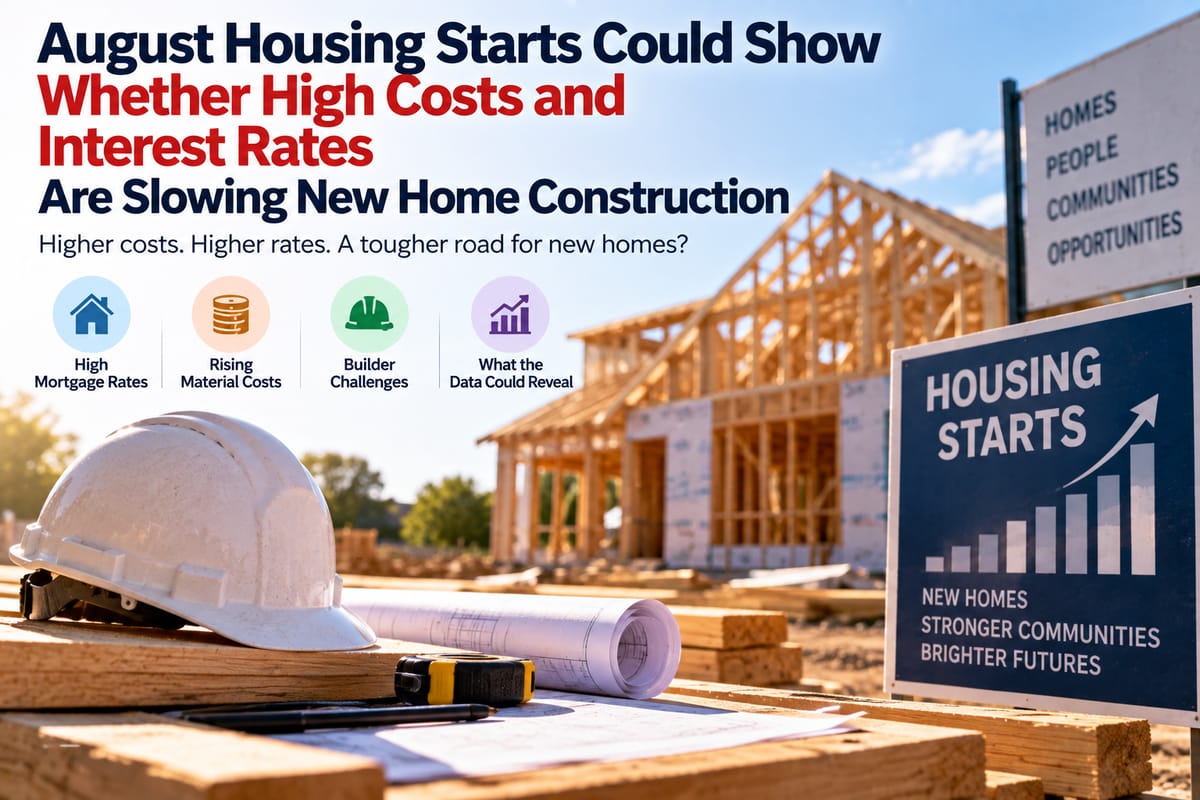
August Housing Starts Could Show Whether High Costs and Interest Rates Are Slowing New Home Construction
The latest U.S. housing starts report could provide an important look at whether high borrowing costs, elevated construction expenses and cautious buyers are beginning to weigh more heavily on new home construction.
The U.S. Census Bureau and Department of Housing and Urban Development are scheduled to release August housing starts, building permits and housing completions on September 17. The report is closely watched because housing starts measure construction that has actually begun, rather than projects that have only received authorization.
The timing makes the report particularly relevant. Mortgage rates have remained elevated, construction costs continue to challenge builders, and recent indicators have pointed to softer demand in parts of the housing market.
The August figures could therefore help show whether builders are continuing to move ahead with new projects or becoming more cautious about committing capital to homes that may take months to complete.
July Housing Starts Offered a Warning Sign
The previous report showed that construction activity weakened sharply in July.
Privately owned housing starts fell to a seasonally adjusted annual rate of 1.239 million in July, down 12.4% from the revised June rate and 13.5% from July 2025. Single-family housing starts declined 9.9% to an annual rate of 808,000.
At the same time, building permits moved in the opposite direction.
Permits for privately owned housing units increased to an annual rate of 1.443 million in July, up 5% from June and 3.1% from a year earlier. Single-family permits rose 2.5% to 894,000.
That divergence matters because a building permit represents authorization to proceed, while a housing start indicates that construction has actually begun.
If August starts remain weak despite a relatively stronger pipeline of permits, it could suggest that some builders are delaying projects after securing approval.
High Mortgage Rates Remain a Major Constraint
One of the biggest issues facing the housing market is the cost of financing.
Mortgage rates have remained well above the levels many buyers became accustomed to before the pandemic. Reuters reported that the average 30-year mortgage rate had risen to roughly 6.85% in September, while longer-term Treasury yields were above 5%.
Higher mortgage rates affect builders indirectly as well as buyers directly.
When monthly mortgage payments rise, some potential buyers postpone purchases or reduce the price of the homes they are willing to consider. Builders then face a more difficult question when deciding whether to begin construction: Will enough buyers be able and willing to purchase the finished homes at prices that cover today’s construction costs?
That relationship makes mortgage affordability an important part of understanding the new-construction market. Homebuyers trying to assess their own purchasing limits can also review How to Determine How Much House You Can Afford before considering a new-build purchase.
Builders Are Dealing With More Than Mortgage Rates
Interest rates are only one part of the equation.
Builders also have to account for land, labor, materials, financing, insurance, permitting and other expenses. When several of those costs remain elevated at the same time, starting a new project can become harder to justify.
Recent builder sentiment data illustrates the pressure. The NAHB/Wells Fargo Housing Market Index fell three points in September to 32, its lowest reading in a year, according to Reuters. Builders cited elevated mortgage rates, high home prices, material costs and labor shortages among the challenges affecting the market.
The same survey showed that 38% of builders reported cutting prices, while builders have also increasingly used sales incentives to attract buyers.
These measures can help support sales, but they can also put pressure on profit margins.
Material Costs Could Influence the August Numbers
Construction materials represent another important variable.
When lumber, metals, concrete products, electrical equipment and other building inputs become more expensive, builders have several potential responses. They can absorb some of the additional cost, raise prices, redesign projects, delay construction or reduce the number of homes they start.
Those pressures are already relevant to homeowners planning renovation work. The broader relationship between material prices and household projects is examined in Rising Material Costs Could Make Home Renovations More Expensive as Homeowners Delay Big Projects.
New construction faces a similar basic challenge: the economics of a project have to work from the moment construction begins through completion and sale.
Why Single-Family Starts Matter So Much
The single-family portion of the report will receive particular attention.
Single-family homes account for a large share of new residential construction, and their construction patterns can provide a useful indication of how builders view demand from individual households.
July’s single-family starts fell to 808,000 units at a seasonally adjusted annual rate, while single-family permits were considerably higher at 894,000.
If the August data shows another significant gap between permits and starts, analysts may examine whether builders are accumulating approved projects without immediately breaking ground.
On the other hand, an increase in starts could indicate that some builders are becoming more comfortable with current demand and financing conditions.
The data alone, however, will not identify one single cause for every change. Weather, regional conditions, project timing and the mix between single-family and multifamily construction can all affect monthly figures.
New Construction Is Closely Tied to Affordability
The housing construction pipeline ultimately depends on whether finished homes can find buyers.
High mortgage rates can make even moderately priced homes difficult for some households to afford. At the same time, builders face pressure to keep prices high enough to cover expensive land, labor and materials.
This creates a difficult balance.
If builders lower prices too aggressively, margins can shrink. If they keep prices high, fewer buyers may qualify for financing or feel comfortable taking on a mortgage.
For households evaluating whether to purchase a newly built property, The Complete Guide to Mortgages provides broader context on mortgage types, borrowing costs and the factors that shape home financing.
Homebuilder Sentiment Points to Continued Caution
The housing starts report will arrive against a backdrop of cautious builder sentiment.
September’s NAHB/Wells Fargo index fell to 32, with measures of current sales, future sales and buyer traffic all weakening. Reuters reported that builders were also dealing with elevated home prices, softer demand and difficulties obtaining sufficient labor.
That does not guarantee that August construction activity declined.
Sentiment surveys and hard construction data measure different things. Builders can remain cautious while continuing projects that were already planned, financed or permitted.
Still, the combination of weaker sentiment and elevated borrowing and construction costs provides an important backdrop for interpreting the new figures.
What the August Report Could Reveal
Several parts of the release will be worth watching.
Total Housing Starts
The headline starts figure will show whether overall residential construction accelerated or slowed in August compared with July.
A significant change would provide a fresh indication of how construction activity is responding to current market conditions.
Single-Family Starts
The single-family figure will show whether builders are increasing or reducing construction aimed primarily at individual homebuyers.
Because single-family construction is closely connected to mortgage affordability, this measure can offer useful insight into the relationship between financing costs and construction decisions.
Building Permits
Permits can provide an indication of the future construction pipeline.
If permits remain stronger than starts, builders may be obtaining approvals without immediately moving into construction. If both permits and starts weaken, that could point to broader caution in the development pipeline.
Housing Completions
Completions show how many homes finished construction during the month.
This measure matters because a slowdown in starts does not immediately reduce the number of homes reaching the market. Projects already under construction can continue toward completion even when builders become more cautious about starting new ones.
Rising Construction Costs Can Affect Renovation Decisions Too
The same economic forces affecting new construction can influence homeowners deciding whether to renovate.
When materials and labor become more expensive, a kitchen remodel, addition or major repair can cost substantially more than originally expected. Financing costs can add another layer of pressure for households using loans or credit to fund projects.
That is why understanding Why Home Improvement Projects Are Going Over Budget in 2026 can be useful when considering how construction costs affect household decisions beyond new homebuilding.
For some homeowners, higher renovation costs may encourage postponement. For builders, similar cost pressures can influence when and how many new homes they decide to start.
Why the Numbers Matter Beyond Builders
Housing construction has implications beyond the companies building homes.
New construction contributes to the supply of available housing, supports employment in construction and related industries, and creates demand for building materials, appliances, furnishings and professional services.
A sustained slowdown in construction can therefore affect several parts of the economy.
At the household level, the amount and type of new housing being built can also influence future availability and prices. When demand remains strong but new supply grows slowly, affordability pressures can persist.
However, a single month’s housing starts report cannot establish a long-term trend. Monthly data can be volatile and is subject to revisions.
A Housing Market Still Searching for Balance
The August housing starts report arrives at a time when several parts of the U.S. housing market are moving in different directions.
July permits increased while starts declined. Existing home sales fell to a 14-month low in August, while inventory increased, according to Reuters.
Meanwhile, mortgage rates remain elevated and builder sentiment has weakened.
Taken together, those indicators show why the new construction data matters. The August report can help determine whether the July decline in starts was an isolated monthly move or part of a broader period of caution among builders.
The results will also provide another piece of the affordability puzzle for buyers and homeowners. For households thinking about purchasing, building or renovating, the broader principles covered in The Complete Guide to Mortgages and other home-financing resources remain relevant as borrowing and construction costs continue to shape the decisions people make.
Ultimately, the most important signal may not come from the headline starts number alone. The relationship between permits, starts, completions, mortgage rates, construction costs and buyer demand will provide a more complete picture of whether builders are still willing to expand supply in an expensive financing environment.