Complete Guide to Smart Home Networking
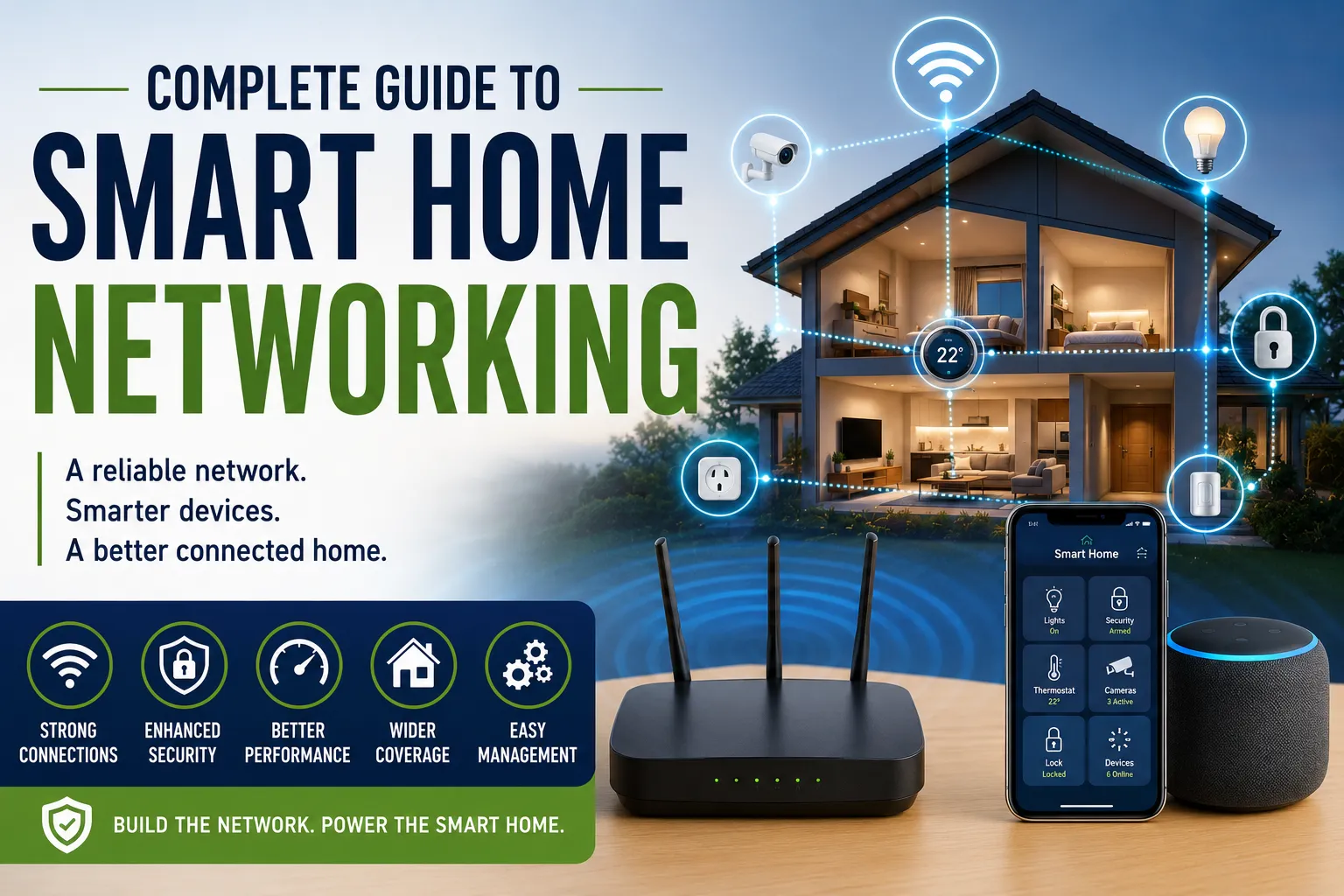
Complete Guide to Smart Home Networking
A smart home can have intelligent lights, cameras, thermostats, speakers, locks, sensors and appliances, but none of those devices can work reliably without a network connecting them.
For many homeowners, networking is the least visible part of a smart home. You plug in a smart bulb, connect a camera to an app or add a voice assistant, and everything appears to work automatically.
Until it doesn’t.
A weak Wi-Fi signal can make a smart camera disconnect. Too many devices can create congestion. Poor router placement can leave parts of a home with unreliable coverage. And inadequate security can expose connected devices to unnecessary risks.
Understanding how smart-home networking works makes it easier to build a connected home that is reliable, secure, responsive and easier to maintain. It is also one of the foundations covered in the complete guide to smart homes.
What Is Smart Home Networking?
Smart-home networking is the system of wired and wireless connections that allows connected household devices to communicate with each other, with a central controller and, when necessary, with internet-based services.
A typical smart-home network may connect:
- Smartphones and tablets
- Smart TVs
- Voice assistants
- Smart lights
- Smart plugs
- Security cameras
- Video doorbells
- Smart locks
- Thermostats
- Motion sensors
- Door and window sensors
- Robot vacuums
- Smart appliances
- Home automation hubs
- Computers and printers
Some devices communicate directly over Wi-Fi, while others use technologies such as Zigbee, Z-Wave, Thread or Bluetooth.
The network therefore is not necessarily just your Wi-Fi router.
It is an ecosystem of different communication technologies working together.
Why Networking Matters in a Smart Home
A smart-home device can be excellent on its own and still perform poorly if the network supporting it is inadequate.
Networking affects several important aspects of the smart-home experience.
Reliability
A reliable network helps devices remain connected and available when you need them.
A smart lock that takes several seconds to respond or a security camera that repeatedly loses its connection can quickly become frustrating.
Speed
Some devices need very little bandwidth.
A temperature sensor may transmit tiny amounts of information, while a security camera can continuously send high-resolution video.
The network needs to accommodate these different demands.
Coverage
Wi-Fi signals weaken as they travel through walls, floors and other obstacles.
Large homes, multi-story buildings and properties with thick construction materials may require additional networking equipment.
Security
Every connected device can potentially become part of your home’s digital environment.
Strong passwords, updated firmware, appropriate network segmentation and secure configuration can reduce unnecessary exposure.
The Role of the Router
The router is usually the central networking device in a home.
It connects devices on the local network and typically provides the connection between the home and the internet.
Many internet service providers supply combination devices that include:
- Modem or optical network terminal functionality
- Router functionality
- Wi-Fi access point functionality
- Basic firewall features
In other homes, these functions are handled by separate devices.
For a smart home, the router becomes particularly important because it may be responsible for managing dozens of connected devices simultaneously.
How Many Devices Can a Home Network Support?
There is no single number that applies to every household.
A router’s theoretical device limit may be much higher than the number of devices it can handle comfortably under real-world conditions.
The practical capacity depends on factors such as:
- Router hardware
- Wi-Fi generation
- Available bandwidth
- Number of simultaneous connections
- Type of traffic
- Network configuration
- Interference
- Device behavior
- Internet connection speed
A smart home with 50 low-bandwidth sensors does not necessarily place the same demand on a network as a home with 20 devices streaming high-resolution video.
This is why device count alone is a poor measure of network load.
Wi-Fi in Smart Homes
Wi-Fi is one of the most common networking technologies in modern smart homes.
It is particularly useful for devices that need relatively high bandwidth or already have built-in Wi-Fi support.
Common Wi-Fi smart-home devices include:
- Cameras
- Smart TVs
- Speakers
- Appliances
- Thermostats
- Streaming devices
- Some lighting products
- Computers and phones
Wi-Fi is convenient because most homes already have a Wi-Fi network.
However, using Wi-Fi for every smart-home device is not always the best approach.
Why Not Put Everything on Wi-Fi?
A large number of Wi-Fi devices can increase network management requirements and wireless congestion.
Many smart sensors do not need the bandwidth that Wi-Fi provides.
For example, a door sensor may only need to communicate a simple message such as:
Door opened.
Using a low-power protocol for that type of device can be more efficient than connecting every sensor directly to Wi-Fi.
This is one reason smart-home ecosystems often combine several networking technologies.
Understanding Zigbee
Zigbee is a low-power wireless technology commonly used for smart-home devices.
It is particularly associated with:
- Smart lighting
- Sensors
- Switches
- Plugs
- Home automation devices
One of its important characteristics is its ability to support mesh networking.
In a mesh network, compatible devices can help relay communication rather than requiring every device to communicate directly with the central hub.
This can be useful in larger homes.
However, Zigbee devices generally require a compatible coordinator or hub to connect them to the broader smart-home ecosystem.
Understanding Z-Wave
Z-Wave is another wireless technology designed for home automation.
It is commonly used for:
- Door locks
- Sensors
- Switches
- Thermostats
- Lighting controls
- Security-related devices
Like Zigbee, Z-Wave can use mesh networking.
That means compatible powered devices can help extend the network throughout a property.
One of the important differences between Z-Wave and Zigbee is that they are separate technologies. A Zigbee device does not automatically communicate directly with a Z-Wave device.
A compatible controller can, however, integrate different technologies at the smart-home system level.
What Is Thread Networking?
Thread is a low-power wireless networking protocol designed for connected devices.
It uses an IPv6-based architecture and supports mesh networking.
Thread has gained significant attention in smart-home networking because it is designed specifically for connected-device communication while using relatively low power.
It is particularly relevant to modern smart-home ecosystems and devices designed to work with Matter.
Thread should not be confused with Wi-Fi.
Wi-Fi is generally used for higher-bandwidth networking, while Thread is designed for low-power connected devices.
What Is Matter?
Matter is an application-layer smart-home standard designed to improve interoperability between compatible smart-home ecosystems and devices.
The goal is relatively straightforward:
A compatible smart-home device should be easier to use across different platforms.
Matter can operate over networking technologies including:
- Wi-Fi
- Ethernet
- Thread
It can help reduce the frustration associated with buying a device only to discover that it does not work with a particular smart-home platform.
However, Matter does not eliminate every compatibility issue.
Device features, controllers, platforms and manufacturer implementations can still affect what a particular product can do.
Wi-Fi vs Thread vs Zigbee vs Z-Wave
These technologies are not necessarily competitors where only one must be chosen.
They serve different purposes.
| Technology | Typical use | Strength |
|---|---|---|
| Wi-Fi | Cameras, TVs, appliances, speakers | High bandwidth |
| Thread | Sensors, smart-home devices | Low-power mesh networking |
| Zigbee | Lighting and sensors | Mature mesh ecosystem |
| Z-Wave | Automation and security devices | Reliable home-automation mesh |
| Ethernet | Hubs, access points, TVs, computers | Wired reliability |
A well-designed smart home can use several of these technologies simultaneously.
Ethernet Still Matters
Wireless technology receives most of the attention in smart-home discussions, but wired Ethernet remains extremely valuable.
Ethernet can provide:
- High reliability
- Low latency
- Stable connections
- Reduced wireless congestion
- High bandwidth
Devices that remain in one location can often benefit from a wired connection.
Examples include:
- Desktop computers
- Network storage
- Smart-home hubs
- Wi-Fi access points
- Smart TVs
- Gaming consoles
- Some security cameras
- Network video recorders
Using Ethernet for stationary, high-bandwidth devices can leave more wireless capacity available for mobile and low-power devices.
What Is a Mesh Wi-Fi System?
A mesh Wi-Fi system uses multiple networking units to provide broader wireless coverage across a home.
Instead of relying on one router to cover every room, a mesh system distributes wireless access points throughout the property.
This can be particularly useful for:
- Large homes
- Multi-story properties
- Homes with thick walls
- Long floor plans
- Properties with dead zones
The individual units communicate with each other and provide wireless coverage to nearby devices.
Mesh Wi-Fi vs Wi-Fi Extenders
Traditional Wi-Fi extenders and mesh systems both attempt to improve coverage, but their architectures can differ.
An extender typically takes an existing wireless signal and retransmits it.
A mesh system is designed as a coordinated network of access points.
A well-designed mesh system can provide a more seamless experience, although actual performance depends heavily on placement and the system’s hardware.
Mesh does not automatically mean faster.
Poorly positioned mesh nodes can still produce weak or congested connections.
Where Should You Put Your Router?
Router placement can have a surprisingly large impact on network performance.
Whenever practical, place the primary router:
- Near the center of the home
- In an elevated, open location
- Away from large obstructions
- Away from sources of significant interference
- Away from enclosed cabinets
- Away from large metal objects
Avoid hiding a router behind furniture simply because it looks cleaner.
The router needs to communicate with devices throughout the house, and physical obstructions can weaken wireless signals.
Why Some Rooms Have Poor Wi-Fi
Wi-Fi does not travel equally well through every building material.
Signal strength can be affected by:
- Concrete
- Brick
- Metal
- Thick walls
- Floors
- Mirrors
- Certain appliances
- Distance
- Other wireless networks
This is why a router that works perfectly in a living room may provide poor performance in a bedroom on another floor.
Before buying additional equipment, determine where the actual coverage problem exists.
How to Find Wi-Fi Dead Zones
You can test your home by walking through different rooms while checking:
- Signal strength
- Internet speed
- Connection stability
- Latency
Pay particular attention to rooms containing important smart-home devices.
A camera near the front door, for example, should have a reliable connection if you depend on it for security notifications.
The objective is not to achieve maximum signal strength in every square meter.
It is to ensure that important devices have a stable and sufficient connection.
Smart Home Network Security
Smart-home security should be treated as part of the overall home-security strategy. For a broader look at protecting connected devices and systems, see the Smart Home Security Guide.
A compromised connected device can potentially expose information about your household or become an entry point into other systems.
Basic security measures include:
Use Strong, Unique Passwords
Avoid using the same password across your router, smart-home accounts and other services.
Enable Multi-Factor Authentication
Where supported, multi-factor authentication can provide an additional layer of account protection.
Change Default Credentials
Never leave default administrator credentials unchanged when a device allows you to modify them.
Update Firmware
Device manufacturers periodically release updates that can address security vulnerabilities and improve functionality.
Secure Your Router
Your router controls a large portion of your home’s network environment, so protecting its administrator account is particularly important.
What Is a Guest Network?
A guest network creates a separate Wi-Fi network intended primarily for visitors.
It can be useful because guests do not necessarily need access to the same network used by your computers, storage devices and other equipment.
However, simply creating a guest network does not guarantee complete isolation from every other device.
Check your router’s documentation to understand how its guest-network implementation works.
Should Smart Devices Have Their Own Network?
For security-conscious households, separating smart-home devices from computers and other sensitive equipment can be a useful strategy.
This is commonly achieved through:
- Separate SSIDs
- VLANs
- Network segmentation
- Firewall rules
For example, a household might maintain:
Main network:
Computers, phones and trusted personal devices.
IoT network:
Smart plugs, lights, appliances and other connected devices.
Guest network:
Visitors and temporary devices.
This approach can make network management more complicated, but it can also reduce the potential impact of a compromised smart device.
What Is a VLAN?
A Virtual Local Area Network, or VLAN, allows a physical network to be logically divided into separate networks.
For example, one physical Ethernet infrastructure could carry separate networks for:
- Personal devices
- Smart-home devices
- Security equipment
- Guests
VLANs are particularly useful for advanced home networks.
They are not necessary for every household, however.
Someone with a small number of smart devices may be better served by a simpler configuration that is easy to understand and maintain.
Smart Cameras Need Special Attention
Security cameras are among the most demanding smart-home devices because they can continuously transmit video.
A network supporting multiple high-resolution cameras may require substantially more capacity than one supporting lights and sensors.
Consider:
- Camera resolution
- Frame rate
- Number of cameras
- Recording method
- Cloud vs local storage
- Wired vs wireless connectivity
If a camera repeatedly disconnects, do not immediately assume the camera itself is defective.
The problem may be Wi-Fi coverage, interference, network congestion or inadequate bandwidth.
Cloud-Based vs Local Smart Homes
Smart-home devices can communicate with cloud services, locally within the home, or through a combination of both.
Cloud-Based Systems
Cloud-connected systems may allow you to control devices remotely from outside the home.
They can also provide manufacturer-managed services and integrations.
However, they depend to some extent on internet connectivity and the manufacturer’s infrastructure.
Local Systems
Local automation can allow devices to communicate within the home without relying on an external cloud service for every action.
Potential advantages include:
- Faster response
- Greater resilience when the internet is unavailable
- More control over data
- Reduced dependence on external services
The best approach depends on the ecosystem and the user’s priorities.
What Happens When the Internet Goes Down?
A smart home does not necessarily stop functioning when the internet connection fails.
It depends on how the system is designed.
Some devices require cloud connectivity for certain functions.
Others can continue communicating locally.
For example, a locally controlled light may continue responding to a local automation even if the internet is unavailable, while a cloud-dependent camera feature may stop working.
This makes local control an important consideration when designing a reliable smart home.
Internet Speed vs Home Network Performance
A faster internet plan does not automatically fix every smart-home networking problem.
Suppose your internet connection provides hundreds of megabits per second, but your bedroom has a weak Wi-Fi signal.
Increasing your internet subscription may not improve the bedroom connection.
The problem is inside the home network.
Similarly, a slow smart-home response could be caused by:
- Weak Wi-Fi
- Router congestion
- Device processing
- Cloud-server latency
- Poor protocol configuration
- Interference
Diagnosing the actual bottleneck is more useful than automatically buying a faster internet plan.
Understanding Network Bandwidth
Bandwidth describes the amount of data a connection can carry over a given period.
Different smart-home devices require very different amounts.
A simple temperature sensor may transmit almost no data compared with a 4K security camera.
A practical network therefore needs to prioritize devices according to their requirements.
High-bandwidth devices include:
- Security cameras
- Streaming TVs
- Game consoles
- Video conferencing systems
- Network storage
Low-bandwidth devices often include:
- Motion sensors
- Door sensors
- Temperature sensors
- Smart buttons
- Simple switches
Why Network Congestion Happens
Congestion can occur when many devices compete for limited wireless capacity.
It may become more noticeable when several household members are simultaneously:
- Streaming video
- Playing online games
- Downloading large files
- Conducting video calls
- Uploading security-camera footage
The smart-home network must operate alongside these activities.
Using wired Ethernet for stationary high-bandwidth equipment and appropriate low-power protocols for sensors can help reduce unnecessary wireless demand.
Choosing Between 2.4 GHz and 5 GHz
Many Wi-Fi systems support multiple frequency bands.
The 2.4 GHz band generally offers greater range and can travel through obstacles more effectively, although it is often more crowded.
The 5 GHz band can offer higher performance at shorter distances but generally has less range through obstacles.
Some modern Wi-Fi systems also use additional bands.
For smart-home devices, the best band depends on the device and its location.
Low-bandwidth devices located far from the router may benefit from the characteristics of 2.4 GHz.
High-bandwidth devices near a capable access point may benefit from a faster band.
What About 6 GHz Wi-Fi?
Newer Wi-Fi generations can use the 6 GHz band, providing additional spectrum for compatible devices.
Its availability and supported features depend on the country, router and client device.
The shorter effective range compared with lower-frequency bands also means that 6 GHz is not automatically the best choice for every smart-home device.
It can be particularly useful for compatible high-performance devices in appropriate locations.
Designing a Smart Home From Scratch
If you are building a new home or carrying out major renovations, networking deserves consideration before the walls are closed.
Running Ethernet cables during construction can be much easier than installing them later.
Consider wiring locations for:
- Wi-Fi access points
- Security cameras
- Smart TVs
- Home offices
- Smart-home hubs
- Network storage
- Doorbell cameras
- Entertainment systems
A centralized network cabinet can also make equipment easier to manage.
Why Ethernet Backhaul Matters for Mesh Wi-Fi
Some mesh systems allow their nodes to communicate with one another over Ethernet rather than wireless connections.
This is known as wired backhaul.
It can be beneficial because the mesh nodes do not have to use wireless capacity to communicate with each other.
If you are building or renovating a home, running Ethernet to planned access-point locations can therefore provide significant flexibility.
Smart Home Networking for Apartments
Apartment dwellers face different challenges.
You may have less control over:
- Wall construction
- Wiring
- Router placement
- Nearby wireless networks
- Building infrastructure
Dense apartment buildings can also have significant Wi-Fi interference because many neighboring networks operate in close proximity.
In these situations, careful router placement and channel management can be particularly important.
Smart Home Networking for Large Houses
Large homes may need multiple access points.
Simply increasing the transmit power of one router is not necessarily the best solution.
A better design may use strategically positioned access points connected through Ethernet or a well-designed mesh system.
Important devices such as security cameras should be tested from their actual installation locations rather than assuming that coverage will be adequate.
Common Smart Home Networking Mistakes
Using One Router in a Large House
A single router may struggle to provide reliable coverage across multiple floors.
Putting the Router in a Cabinet
Enclosing wireless equipment can unnecessarily weaken its signal.
Connecting Every Device to Wi-Fi
Low-power protocols may be more appropriate for many sensors and automation devices.
Ignoring Firmware Updates
Outdated devices can create unnecessary security and reliability problems.
Using Weak Passwords
Smart-home accounts deserve the same security attention as other important online accounts.
Buying Equipment Without Testing
More networking hardware is not automatically better.
Focusing Only on Internet Speed
A fast internet connection cannot compensate for poor internal Wi-Fi coverage.
Overcomplicating the Network
Advanced segmentation can be useful, but unnecessary complexity can make troubleshooting difficult.
A Practical Smart Home Network Architecture
A balanced home network might look something like this:
Internet connection
↓
Router / firewall
↓
Network switch
↓
Ethernet devices + Wi-Fi access points
↓
Phones, computers, TVs and high-bandwidth devices
Alongside that network, a smart-home hub or border router may connect:
Thread / Zigbee / Z-Wave devices
↓
Smart-home controller
↓
Home automation system
This architecture allows different technologies to perform the jobs they are best suited for. The way those different technologies and devices are brought together is also closely related to smart home integration and compatibility.
How to Troubleshoot Smart Home Connectivity
When a smart device stops responding, avoid immediately resetting everything.
Use a systematic process.
Step 1: Check the Device
Make sure it has power.
Step 2: Check the Network
Determine whether other devices are experiencing connectivity problems.
Step 3: Check Signal Strength
If the device is wireless, determine whether it is receiving a usable signal.
Step 4: Restart the Appropriate Equipment
Restarting a device, access point or router can sometimes resolve temporary problems.
Step 5: Check for Updates
Look for firmware or software updates.
Step 6: Look for Interference
Consider whether nearby equipment or physical changes could be affecting connectivity.
Step 7: Check the Smart-Home Platform
If the network is functioning but automation is not, the problem may be with the hub, cloud service or integration.
Step 8: Reset Only as a Last Resort
Factory resets can remove configurations and create unnecessary work.
Building a Future-Ready Smart Home Network
Technology will continue to change, so the goal should not be to predict every future device.
Instead, build a flexible infrastructure.
Useful principles include:
- Install adequate Ethernet where practical.
- Choose networking equipment that can receive firmware updates.
- Avoid locking the entire home into one proprietary ecosystem unnecessarily.
- Prefer broadly supported standards where they meet your needs.
- Maintain strong account security.
- Keep a record of important network settings.
- Leave room for additional devices.
- Design for local reliability where possible.
A flexible infrastructure can outlast individual smart-home products.
How Much Should a Smart Home Network Cost?
There is no universal budget.
A basic apartment with a few smart lights may require little beyond the router already supplied by an internet provider.
A large house with:
- Multiple access points
- Wired Ethernet
- Security cameras
- Network storage
- Smart-home hubs
- Managed switches
- Advanced segmentation
can require a considerably larger investment.
The important principle is to spend money where it solves an actual problem.
A more expensive router does not automatically produce a better smart home.
The Most Important Principle: Reliability Over Complexity
A smart home should make life easier, not turn the homeowner into a full-time network administrator.
The best network is therefore not necessarily the one with the most advanced equipment.
It is the one that:
- Provides adequate coverage
- Handles the household’s traffic
- Keeps important devices connected
- Protects connected equipment
- Can be troubleshot without excessive difficulty
- Can expand as the home evolves
Start with the fundamentals.
Make sure the router is positioned properly. Improve coverage where necessary. Use Ethernet for stationary high-bandwidth devices when practical. Use appropriate low-power protocols for sensors. Keep firmware updated. Secure accounts and networking equipment.
From there, advanced features such as VLANs, local automation and dedicated IoT networks can be introduced when they provide a clear benefit.
A Smarter Network Makes a Smarter Home
The most impressive smart-home technology is often the part you never notice.
Lights respond immediately. Cameras remain connected. Sensors trigger automations without delays. Voice commands work when expected. Devices continue communicating even when one part of the system has a problem.
That experience does not happen by accident.
It comes from treating networking as the foundation of the smart home rather than an afterthought.
Whether you are connecting five smart devices or building a house with dozens of sensors, cameras, appliances and automated systems, a thoughtful network design can make the difference between a collection of gadgets and a genuinely connected home.
The technology will continue to evolve, but the fundamentals will remain remarkably consistent: reliable connectivity, appropriate networking technologies, sensible security and a system designed around how the household actually lives.