How Freezing Preserves Food for Longer
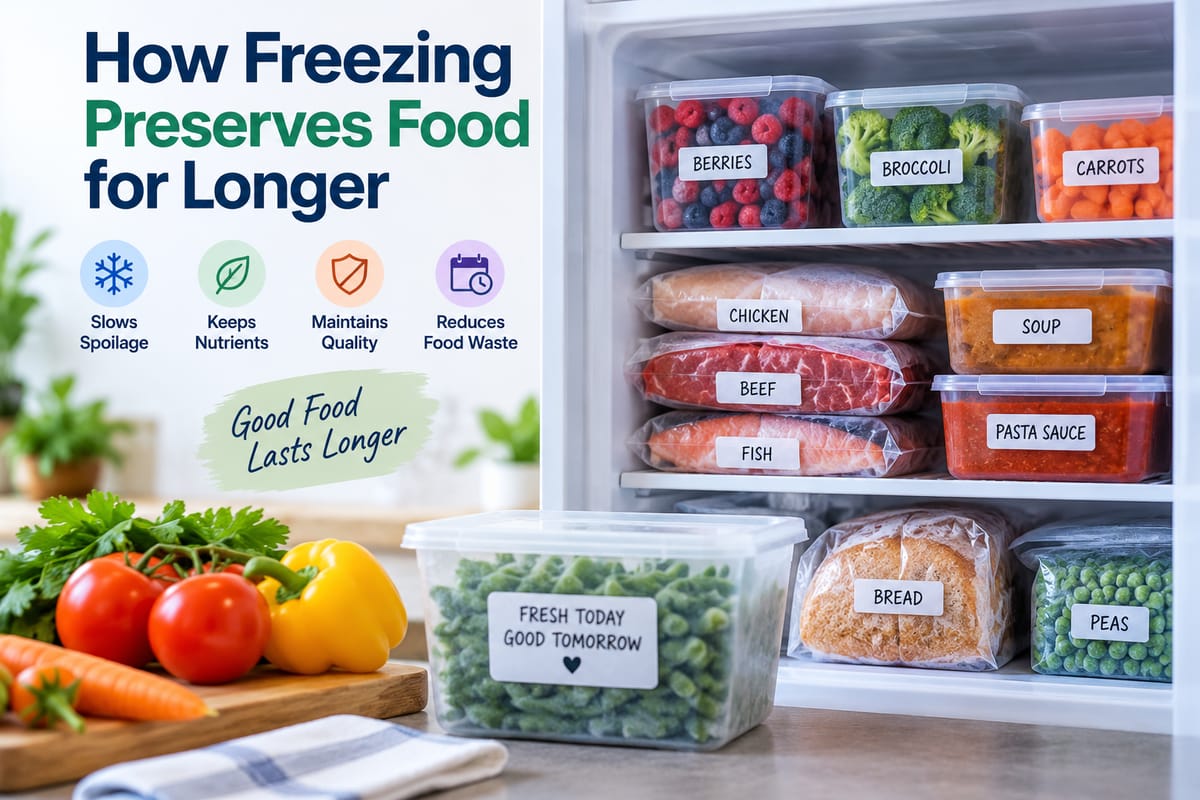
**How Freezing Preserves Food for Longer
Freezing is one of the simplest ways to keep food usable for an extended period. From leftover meals and fresh vegetables to meat, fish, bread and prepared ingredients, a freezer can slow the changes that normally make food deteriorate.
The basic idea is straightforward: freezing lowers the temperature of food enough to turn much of its water into ice. This dramatically slows the activity of microorganisms and chemical reactions that contribute to spoilage.
Freezing does not make food permanently safe or preserve its original quality indefinitely. Food can still experience quality loss, freezer burn and changes in texture over time. Proper preparation, packaging, storage temperature and handling all play a role in getting the best results.
What Happens When Food Freezes?
Most foods contain a substantial amount of water. When their temperature falls below the freezing point, that water begins forming ice crystals.
As the temperature continues to decrease, more of the available water becomes frozen.
This matters because many processes responsible for food deterioration depend on liquid water and suitable temperatures. Freezing makes conditions much less favorable for these processes.
The food does not become biologically inactive in every respect, but many microorganisms cannot actively multiply while the food remains properly frozen.
How Low Temperatures Slow Food Spoilage
Food naturally changes over time because of microorganisms, enzymes and chemical reactions.
Bacteria, yeasts and molds can contribute to spoilage when conditions allow them to grow. Freezing greatly slows their activity and prevents most of them from multiplying while food remains frozen.
Enzymes naturally present in foods can also contribute to changes in flavor, color and texture. Freezing slows enzyme activity, although it does not necessarily stop it completely.
Chemical reactions also generally proceed more slowly at lower temperatures.
Together, these effects explain why freezing can extend the usable life of many foods.
Freezing Does Not Kill Everything
One common misconception is that freezing kills all harmful microorganisms.
That is not generally the case. Many microorganisms can survive freezing and become active again when food is thawed and conditions become favorable.
For this reason, freezing should be understood primarily as a method of slowing deterioration rather than sterilizing food.
Safe handling before freezing and after thawing remains important. The broader principles are covered in The Complete Guide to Food Safety.
Why Water Becomes So Important
Water plays a major role in the freezing process.
When water inside food forms ice crystals, it becomes less available in its liquid form. This makes it harder for microorganisms to grow and slows many chemical and biological processes.
However, the formation of ice crystals can also affect food quality.
Large ice crystals can damage the structure of foods, particularly fruits and vegetables. When the food eventually thaws, the damaged cells may release water, leaving the food softer or more watery than it was before freezing.
This is one reason freezing technique matters.
Fast Freezing and Ice Crystals
The speed at which food freezes can influence the size of ice crystals that form inside it.
Rapid freezing generally produces smaller ice crystals. Smaller crystals are less likely to cause extensive structural damage than larger crystals.
Slow freezing allows larger crystals to develop, which can disrupt cellular structures more significantly.
This is particularly noticeable in foods with high water content.
For home cooks, spreading food into relatively shallow portions and avoiding unnecessary delays before freezing can help food freeze more efficiently.
Why Texture Can Change After Thawing
Freezing can preserve many aspects of food while still changing its texture.
Fresh lettuce, for example, contains a large amount of water and has delicate cellular structures. Once frozen and thawed, those structures can become damaged, making the leaves limp.
Other foods handle freezing much better.
Many meats, breads, prepared meals, soups and certain vegetables can retain useful quality when properly frozen.
The suitability of freezing therefore depends partly on the food’s physical structure.
Freezer Burn and What Causes It
Freezer burn is a common quality problem associated with long-term frozen storage.
It can occur when moisture moves from the surface of frozen food and escapes into the surrounding freezer environment. Areas exposed to air can become dry, discolored or leathery.
Freezer-burned food is not necessarily unsafe solely because it has freezer burn, but its taste and texture may be affected.
Good packaging can substantially reduce the risk.
Packaging Food for the Freezer
Packaging serves several purposes.
It helps protect food from air, limits moisture loss, reduces exposure to odors and can help prevent physical damage.
Suitable freezer packaging should be:
- Moisture resistant
- Airtight or tightly sealed
- Durable at low temperatures
- Appropriate for the type of food being stored
Removing as much excess air as practical before sealing can help reduce moisture loss and freezer burn.
Foods should also be divided into portions that make sense for future use. Freezing a large container of food may be convenient initially but inconvenient when only a small amount is needed later.
Freezing Meat and Fish
Meat and fish are commonly frozen because low temperatures can greatly slow microbial growth and quality deterioration.
Before freezing, food should be handled hygienically and packaged appropriately.
Portioning meat into meal-sized quantities can make later thawing easier. Wrapping individual portions also reduces the need to repeatedly expose the remaining food to air.
Fish and other delicate foods may benefit particularly from careful packaging because dehydration and oxidation can affect their quality.
Freezing Fruits and Vegetables
Many fruits can be frozen successfully, although their texture may change after thawing.
Berries, sliced fruit and other suitable produce can often be spread out and frozen before being transferred to longer-term storage packaging.
Many vegetables benefit from blanching before freezing. Blanching involves briefly heating the vegetables and then cooling them rapidly.
This process can help slow enzyme-related quality changes that would otherwise continue during frozen storage.
The appropriate preparation method varies by vegetable.
Freezing Cooked Meals
Freezing can be especially useful for prepared meals.
Soups, stews, sauces, casseroles and many cooked dishes can be divided into portions and frozen for later use.
Allowing food to cool appropriately before packaging and freezing can help with efficient storage, although perishable cooked food should not be left at room temperature for extended periods.
Containers should also leave appropriate space when necessary because some foods expand as their water content freezes.
Bread and Baked Goods
Bread generally freezes well when protected from air and moisture loss.
Loaves can be wrapped tightly, while individual slices can be separated so that only the required amount needs to be removed.
Many baked goods, including some cakes, muffins and cookies, can also be frozen successfully.
The quality after thawing depends on the ingredients and preparation method.
Understanding how different ingredients behave can make freezing more effective. The Cooking Ingredients Guide: Types, Uses, Substitutions and Storage provides broader information about ingredients and their storage characteristics.
What Foods Do Not Freeze Well?
Not every food retains its original quality after freezing.
Foods that may experience undesirable texture changes include:
- Raw leafy salad greens
- Some high-water-content vegetables
- Certain creamy sauces
- Some custards
- Foods with delicate emulsions
- Certain fresh fruits
This does not necessarily mean these foods become unusable. They may simply be better suited to cooked applications after thawing.
For example, a fruit that becomes softer after freezing may still work well in a smoothie, sauce or baked dish.
The Importance of the Freezer Temperature
A stable, sufficiently low freezer temperature is important for maintaining frozen food.
Temperature fluctuations can cause partial thawing and refreezing. This can contribute to larger ice crystals and quality deterioration.
A consistently cold freezer also helps ensure that frozen food remains in the intended state.
Opening the freezer frequently, leaving the door open for long periods or overloading the appliance in ways that interfere with air circulation can affect temperature stability.
Organizing a Freezer for Better Food Quality
Freezer organization can make food easier to manage and reduce waste.
A practical system might separate:
- Raw meats
- Fish and seafood
- Frozen vegetables
- Prepared meals
- Bread and baked goods
- Fruits
- Ingredients
- Long-term storage items
Clearly labeling containers with the food name and freezing date can also help.
This makes it easier to use older items before newer ones and reduces the likelihood of forgotten food remaining in the freezer for years.
How Long Can Frozen Food Be Stored?
Freezing can keep food usable for a long time, but storage duration depends on the type of food, packaging, freezer temperature and desired quality.
Safety and quality are also separate considerations.
Food maintained continuously at appropriate freezer temperatures can remain safe for a very long time, but its quality may gradually decline.
Flavor, texture, color and moisture content can change even when the food remains frozen.
For this reason, recommended storage periods are often designed primarily around maintaining quality.
Freezing Versus Other Preservation Methods
Freezing is one of several methods used to extend food storage.
Other methods include:
- Refrigeration
- Drying
- Canning
- Fermentation
- Pickling
- Salting
- Smoking
Each method works differently and produces different effects on food.
Freezing generally has the advantage of preserving many foods without requiring the high temperatures associated with some cooking-based preservation techniques.
However, freezing also requires continuous access to electricity or another reliable cold-storage system.
The broader role of cooking and heat-based techniques can be explored through Cooking Methods Explained: The Complete Guide.
Thawing Frozen Food Safely
How food is thawed matters almost as much as how it is frozen.
Appropriate methods can include thawing food in the refrigerator, using cold water under controlled conditions, or using a microwave when the food will be cooked immediately afterward.
Leaving perishable food at room temperature for extended periods can allow microorganisms to multiply as the food warms.
Once food has thawed, it should be handled according to appropriate food-safety practices.
Preventing Cross-Contamination
Frozen food can also become part of a cross-contamination problem if raw and ready-to-eat foods are handled carelessly.
For example, juices from raw meat can contaminate surfaces, packaging or other foods.
Separate preparation areas, clean utensils and proper handwashing can help reduce these risks.
The principles described in How to Prevent Cross-Contamination in the Kitchen are particularly relevant when preparing foods for freezing and thawing.
Refreezing Thawed Food
Whether food can be safely refrozen depends on how it was thawed and how it was handled.
Food thawed safely in the refrigerator can generally be refrozen, although its quality may decline because another freeze-thaw cycle can further affect texture.
Food that has been left in unsafe temperature conditions should not simply be refrozen as a way of making it safe.
When uncertain, food safety should take priority over avoiding waste.
Why Portioning Makes Freezing Easier
Portioning food before freezing can solve several practical problems.
Smaller portions freeze more quickly and are easier to thaw. They also reduce the need to repeatedly thaw and refreeze a large quantity when only part of it is required.
For example, a large batch of soup can be divided into individual or family-sized containers.
The same principle can apply to cooked meat, sauces, bread and prepared ingredients.
Freezing as a Tool for Reducing Food Waste
Freezing can also help households use food more efficiently.
Fresh ingredients that will not be consumed before they deteriorate can sometimes be frozen for later use. Extra portions from a meal can be stored rather than discarded.
This is particularly useful for households that cook in batches.
However, freezing works best when it becomes part of an organized food-management routine. Labeling, rotating stored food and planning meals around frozen ingredients can prevent items from being forgotten.
What Freezing Preserves—and What It Cannot
Freezing is highly effective at slowing many of the processes responsible for food spoilage, but it does not stop every change.
Food can still lose moisture, suffer texture changes, develop freezer burn and gradually lose some aspects of its original quality.
The condition of food before freezing also matters. Freezing cannot restore freshness that has already been lost.
For best results, food should be frozen while it is still in good condition and stored in packaging that protects it from air and moisture.
The Science Behind a Simple Kitchen Tool
Freezing works because low temperatures slow microbial growth, enzyme activity and many chemical reactions while turning much of the food’s water into ice. The result is a preservation method that can significantly extend the storage life of a wide range of foods.
The process is simple, but good results depend on details such as appropriate packaging, rapid and consistent freezing, sensible portioning, stable freezer temperatures and safe thawing.
Used properly, the freezer becomes more than a place to store leftovers. It can help households preserve seasonal ingredients, prepare meals ahead of time, protect food quality and reduce unnecessary waste while keeping food management more convenient.