How Smart Home Sensors Monitor Indoor Conditions
How Smart Home Sensors Monitor Indoor Conditions
A smart home can do much more than turn lights on with a voice command or adjust the thermostat automatically. Increasingly, connected homes are using sensors to understand what is happening inside the building—from temperature and humidity to motion, occupancy, light levels, and aspects of indoor air quality.
These sensors provide the data that allows smart-home systems to respond to changing conditions. A sensor might detect rising humidity in a bathroom, notice that a room is occupied, identify an increase in airborne particles while cooking, or recognize that a room has become warmer than expected.
The result is a home that can respond to its environment instead of relying entirely on people to make every adjustment manually.
For a broader overview of how sensors fit into connected-home technology, see The Complete Guide to Smart Homes.
What Are Smart Home Sensors?
A smart home sensor is a device designed to detect a physical or environmental condition and convert that information into data that another device or system can use.
Depending on its purpose, a sensor can detect things such as:
-
Temperature
-
Humidity
-
Motion
-
Occupancy
-
Light
-
Air pressure
-
Water leaks
-
Smoke
-
Carbon monoxide
-
Carbon dioxide
-
Particulate matter
-
Certain volatile organic compounds
-
Door and window activity
The U.S. Environmental Protection Agency describes sensors as devices that detect or measure physical, chemical, or mechanical stimuli and convert them into signals that can be interpreted by people, appliances, instruments, or machines.
In a smart home, that information can become an input for automation.
For example, a temperature sensor could tell a thermostat that a particular room is warmer than expected. A motion sensor could tell lighting equipment that someone has entered a room. An air-quality sensor could detect changing particulate levels and trigger an air cleaner.
How Smart Sensors Collect Information
Most sensors perform a relatively simple task: measure a physical condition and turn the measurement into an electrical signal or digital reading.
The technology varies considerably depending on what is being measured.
A temperature sensor, for example, responds to changes in temperature. A humidity sensor detects changes associated with moisture in the air. A motion sensor detects movement through technologies such as infrared sensing.
Air-quality sensors are more complicated because indoor air contains a mixture of gases and particles. Different sensor technologies are designed to detect different substances or environmental factors.
Once collected, the information may be sent through a home’s wireless network or another communication system to an app, hub, controller, appliance, or automation platform.
For more information about the network infrastructure that allows these devices to communicate, see the Complete Guide to Smart Home Networking.
Temperature Sensors Help Maintain Comfortable Rooms
Temperature is one of the simplest conditions for a smart home to measure.
A connected temperature sensor can monitor conditions in individual rooms rather than relying exclusively on a single measurement from a central thermostat.
This can be useful in homes where temperatures vary significantly between rooms.
For example, a bedroom on an upper floor may become warmer than a living room downstairs. A sensor in each space can provide more detailed information about those differences.
Smart-home systems can then use temperature readings to support actions such as:
-
Adjusting heating or cooling
-
Changing ventilation
-
Activating fans
-
Sending temperature alerts
-
Monitoring rooms that are rarely occupied
-
Creating customized comfort settings
Wireless building sensors are also used to monitor environmental conditions such as temperature, indoor air quality, light, and occupancy.
Humidity Sensors Monitor Moisture Levels
Humidity is another important indoor condition.
A humidity sensor measures relative humidity—the amount of water vapor in the air relative to the maximum amount the air can hold at a particular temperature.
Smart humidity sensors can be particularly useful in bathrooms, kitchens, laundry areas, basements, and other spaces where moisture levels can change quickly.
A smart system might detect increasing humidity and respond by:
-
Activating an exhaust fan
-
Increasing ventilation
-
Sending an alert
-
Adjusting a connected dehumidifier
-
Recording the change for later analysis
Monitoring humidity can also help homeowners identify unusual patterns, such as a room that consistently becomes excessively damp.
However, a sensor reading is not a diagnosis of a building problem. Persistent moisture issues may require inspection to determine whether the underlying cause is condensation, inadequate ventilation, plumbing problems, water intrusion, or another issue.
Air-Quality Sensors Look Beyond Temperature
Some of the most sophisticated smart-home sensors monitor indoor air quality.
Depending on the device, an indoor air-quality monitor may measure one or more pollutants or environmental factors, including particulate matter, carbon dioxide, volatile organic compounds, temperature, and humidity.
This creates an additional layer of environmental awareness.
Consider what happens when someone cooks.
Cooking can temporarily increase airborne particles. A sensor may detect that change and display an increase in particulate matter. A connected system could potentially respond by increasing ventilation or activating an air-cleaning device.
Air-sensor technology can increasingly be incorporated into equipment and appliances that measure indoor conditions and can also trigger actions such as turning on an air cleaner when predefined conditions are reached.
Carbon Dioxide Sensors Can Indicate Changes in Ventilation
Carbon dioxide, commonly abbreviated as CO₂, is another measurement found in some indoor monitors.
People continuously release CO₂ when they breathe, so concentrations can rise in occupied rooms when ventilation is limited.
A CO₂ sensor can therefore provide useful information about how indoor conditions change as the number of occupants changes.
For example, a smart sensor could observe rising CO₂ levels in a home office while someone is working. Depending on how the system is configured, that information might prompt the occupant to increase ventilation or could be used by a building-control system to adjust ventilation automatically.
Continuous CO₂ sensors can also be used alongside temperature and humidity measurements to study indoor air exchange rates.
Importantly, CO₂ monitoring should not be confused with carbon monoxide detection.
Carbon monoxide is a dangerous, potentially fatal gas. A dedicated certified carbon monoxide alarm is a safety device designed to warn occupants of potentially dangerous concentrations. Low-cost indoor air-quality monitors should not automatically be treated as substitutes for dedicated safety alarms.
Particulate Sensors Detect Airborne Particles
Particulate matter sensors are designed to detect particles suspended in the air.
These particles can come from a variety of indoor sources, including cooking, combustion, dust, and other activities.
A smart particulate sensor may show readings in real time, allowing homeowners to see how indoor particle levels change during different activities.
For example:
Cooking begins → particle levels rise → sensor detects the change → ventilation or air cleaning increases → particle levels fall.
This kind of feedback can make invisible environmental changes easier to understand.
However, sensor readings need to be interpreted carefully. Low-cost monitors can have limitations related to accuracy, placement, temperature, humidity, data processing, and other factors.
Motion Sensors Understand Activity
Not every smart-home sensor is concerned with air.
Motion sensors can determine whether movement is occurring within an area, making them useful for lighting, security, energy management, and automation.
A simple example is an automated hallway light.
Motion detected → light turns on → no motion for a set period → light turns off.
Motion information can also help a smart home understand patterns of activity.
A system might determine that a room is regularly occupied during certain periods and adjust lighting or climate settings accordingly.
Some systems combine motion detection with other forms of occupancy sensing to distinguish between an empty room and an occupied one more reliably.
For a deeper look at how sensors can be combined with alerts and monitoring, see the Smart Home Monitoring Guide: Sensors and Alerts.
Light Sensors Help Homes Respond to Daylight
Light sensors measure the amount of light in an environment.
A smart home can use this information to adjust artificial lighting based on natural daylight.
For instance, if sunlight entering a room becomes strong enough, connected lights could be dimmed or switched off.
Light sensors can therefore contribute to both convenience and energy management.
They can also be combined with other sensors. A room might use motion detection to determine whether someone is present and light sensing to determine whether additional illumination is necessary.
Instead of simply responding to motion, the system responds to motion plus environmental conditions.
Water Sensors Watch for Leaks
Water-leak sensors address a different kind of indoor condition: unwanted moisture.
These small devices can be placed near areas where leaks are more likely to cause problems, such as:
-
Under sinks
-
Near washing machines
-
Around water heaters
-
Near dishwashers
-
In basements
-
Around plumbing equipment
When water reaches the sensor, it can send an alert to the homeowner or connected system.
Some smart-home systems can go further by connecting detection with automatic shutoff equipment.
The basic concept is simple:
Water detected → alert sent → homeowner responds or automatic protection activates.
This is an example of why sensors can be valuable even when they do not directly control anything. Their ability to detect an unusual condition can provide an early warning.
Smart Sensors Turn Data Into Automation
A sensor becomes significantly more useful when its information is connected to an automation system.
Without automation, a sensor might simply display a number.
With automation, that number can become an action.
For example:
| Sensor detects | Possible smart-home response |
|---|---|
| High temperature | Adjust cooling |
| High humidity | Activate ventilation |
| Motion | Turn on lighting |
| Low light | Increase illumination |
| Rising particulate matter | Activate air cleaning |
| Water detected | Send an alert |
| Room unoccupied | Reduce energy use |
| Door opened | Trigger notification |
The precise capabilities depend on the sensor, connected devices, software, and automation rules.
Why Sensor Placement Matters
Where a sensor is installed can affect the quality and usefulness of its readings.
An indoor air-quality sensor should not simply be hidden in a cabinet or placed directly beside a pollution source.
Indoor air sensors are generally most useful when positioned around typical breathing-zone height and kept away from pollution sources and air-cleaning devices. Sensors should also have adequate airflow rather than being tucked behind furniture or into corners.
Placement can matter for temperature and humidity sensors as well.
A sensor directly beside a heating vent, for example, may experience conditions that are not representative of the rest of the room.
The objective is to measure the environment that the sensor is intended to represent—not an unusual microenvironment created by its immediate surroundings.
Smart Sensor Readings Are Not Always Perfect
One of the biggest misconceptions about smart sensors is that every number they produce is automatically accurate.
In reality, sensor performance varies.
Low-cost air sensors can be affected by factors including temperature, humidity, placement, time in use, data processing, and the presence of multiple contaminants. Some sensors may also require calibration.
This is particularly important for air-quality monitoring.
A consumer air-quality monitor can be useful for identifying patterns and changes, but it does not necessarily provide the same measurements as professional or regulatory monitoring equipment.
A sensor designed to measure particulate matter also cannot tell you about pollutants it was not designed to detect.
Sensors Can Reveal Patterns Humans Cannot Easily See
Perhaps the biggest advantage of smart-home sensors is not any individual reading.
It is the pattern created by many readings over time.
Imagine a home that records temperature, humidity, occupancy, and air-quality information continuously.
After several weeks, the homeowner might discover:
-
Humidity consistently rises after showers.
-
A bedroom becomes unusually warm overnight.
-
Airborne particles increase during cooking.
-
CO₂ rises when several people gather in one room.
-
A particular room remains humid even when unoccupied.
-
Energy use increases when certain rooms are occupied.
These patterns can provide useful clues about how a home behaves.
Instead of relying on occasional observations, homeowners can see how indoor conditions change throughout the day.
Privacy Is Part of Smart Sensor Design
Environmental sensors may appear less intrusive than cameras or microphones, but smart-home data can still reveal information about household behavior.
Motion and occupancy sensors can potentially indicate when people are home. Connected devices may record timestamps and environmental changes. Cloud-connected systems can also transmit information outside the home.
For that reason, homeowners should consider:
-
What data the device collects
-
Whether information is stored locally or in the cloud
-
Which accounts can access the data
-
Whether data is shared with third parties
-
How long records are retained
-
Whether the device supports local control
-
What happens if internet connectivity is lost
A smart home should not become so convenient that homeowners lose sight of what information their devices are collecting.
The Future of Indoor Monitoring Is More Contextual
The most interesting development in smart-home sensing is likely to be the combination of multiple measurements.
Instead of looking at temperature alone, a system can consider temperature, humidity, occupancy, time of day, light levels, and other environmental information simultaneously.
That creates a more complete picture of the indoor environment.
For example, the system might recognize:
The room is occupied + CO₂ is rising + outdoor conditions permit ventilation.
That combination could produce a more useful response than any single sensor operating independently.
Wireless sensor networks can support monitoring of building conditions including temperature, indoor air quality, light, and occupancy, with the potential to support optimized building operations.
A Smarter Home Starts With Better Information
Smart-home sensors are essentially the senses of a connected house.
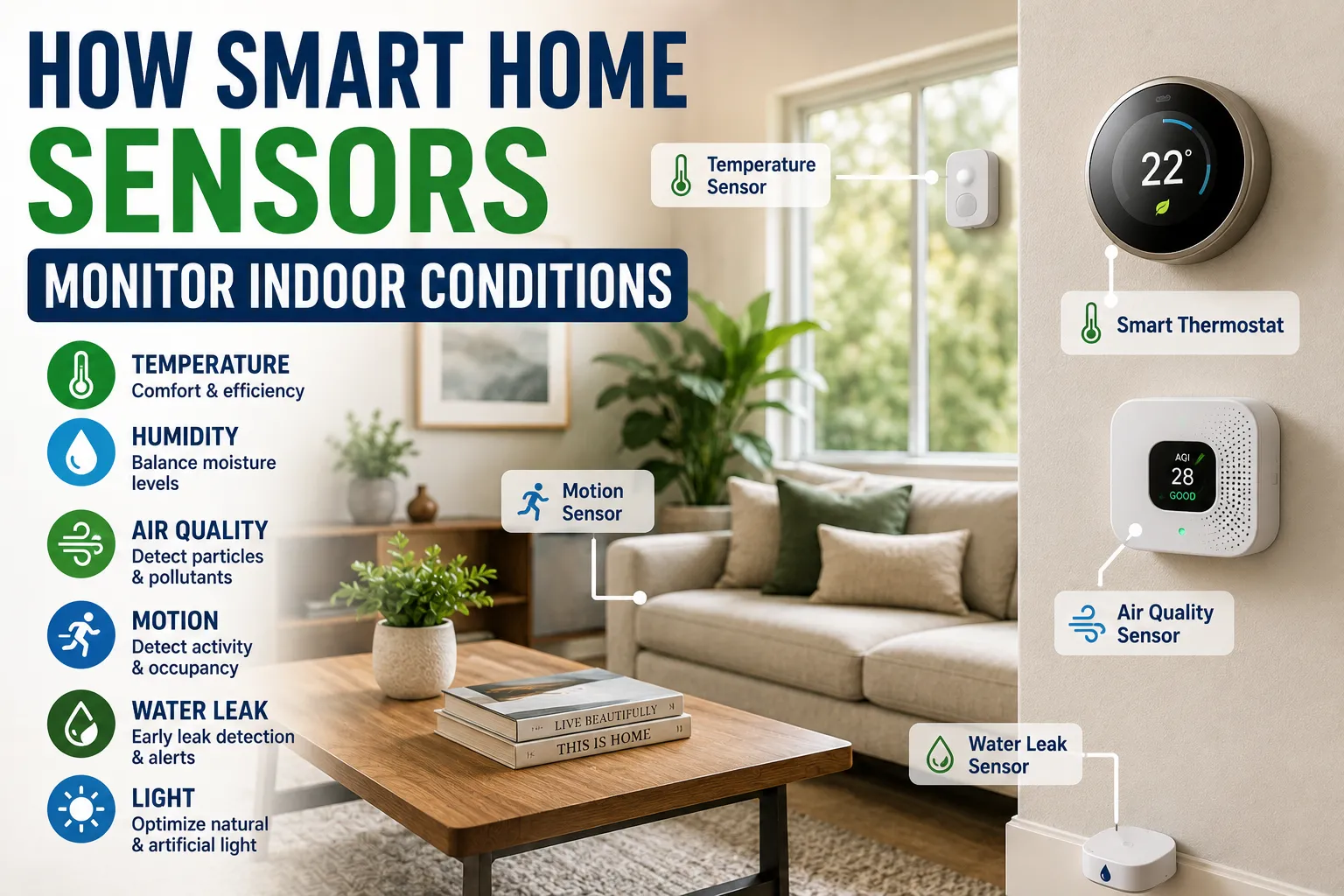
Temperature sensors detect heat. Humidity sensors detect moisture. Motion sensors detect activity. Light sensors detect illumination. Air-quality sensors can detect selected particles, gases, and environmental conditions. Water sensors can identify unwanted moisture.
The sensors themselves are only the beginning.
Their real value comes from turning measurements into useful information—and, where appropriate, connecting that information to automated responses.
At the same time, smart-home owners should remember that sensor readings have limitations. Indoor air monitors in particular should be treated as tools for understanding patterns rather than universal diagnostic instruments. Consumer monitors detect only the pollutants or conditions they are designed to measure and can have accuracy and interpretation limitations.
As connected homes become more sophisticated, the most useful smart home may not be the one with the largest number of devices. It may be the one that uses a carefully chosen set of sensors to understand its environment, respond intelligently, and give homeowners information they can actually use.