How Smart Sensors Monitor Indoor Home Conditions
How Smart Sensors Monitor Indoor Home Conditions
Smart homes are often associated with voice assistants, connected lights and automated appliances. But some of the most useful smart-home technology works quietly in the background.
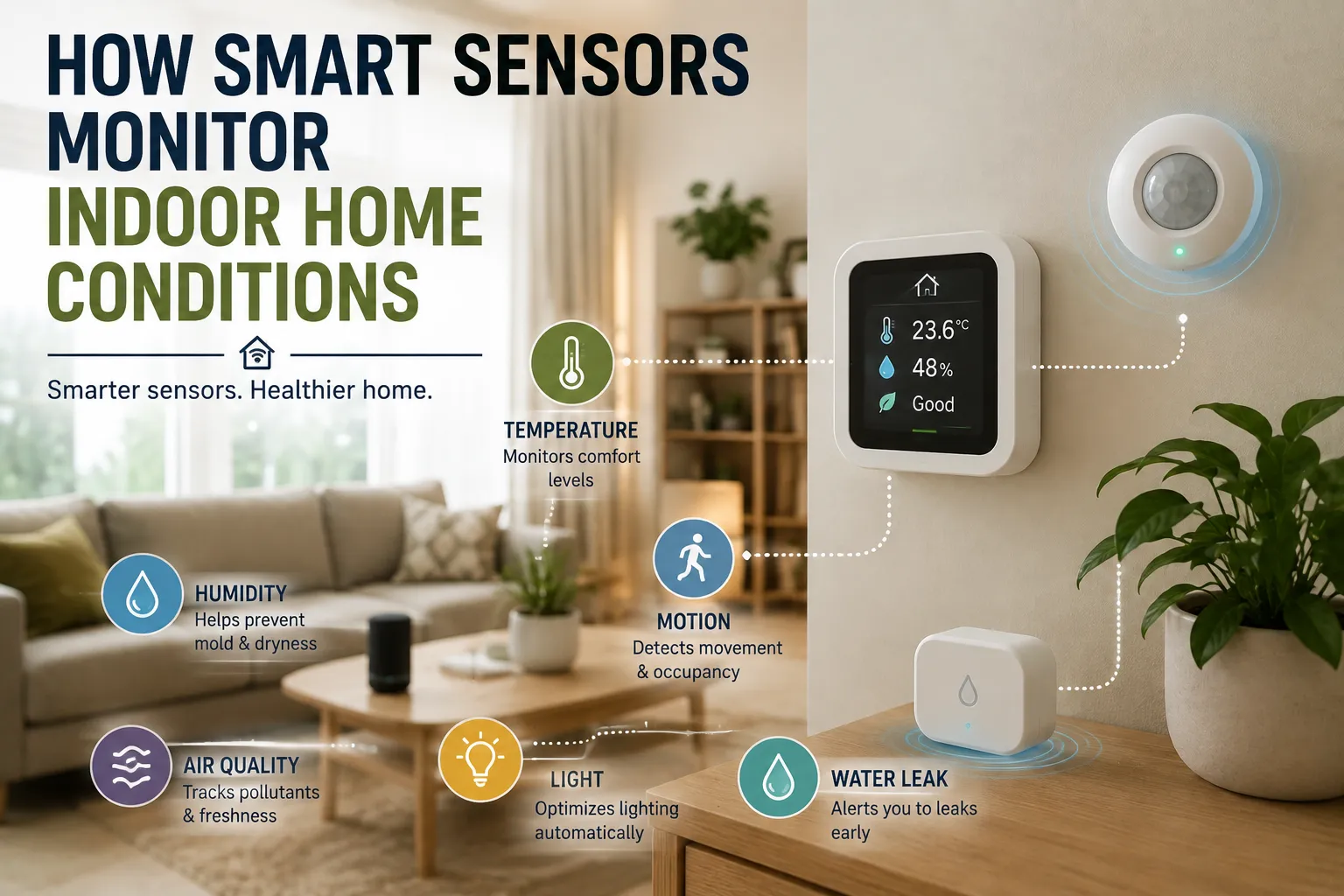
Smart sensors can continuously monitor conditions inside a home and provide information about factors such as temperature, humidity, air quality, motion, light and water leaks. When connected to a central smart-home platform, these sensors can also trigger automated responses or alert homeowners when something appears unusual.
The result is a home that can respond to changing conditions rather than relying entirely on people to notice problems themselves.
What Are Smart Home Sensors?
A smart sensor is a connected device that detects a change in its surrounding environment and communicates that information to another device, app or home-automation system.
Depending on the sensor, it might measure:
- Temperature
- Humidity
- Air quality
- Carbon dioxide
- Motion
- Occupancy
- Light levels
- Water leaks
- Smoke or other environmental conditions
- Door and window activity
Some sensors perform one specific task, while others combine several sensing capabilities in a single device.
The important difference between a conventional sensor and a smart sensor is connectivity. A smart sensor can send information to a digital system, allowing the homeowner to view data, receive alerts or create automated routines.
Temperature Sensors Help Track Indoor Comfort
Temperature is one of the most basic conditions that smart-home technology can monitor.
A temperature sensor can measure the conditions in a room and communicate that information to a smart thermostat or home-automation system.
For example, a homeowner might establish a preferred temperature range. If a room becomes too warm, the system could adjust heating or cooling equipment if the connected devices support that function.
Temperature monitoring can also help identify unusual conditions.
If a room that normally stays relatively stable suddenly becomes much colder or hotter, the homeowner may want to investigate whether a window has been left open, an HVAC system has malfunctioned or another problem has occurred.
Humidity Sensors Monitor Moisture in the Air
Humidity can have a major effect on indoor comfort and the condition of a home.
Excessively high humidity can contribute to condensation and create conditions that encourage mold growth. Very dry indoor air can also make some people uncomfortable and may affect certain materials.
A smart humidity sensor can track moisture levels and provide information through a smartphone app or smart-home platform.
Some systems can combine humidity data with ventilation, air-conditioning or dehumidification equipment.
This makes it possible to move beyond simply measuring humidity toward actively managing indoor conditions.
Air-Quality Sensors Provide More Information About the Indoor Environment
Indoor air can contain a variety of pollutants and particles.
Depending on the sensor, smart air-quality monitors may track indicators such as particulate matter, carbon dioxide or volatile organic compounds.
These measurements can help homeowners understand how indoor conditions change over time.
For instance, cooking, cleaning products, candles, poor ventilation and outdoor pollution can affect indoor air conditions.
A sensor can reveal patterns that may otherwise be difficult to notice.
If air-quality measurements repeatedly worsen during certain activities, a homeowner can investigate whether better ventilation or changes in household routines could help.
Carbon Dioxide Sensors Can Indicate Ventilation Changes
Carbon dioxide sensors are increasingly used as indicators of indoor ventilation.
People naturally produce carbon dioxide when they breathe, so levels can rise in occupied rooms when there is insufficient fresh-air exchange.
A smart CO₂ sensor can monitor changes and provide an indication that a room may need better ventilation.
For example, a sensor might detect that carbon dioxide levels consistently increase when several people are gathered in a closed room.
This information can help homeowners understand how occupancy and ventilation interact.
However, carbon dioxide measurements should not be confused with carbon monoxide detection. CO₂ and CO are different gases, and a carbon monoxide alarm should be used for protection against carbon monoxide.
Motion Sensors Detect Activity
Motion sensors are another common component of smart homes.
They can detect movement within a particular area and communicate that information to a home-automation system.
Although motion sensors are often associated with security, they can also be used to manage indoor conditions.
For example, a smart home could use occupancy information to:
- Turn lights on when someone enters
- Reduce heating or cooling in empty rooms
- Adjust lighting based on activity
- Trigger ventilation
- Turn appliances or devices off after a period of inactivity
This can make the home more responsive without requiring residents to manually control every device.
Occupancy Sensors Go Beyond Simple Motion Detection
Traditional motion sensors generally detect movement.
Occupancy sensors can use additional information to determine whether a room is being used, even when someone is relatively still.
This distinction can be useful for heating, cooling and lighting automation.
Imagine someone sitting quietly at a desk. A basic motion sensor might eventually stop detecting movement, while an occupancy-oriented system could continue recognizing that the room is in use.
More accurate occupancy detection can therefore improve automation and reduce situations where lights or climate systems switch off while someone is still present.
Light Sensors Measure Natural and Artificial Lighting
Smart light sensors can detect the brightness of an environment.
A connected lighting system can use this information to determine when additional artificial light is needed.
For example, lights could automatically become brighter when natural daylight decreases.
Light sensors can also support energy-saving routines by preventing artificial lighting from operating unnecessarily during bright periods.
Combined with motion or occupancy detection, they can create more sophisticated lighting automation.
Water-Leak Sensors Can Detect Problems Early
Some of the most valuable smart sensors are designed to detect water.
A small leak under a sink, washing machine or water heater may initially go unnoticed. Over time, however, even a relatively small leak can cause significant property damage.
Water-leak sensors can be positioned near areas where leaks are more likely to occur.
When moisture is detected, the sensor can send an alert to a smartphone or connected home system.
Some advanced systems can also communicate with an automatic water shutoff valve, potentially allowing the home’s water supply to be stopped when a serious leak is detected.
The ability to identify a problem while it is still small can make water sensors particularly useful.
Door and Window Sensors Track Openings
Contact sensors can determine whether a door or window is open or closed.
Although these devices are commonly used for security, they can also contribute to indoor climate management.
A smart-home system could, for example, detect an open window and adjust heating or cooling behavior accordingly.
This can prevent a heating or cooling system from working unnecessarily while a window is open.
The sensors can also provide useful information about household routines.
Smart Sensors Can Work Together
The real potential of smart sensors appears when multiple devices communicate with one another.
Consider a simple example.
A temperature sensor detects that a room is becoming warmer. An occupancy sensor confirms that someone is inside. A humidity sensor detects elevated moisture, while an air-quality sensor indicates that ventilation may be needed.
Instead of treating each measurement separately, a smart-home platform can combine the information and potentially respond according to predefined rules.
This is one of the fundamental ideas behind home automation:
Sensors collect information, software interprets it, and connected devices respond.
Automation Turns Data Into Action
Monitoring alone is useful, but automation can make sensor data considerably more practical.
A homeowner might create a rule such as:
If the bathroom humidity remains above a certain level after a shower, turn on the ventilation fan.
Another routine could be:
If nobody is detected in the room for a specified period, adjust the thermostat.
Or:
If a water sensor detects moisture, send an immediate alert.
The exact capabilities depend on the sensors, smart-home platform and connected equipment.
The important point is that sensors provide the information required for these automated decisions.
Smart Sensors Can Help Improve Energy Efficiency
Heating, cooling and lighting account for significant energy use in many homes.
Smart sensors can help reduce unnecessary consumption by providing information about when rooms are occupied and what conditions exist inside them.
For example, a heating or cooling system may not need to operate at the same level in an empty room as it does when people are present.
Likewise, lighting can be reduced or switched off when sufficient daylight is available.
These strategies do not guarantee lower energy bills, since savings depend on the equipment, settings, building and household behavior. However, better information can make more targeted automation possible.
Sensors Can Reveal Patterns Over Time
One of the advantages of connected sensors is that they can collect data continuously.
Instead of taking a single temperature reading, a smart sensor can record changes throughout the day.
Over several weeks, this may reveal patterns such as:
- Which rooms become hottest
- When humidity regularly rises
- How quickly a room cools overnight
- When air-quality measurements change
- How occupancy affects carbon dioxide levels
- When heating or cooling equipment operates most frequently
This historical information can help homeowners make better decisions about ventilation, insulation, heating, cooling and other aspects of home management.
Smart Sensors Can Help Identify Unusual Conditions
A home normally has patterns.
A particular room may maintain a relatively stable temperature. Humidity might increase predictably after showers. A basement may normally remain cooler than the rest of the house.
When sensor data suddenly deviates from those patterns, it can provide an early signal that something has changed.
For example, an unexpected increase in humidity might prompt a homeowner to investigate a leak or ventilation problem.
A sudden temperature change might indicate an HVAC issue.
A water sensor can provide an even more direct warning by detecting moisture where it should not be.
Sensors cannot diagnose every household problem, but they can provide useful early information.
Smart Sensors Are Not Perfect
Despite their advantages, sensors have limitations.
Different devices vary in accuracy, sensitivity and reliability. Placement also matters.
A temperature sensor positioned next to a heater may provide a very different reading from one placed in the center of a room.
Likewise, an air-quality sensor may not provide a complete picture of every pollutant present in a home.
Homeowners should therefore treat sensor readings as useful measurements rather than absolute representations of every aspect of indoor environmental quality.
Placement Matters
Getting the best results from a smart sensor often requires thoughtful placement.
Temperature sensors should generally be positioned where they can measure representative room conditions rather than being exposed to direct sunlight or strong heat sources.
Humidity sensors should be placed where the measured conditions are relevant to the intended purpose.
Water sensors need to be positioned near potential leak sources.
Motion and occupancy sensors need an appropriate field of view.
A poorly positioned sensor can produce data that is technically accurate at its location but not useful for understanding the room as a whole.
Connectivity Is an Important Consideration
Smart sensors need a way to communicate.
Depending on the product, they may use technologies such as Wi-Fi, Bluetooth, Zigbee, Z-Wave, Thread or other connectivity standards.
Some devices communicate directly with a smart-home hub, while others connect through a manufacturer’s cloud service.
Connectivity affects installation, battery life, range and compatibility.
Before buying several sensors, homeowners should check whether they can work together within the same smart-home ecosystem.
Battery Life Can Affect Convenience
Many small smart sensors operate on batteries.
Battery-powered devices are convenient because they do not require electrical wiring, but batteries eventually need to be replaced or recharged.
A sensor that is difficult to access can become inconvenient if its battery needs frequent replacement.
For that reason, battery life should be considered when choosing devices, particularly for sensors installed in less accessible areas.
Smart Home Security and Privacy Matter
Sensors can collect a surprising amount of information about household activity.
A motion or occupancy sensor may reveal when people are home. A door sensor can show when an entrance is opened. Environmental sensors can create detailed records of household routines.
That makes security and privacy important considerations.
Homeowners should:
- Use strong account passwords
- Enable multi-factor authentication when available
- Keep device software updated
- Understand what information a manufacturer collects
- Review privacy settings
- Use reputable products from manufacturers that provide ongoing security support
A connected device should not be treated as secure simply because it performs a simple task.
Local Processing Can Offer Privacy Advantages
Some smart-home systems process sensor information locally rather than sending every piece of data to a remote cloud service.
Local processing can potentially reduce dependence on external servers and may offer privacy benefits.
However, cloud connectivity can also provide useful features, including remote notifications, data synchronization and access from outside the home.
The right approach depends on the homeowner’s priorities.
Before purchasing a sensor, it can be worthwhile to understand where the data goes, how long it is stored and what other services can access it.
Smart Sensors Should Complement, Not Replace, Safety Devices
One important distinction is between general-purpose smart sensors and certified safety equipment.
A smart air-quality monitor should not automatically be treated as a replacement for a dedicated smoke alarm or carbon monoxide detector.
Safety-critical devices should be designed, tested and installed for their intended purpose.
Smart-home technology can complement these systems by providing additional monitoring and notifications, but homeowners should not remove essential safety equipment simply because another connected sensor provides related information.
The Future of Indoor Home Monitoring
Smart-home technology is moving toward increasingly integrated environmental monitoring.
Instead of having isolated devices for temperature, lighting, security and air quality, future systems may combine information from many sensors and use software to understand the home’s overall condition.
Artificial intelligence could make these systems more capable of identifying patterns and recommending adjustments.
For example, a future home-management system might learn that humidity consistently rises after showers, recognize how quickly it falls when ventilation is activated and automatically optimize the ventilation schedule.
The challenge will be ensuring that greater automation does not come at the expense of privacy, reliability or user control.
Choosing Smart Sensors for Your Home
Homeowners do not need dozens of sensors to benefit from smart-home monitoring.
A practical starting point could include:
- Temperature and humidity sensor — useful for monitoring comfort and moisture conditions.
- Water-leak sensors — particularly useful near plumbing fixtures and appliances.
- Motion or occupancy sensors — useful for lighting and climate automation.
- Air-quality monitor — helpful for understanding changes in indoor air conditions.
- Door and window sensors — useful for security and climate-related automation.
The best combination depends on the home’s size, climate, existing equipment and the problems the homeowner wants to solve.
Turning a Home Into a More Responsive Environment
Smart sensors are essentially the information-gathering layer of a connected home.
They can tell a system when a room becomes too warm, when humidity rises, when someone enters a space, when a window is opened or when water appears where it should not.
On their own, these measurements may seem simple. Connected to automation systems, however, they can become the foundation for a more responsive home.
The most useful smart-home setup is not necessarily the one with the largest number of connected devices. It is the one that collects useful information, responds appropriately and gives homeowners meaningful control.
As sensors become smaller, more affordable and more capable, indoor monitoring is likely to become a more ordinary part of home management. The result could be homes that do more than respond to commands—they can increasingly recognize changing conditions and help people manage their living environments before small problems become bigger ones.