How to Budget for Home Maintenance
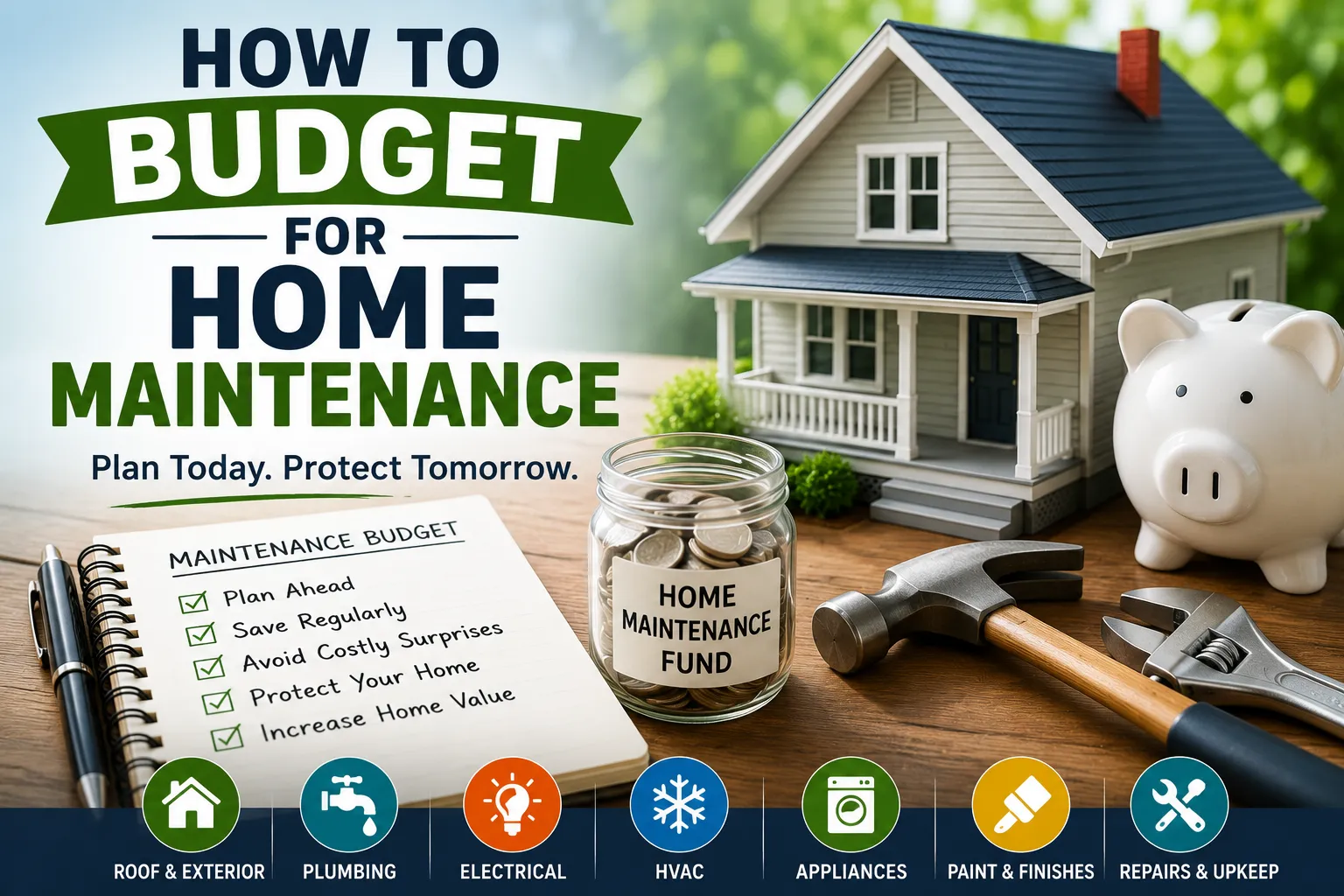
How to Budget for Home Maintenance
Buying a home is often described as one of the biggest financial commitments a person can make. Yet the purchase price, mortgage, and closing costs are only part of the long-term expense.
Every home requires ongoing maintenance.
Roofs age, plumbing needs attention, heating and cooling systems require servicing, appliances eventually fail, and exterior surfaces need to be repaired or replaced. Some expenses are predictable, while others arrive unexpectedly.
Creating a home maintenance budget can make these costs easier to manage. Instead of treating every repair as a financial emergency, homeowners can plan ahead and gradually build funds for both routine maintenance and larger replacements.
A maintenance budget works best when it is part of a broader approach to home maintenance projects, where homeowners understand which systems need attention and when.
Why Home Maintenance Needs Its Own Budget
Home maintenance is different from many ordinary household expenses because the timing can be unpredictable.
You may know that a roof will eventually need replacement, but you may not know exactly when. The same applies to water heaters, exterior paint, appliances, flooring, and major mechanical systems.
Without a dedicated maintenance fund, a major repair can force homeowners to:
- Dip into emergency savings
- Use a credit card
- Take out a personal loan
- Delay necessary repairs
- Reduce spending in other important areas
A maintenance budget provides a financial buffer between normal household expenses and major home repairs.
How Much Should You Budget for Home Maintenance?
There is no universal amount that works for every property.
A commonly used starting point is to set aside around **1% to 4% of the home’s value per year** for maintenance and repairs. However, this is only a budgeting guideline rather than a guaranteed annual expense.
A newer home may require less routine repair spending in some years, while an older property can require substantially more.
The home’s:
- Age
- Size
- Condition
- Construction
- Location
- Climate
- Number of systems
- Quality of previous maintenance
can all affect how much you should reserve.
Another approach is to estimate the likely replacement cost of major systems and divide those costs across their expected useful lives.
Using more than one method can give homeowners a more realistic target.
Consider the Age of the Home
The age of a property can have a significant impact on maintenance planning.
A recently built home may have relatively new roofing, plumbing, electrical systems, appliances, windows, and mechanical equipment.
An older home may have several major components approaching the end of their useful lives at roughly the same time.
This does not mean an older home is necessarily a bad investment.
It simply means homeowners should understand what they are buying and budget accordingly.
Create a Home Maintenance Inventory
Before setting a maintenance budget, make a list of the major components of the property.
Include items such as:
- Roof
- Gutters
- Exterior walls
- Windows
- Doors
- Plumbing
- Electrical system
- Heating system
- Cooling system
- Water heater
- Major appliances
- Flooring
- Driveways and walkways
- Fencing
- Landscaping
- Drainage systems
For each item, record its approximate age, condition, expected maintenance requirements, and likely replacement cost if that information is available.
This creates a basic financial roadmap for the property.
Understanding how the major components fit together can also make this inventory more useful. Homeowners can refer to how major home systems work and what homeowners maintain when identifying the systems and equipment that deserve regular attention.
Separate Maintenance From Major Replacements
Not every home expense should be treated the same way.
Routine maintenance might include:
- Changing filters
- Cleaning gutters
- Servicing HVAC equipment
- Sealing minor gaps
- Touching up exterior finishes
- Maintaining landscaping
- Inspecting plumbing
Major replacement expenses can include:
- A new roof
- HVAC replacement
- Water heater replacement
- New windows
- Major plumbing work
- Electrical upgrades
- Exterior renovations
Keeping these categories separate makes it easier to understand where your money is going.
Build a Home Maintenance Fund
A dedicated savings account can make maintenance expenses easier to manage.
Instead of waiting for a repair and then finding the money, homeowners can contribute regularly.
For example, you might transfer a fixed amount into a home maintenance account every month.
The exact amount depends on your property and financial situation.
The important part is consistency.
Even relatively modest monthly contributions can build a useful reserve over time.
Don’t Confuse Maintenance Savings With an Emergency Fund
A home maintenance fund and an emergency fund serve different purposes.
An emergency fund is generally intended for unexpected personal or financial problems, such as a loss of income or urgent living expenses.
A maintenance fund is specifically designed for property-related costs.
If your washing machine breaks, the roof develops a leak, or your water heater needs replacement, having a dedicated home fund can prevent you from immediately relying on money intended for other emergencies.
Ideally, homeowners should work toward having both.
Use Your Home Inspection Report
If you recently purchased a home, your inspection report can be one of the most useful documents for building a maintenance budget.
Look for information about:
- Roof condition
- Plumbing
- Electrical systems
- Heating and cooling equipment
- Foundation
- Drainage
- Windows
- Exterior materials
- Appliances
The report may identify components that are functioning now but are likely to require attention in the future.
Use those findings to create a maintenance calendar.
Plan for Large Expenses Before They Become Emergencies
One of the biggest advantages of budgeting is being able to prepare for predictable replacements.
If your roof is approaching the end of its expected service life, for example, you can begin researching replacement costs and saving before a major failure occurs.
The same principle applies to:
- Heating and cooling systems
- Water heaters
- Appliances
- Exterior paint
- Decking
- Fencing
- Windows
Planning ahead gives you more options.
You can compare contractors, research materials, obtain multiple estimates, and schedule work rather than making a rushed decision during an emergency.
Learn the Difference Between Repair and Replacement
Sometimes repairing a component makes sense.
Other times, repeatedly repairing an aging system may cost more than replacing it.
For example, an older appliance may require several repairs within a short period. Continuing to spend money on repairs may not be financially sensible if the appliance is nearing the end of its useful life.
This does not mean every old component should immediately be replaced.
Consider:
- Repair cost
- Replacement cost
- Expected remaining life
- Energy efficiency
- Reliability
- Availability of parts
- Future maintenance requirements
A professional assessment can help when the decision is complicated.
Prioritize Safety-Critical Repairs
When money is limited, not every repair has the same priority.
Safety and structural problems should generally receive immediate attention.
These can include:
- Electrical hazards
- Significant roof leaks
- Major plumbing leaks
- Gas-related problems
- Structural damage
- Serious drainage problems
- Dangerous mold or moisture conditions
- Broken security features
Cosmetic improvements can usually wait when the alternative is leaving a serious maintenance problem unresolved.
For a broader look at household risks that may require prompt attention, homeowners can also review how to identify and prevent common safety hazards inside a home.
Use a Three-Level Maintenance Priority System
A simple priority system can make decisions easier.
Priority One: Immediate
Problems that could create safety risks or significant property damage.
Priority Two: Planned
Issues that are not emergencies but should be addressed within months.
Priority Three: Cosmetic
Improvements that make the property look better but do not significantly affect safety or functionality.
This approach can help prevent limited maintenance funds from being consumed by purely cosmetic projects.
Account for Seasonal Maintenance
Some maintenance tasks need to happen at particular times of year.
Depending on the climate and property, these may include:
- Cleaning gutters
- Servicing heating systems
- Inspecting air conditioning
- Preparing outdoor plumbing
- Checking roof drainage
- Maintaining trees
- Inspecting exterior seals
- Preparing outdoor equipment
A seasonal checklist can prevent important tasks from being forgotten.
Don’t Ignore Small Problems
Small maintenance issues can become expensive when they are allowed to continue.
A minor leak may eventually damage flooring or walls.
A damaged roof component may allow moisture into the structure.
A clogged gutter can contribute to drainage problems.
A small crack may become larger over time.
Regular inspections and prompt repairs can therefore be part of a financial strategy, not simply a housekeeping task.
A useful companion resource is the home repairs guide, which covers common household problems and the types of solutions homeowners may encounter.
Keep Records of Repairs
Maintain a simple record of work performed on the home.
Record:
- Date
- Problem
- Repair performed
- Contractor
- Cost
- Materials used
- Warranty information
- Recommended future maintenance
These records can help you understand spending patterns and anticipate future expenses.
They can also be useful when selling the property because they demonstrate that the home has been maintained.
Track Major Systems Separately
For major components, create a simple replacement schedule.
For example:
| Home Component | Installation Date | Current Condition | Estimated Replacement Period | Priority |
|---|---|---|---|---|
| Roof | Record date | Good/Fair/Poor | Research expected life | High |
| Water Heater | Record date | Good/Fair/Poor | Research expected life | Medium |
| HVAC System | Record date | Good/Fair/Poor | Research expected life | High |
| Windows | Record date | Good/Fair/Poor | Long-term | Medium |
| Appliances | Record date | Good/Fair/Poor | Varies | Medium |
The purpose is not to predict an exact replacement date.
It is to identify expenses that may eventually require significant savings.
Consider Your Insurance Separately
Homeowners insurance and maintenance funds serve different purposes.
Insurance may cover certain sudden or accidental losses depending on the policy, exclusions, deductibles, and circumstances.
Routine wear and tear and ordinary maintenance are generally not the same thing as an insured event.
Homeowners should understand their policy rather than assuming that every expensive repair will be covered.
Keep Warranties Organized
New appliances, roofing materials, heating and cooling equipment, windows, and other products may come with warranties.
Keep warranty documents together with receipts and installation records.
Knowing when a warranty expires can prevent homeowners from paying for work that might otherwise qualify for coverage.
Get Multiple Estimates for Major Work
When a major repair becomes necessary, obtain estimates from appropriately qualified professionals when practical.
Compare more than the final price.
Consider:
- Scope of work
- Materials
- Labor
- Warranty
- Licensing or credentials where applicable
- Insurance
- Timeline
- References
- Payment terms
The cheapest estimate is not necessarily the best value.
Budget for Labor, Not Just Materials
Homeowners sometimes underestimate repair costs because they focus on the price of materials.
For many projects, labor can represent a substantial portion of the total expense.
When estimating future costs, include:
- Materials
- Labor
- Permits where required
- Disposal
- Equipment
- Potential preparation work
- Unexpected complications
A professional estimate is generally more useful than relying solely on the retail price of materials.
Keep a Contingency Buffer
Even a carefully planned repair can reveal additional problems once work begins.
A contingency amount can provide protection against unexpected costs.
For major projects, homeowners should discuss potential additional work with the contractor before work begins and understand how changes will be approved and priced.
Maintenance Can Protect Home Value
Regular maintenance is not simply about avoiding inconvenience.
A well-maintained property can be easier to sell and may present better to prospective buyers.
Deferred maintenance can create the opposite effect.
Visible problems such as damaged roofing, neglected landscaping, water stains, broken fixtures, or poorly maintained exterior surfaces can raise concerns about what other problems may exist.
Maintenance therefore contributes to the long-term condition and marketability of the property.
Homeowners interested in the longer-term financial side of upkeep can also explore how to protect and improve home value.
Energy Efficiency Can Be Part of the Budget
Some maintenance decisions can also reduce operating costs.
Examples may include:
- Maintaining HVAC equipment
- Sealing air leaks
- Improving insulation
- Replacing inefficient equipment
- Maintaining windows and doors
- Addressing plumbing leaks
However, not every energy-efficiency upgrade will provide the same financial return.
Consider the upfront cost, expected savings, useful life, and your plans for the property before committing to a major upgrade.
Don’t Forget Outdoor Maintenance
Homeowners sometimes focus on the building itself and overlook the surrounding property.
Outdoor maintenance can include:
- Tree care
- Lawn and garden maintenance
- Drainage
- Fencing
- Decks
- Patios
- Driveways
- Walkways
- Exterior lighting
Some outdoor problems can affect the structure.
For example, poor drainage or neglected trees can potentially create more serious property issues.
Budget Differently for New and Older Homes
A newer home may have lower immediate maintenance requirements but can still require routine servicing.
An older property may have more frequent repairs and a greater likelihood of major system replacements.
Your budget should therefore reflect the actual condition of the home rather than relying entirely on its age.
A recently renovated older home may have very different maintenance needs from an older property that has received little investment.
What If You Can’t Afford a Large Maintenance Fund?
Not every homeowner can immediately build a large reserve.
Start with an amount that is financially sustainable.
Even a modest automatic transfer can establish the habit of saving for maintenance.
If an urgent repair occurs before the fund is sufficiently developed, prioritize the problem based on safety and potential property damage.
Avoid postponing critical repairs simply because the maintenance account is not yet large enough.
Reassess the Budget Every Year
Your maintenance budget should change as your home changes.
Review it annually and consider:
- New repairs
- Completed projects
- Major system ages
- Changes in income
- Changes in household expenses
- Insurance costs
- Property condition
- Upcoming replacements
If you recently replaced the roof, for example, the priority for roof-related savings may decrease while another aging system becomes more important.
A Simple Monthly Home Maintenance Budget
A practical system can divide your monthly housing budget into several categories:
**Routine maintenance:** Money for regular servicing and small repairs.
**Major replacement fund:** Savings for expensive systems such as roofing, HVAC, plumbing, or appliances.
**Emergency home reserve:** Money available for unexpected urgent property problems.
**Improvement fund:** Optional savings for renovations and cosmetic projects.
This separation makes it easier to distinguish necessary maintenance from discretionary upgrades.
Don’t Let Home Improvement Replace Maintenance
Renovations can be exciting, but they should not always take priority over basic maintenance.
A homeowner might prefer a new kitchen countertop, flooring, or decorative feature.
However, if the roof is deteriorating or the plumbing system has a serious problem, those issues should generally receive attention first.
A beautiful home still needs to function properly.
Make Maintenance Part of Homeownership
The best time to think about maintenance is before something breaks.
Create an inventory of the home’s major systems, understand their condition, estimate future replacement costs, and begin setting aside money regularly.
You do not need to predict every repair.
You simply need a system that makes unexpected expenses less disruptive.
A Maintenance Budget Buys More Than Repairs
Home maintenance is one of the less glamorous parts of owning property, but it can have an enormous impact on long-term costs.
Setting aside money regularly turns maintenance from a series of financial surprises into a manageable part of homeownership.
Start with what you know: the home’s age, condition, major systems, and upcoming needs. Prioritize safety and structural issues, plan for predictable replacements, and keep records of what you spend.
The goal is not to eliminate every unexpected expense. That is impossible.
The goal is to make sure that when something eventually needs attention, your finances are prepared for it.