How to Cook Different Cuts of Meat and Poultry Properly
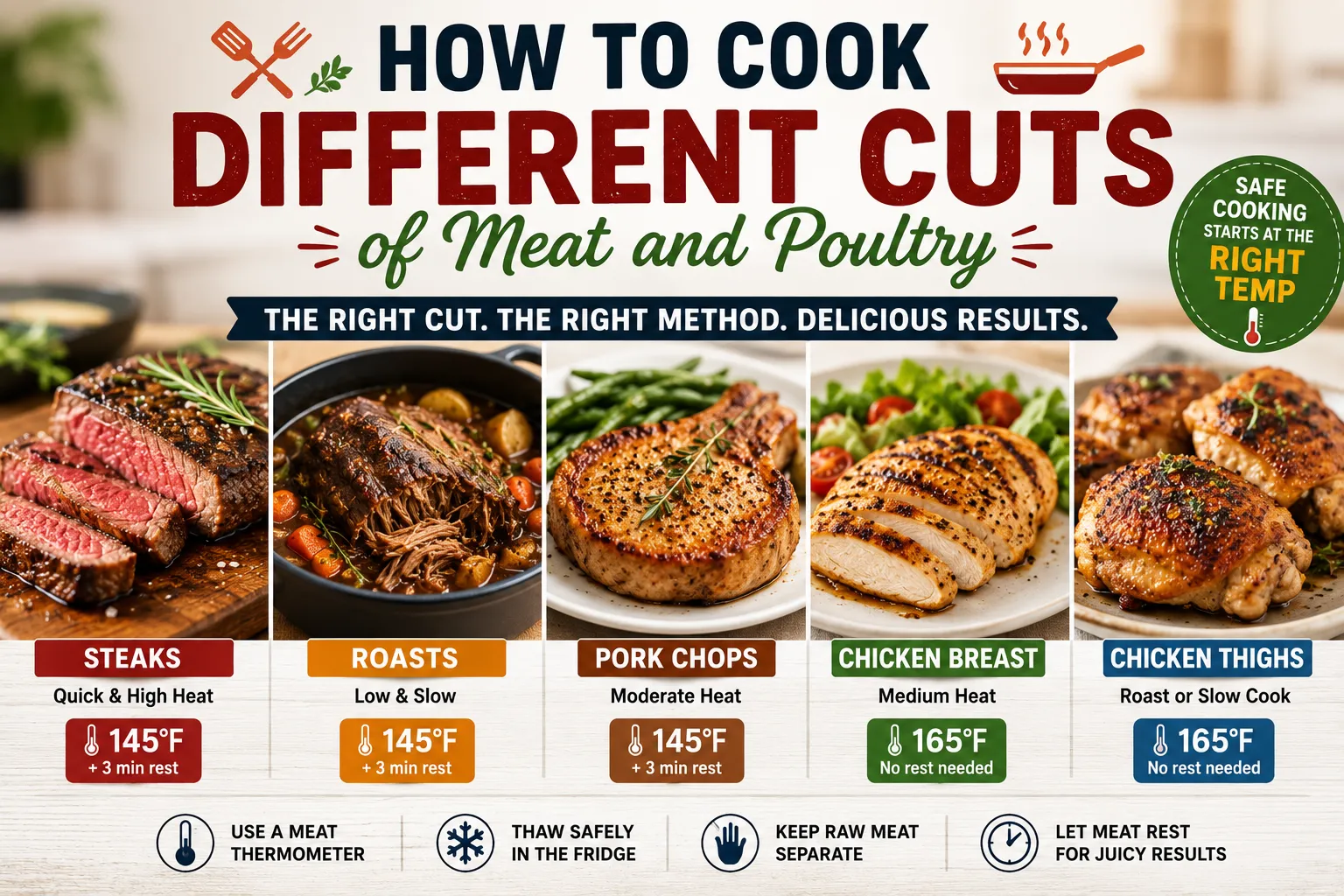
How to Cook Different Cuts of Meat and Poultry Properly
Cooking meat and poultry well is about more than simply putting food over heat and waiting until it looks done. Different cuts have different amounts of fat, muscle fibers, connective tissue, and thickness, which means they respond very differently to heat.
A tender steak can become dry when overcooked, while a tough beef chuck roast may remain chewy if cooked quickly. Chicken breast needs careful attention because it is relatively lean, while chicken thighs can benefit from longer cooking.
Understanding the relationship between the cut, the cooking method, temperature, and cooking time can help you produce meat that is both safer and more enjoyable to eat.
For a broader foundation covering essential cooking skills, techniques, ingredients, and kitchen knowledge, see the Complete Guide to Cooking for Beginners.
Why Different Cuts Need Different Cooking Methods
Not all meat is built the same way.
Some cuts come from muscles that do relatively little work. These muscles tend to be naturally tender and can often be cooked quickly using methods such as grilling, pan-searing, or broiling.
Other cuts come from muscles that work harder. They generally contain more connective tissue and can be tougher. Slow, moist cooking can gradually soften that connective tissue and produce tender results.
This creates a useful rule:
Tender cuts generally benefit from fast cooking, while tougher cuts often benefit from slow cooking.
The thickness of the cut also matters. A thin steak and a thick roast may come from the same animal but require completely different approaches.
**—
Start With the Cut of Meat
Before deciding how to cook meat, identify what you have.
Common beef cuts include:
- Ribeye
- Strip steak
- Tenderloin
- Sirloin
- Top round
- Chuck roast
- Brisket
- Short ribs
- Ground beef
Pork cuts include:
- Pork chops
- Pork tenderloin
- Pork shoulder
- Pork loin
- Ribs
- Ground pork
Lamb can include:
- Chops
- Leg
- Shoulder
- Rack
- Shank
- Ground lamb
Poultry is similarly varied:
- Chicken breast
- Chicken thighs
- Chicken wings
- Drumsticks
- Whole chicken
- Turkey breast
- Turkey legs
- Ground poultry
Knowing the cut gives you a starting point for choosing the right cooking method.
**—
Understanding Tender Cuts
Tender cuts usually require less time to become enjoyable because they contain relatively little tough connective tissue.
Examples include beef tenderloin, ribeye, strip steak, pork tenderloin, and some lamb chops.
These cuts are often best suited to relatively fast cooking.
Good methods include:
- Pan-searing
- Grilling
- Broiling
- Roasting
- Stir-frying
The goal is generally to develop a flavorful browned exterior without unnecessarily drying out the interior.
**—
How to Cook Steak Properly
Steaks are among the easiest meats to overcook because they can move from juicy to dry relatively quickly.
For a pan-seared steak, start by drying the surface with paper towels. Moisture on the exterior can interfere with browning.
Season the steak according to your recipe, then heat a suitable skillet until hot.
Place the steak in the pan and allow the surface to develop a deep brown crust before turning it.
The exact cooking time depends on:
- Thickness
- Starting temperature
- Cooking surface
- Heat level
- Desired doneness
Rather than relying entirely on a timer, use a food thermometer.
For whole cuts of beef, pork, lamb, and veal, a safe minimum internal temperature is 145°F (63°C), followed by at least a three-minute rest. This is a food-safety minimum, not a requirement that everyone must prefer the same level of doneness.
**—
How to Cook Ribeye and Other Marbled Steaks
Ribeye contains significant intramuscular fat, which can contribute to its rich flavor.
It works particularly well with:
- Grilling
- Cast-iron searing
- Broiling
- High-heat pan cooking
Allow the surface to brown properly, but avoid repeatedly moving the steak around the pan.
After cooking, let the steak rest briefly before slicing.
Resting allows the meat to settle and can reduce the amount of juice lost immediately when the steak is cut.
**—
How to Cook Tenderloin
Tenderloin is naturally tender but relatively lean compared with heavily marbled cuts.
That means it can be especially easy to overcook.
Good methods include:
- Pan-searing
- Grilling
- Roasting
- Searing followed by oven cooking
Because tenderloin does not need long cooking to soften connective tissue, prolonged high heat can work against you.
Use a thermometer rather than assuming that a particular number of minutes will always produce the same result.
**—
How to Cook Tough Beef Cuts
Cuts such as chuck roast, brisket, and beef shank contain more connective tissue.
Trying to cook these cuts like a quick steak can result in meat that remains tough.
Instead, consider:
- Braising
- Slow cooking
- Pressure cooking
- Long, low-temperature roasting
- Stewing
These methods give connective tissue time to break down.
The basic idea behind braising
Braising usually involves browning the meat first and then cooking it slowly with a relatively small amount of liquid in a covered pot.
The combination of time, moisture, and moderate heat can transform a tough cut into tender meat.
The relationship between heat, time, moisture, browning, and texture is explored in greater detail in How Cooking Temperature Affects Food and Cooking Results.
**—
How to Cook Chuck Roast
Chuck roast is particularly well suited to slow cooking.
A common approach is:
- Season the roast.
- Brown it on several sides.
- Add aromatics such as onions and garlic.
- Add an appropriate cooking liquid.
- Cover the pot.
- Cook slowly until the meat becomes tender.
- Allow it to rest before serving.
The exact cooking time depends on the size of the roast and the cooking method.
With tough cuts, tenderness is often a better indicator of readiness than simply watching the clock.
**—
How to Cook Beef Brisket
Brisket contains substantial connective tissue and is traditionally associated with long, slow cooking.
Popular methods include:
- Smoking
- Slow roasting
- Braising
When smoking brisket, maintaining stable cooking conditions is important.
Completely thaw meat before smoking and use a food thermometer to verify that the meat reaches a safe internal temperature.
Brisket also benefits from adequate resting time before slicing.
When slicing, cut across the grain to make the meat easier to chew.
**—
How to Cook Short Ribs
Short ribs can be prepared using either dry or moist cooking methods depending on the cut and recipe.
For particularly tough short ribs, braising is a popular choice.
The ribs can be browned first and then slowly cooked with stock, wine, tomatoes, or another flavorful liquid.
The long cooking process allows connective tissue to soften while the cooking liquid helps keep the dish moist.
**—
How to Cook Ground Meat Properly
Ground meat requires special attention because grinding distributes material throughout the meat rather than leaving it primarily on the surface.
Ground beef, pork, lamb, and veal should reach 160°F (71°C) internally.
Ground poultry should reach 165°F (74°C).
Do not rely solely on color.
Ground meat can brown before it reaches a safe internal temperature, so a food thermometer is the more reliable method.
**—
How to Cook Pork Chops
Pork chops are relatively quick to cook, but their lean nature means they can become dry if exposed to excessive heat for too long.
Pan-searing and grilling are popular methods.
A basic approach is:
- Pat the chops dry.
- Season them.
- Heat the cooking surface.
- Sear both sides.
- Check the thickest part with a thermometer.
- Remove from the heat once the safe temperature is reached.
- Rest before serving.
A safe minimum internal temperature for pork steaks, chops, and roasts is 145°F (63°C), followed by at least three minutes of rest.
**—
How to Cook Pork Tenderloin
Pork tenderloin is lean and naturally tender.
It can be:
- Roasted
- Grilled
- Pan-seared
- Sliced into medallions
Because it is relatively lean, avoid treating it like a tough pork shoulder.
Long, unnecessary cooking can cause it to lose moisture.
A thermometer is particularly useful for determining when it has reached the recommended safe temperature.
**—
How to Cook Pork Shoulder
Pork shoulder is almost the opposite of pork tenderloin.
It contains more fat and connective tissue and is particularly well suited to slow cooking.
Popular methods include:
- Smoking
- Braising
- Slow roasting
- Slow cooking
The long cooking period allows connective tissue to soften.
This is why pork shoulder is commonly used for pulled pork.
Rather than rushing the process, give the cut enough time to become tender.
**—
How to Cook Pork Ribs
Ribs benefit from cooking methods that allow connective tissue to soften gradually.
Depending on the style, they can be:
- Smoked
- Baked
- Braised
- Grilled after slow cooking
One useful approach is to cook the ribs gently first and finish them over higher heat to develop a browned exterior and sauce.
Avoid applying sugary sauces too early over very high heat because they can burn before the meat is ready.
**—
How to Cook Lamb Chops
Lamb chops are generally tender enough for relatively fast cooking.
Good options include:
- Grilling
- Pan-searing
- Broiling
Because chops vary considerably in thickness, use their size and a thermometer rather than relying on a fixed cooking time.
Herbs such as rosemary, thyme, garlic, and mint can complement lamb particularly well.
For more guidance on building flavor with herbs, spices, salt, and other ingredients, see How to Season Food With Herbs, Spices, Salt and Other Flavors.
**—
How to Cook Lamb Shoulder
Lamb shoulder contains more connective tissue than lamb chops.
It can benefit from:
- Slow roasting
- Braising
- Slow cooking
Cooking it slowly allows connective tissue to soften and gives the meat time to develop deeper flavor.
A covered cooking environment can help prevent excessive moisture loss.
**—
How to Cook Chicken Breast
Chicken breast is lean and relatively easy to dry out.
Common cooking methods include:
- Baking
- Grilling
- Pan-searing
- Poaching
- Air frying
The most important principle is to avoid cooking it far beyond the temperature needed for safety.
All poultry, including chicken breast, should reach 165°F (74°C) internally.
Insert the thermometer into the thickest portion of the breast, avoiding bone.
If the breast is particularly thick, consider pounding it to a more even thickness before cooking. This can help it cook more evenly.
**—
How to Cook Chicken Thighs
Chicken thighs contain more fat and connective tissue than breast meat.
They are generally more forgiving during cooking.
They can be:
- Roasted
- Braised
- Grilled
- Pan-seared
- Slow-cooked
Chicken thighs still need to reach 165°F (74°C) for food safety.
For crispy skin, dry the skin before cooking and give it sufficient exposure to heat.
**—
How to Cook Chicken Wings
Chicken wings are commonly roasted, grilled, fried, or air-fried.
For crispiness, moisture management is important.
Pat the wings dry before seasoning and avoid overcrowding the cooking surface.
Air circulation around the pieces helps promote browning.
Regardless of cooking method, poultry should reach a minimum internal temperature of 165°F (74°C).
**—
How to Cook Chicken Drumsticks
Drumsticks are well suited to roasting and grilling.
Their relatively high amount of connective tissue means they can tolerate longer cooking than lean chicken breast.
Popular approaches include:
- Oven roasting
- Grilling
- Braising
- Air frying
Cook until the thickest portion reaches the safe minimum temperature, avoiding contact between the thermometer probe and the bone.
**—
How to Cook a Whole Chicken
Cooking a whole chicken requires attention to different parts of the bird.
The breast can cook faster than the thighs, while the interior cavity takes longer to heat.
For a whole bird, check the innermost part of the thigh and wing and the thickest part of the breast, avoiding bone. All should reach 165°F (74°C).
Roasting is one of the simplest methods.
For more even cooking, make sure the chicken is completely thawed before roasting.
If stuffing poultry, the stuffing itself must also reach 165°F (74°C).
**—
How to Cook Turkey Properly
Turkey can be cooked whole or in separate parts.
Turkey breast is relatively lean and can become dry when overcooked, while legs and thighs contain more connective tissue.
For whole turkey, use a thermometer to check several appropriate locations rather than relying on appearance alone.
A safe minimum internal temperature for poultry, including turkey, is 165°F (74°C).
For large poultry, an oven temperature of at least 325°F (163°C) is commonly recommended for roasting.
**—
Choosing the Right Cooking Method
A simple way to select a method is to consider tenderness.
| Cut Type | Examples | Good Cooking Methods |
|---|---|---|
| Tender beef | Ribeye, tenderloin, strip steak | Grilling, searing, broiling |
| Tough beef | Chuck, brisket, shank | Braising, slow cooking, smoking |
| Tender pork | Tenderloin, loin chops | Roasting, grilling, searing |
| Tough pork | Shoulder, ribs | Slow cooking, smoking, braising |
| Tender lamb | Chops, rack | Grilling, searing, roasting |
| Tough lamb | Shoulder, shank | Braising, slow roasting |
| Lean poultry | Chicken breast, turkey breast | Roasting, grilling, pan-searing |
| Dark poultry | Thighs, legs, wings | Roasting, grilling, braising, frying |
| Ground meat | Beef, pork, lamb | Pan-frying, grilling, baking |
| Ground poultry | Chicken, turkey | Pan-frying, baking, grilling |
This is a starting point rather than a rigid rule.
**—
Why Browning Improves Meat
Browning creates many of the flavors associated with well-cooked meat.
When the surface becomes sufficiently hot and dry, chemical reactions contribute to the development of a browned crust and more complex flavors.
This is why drying meat before searing can make a difference.
If the surface is covered with excess moisture, some of the available heat is used to evaporate that water rather than rapidly browning the meat.
For this reason, avoid overcrowding a pan when searing multiple pieces.
**—
Avoid Overcrowding the Pan
Putting too much meat into a pan at once can reduce surface temperature.
Instead of quickly browning, the meat may release moisture and begin to steam.
If you have a large amount to cook, work in batches.
Give each piece enough room for heat to circulate and for moisture to escape.
This is especially important when cooking:
- Steak pieces
- Chicken pieces
- Ground meat
- Stir-fry strips
- Pork chops
**—
Let Meat Rest After Cooking
Resting is an important final step.
For beef, pork, lamb, and veal steaks, chops, and roasts, a safe cooking process includes reaching 145°F (63°C) and allowing at least three minutes of rest.
The appropriate resting period can vary depending on the size of the cut.
Large roasts generally benefit from more resting time than thin pieces.
Avoid immediately slicing into a large roast simply because it has reached the target temperature.
**—
Use a Food Thermometer Instead of Guesswork
A food thermometer is one of the most useful tools for cooking meat safely.
It is particularly valuable when:
- Cooking thick cuts
- Roasting whole poultry
- Cooking ground meat
- Preparing large roasts
- Trying a new recipe
- Using unfamiliar cooking equipment
Insert the thermometer into the thickest portion of the food without touching bone, fat, or gristle.
For thin hamburger patties or similar pieces, inserting the thermometer from the side can help the probe reach the center.
**—
Don’t Judge Meat Safety by Color Alone
Color can be misleading.
Meat may remain pink after reaching a safe temperature, while other meat can brown before reaching the recommended temperature.
Color and juice appearance should not be used as the sole indicators of doneness.
A thermometer provides much more useful information.
**—
Thaw Meat Safely Before Cooking
Frozen meat should be thawed safely before cooking when the recipe calls for fully thawed meat.
The refrigerator is one of the safest methods because it keeps the food cold while it gradually thaws.
For faster thawing, cold-water thawing in a leak-proof package or microwave thawing followed by immediate cooking can also be used.
Never rely on leaving raw meat or poultry sitting at room temperature to thaw.
**—
Keep Raw and Cooked Meat Separate
Cross-contamination can undermine otherwise careful cooking.
Use separate clean plates and utensils for cooked meat and raw meat.
Wash hands, cutting boards, knives, and work surfaces after handling raw meat and poultry.
Keep raw meat and poultry away from other foods during preparation.
Never place cooked meat on a plate that previously held raw meat unless the plate has been properly washed.
**—
Marinate Meat Safely
Marinades can add flavor and sometimes help tenderize certain cuts.
Always marinate meat and poultry in the refrigerator rather than on the counter.
If you want to use the marinade as a sauce after it has contacted raw meat, do not simply pour it over cooked food.
Reserve some marinade separately before adding the raw meat, or properly boil the used marinade before using it as a sauce.
**—
Common Meat-Cooking Mistakes
Even experienced home cooks can run into problems.
Cooking every cut the same way
A steak and a chuck roast need very different treatment.
Using time instead of temperature
Cooking time varies with thickness, equipment, and starting temperature.
Overcooking lean meat
Chicken breast and pork tenderloin can become dry when cooked excessively.
Undercooking ground meat
Ground meat requires a higher minimum internal temperature than whole cuts.
Cutting immediately after cooking
Resting can improve the eating quality of many larger cuts.
Overcrowding the pan
Too much food can prevent proper browning.
Cooking straight from an unsafe thaw
Thaw meat using a safe method rather than leaving it at room temperature.
Relying on appearance
Color alone is not a reliable food-safety test.
**—
A Simple Method for Cooking Any New Cut
When you encounter an unfamiliar cut, follow a basic process.
Step 1: Identify the cut
Determine whether it is tender, tough, lean, fatty, thin, or thick.
Step 2: Choose an appropriate method
Fast cooking generally suits tender cuts, while tougher cuts often need longer cooking.
Step 3: Prepare the surface
Pat meat dry when appropriate and season according to the recipe.
Step 4: Control the heat
Use enough heat to brown when browning is desired, but avoid excessive heat that burns the exterior before the center is ready.
Step 5: Check the internal temperature
Use a food thermometer in the thickest appropriate portion.
Step 6: Rest when appropriate
Give the meat time to rest before slicing or serving.
Step 7: Slice correctly
For many larger cuts, slicing across the grain can make the meat easier to chew.
**—
The Right Cut Makes Cooking Easier
Learning how to cook meat properly becomes much easier once you stop treating every cut as though it were the same.
Tender steaks generally reward high-heat, relatively quick cooking. Tough cuts such as chuck, brisket, and shoulder often become better with time and controlled low-temperature cooking. Lean poultry requires careful temperature control, while darker poultry cuts can tolerate longer cooking.
Most importantly, cooking technique and food safety should work together.
Use the appropriate cooking method for the cut, avoid cross-contamination, thaw meat safely, and use a food thermometer rather than relying on appearance alone. For whole cuts of beef, pork, lamb, and veal, 145°F (63°C) with at least a three-minute rest is a common food-safety minimum; ground beef, pork, lamb, and veal should reach 160°F (71°C), while all poultry should reach 165°F (74°C).
Turning Different Cuts Into Better Meals
The biggest improvement most home cooks can make is to match the cut to the cooking method.
Instead of asking only, “How long should I cook this?”, ask:
What kind of cut is this, how much connective tissue does it contain, how thick is it, and what cooking method will bring out its best qualities?
Once you understand those questions, recipes become easier to adapt. A tough cut no longer needs to be frustratingly chewy, a lean chicken breast does not have to become dry, and a good steak does not have to be overcooked simply because you are unsure when it is ready.
Good meat cookery is ultimately a combination of heat, time, technique, and temperature control—with the right approach for the particular cut on your plate.