How to Determine How Much House You Can Afford
How to Determine How Much House You Can Afford
Buying a home is one of the largest financial decisions most people make. It is easy to start with the question, “How much will a lender approve me for?”
A better question is:
“How much can I comfortably afford without putting the rest of my financial life under pressure?”
Those two numbers can be very different.
Mortgage lenders evaluate income, debts, credit history, down payment and other factors to determine how much they may be willing to lend. But a lender does not necessarily know about every financial priority in your life, such as saving for retirement, supporting children, paying for education, building an emergency fund or preparing for major future expenses.
A broader understanding of how mortgages work can help you put those numbers into context. For a comprehensive overview, see the Mortgage Explained guide.
Determining an affordable home price therefore requires looking beyond the listing price and mortgage payment.
You need to consider your income, existing debts, down payment, interest rate, taxes, insurance, maintenance, utilities, closing costs, savings and the financial flexibility you want to preserve after becoming a homeowner.
What Does “Affordable” Really Mean?
A home is affordable when its costs fit comfortably within your overall financial situation.
That means being able to pay for the home while still having enough money for:
- Food
- Transportation
- Utilities
- Healthcare
- Insurance
- Childcare
- Debt payments
- Retirement savings
- Emergency savings
- Travel and entertainment
- Home maintenance
- Unexpected expenses
Affordability is therefore personal.
Two households with identical incomes may have completely different affordable home prices if one has significant student loans, childcare expenses and car payments while the other has very little debt.
Don’t Confuse Loan Qualification With Affordability
A lender’s approval amount is useful, but it should not automatically become your house-hunting budget.
Lenders primarily evaluate whether you meet their underwriting requirements and can repay the proposed loan. Your personal financial goals may not be fully reflected in that calculation.
How much you qualify to borrow is different from how much you can comfortably afford to repay.
If a lender says you qualify for a $500,000 mortgage, that does not mean buying a $500,000 home is necessarily the right decision.
You might decide that $400,000—or even $350,000—leaves you with a healthier financial cushion.
Start With Your Monthly Income
The first step is understanding how much money comes into your household.
For affordability calculations, lenders generally look at gross income, meaning income before taxes and other deductions.
Your personal budget should also examine take-home income, because that is the money actually available to pay for everyday living.
If your household earns $10,000 per month before taxes, that does not mean you have $10,000 available to spend.
Taxes, retirement contributions, health insurance and other deductions reduce the amount that reaches your bank account.
This is why both lender calculations and personal budgeting matter.
Calculate Your Existing Monthly Debt
Next, list your recurring debt payments.
These might include:
- Car loans
- Student loans
- Credit card payments
- Personal loans
- Child support
- Other installment debts
Debt-to-income ratio, or DTI, is calculated by dividing monthly debt payments by gross monthly income. Different lenders and loan products can have different DTI limits.
For example, suppose you earn $8,000 per month before taxes and have $1,600 in qualifying monthly debt payments.
Your DTI would be:
$1,600 ÷ $8,000 × 100 = 20%
Once the proposed housing payment is added, your total DTI will increase.
Understand the 28% Housing Rule
A commonly used mortgage affordability guideline is to keep the total monthly home payment around 28% or less of gross monthly income.
For example, if your household earns $8,000 per month before taxes:
$8,000 × 28% = $2,240
That would give you a rough target of $2,240 for the total monthly home payment.
But this is a guideline, not a universal law.
Your actual affordable payment may need to be lower if you have significant expenses or financial goals.
Consider the 36% Debt Guideline
Another commonly referenced guideline is keeping total monthly debt obligations below roughly 36% of gross income.
Many lenders use guidelines around 30% for housing expenses and 36% for total debt, although actual underwriting standards vary.
The important point is that these ratios are lending guidelines, not personal financial targets.
A household may technically qualify at a higher ratio but still find the resulting payment uncomfortable.
Calculate the Full Monthly Housing Cost
One of the biggest mistakes prospective buyers make is looking only at principal and interest.
Your actual housing cost can include:
- Mortgage principal
- Mortgage interest
- Property taxes
- Homeowners insurance
- Mortgage insurance
- HOA fees
- Flood insurance where applicable
- Other property-specific costs
A house with a lower purchase price can therefore have a higher monthly cost than another property if taxes, insurance or association fees are substantially higher.
Principal and Interest Are Only Part of the Payment
Suppose your mortgage principal and interest would be $1,800 per month.
That does not necessarily mean your housing budget is $1,800.
Imagine the property also requires:
- $300 property tax
- $150 homeowners insurance
- $100 HOA fee
- $75 mortgage insurance
Your actual monthly housing expense would be:
$1,800 + $300 + $150 + $100 + $75 = $2,425
That difference can significantly change how much house you can comfortably afford.
Your Down Payment Matters
The amount you put down affects the size of your mortgage.
Suppose you purchase a $400,000 home.
With a $40,000 down payment:
$400,000 − $40,000 = $360,000 mortgage
With an $80,000 down payment:
$400,000 − $80,000 = $320,000 mortgage
The second borrower has a smaller loan and therefore generally has lower principal and interest payments, assuming comparable loan terms.
A larger down payment can also affect loan-to-value ratio and mortgage insurance requirements.
But putting more money down is not automatically better.
You should avoid draining your savings simply to increase the down payment.
Don’t Empty Your Savings to Buy a House
Buying a home requires more cash than the down payment alone.
You may also need money for:
- Closing costs
- Moving
- Furniture
- Appliances
- Immediate repairs
- Home improvements
- Emergency expenses
Maintaining savings for emergencies and other financial priorities is an important part of responsible homebuying.
A homeowner with a large down payment but almost no cash savings can be financially vulnerable when an unexpected repair arrives.
Account for Closing Costs
Closing costs can include a range of expenses associated with obtaining and completing a mortgage and purchasing a property.
Depending on the transaction, they may include:
- Loan origination fees
- Appraisal fees
- Credit-related fees
- Recording charges
- Title-related expenses
- Prepaid taxes
- Insurance
- Other settlement costs
Closing costs often represent a meaningful percentage of the purchase price, although the actual amount varies by transaction and location.
On a $400,000 home, a 2%–5% range would represent approximately:
- 2% = $8,000
- 5% = $20,000
These costs are separate from your down payment.
Don’t Forget Moving Costs
Moving into a home can create a surprisingly large collection of expenses.
You may need to pay for:
- Movers
- Transportation
- New furniture
- Curtains and blinds
- Appliances
- Locks
- Cleaning
- Basic tools
- Immediate repairs
Some expenses will be optional, but others can arrive immediately.
Build them into your homebuying budget rather than assuming the purchase price is the end of the spending.
Estimate Your Mortgage Payment
Once you know how much you can comfortably allocate to housing, you can work backward to estimate the home price.
The basic mortgage payment calculation depends on:
- Loan amount
- Interest rate
- Loan term
A mortgage calculator can help determine the loan amount associated with a monthly principal-and-interest payment you can afford, after which you can add your down payment to estimate an affordable home price.
This is more useful than starting with a home price and simply asking whether a lender will approve it.
Interest Rates Can Dramatically Change Affordability
Mortgage interest rates have a major impact on monthly payments.
Consider two identical loans with different interest rates.
The higher-rate loan will generally require a higher monthly principal-and-interest payment.
That means the same household income can support different home prices depending on the mortgage rate available at the time of purchase.
This is why affordability calculations should use a realistic interest-rate assumption rather than relying on an unusually low promotional rate.
Compare Different Mortgage Terms Carefully
A longer mortgage term can reduce the monthly payment while increasing the amount of interest paid over the life of the loan.
A shorter term can increase the monthly payment but may reduce total interest costs.
For example, a buyer might compare:
- 30-year fixed mortgage
- 15-year fixed mortgage
- Other available loan structures
The right choice depends on income, goals, risk tolerance and the specific loan terms.
Do not choose a mortgage solely because it produces the smallest monthly payment.
Fixed and Adjustable Rates Are Different
A fixed-rate mortgage generally keeps the interest rate unchanged according to the loan’s terms.
An adjustable-rate mortgage can change under specified conditions.
That means borrowers considering an adjustable-rate loan need to understand not only the initial payment but also how future payments could change.
If your budget is already tight, uncertainty around future payments deserves particular attention.
Property Taxes Can Change Your Budget
Property taxes can vary significantly from one location to another.
Two homes with identical purchase prices can therefore have very different monthly ownership costs.
Taxes can also change over time.
When estimating affordability, use the actual or reasonably estimated tax burden for the specific property rather than relying on a generic percentage.
Homeowners Insurance Matters Too
Insurance premiums are another recurring expense.
The cost can depend on factors such as:
- Location
- Property value
- Construction
- Coverage
- Claims history
- Weather and disaster risks
This is particularly important in areas exposed to flooding, hurricanes, wildfires or other natural hazards.
For a deeper look at how this expense fits into the overall cost of owning a home, the Ultimate Homeowners Insurance Guide provides additional context.
HOA Fees Can Change the Equation
If the property is part of a homeowners association, HOA fees need to be included in the budget.
These fees can pay for things such as:
- Common-area maintenance
- Landscaping
- Trash services
- Shared amenities
- Building maintenance in some communities
HOA fees can increase over time and are typically the homeowner’s responsibility.
Do not assume that a low monthly mortgage payment means the property is inexpensive to own.
Budget for Maintenance
Homeownership transfers many repair responsibilities from a landlord to you.
You may eventually need to pay for:
- Roof repairs
- Plumbing
- Electrical work
- HVAC maintenance
- Appliance replacement
- Pest control
- Landscaping
- Painting
- Gutter maintenance
Routine maintenance and savings for major repairs and replacements should therefore be part of your affordability calculation.
A home with an aging roof or HVAC system may require a larger maintenance reserve than a newer property.
Utilities Can Be Surprisingly Important
Utilities are not always included in mortgage affordability calculations.
Consider:
- Electricity
- Gas
- Water
- Sewer
- Trash
- Internet
- Heating
- Cooling
A large home may have significantly higher utility costs than a smaller property.
Energy efficiency can therefore affect affordability beyond the purchase price.
Consider the Home’s Condition
Two houses listed for the same price can have very different financial implications.
One might have:
- A newer roof
- Updated plumbing
- Modern electrical systems
- Efficient windows
- A newer HVAC system
The other might need:
- Roof replacement
- Foundation work
- Plumbing repairs
- Electrical upgrades
- New appliances
The second home may appear affordable based on its purchase price but become much more expensive after necessary repairs.
A Home Inspection Can Protect Your Budget
A professional home inspection can identify potential problems before you commit to the purchase.
An inspection does not guarantee that every future repair will be discovered.
But it can reveal issues that may materially affect the decision.
Depending on the property, inspectors may examine areas such as:
- Roof
- Foundation
- Structure
- Plumbing
- Electrical systems
- HVAC
- Windows
- Drainage
The findings can help you estimate future costs and negotiate where appropriate.
For a more detailed look at the process, see the Home Inspection Guide: What Buyers Need to Check.
Think About Your Emergency Fund
A homeowner should ideally have cash available for expenses that cannot be predicted precisely.
Examples include:
- Job loss
- Medical expenses
- Major repairs
- Insurance deductibles
- Emergency travel
- Unexpected family expenses
Continuing to prioritize emergency savings after buying a home is important.
If buying a particular house would leave you with almost no emergency savings, the property may be too expensive even if the mortgage payment technically fits within a lender’s limits.
Don’t Sacrifice Retirement Savings
Homeownership can be an important financial goal, but it should not necessarily consume every other financial priority.
If buying a larger home requires you to stop retirement contributions for years, compare the long-term consequences.
A smaller home may provide more flexibility to continue building wealth elsewhere.
Affordability should therefore be considered as part of your entire financial plan.
Think About Future Expenses
Your financial situation may change after buying the home.
Possible future costs include:
- Children
- Childcare
- Education
- New vehicles
- Career changes
- Medical expenses
- Supporting family members
- Relocation
- Major home improvements
A mortgage that is manageable today may become stressful if your expenses increase substantially.
Leave Room for Lifestyle Spending
A budget that leaves no room for enjoyable activities can become difficult to maintain.
Homeownership should not necessarily mean eliminating:
- Vacations
- Dining out
- Hobbies
- Entertainment
- Gifts
- Social activities
These expenses are discretionary, but they are still part of real life.
If your mortgage consumes nearly every available dollar, you may find that the home is technically affordable but practically restrictive.
Consider Income Stability
The reliability of your income matters as much as the amount.
Someone with a stable salary may have a different risk profile from someone whose income depends heavily on commissions, freelance contracts, seasonal work or business profits.
Before taking on a large mortgage, consider how the payment would work if your income temporarily declined.
A conservative budget provides more protection against unexpected changes.
Use the “What If?” Test
One useful way to test affordability is to stress-test your budget.
Ask:
What if my income falls for six months?
What if property taxes rise?
What if insurance becomes more expensive?
What if the roof needs replacing?
What if I need a new car?
What if childcare costs increase?
You do not need to predict the future perfectly.
You are testing whether the home leaves enough financial flexibility to absorb reasonable shocks.
Compare Multiple Homes at the Same Price
A home’s purchase price does not tell the whole story.
Suppose two properties both cost $400,000.
Home A
- Lower property taxes
- Lower insurance
- No HOA
- New roof
- Efficient appliances
Home B
- Higher property taxes
- HOA fee
- Older roof
- Older HVAC
- Higher insurance
Home A could be considerably cheaper to own despite having the same purchase price.
This is why affordability should be evaluated at the property level, not just the listing-price level.
Location Can Affect Affordability
Location influences more than the purchase price.
It can affect:
- Property taxes
- Insurance
- Transportation
- Utilities
- School-related expenses
- HOA costs
- Commuting
- Maintenance
- Future resale value
A cheaper home farther from work may create higher transportation costs.
A more expensive home closer to work might reduce commuting expenses.
When comparing potential properties, it can also help to consider how to choose the best location when buying a house rather than evaluating price alone.
The right comparison is therefore the total cost of the lifestyle, not just the mortgage.
Consider Transportation Costs
Housing and transportation are closely connected.
A home with a lower mortgage may require:
- Two vehicles
- Longer commutes
- More fuel
- More maintenance
- Higher insurance
A more expensive property in a location that allows shorter commutes or easier access to public transportation may have a different overall financial profile.
When evaluating affordability, consider both the home and how you will live around it.
Don’t Rely on the “Income Multiplier” Alone
Some homebuying guides use a rough rule such as multiplying annual income by 2.5 to estimate a possible home price.
This can be a rough starting point, but debt, credit history, interest rates and other factors affect actual affordability.
For example, an annual gross income of $100,000 multiplied by 2.5 produces:
$100,000 × 2.5 = $250,000
But this should not be treated as a universal affordability formula.
A household with substantial savings and minimal debt may have a different affordable price than a household earning the same amount while carrying significant monthly obligations.
Your Credit Score Can Affect Affordability
Credit history can influence both mortgage eligibility and loan pricing.
A stronger credit profile may provide access to more favorable loan terms, depending on the lender and loan program.
That matters because a lower interest rate can reduce the monthly payment associated with a given loan amount.
If you are several months away from buying, improving your credit profile and avoiding unnecessary new debt may help your mortgage options.
Avoid Taking on New Debt Before Buying
Large purchases before closing can complicate your mortgage application.
Examples include:
- New cars
- Large credit-card balances
- Personal loans
- New financing accounts
New debt can change your DTI and potentially affect loan qualification.
If you are preparing to buy, discuss major financial changes with your mortgage professional before taking on significant new obligations.
Determine Your Maximum Comfortable Payment First
Rather than starting with:
“What home price can I afford?”
start with:
“What total monthly housing payment would I be comfortable making?”
Suppose you decide that $2,500 is the maximum payment that still allows you to:
- Save regularly
- Pay existing debts
- Cover everyday expenses
- Maintain an emergency fund
- Handle maintenance
- Enjoy your lifestyle
You can then subtract estimated taxes, insurance, HOA fees and mortgage insurance.
What remains is the amount available for principal and interest.
From there, a mortgage calculator can help estimate the corresponding loan amount.
This approach is much more grounded in your actual financial life.
A Simple Affordability Example
Imagine a household with:
- Gross monthly income: $8,000
- Existing monthly debt: $700
- Comfortable total housing budget: $2,300
- Down payment: $60,000
Suppose the estimated monthly property taxes, homeowners insurance and other housing costs total $450.
That leaves:
$2,300 − $450 = $1,850
for principal and interest.
The buyer can then use a mortgage calculator with the expected interest rate and loan term to estimate the mortgage amount corresponding to a $1,850 principal-and-interest payment.
Add the $60,000 down payment to that estimated loan amount to establish a preliminary home-price range.
This is a more useful process than simply asking a lender for the largest possible loan.
Build Three Numbers Instead of One
Rather than having a single “maximum home price,” consider establishing three numbers:
Comfortable Price
The price that fits easily within your budget.
Stretch Price
A price that is manageable but requires careful budgeting.
Absolute Ceiling
The maximum price you will not exceed.
Your actual house search should generally focus closer to the comfortable range than the absolute ceiling.
This provides room for negotiation, unexpected costs and changes in your financial circumstances.
Don’t Forget Future Home Improvements
Many buyers purchase a home expecting to make changes.
Potential projects include:
- Kitchen renovations
- Bathroom upgrades
- Flooring
- Painting
- Landscaping
- Fencing
- Energy improvements
- Security systems
If you know you will want significant improvements, reserve money for them.
A home that consumes your entire budget at purchase may leave you unable to make necessary improvements later.
Consider the Cost of Waiting
Affordability is not only about whether you can buy today.
There can also be financial consequences to waiting.
Home prices, mortgage rates, rent, income and savings can all change.
However, trying to predict the housing market perfectly is extremely difficult.
A better strategy is to buy when the combination of your financial readiness, housing needs and available financing makes sense for you—not simply because you are afraid prices might rise.
Rent vs. Buy Is a Separate Question
Determining how much house you can afford does not automatically mean buying is the right choice.
You should also consider:
- How long you expect to stay
- Local rent levels
- Transaction costs
- Maintenance responsibilities
- Career flexibility
- Savings
- Job stability
- Lifestyle preferences
Buying generally involves substantial transaction costs, so someone who expects to move again soon may have different considerations from someone planning to stay for many years.
Don’t Let a Beautiful House Set Your Budget
One of the easiest mistakes is touring expensive homes before establishing an affordable price range.
Once you see a larger kitchen, better finishes, extra bedrooms and a beautiful yard, a cheaper property can suddenly feel inadequate.
Set your financial boundaries first.
Then shop within them.
Your budget should determine which homes you consider—not the other way around.
Use Mortgage Preapproval as a Reality Check
Once you have created your personal budget, mortgage preapproval can help establish what lenders are willing to offer.
It can also identify potential problems with:
- Credit
- Income documentation
- Debt
- Down payment
- Loan eligibility
But remember that preapproval is not a command to spend the full amount.
If your lender approves $450,000 and your personal budget says $375,000 is more comfortable, your budget should remain the stronger constraint.
Ask for a Loan Estimate
When comparing mortgage offers, review the loan terms carefully.
Look beyond the advertised interest rate.
Consider:
- Loan amount
- Interest rate
- APR
- Monthly payment
- Closing costs
- Points
- Mortgage insurance
- Prepayment terms
- Fixed or adjustable rate
- Other fees
A slightly lower interest rate does not necessarily mean a better overall loan if it comes with substantially higher upfront costs.
Recalculate When the Numbers Change
Affordability calculations should be revisited as you learn more.
For example, update your estimate when you know:
- Your actual mortgage rate
- Property taxes
- Insurance costs
- HOA fees
- Down payment amount
- Closing costs
- Loan terms
Home-price affordability is an estimate that should be refined as better information becomes available.
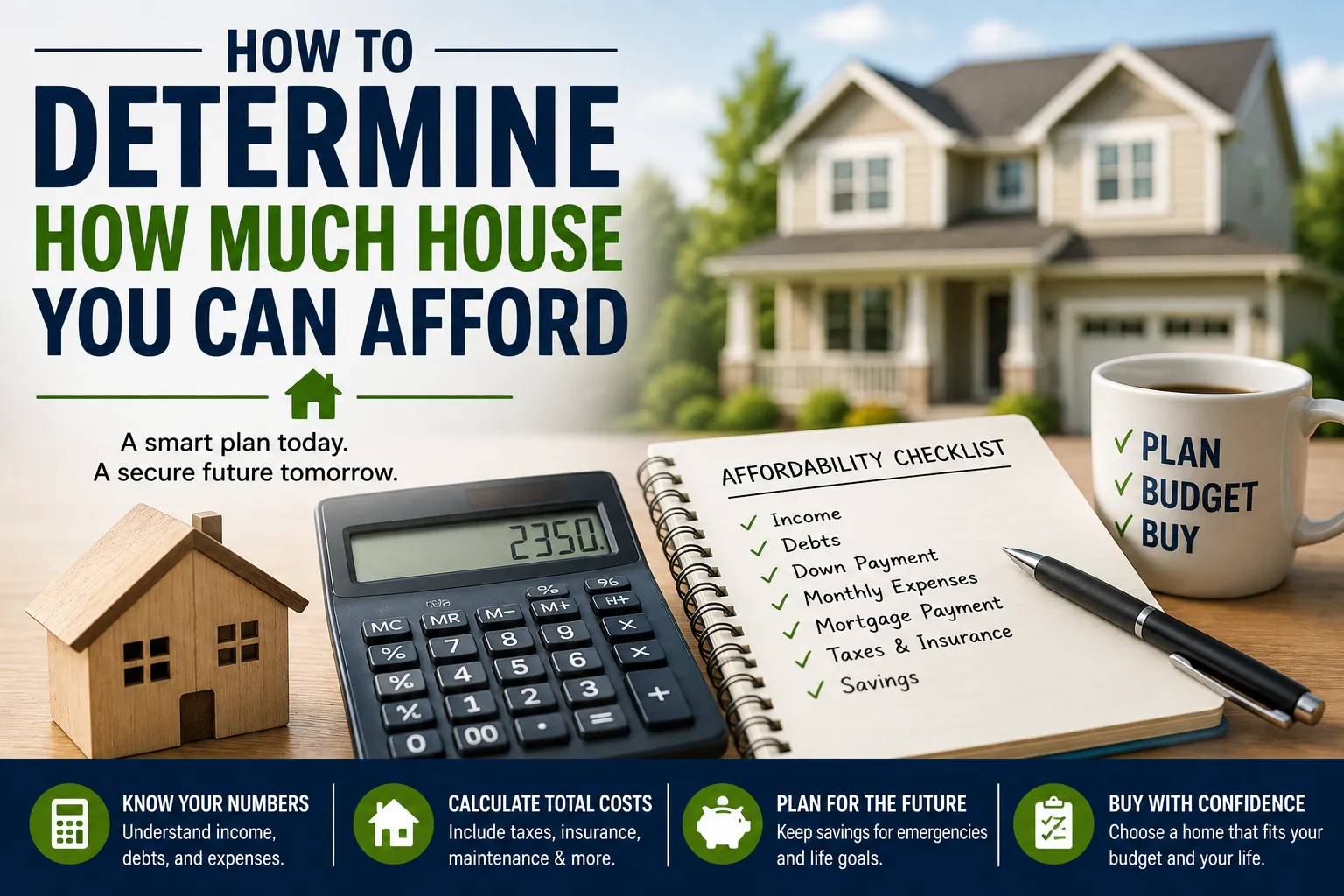
A Home Affordability Checklist
Before making an offer, ask yourself:
Income
- Is my income stable?
- What is my gross monthly income?
- What is my actual take-home pay?
Debt
- How much do I owe each month?
- What will my total DTI look like after buying?
Cash
- How much can I put down?
- How much will remain after closing?
- Do I have an emergency fund?
Housing
- What will principal and interest cost?
- How much are property taxes?
- How much is homeowners insurance?
- Is there mortgage insurance?
- Is there an HOA?
Maintenance
- How old are the roof and HVAC system?
- What repairs may be needed?
- How much should I reserve for maintenance?
Lifestyle
- Can I continue saving?
- Can I afford transportation?
- Will I have money for family and personal priorities?
- What happens if my income temporarily falls?
If the answers make you uncomfortable, the house may be too expensive.
The Goal Is Financial Breathing Room
Buying the largest house a lender will approve can create a very different experience from buying a house that comfortably fits your life.
A manageable mortgage leaves room for savings, maintenance, emergencies and unexpected changes.
It also gives you flexibility.
You may be able to continue investing, travel, change jobs, support family members or handle a major repair without immediately turning to debt.
That flexibility has real financial value.
How to Know When a House Is Truly Affordable
The right home price is ultimately determined by more than your salary or a lender’s approval letter.
Start with your comfortable monthly payment, not the maximum loan amount.
Then account for the entire cost of ownership:
- Principal
- Interest
- Taxes
- Insurance
- Mortgage insurance
- HOA fees
- Utilities
- Maintenance
- Repairs
Next, make sure the purchase leaves enough money for an emergency fund and your other financial priorities.
Use mortgage calculators and lender estimates to refine the numbers, but treat affordability guidelines as starting points rather than absolute rules.
Most importantly, leave yourself some breathing room.
The best home you can afford is not the most expensive house a lender will finance. It is the home you can comfortably own while continuing to build savings, handle unexpected expenses and live the rest of your financial life without feeling trapped by the mortgage.