Lowe's Earnings Could Reveal Where Homeowners Are Still Spending—and Where They're Not
Lowe’s Earnings Could Reveal Where Homeowners Are Still Spending—and Where They’re Not
For homeowners trying to decide whether to tackle a renovation, replace an aging appliance or simply postpone a major project, the latest results from Lowe’s Companies could offer an unusually useful snapshot of household spending.
Lowe’s is scheduled to report its second-quarter fiscal 2026 results on Wednesday, August 19, making the company one of the week’s most closely watched retailers. Analysts are currently expecting roughly $4.26 in earnings per share and $26.27 billion in revenue, according to current earnings estimates.
The numbers will matter to investors, but they could also tell homeowners something more practical: which types of home projects people are still willing to pay for when budgets are under pressure—and which projects they are putting off.
That distinction is becoming increasingly important as mortgage rates remain elevated, housing activity stays relatively subdued and consumers become more selective about large discretionary purchases.
Lowe’s enters the earnings report with a mixed picture
Lowe’s first quarter provided a useful preview of what may emerge in the second quarter.
The company reported $23.1 billion in sales, up 10.3% from the previous year, while comparable sales increased 0.6%. However, the headline sales growth was influenced in part by Lowe’s acquisitions, meaning comparable sales provide a better indication of underlying customer demand.
The first quarter also showed a striking divide between different types of spending.
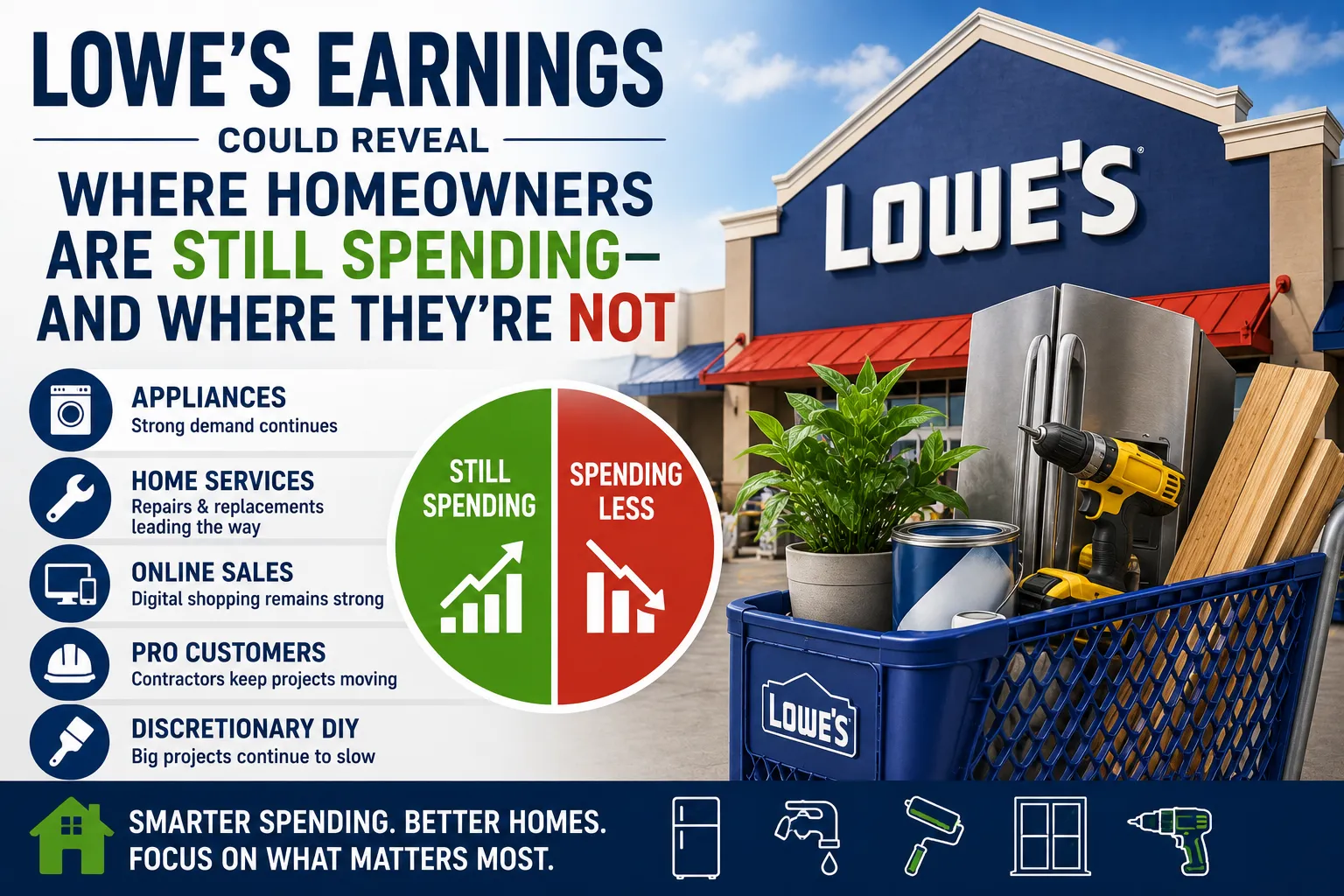
Lowe’s said strength came from professional customers, appliances, online sales and home services, while discretionary do-it-yourself projects remained under pressure. Comparable transactions declined 0.9%, even as the average ticket increased 1.5%.
That combination is important.
It suggests consumers were not necessarily abandoning home improvement altogether. Instead, they appeared to be prioritizing certain purchases while delaying others.
For homeowners trying to make those choices themselves, a broader Home Maintenance Projects approach can help distinguish urgent repairs and ongoing maintenance from larger discretionary improvements.
Essential repairs may be winning over big renovations
One of the clearest themes from Lowe’s previous earnings call was the difference between repair, maintenance and replacement spending and larger discretionary projects.
Company executives said DIY customers remained engaged, but spending continued to be concentrated in repair, maintenance and replacement-related categories. Bigger discretionary projects were described as a continuing source of pressure.
That distinction makes intuitive sense in a high-cost environment.
A homeowner whose refrigerator stops working may have little choice but to replace it.
Someone considering a $20,000 kitchen renovation, on the other hand, can decide to wait another year.
The same principle can apply to bathrooms, flooring, outdoor projects and other upgrades that improve a home but are not immediately necessary.
This shift toward fixing problems before pursuing major upgrades is also consistent with the broader trend discussed in Homeowners Continue Prioritizing Repairs Over Major Remodels.
Appliances could remain a bright spot
Appliances were one of Lowe’s stronger areas in the first quarter, and the company’s comments suggest there is a practical reason.
Lowe’s said approximately 70% of appliance transactions are driven by what it calls a “duress occasion”—situations in which customers need to replace a refrigerator, washing machine or another appliance relatively quickly.
That makes appliance demand different from discretionary remodeling.
A homeowner can postpone replacing perfectly functional kitchen cabinets.
It is much harder to postpone replacing a washing machine that suddenly stops working.
If appliances continue to outperform in the second quarter, it could reinforce the idea that homeowners are still spending when a purchase is unavoidable.
For homeowners dealing with an unexpected failure, understanding How Major Home Systems Work and What Homeowners Maintain can also make it easier to distinguish routine replacement needs from larger system problems.
Home services could provide another clue
Lowe’s has also been emphasizing home services, including repair and installation.
The company said HVAC and water heaters were particularly strong in the first quarter, supported by improvements to its home-services offering. Millwork also benefited from replacement projects involving windows and doors.
These categories are interesting because they sit somewhere between maintenance and improvement.
Replacing an old water heater is necessary. Upgrading windows may be partly discretionary but can also address efficiency, comfort or deterioration.
If these areas remain strong, it could suggest homeowners are still willing to spend when a project has a clear functional benefit.
The biggest question may be discretionary DIY spending
The more revealing part of the earnings report could be what happens to large discretionary projects.
Lowe’s previously identified categories connected to bigger projects as an area of weakness.
That includes the kinds of purchases associated with substantial renovations, where consumers have greater flexibility about when to spend.
The company has acknowledged that the housing environment remains challenging and has said it is trying to provide additional value to customers in this environment.
If those categories remain weak, it would provide another indication that homeowners are taking a more cautious approach to major upgrades.
That caution can make the distinction between necessary repairs and optional improvements particularly important. A practical Home Repairs Guide: Common Problems and Solutions can help homeowners think through which problems should be addressed promptly and which improvements can reasonably wait.
Ticket size versus transactions tells an important story
One of the most useful figures to watch will be the relationship between average ticket size and transaction volume.
Lowe’s first-quarter comparable average ticket increased 1.5%, while comparable transactions fell 0.9%.
That creates an interesting picture.
If customers make fewer trips but spend more when they do visit, several explanations are possible.
They may be concentrating spending on necessary purchases. Prices may also be higher. Professional customers may be contributing more to sales. Or consumers may simply be consolidating shopping trips.
A stronger average ticket combined with weak transaction growth does not necessarily mean homeowners are enthusiastically renovating.
It can mean something much more nuanced: people are buying what they need while being more selective about everything else.
The professional customer is becoming increasingly important
Lowe’s is also putting considerable emphasis on its professional, or “Pro,” customer base.
These customers include contractors and other professionals who purchase building materials and supplies for projects.
In the first quarter, Pro sales remained a source of strength, with Lowe’s highlighting repair and maintenance activity among small- and medium-sized professionals.
That matters because professional spending can behave differently from ordinary DIY spending.
A contractor working on a paid project cannot necessarily postpone purchasing materials simply because consumers feel uncertain.
The strength of Pro sales could therefore help Lowe’s offset weaker discretionary spending by homeowners.
Housing conditions remain a major obstacle
The broader housing market is an important backdrop to the earnings report.
Mortgage rates have remained elevated, with the average 30-year fixed rate reported at 6.74% on August 13. Higher borrowing costs can discourage both home purchases and major renovations financed through borrowing.
Recent housing indicators have also remained subdued.
Reports ahead of this week’s retail earnings have pointed to a relatively flat housing market, with July home sales and buyer traffic showing weakness.
That environment can affect home-improvement retailers in several ways.
People who do not move may have less incentive to undertake major pre-sale renovations. At the same time, homeowners who remain in their properties for longer may eventually spend more on maintenance and replacement.
The result can be a shift in the type of home-improvement spending rather than an outright disappearance of demand.
Lowe’s outlook already reflects caution
When Lowe’s reported its first-quarter results, it maintained its full-year 2026 outlook.
The company expects total sales of $92 billion to $94 billion, representing approximately 7% to 9% growth, but forecasts comparable sales ranging from flat to up 2%. It also projected adjusted diluted EPS of approximately $12.25 to $12.75.
The relatively modest comparable-sales outlook is significant.
It indicates that Lowe’s does not expect a dramatic acceleration in underlying demand, even as total sales benefit from the company’s broader strategy and acquisitions.
Wednesday’s report will show whether the company remains comfortable with those expectations.
For homeowners, the broader question is whether cautious consumer spending will continue pushing households toward maintenance and smaller improvements instead of expensive remodeling.
Online shopping could reveal changing homeowner behavior
Online sales were another bright spot in Lowe’s first quarter.
The company reported 15.5% online sales growth in its first-quarter earnings materials.
That trend is worth watching because home improvement is increasingly becoming an omnichannel category.
Homeowners can research products online, compare specifications, check availability and then decide whether to buy digitally or visit a store.
Strong online growth could indicate that customers remain active but are becoming more deliberate about researching purchases before spending.
It could also reflect Lowe’s efforts to expand its online assortment and improve the shopping experience.
Paint and other smaller projects may offer another signal
Not every home improvement project requires a major budget.
Paint, cleaning products, tools, hardware and smaller seasonal purchases can provide homeowners with relatively inexpensive ways to improve their surroundings.
Lowe’s reported positive comparable sales in paint during the first quarter, including interior paint, sundries, tools, stain, spray paint and buckets.
This kind of spending could become more important when consumers are reluctant to commit to expensive renovations.
A homeowner who postpones a full kitchen remodel may still repaint the kitchen.
Someone who delays a major landscaping project may still buy plants, tools or outdoor equipment.
That creates a potential small-project economy within the broader home-improvement market.
What homeowners may be telling retailers
The emerging pattern from Lowe’s previous results can be summarized fairly simply:
Necessary spending is holding up better than optional spending.
That does not mean homeowners have stopped improving their properties.
It means the definition of “worth spending money on” may have changed.
Projects that repair something broken, maintain an existing system, improve basic functionality or address an immediate need may be getting priority.
Projects that can wait are more likely to face scrutiny.
For homeowners, that may mean the current environment favors planning and prioritization rather than attempting every improvement at once.
A household that is unsure where to begin can also use How to Budget for Home Maintenance to think about maintenance reserves, recurring expenses and larger replacement costs before committing to discretionary projects.
Homeowners may be choosing value over ambition
When household budgets are stretched, consumers often become more focused on the practical return from a purchase.
Replacing an inefficient appliance may feel easier to justify than installing an entirely new kitchen.
Fixing a leaking roof is more urgent than replacing perfectly functional windows for aesthetic reasons.
Refreshing paint may be easier to justify than a full-room renovation.
That does not necessarily mean homeowners are becoming less interested in their homes.
They may simply be asking a different question:
Will this expense solve a real problem or meaningfully improve the home enough to justify the cost right now?
Lowe’s earnings could provide evidence of how widespread that thinking has become.
Home Depot’s results could add another piece of the puzzle
Lowe’s is not operating in isolation.
The Home Depot is scheduled to report its second-quarter results on August 18, one day before Lowe’s. That makes the two reports particularly useful when viewed together.
Home Depot’s results could provide an early indication of whether trends seen at Lowe’s are company-specific or part of a broader shift in home-improvement spending.
If both retailers report weakness in large discretionary projects but strength in repairs, maintenance and replacement categories, the message would become considerably stronger.
It would suggest that homeowners are not abandoning home improvement.
They are changing where the money goes.
The comparison is especially relevant alongside Why Home Improvement Projects Are Going Over Budget in 2026, since rising project costs can make homeowners even more selective about which renovations they undertake.
What to watch when Lowe’s reports
Several details deserve particular attention when the results arrive.
Comparable sales
This will be one of the clearest indicators of underlying customer demand.
Transaction volume
If transactions continue to decline, it could indicate that consumers are making fewer purchases even if individual baskets remain relatively large.
Average ticket
A higher ticket could reflect inflation, Pro customers or consumers concentrating spending on larger necessary purchases.
DIY versus Pro
The balance between ordinary homeowners and professional customers will help show whether the consumer side of the business is strengthening.
Appliances and home services
Continued strength here would reinforce the idea that replacement and maintenance spending remain resilient.
Big-ticket discretionary categories
This may be the most important signal for homeowners considering major renovations.
Online sales
Continued digital growth could show that customers are still shopping actively but using more research and comparison before purchasing.
Full-year guidance
Any change to Lowe’s outlook could provide the clearest indication of how management views the remainder of the year.
What the results could mean for homeowners
Lowe’s earnings will primarily be interpreted as a corporate and investment story, but the underlying sales data can offer a useful window into household priorities.
If repairs, appliances, maintenance, services and smaller projects remain strong while major discretionary renovations continue to struggle, homeowners may be entering a period where function comes before transformation.
That could mean more money spent keeping existing homes working well and less money spent on expensive upgrades simply because they are desirable.
For consumers, that is not necessarily bad news.
A cautious spending environment can encourage homeowners to prioritize projects, compare prices, maintain existing equipment and focus on improvements that provide measurable value.
The bigger story behind Lowe’s numbers
The most revealing part of Lowe’s upcoming earnings may not be whether the company beats or misses Wall Street’s forecast.
It may be what the sales mix says about how homeowners are thinking.
The first quarter already showed a divide: total sales rose strongly, but comparable sales were only slightly higher; appliances, services, online and Pro remained relatively strong, while larger discretionary DIY projects continued to lag.
With mortgage rates still elevated and consumers facing continued economic uncertainty, the second-quarter results could show whether that pattern is becoming more entrenched.
If homeowners are still spending on repairs, replacements, maintenance and smaller improvements while delaying major renovations, Lowe’s numbers would offer a broader lesson about the current housing economy.
People may not be giving up on improving their homes.
They may simply be becoming much more selective about which improvements are worth paying for now.