Plant Diseases Guide: Identify, Prevent and Manage Problems
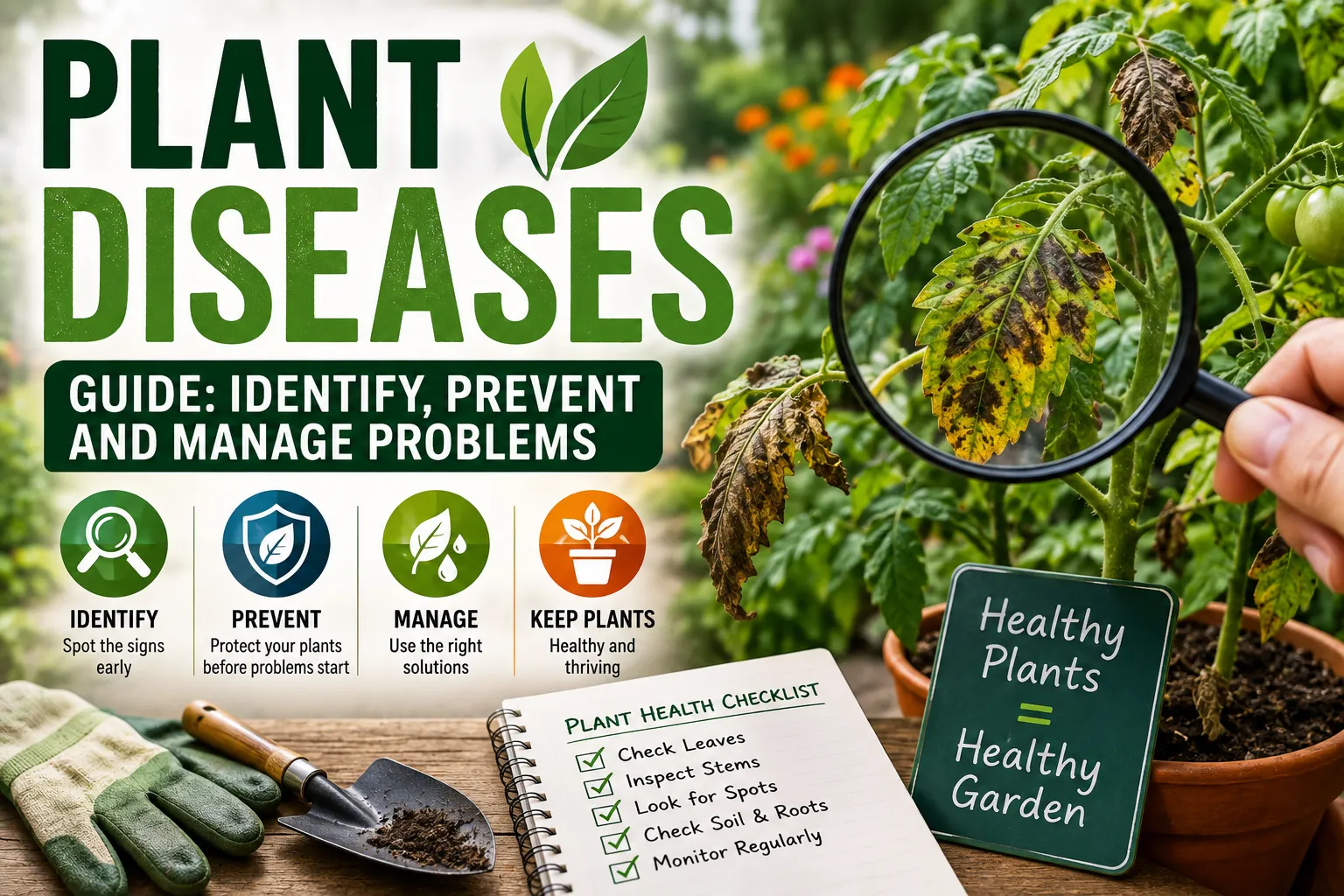
Plant Diseases Guide: Identify, Prevent and Manage Problems
A healthy garden can change quickly.
One week, tomato plants may be producing vigorous green growth. The next, leaves develop dark spots, stems begin to wilt, or a powdery coating appears across the foliage. Fruit may crack or rot, seedlings can collapse, and plants that looked perfectly healthy may suddenly stop growing.
The first instinct is often to reach for a pesticide or fungicide.
But treating a plant disease effectively starts with something more important: getting the diagnosis right.
Plant problems can be caused by infectious organisms such as fungi, bacteria, viruses, and other pathogens. They can also result from noninfectious problems such as drought, excessive moisture, nutrient deficiencies, temperature stress, herbicide injury, salt damage, or compacted soil. These problems can produce surprisingly similar symptoms.
That is why successful disease management is less about finding a “strong” treatment and more about understanding what is actually happening.
This complete guide explains how to recognize common plant-disease symptoms, distinguish disease from environmental stress, prevent problems before they spread, and manage affected plants using practical garden-management strategies.
What Is a Plant Disease?
A plant disease is a condition that prevents a plant from functioning normally and reaching its full potential.
Plant diseases are commonly divided into two broad groups:
- Biotic or infectious diseases, caused by living disease-causing organisms
- Abiotic or noninfectious disorders, caused by environmental or physical factors
Infectious diseases can be caused by organisms such as fungi, bacteria, viruses, and other pathogens. Noninfectious problems can result from factors such as nutrient deficiencies, salt injury, extreme temperatures, soil compaction, or chemical exposure.
This distinction matters because an infectious disease may spread from plant to plant, while an environmental problem generally will not.
For example, if several plants develop symptoms after exposure to herbicide drift, spraying them with a fungicide will not solve the problem.
Why Plant Disease Diagnosis Is Difficult
Plants communicate stress through a relatively limited set of visible symptoms.
Yellow leaves can indicate:
- Disease
- Overwatering
- Underwatering
- Nutrient problems
- Root damage
- Poor drainage
- Temperature stress
- Herbicide injury
Similarly, wilting does not automatically mean a plant has a fungal wilt disease.
It could simply need water—or its roots could be sitting in saturated soil.
University extension specialists recommend looking at the pattern, progression, environmental conditions, and other evidence rather than treating symptoms in isolation.
Symptoms vs. Signs
There is a useful distinction between symptoms and signs.
Symptoms
Symptoms are changes in the plant caused by the problem.
Examples include:
- Yellowing
- Wilting
- Stunting
- Leaf spots
- Dieback
- Distorted growth
- Lesions
- Premature leaf drop
- Poor fruit development
Signs
Signs are physical evidence of the pathogen or pest itself.
Examples can include:
- Fungal growth
- Spores
- Bacterial ooze
- Visible insects
- Insect eggs
- Fruiting structures
Finding a sign can provide much stronger evidence about the cause than a symptom alone.
Start With the Whole Plant
Before focusing on one damaged leaf, examine the entire plant.
Look at:
- Roots
- Stem
- Leaves
- Flowers
- Fruit
- Growing tips
- Soil around the plant
- Nearby plants
Ask whether the problem is limited to one section or affecting the entire plant.
Also look at neighboring plants.
If one plant is affected while everything around it looks healthy, the problem may have a different cause from a situation where an entire bed is showing the same symptoms.
Look at the Pattern of Damage
The location and pattern of symptoms can provide important clues.
For example:
- Symptoms on lower leaves may suggest one set of possibilities.
- Damage concentrated on new growth may suggest another.
- Symptoms along leaf veins can provide useful clues.
- Root problems may produce above-ground symptoms.
- Symptoms appearing in a circular area can indicate a localized source.
- Uniform damage across an entire planting may point toward environmental conditions.
The University of Minnesota’s diagnostic resources organize plant problems by symptoms such as leaf spots, discoloration, distortion, wilting, stunting, and damage to stems, roots, fruit, and other plant parts.
Track How the Problem Changes
Time is one of the most useful diagnostic tools.
Ask:
Is the problem getting worse, staying the same, or improving?
Oregon State University Extension notes that disease and pest problems often worsen over time, while environmental stress may stabilize or improve once the underlying condition changes.
For example, a plant that wilts during a hot afternoon but recovers in the evening may be responding differently from one that becomes progressively more wilted regardless of watering.
Take photographs over several days if you’re unsure.
A timeline can reveal patterns that are difficult to notice from memory.
Common Plant Disease Symptoms
Yellow Leaves
Yellowing, or chlorosis, is one of the most common plant symptoms.
Possible causes include:
- Disease
- Root damage
- Water stress
- Nutrient deficiencies
- Poor drainage
- Natural aging
- Temperature stress
Do not automatically assume yellow leaves require fertilizer.
Adding nutrients without knowing the cause can make some problems worse.
Brown or Black Spots
Leaf spots can result from several causes.
Disease-related spots may be associated with fungal or bacterial pathogens, while environmental injury can produce similar-looking damage.
Pay attention to:
- Spot size
- Shape
- Color
- Location
- Whether spots have borders
- Whether they are expanding
- Whether new leaves are affected
- Whether similar symptoms appear on stems or fruit
A photograph of the entire plant and close-ups of affected tissue can be useful when seeking expert identification.
Wilting
Wilting occurs when leaves and stems lose their normal firmness.
Possible causes include:
- Lack of water
- Root damage
- Root rot
- Vascular disease
- Heat stress
- Physical damage
- Severe pest pressure
Check the soil before assuming the plant needs more water.
Adding water to already saturated soil can worsen root problems.
For more guidance on determining when and how garden plants need water, see the Complete Guide to Watering Garden Plants Correctly.
Powdery Growth
A white, powdery coating on leaves or stems can be characteristic of powdery mildew.
Powdery mildew affects many types of plants.
Management generally emphasizes prevention and cultural practices, including adequate air circulation, avoiding overcrowding, and selecting resistant varieties where available.
Downy Growth
Downy mildew can look different from powdery mildew and affects a variety of plants.
Symptoms can include yellow or discolored areas on the upper leaf surface with downy growth under favorable conditions on the underside.
Because downy mildew diseases differ by host, identification should be based on the specific plant and symptoms rather than assuming every fuzzy growth is the same disease.
Stunted Growth
Stunting can result from:
- Root problems
- Nutrient deficiencies
- Viruses
- Soil conditions
- Temperature stress
- Insect feeding
- Crowding
- Disease
Viruses can be particularly serious in some vegetable crops because infected plants may become stunted and produce distorted leaves or fruit. Some viral diseases have limited management options after infection, making prevention important.
Distorted Leaves
Curled, cupped, twisted, or unusually shaped leaves can result from:
- Viruses
- Herbicide injury
- Insect feeding
- Environmental stress
- Nutrient problems
- Certain diseases
Look closely for insects and examine new growth.
Common Categories of Plant Diseases
Fungal Diseases
Fungal pathogens cause many common garden diseases.
Examples include:
- Powdery mildew
- Rust
- Anthracnose
- Some leaf spots
- Certain wilts
- Some rots
Fungal diseases often become more problematic under environmental conditions that favor infection and pathogen development.
Oomycete Diseases
Some diseases that gardeners traditionally call “fungal” are actually caused by oomycetes, a different group of organisms.
Downy mildew and some root and crown rots are examples.
This distinction can matter when selecting management strategies because not every fungicide works against every pathogen.
Bacterial Diseases
Bacteria can cause:
- Leaf spots
- Blights
- Cankers
- Wilts
- Fruit and stem infections
Bacterial diseases can spread through splashing water, contaminated tools, insects, infected plant material, and other routes depending on the pathogen.
Viral Diseases
Plant viruses can cause:
- Mottling
- Mosaic patterns
- Rings
- Distortion
- Stunting
- Discoloration
- Reduced yields
Viruses can be particularly difficult to manage after infection.
Prevention, healthy plant material, and control of vectors such as insects can therefore be important.
Root and Soilborne Diseases
Some pathogens survive in soil or plant debris and attack roots or crowns.
Symptoms above ground can include:
- Wilting
- Yellowing
- Stunting
- Poor growth
- Premature death
Because the damage begins below the soil surface, diagnosis can be challenging.
Common Plant Problems That Are Not Diseases
Not every unhealthy plant has an infectious disease.
Underwatering
Plants may wilt, develop dry leaf edges, or stop growing.
Overwatering
Excess moisture can reduce oxygen around roots and contribute to root problems.
Poor Drainage
Water that remains around roots for too long can create stressful conditions and favor certain diseases.
Nutrient Deficiency
Nutrient problems can cause discoloration, stunting, and abnormal growth.
Heat Stress
High temperatures can cause wilting, leaf scorch, flower drop, or poor fruit development.
Cold Injury
Frost and freezing temperatures can damage leaves, stems, flowers, and young plants.
Herbicide Injury
Accidental exposure to herbicides can cause distorted leaves, discoloration, or abnormal growth.
Salt Injury
High salt concentrations in soil or irrigation water can damage roots and cause leaf-edge burn.
These problems require different solutions from infectious diseases.
Watering: One of the Biggest Disease-Prevention Factors
Water is essential for plant health, but both too little and too much can create problems.
Penn State Extension notes that getting the balance right can help plants remain healthy and minimize disease.
Avoid treating watering as a fixed rule such as “water every day.”
Instead, consider:
- Plant type
- Soil type
- Weather
- Container size
- Drainage
- Plant maturity
- Season
- Recent rainfall
Check the soil and the plant’s condition.
Avoid Unnecessary Overhead Watering
Water sprayed across foliage can increase leaf wetness and splash pathogens between plants.
For many garden crops, watering the soil around the plant rather than repeatedly wetting foliage can help reduce disease-favorable conditions.
Penn State specifically recommends avoiding overhead watering as part of disease prevention for basil, along with improving air circulation and sanitation.
This does not mean overhead watering is always forbidden.
Some plants tolerate or require it.
The important principle is to avoid creating unnecessarily prolonged leaf wetness when a disease is favored by wet foliage.
Give Plants Enough Space
Crowded plants create a humid environment with reduced air movement.
That can increase the amount of time foliage remains wet after rain, irrigation, or dew.
Good spacing can:
- Improve air circulation
- Reduce humidity around leaves
- Make plants easier to inspect
- Improve access for pruning
- Make spraying or other treatments more effective when needed
Avoid planting according to appearance alone.
Follow the recommended spacing for the crop or ornamental plant.
Pruning for Better Air Circulation
Selective pruning can improve airflow through dense plants.
Remove appropriate:
- Dead growth
- Diseased tissue
- Excessively crowded shoots
- Unnecessary suckers where appropriate
However, avoid aggressive pruning simply because a plant looks crowded.
Pruning requirements vary by species, and excessive cuts can stress plants.
For detailed guidance on pruning different types of garden plants, see How to Prune and Maintain Garden Plants for Healthy Growth.
Sanitation Is a Major Disease-Control Tool
Garden sanitation means reducing sources of infection.
This can include:
- Removing diseased plant material
- Cleaning tools
- Removing fallen infected debris when appropriate
- Controlling weeds that can harbor pathogens
- Using healthy seeds and transplants
- Cleaning containers
- Avoiding unnecessary movement between infected and healthy plants
Good sanitation does not guarantee a disease-free garden, but it can reduce opportunities for pathogens to persist and spread.
What to Do With Diseased Plant Material
Do not automatically put severely diseased plants into a home compost pile.
Some pathogens can survive in plant debris and may return to the garden later.
For example, Penn State recommends promptly discarding infested basil plants rather than adding them to compost piles.
Follow local guidance for disposing of diseased plant material.
For more information about making and using compost appropriately, see How to Make Compost and Use It Effectively in a Garden.
Clean Your Pruning Tools
Pruning tools can potentially transfer pathogens between plants.
If you are working with plants showing suspicious disease symptoms:
- Remove visibly contaminated material.
- Clean tools appropriately.
- Avoid moving directly from an infected plant to a healthy one without cleaning.
- Use disease-specific sanitation recommendations when available.
Tool sanitation is especially important when pruning multiple plants of the same species.
Start With Healthy Seeds and Plants
Disease prevention can begin before a plant enters your garden.
Choose:
- Healthy-looking transplants
- Reliable seed sources
- Disease-resistant varieties when available
- Plants appropriate for your climate and growing conditions
Inspect nursery plants before bringing them home.
Look for:
- Unusual leaf spots
- Wilting
- Mold
- Distorted growth
- Insect infestations
- Discolored stems
- Poor vigor
Bringing one infected plant into a garden can create problems for other susceptible plants.
Disease-Resistant Varieties
One of the most practical disease-prevention strategies is choosing a variety with resistance to a disease known to occur in your area.
Penn State Extension describes resistant varieties as one of the most economical and reliable disease-management methods for vegetable crops.
However, resistance does not necessarily mean immunity.
A resistant variety may still develop disease under high disease pressure or favorable environmental conditions.
Think of resistance as risk reduction, not an absolute guarantee.
Read Disease-Resistance Codes Carefully
Seed catalogs often use abbreviations to indicate resistance.
Depending on the crop, codes may refer to diseases such as:
- Downy mildew
- Powdery mildew
- Fusarium wilt
- Verticillium wilt
- Certain viruses
Always check the seed company’s explanation of its resistance codes.
Resistance to one disease does not mean resistance to every disease.
Crop Rotation
Crop rotation can help reduce some soilborne disease problems.
The basic idea is to avoid planting the same susceptible crop or related crops repeatedly in the same location.
Instead, rotate with a crop that is not a host for the same pathogen.
Rotation is particularly useful for diseases whose pathogens survive in soil or crop residues.
The appropriate rotation period depends on the disease.
For example, Penn State recommends a three- to five-year rotation in managing Verticillium wilt of strawberries.
Do not assume that a one-year rotation will solve every disease problem.
Remove Volunteer Plants and Weeds
Unwanted plants can sometimes maintain disease-causing organisms between growing seasons.
Weeds and volunteer crop plants may act as hosts for pathogens.
Penn State notes that weeds can serve as disease hosts and that dense weed growth can create a more humid environment favorable to infection.
Keeping beds reasonably weed-free can therefore contribute to disease management.
Soil Health and Drainage
Healthy soil supports healthy plant growth.
Important considerations include:
- Adequate drainage
- Appropriate organic matter
- Balanced fertility
- Avoiding severe compaction
- Appropriate soil pH
- Avoiding unnecessary nutrient applications
Plants under stress can be more vulnerable to disease.
For a broader guide to improving the growing environment beneath your plants, see the Ultimate Guide to Soil Health.
Don’t Overfertilize
More fertilizer does not automatically mean healthier plants.
Excessive nitrogen can produce lush, tender growth that may be more vulnerable to certain diseases.
For example, Penn State notes that high nitrogen levels can increase the severity of Verticillium wilt in strawberries.
Use soil testing and crop-specific recommendations where appropriate rather than applying fertilizer based on guesswork.
The Complete Guide to Garden Fertilizers and Plant Nutrition provides additional information about matching plant nutrition to actual needs.
Monitor the Garden Regularly
Early detection is one of the simplest ways to prevent a small problem from becoming a major one.
Walk through the garden regularly and look for:
- New spots
- Wilt
- Unusual discoloration
- Distorted leaves
- Mold
- Cankers
- Stunting
- Abnormal fruit
- Insect activity
You do not need to inspect every leaf.
Focus on plants known to be susceptible and areas where problems have appeared previously.
Keep a Garden Disease Journal
A simple notebook or digital record can become surprisingly useful.
Record:
- Plant variety
- Planting date
- Location
- Weather conditions
- Watering
- Fertilization
- Symptoms
- Date symptoms appeared
- Treatments attempted
- Outcome
Patterns can emerge over several seasons.
You may discover, for example, that the same disease appears every year after a period of prolonged wet weather.
How to Photograph a Plant Problem
If you need help identifying a disease, good photographs can make a major difference.
Take:
- A photo of the entire plant.
- A photo showing several affected leaves.
- A close-up of the symptoms.
- A photo of the stem.
- A photo of the underside of affected leaves.
- A photo of the surrounding soil and nearby plants.
Also provide:
- Plant species and variety if known
- Location
- Age of the plant
- When symptoms started
- Recent weather
- Watering practices
- Fertilizer use
- Recent pesticide or herbicide applications
This gives a diagnostician much more information than a close-up of one damaged leaf.
Use Diagnostic Resources Before Treating
University extension services provide plant-diagnosis tools that can help gardeners work through symptoms.
The University of Minnesota, for example, provides diagnostic resources covering diseases and pests affecting lawns, flowers, vegetables, fruits, trees, and shrubs.
When a problem is difficult to identify, consider using:
- Local extension services
- Plant disease clinics
- Qualified horticulturists
- Master Gardener programs
- University diagnostic resources
A correct diagnosis can save money and prevent unnecessary pesticide applications.
Don’t Spray First and Ask Questions Later
One of the most common mistakes in plant problem management is treating a symptom without identifying its cause.
Oregon State University Extension specifically advises diagnosing the problem before treating it rather than spraying first.
Why?
Because a fungicide cannot correct:
- Drought stress
- Nutrient deficiency
- Herbicide injury
- Root damage caused by poor drainage
- Physical damage
Likewise, an insecticide will not cure a viral disease.
Integrated Pest Management
A strong plant-disease strategy fits into the broader concept of Integrated Pest Management (IPM).
IPM does not mean never using pesticides.
Instead, it combines multiple strategies and uses chemical controls strategically when appropriate.
These strategies can include:
- Prevention
- Correct identification
- Monitoring
- Resistant varieties
- Sanitation
- Cultural practices
- Biological controls
- Physical controls
- Targeted chemical treatment
A broader Complete Guide to Garden Pest Control can also help when insects, disease vectors, and other garden pests become part of the problem.
University of Minnesota Extension recommends IPM because many garden pests and diseases can be managed successfully without pesticides, while treatments are not always necessary for problems that cause only cosmetic damage.
When Treatment May Not Be Necessary
Not every disease requires intervention.
Consider the following:
- Is the plant still growing normally?
- Is the disease affecting only a few leaves?
- Is the crop close to harvest?
- Is the problem primarily cosmetic?
- Is treatment likely to provide meaningful benefit?
- Could treatment harm beneficial organisms?
Some diseases may be unsightly but have little impact on plant health.
In those situations, monitoring may be more sensible than immediately reaching for a chemical treatment.
When Removal Makes Sense
Removing a plant can be difficult emotionally, especially after investing months of care.
But removal may be appropriate when:
- A serious disease is spreading rapidly.
- The plant is unlikely to recover.
- The pathogen can spread easily to nearby susceptible plants.
- The plant is severely damaged.
- There is no practical treatment.
- Keeping it would create an ongoing source of infection.
Some viral diseases, for example, have limited control options once a plant is infected.
Managing Powdery Mildew
Powdery mildew is one of the most recognizable garden diseases.
It often appears as a white powdery growth on leaves or other plant parts.
Management focuses heavily on prevention.
Useful practices include:
- Choose resistant varieties where available.
- Avoid overcrowding.
- Improve air circulation.
- Monitor susceptible plants.
- Avoid unnecessary overwatering.
- Remove severely affected material where appropriate.
Penn State recommends these types of cultural measures for managing powdery and downy mildew in home gardens.
Managing Leaf Spot Diseases
Leaf spots can be caused by different pathogens and environmental conditions.
Do not assume every circular brown spot represents the same disease.
Management may involve:
- Removing severely affected leaves
- Improving air circulation
- Avoiding unnecessary overhead irrigation
- Removing infected debris
- Choosing resistant varieties where available
- Rotating susceptible crops when appropriate
Because leaf spots have many possible causes, identification is particularly important.
Managing Wilts
Wilt diseases can be especially serious because some pathogens attack the plant’s vascular system or roots.
But wilt is also a common symptom of water stress.
Before assuming a pathogen is responsible, check:
- Soil moisture
- Drainage
- Root condition
- Recent weather
- Stem condition
- Distribution of symptoms
If the plant is consistently worsening despite appropriate moisture, further diagnosis may be warranted.
Managing Root Rot
Root and crown diseases are often associated with excessive moisture and poorly drained conditions, although the exact causes vary.
Warning signs can include:
- Persistent wilting
- Yellowing
- Stunting
- Poor growth
- Dark or decaying roots
- Plant collapse
The solution is not necessarily “water less.”
You may need to improve drainage, adjust planting conditions, replace affected plants, or identify the specific pathogen.
Managing Viral Diseases
Viruses are among the most difficult plant diseases to manage once infection is established.
Symptoms can include:
- Mottled leaves
- Mosaic patterns
- Rings
- Distortion
- Stunting
- Reduced yield
Some plant viruses are transmitted by insects, while others can move through infected plant material or contaminated tools.
Prevention is therefore critical.
Use healthy planting material, manage vectors where appropriate, and avoid propagating plants from suspiciously symptomatic material.
Disease Prevention in Container Gardens
Containers have their own disease risks.
Avoid:
- Waterlogged pots
- Poor drainage
- Reusing contaminated potting media
- Dirty containers
- Overcrowding
Make sure containers have appropriate drainage holes.
When reusing containers, clean them appropriately before planting new material.
Houseplants Need Disease Prevention Too
Indoor plants can develop:
- Root problems
- Leaf spots
- Powdery mildew
- Gray mold
- Viral diseases
- Bacterial problems
Indoor conditions can sometimes favor disease because plants are grown close together with limited air movement.
Useful habits include:
- Avoid overwatering.
- Provide adequate light.
- Give plants enough space.
- Remove diseased leaves.
- Inspect new plants before placing them with established plants.
- Improve air circulation where appropriate.
Quarantine New Plants
A new houseplant or nursery purchase can introduce pests or diseases to your existing collection.
When practical, keep new plants separate for a period while checking them for:
- Insects
- Disease symptoms
- Unusual growth
- Leaf spots
- Wilting
This is particularly useful for large indoor plant collections.
Avoid Moving Soil and Debris Unnecessarily
Soil can carry pathogens.
Be cautious about moving soil from a diseased garden bed to another part of the property.
Similarly, contaminated plant debris can spread disease if transported around the garden.
Clean tools, footwear, containers, and equipment when moving between areas where disease is present.
Manage Disease According to the Season
Disease risk changes with weather.
Wet periods can favor some foliar diseases.
Hot, humid conditions can favor others.
Cold weather can cause physiological injury that resembles disease.
Pay attention to weather forecasts and seasonal patterns.
If you know a particular plant is susceptible to a disease, increased scouting during the conditions that favor that disease can help you detect problems early.
Why Weather Matters So Much
Plant disease usually requires an interaction among:
- A susceptible host
- A pathogen
- An environment favorable to disease
This is sometimes described as the disease triangle.
If you can change one side of that triangle, you may reduce disease.
For example:
- Choose a resistant variety to reduce host susceptibility.
- Remove infected material to reduce pathogen pressure.
- Improve airflow to make the environment less favorable.
Oregon State University describes plant disease as an interaction involving a susceptible host, a virulent pathogen, and a conducive environment.
Don’t Ignore the Roots
Gardeners naturally focus on leaves because they are easy to see.
But roots are often where problems begin.
If a plant repeatedly wilts, yellows, or stops growing, inspect the roots when appropriate.
Healthy roots generally have a firm appearance appropriate to the species.
Soft, decaying, discolored, or severely damaged roots can indicate a serious problem.
Root diagnosis can be difficult, so professional assistance may be useful for persistent or severe cases.
When to Seek Professional Help
Consider seeking expert diagnosis when:
- Multiple plants are dying.
- A disease is spreading rapidly.
- Valuable trees or shrubs are affected.
- The problem returns every year.
- The cause is unclear.
- You have tried basic cultural corrections without improvement.
- You suspect a serious soilborne disease.
- You need to protect a commercial crop.
- A plant is valuable or difficult to replace.
Professional diagnosis can prevent repeated unsuccessful treatments.
A Practical Plant-Disease Checklist
When you notice something wrong, work through this sequence.
Step 1: Identify the Plant
Determine the species and, if possible, the cultivar.
Step 2: Photograph the Problem
Take whole-plant and close-up images.
Step 3: Examine the Pattern
Look at where the symptoms occur.
Step 4: Check the Environment
Consider:
- Water
- Drainage
- Temperature
- Light
- Soil
- Fertilizer
- Recent weather
Step 5: Look for Signs
Check for:
- Fungal growth
- Spores
- Insects
- Bacterial ooze
- Eggs
- Other visible evidence
Step 6: Check Nearby Plants
Determine whether the problem is isolated or spreading.
Step 7: Research the Specific Plant
Use reputable extension or horticultural resources.
Step 8: Correct Environmental Problems
Fix watering, drainage, spacing, or other identifiable stress factors.
Step 9: Remove Severely Affected Material When Appropriate
Prevent further spread where possible.
Step 10: Treat Only When There Is a Reason
Use targeted treatments based on a reasonably confident diagnosis.
A Simple Disease-Prevention Routine
You can reduce many plant-disease problems through a consistent routine.
Before Planting
- Select appropriate plants.
- Choose resistant varieties when available.
- Inspect transplants.
- Prepare well-drained soil.
- Plan adequate spacing.
- Rotate susceptible crops where appropriate.
During the Growing Season
- Monitor plants regularly.
- Water appropriately.
- Avoid unnecessary foliage wetting.
- Keep weeds under control.
- Remove diseased material when appropriate.
- Clean tools.
- Maintain good air circulation.
After Harvest
- Remove appropriate diseased crop debris.
- Clean tools and containers.
- Record problems for next season.
- Plan crop rotation.
Common Plant-Disease Mistakes
Mistake 1: Assuming Every Yellow Leaf Is a Disease
Yellowing has many causes.
Mistake 2: Watering Every Day
Plants have different water requirements, and constant moisture can create problems.
Mistake 3: Treating Without Identifying
A chemical treatment aimed at the wrong problem wastes money and can create unnecessary environmental exposure.
Mistake 4: Planting Too Closely
Overcrowding can restrict airflow and create disease-favorable conditions.
Mistake 5: Ignoring Resistant Varieties
Resistance can be one of the simplest ways to reduce disease risk.
Mistake 6: Reusing Contaminated Materials
Soil, containers, tools, and plant debris can sometimes carry pathogens.
Mistake 7: Putting Severely Diseased Plants Into Compost
Depending on the pathogen and composting system, disease organisms may survive. Follow local guidance.
Mistake 8: Ignoring the Weather
Disease risk often changes dramatically with moisture and temperature.
The Goal Is Not a Perfectly Spotless Garden
A healthy garden does not mean every leaf will remain flawless.
Plants live in complex ecosystems containing insects, microorganisms, fungi, bacteria, and other organisms.
Some leaf damage is harmless.
Some diseases are primarily cosmetic.
And some problems resolve when environmental conditions improve.
The objective is not to eliminate every imperfection.
It is to maintain healthy plants, protect yields where food crops are involved, prevent serious diseases from spreading, and intervene when intervention actually provides a meaningful benefit.
Build Prevention Into the Garden From the Start
The strongest plant-disease strategy begins before the first symptoms appear.
Choose plants suited to the site. Select resistant varieties when they are available. Give plants enough room. Maintain good drainage. Water thoughtfully. Keep tools clean. Monitor regularly. Remove serious sources of infection when appropriate.
These measures may seem ordinary, but together they can substantially change the disease environment in a garden. For a broader foundation on planning and maintaining a healthy flower garden, see the Complete Guide to Flower Gardening.
And when something does go wrong, resist the temptation to immediately reach for a spray bottle.
Observe first. Diagnose second. Manage third.
Plant disease prevention works best when the garden itself is designed to make disease harder to establish and easier to detect.
A gardener who learns to recognize patterns, understand environmental triggers, and use integrated management methods can spend less time reacting to problems—and more time growing healthy plants.