Record Summer Heat Is Changing How Homeowners Think About Cooling and Energy Costs
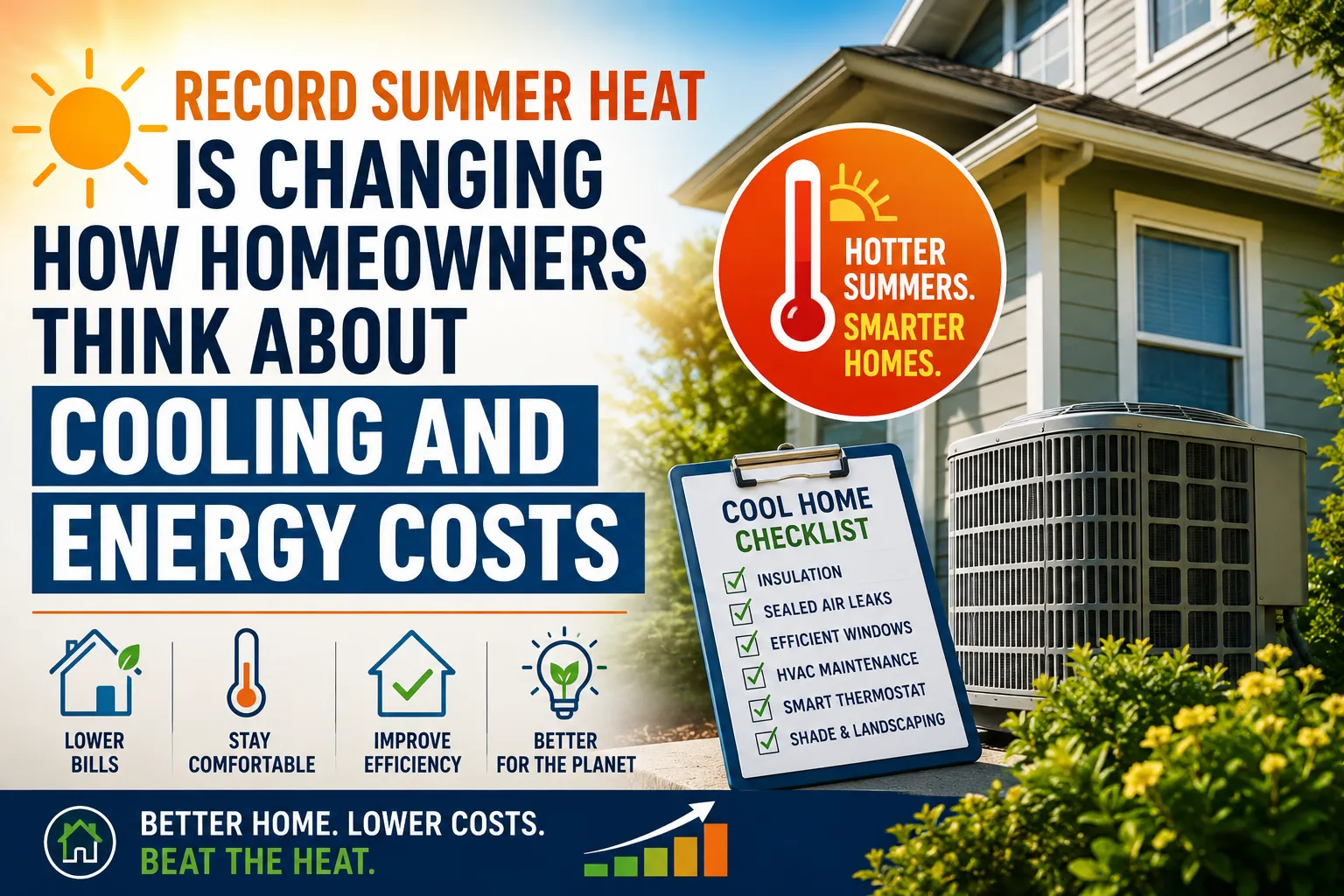
Record Summer Heat Is Changing How Homeowners Think About Cooling and Energy Costs
For many homeowners, summer cooling has traditionally been treated as a seasonal expense: turn on the air conditioner, accept a higher electricity bill for a few months, and wait for cooler weather.
The summer of 2026 is making that calculation harder to ignore.
The contiguous United States recorded its hottest month ever in July 2026, according to NOAA data, with an average temperature of about 76.9°F—surpassing the previous July record set during the Dust Bowl era in 1936. All 48 contiguous states recorded July temperatures at least 1°F above their 20th-century averages.
That kind of heat is changing the way homeowners think about their houses. Cooling is no longer simply about comfort. It is increasingly tied to energy efficiency, insulation, HVAC performance, home design and monthly household budgets.
These considerations are also becoming part of broader home maintenance projects, particularly as homeowners look for improvements that protect comfort and long-term property performance.
Why Extreme Heat Can Send Cooling Costs Higher
Air conditioning already represents a major portion of electricity consumption during the summer.
The U.S. Energy Information Administration says electricity use generally rises as temperatures increase because households and businesses use more air conditioning. On especially hot days, demand for electricity can climb sharply as cooling systems operate for longer periods.
That creates a simple problem for homeowners.
When outdoor temperatures remain high for days or weeks, an air conditioner has to remove more heat from the home. If the building envelope is poorly insulated or leaks significant amounts of outdoor air, the system may have to work even harder.
The result can be a combination of:
- Longer air-conditioning cycles
- Higher electricity consumption
- Greater equipment wear
- Less consistent indoor temperatures
- Higher monthly utility bills
The pressure is particularly noticeable during prolonged heatwaves, when cooling demand can remain elevated around the clock.
The Summer 2026 Heat Record Is Putting Homes to the Test
July’s record was not simply about a few unusually hot afternoons.
NOAA reported that the contiguous U.S. experienced its hottest July on record, with elevated temperatures across the country. Particularly intense heat affected parts of the Mountain West, Southwest, Northern Plains and Southeast.
Another important factor was nighttime heat.
When outdoor temperatures remain high after sunset, homes have fewer opportunities to naturally cool down. That can increase the amount of work required from air-conditioning systems overnight.
For homeowners, this highlights a weakness that may not be obvious during an ordinary summer: a home that performs adequately in moderate heat can struggle when extreme heat becomes persistent.
Homeowners Are Looking Beyond the Air Conditioner
An obvious response to hotter summers might be purchasing a larger air conditioner.
But bigger is not always better.
A home’s cooling performance depends on much more than the capacity of the HVAC equipment. Insulation, air leakage, windows, shading, ductwork and thermostat settings all influence how much cooling a house requires.
The U.S. Department of Energy recommends looking at the entire home rather than relying exclusively on air conditioning. Proper insulation, efficient windows and doors, shading and appropriate ventilation can reduce the amount of cooling energy a home needs.
That is why the conversation around summer energy costs is increasingly becoming a home-performance conversation.
Homeowners looking at the wider condition of their properties can also benefit from understanding how major home systems work and what homeowners maintain.
Insulation Can Make a Major Difference
Insulation helps slow the movement of heat between the outside and inside of a home.
During a heatwave, that matters because the goal is to prevent the home’s interior from absorbing unnecessary amounts of outdoor heat.
The Department of Energy notes that insulation can reduce heating and cooling costs while improving comfort. The effectiveness and appropriate type of insulation depend partly on the home’s climate zone and construction.
For homeowners considering an upgrade, the attic is often an important area to investigate because it can experience substantial temperature differences from conditioned living spaces.
Before adding insulation, however, homeowners should understand the existing condition of the building envelope and address air leakage where appropriate.
Air Leaks Can Undermine Cooling Efficiency
A house can have plenty of insulation and still perform poorly if outside air is entering through gaps and cracks.
The Department of Energy describes air sealing as a way to reduce unwanted airflow through the building envelope. Common leakage points can occur around windows and doors, plumbing penetrations, electrical wiring, ducts, vents and other connections.
This matters during extreme heat because every pathway that allows hot outdoor air into the home creates additional work for the cooling system.
Simple measures such as weatherstripping around movable components and caulking around appropriate stationary gaps can help address some forms of leakage.
For more complicated problems, a professional energy audit or blower-door test can help identify leaks that are difficult to see.
Windows Are Becoming Part of the Cooling Conversation
Windows can be another major pathway for heat entering a home.
Direct sunlight can raise indoor temperatures, particularly on windows facing the strongest afternoon sun.
Homeowners do not necessarily need to replace every window to improve summer performance.
Depending on the house, strategies can include:
- Exterior shading
- Interior blinds or shades
- Curtains designed to reduce solar heat gain
- Awnings
- Shade trees
- Window films
- Energy-efficient replacement windows when existing units are particularly poor performers
The right solution depends on climate, window orientation, existing construction and budget.
A homeowner in a hot, sunny climate may prioritize solar heat control differently from someone living in a milder region.
Shade Can Be a Simple Home Improvement
Landscaping is sometimes viewed as purely cosmetic, but strategically placed shade can affect how much solar heat reaches a home.
Trees, pergolas, awnings and other shading structures can reduce direct sunlight on windows and exterior surfaces.
The Department of Energy includes shading among the strategies that can help keep homes cooler while reducing reliance on air conditioning.
However, landscaping should be planned carefully.
Trees should not be planted so close to a building that their roots, branches or moisture create other maintenance problems. Homeowners should also consider local climate, mature tree size and the amount of shade desired throughout the year.
HVAC Maintenance Matters More During Extreme Heat
A highly efficient air conditioner cannot perform properly if it is poorly maintained.
Before or during a hot season, homeowners should pay attention to basic maintenance such as:
- Replacing or cleaning filters according to manufacturer recommendations
- Keeping outdoor units clear of debris
- Checking for unusual noises or performance problems
- Ensuring supply and return vents are unobstructed
- Checking that ducts are appropriately sealed
- Scheduling professional service when the system is not cooling properly
A cooling system that runs continuously but cannot maintain the desired indoor temperature may have an underlying problem.
It could be related to the equipment itself, refrigerant issues, airflow, ductwork, insulation or the home’s heat load.
Regular attention to these components is part of understanding how to maintain major home systems, rather than treating HVAC performance as an isolated issue.
A Smart Thermostat Can Help—but It Cannot Fix a Bad Building Envelope
Smart thermostats have become popular because they allow homeowners to automate temperature settings and adjust cooling based on occupancy.
They can be useful, particularly when a household routinely cools an empty home.
But smart controls should not be viewed as a substitute for insulation, air sealing or properly sized HVAC equipment.
A thermostat can control the system.
It cannot stop heat from entering through an inadequately insulated roof or air leaking through gaps around the building envelope.
That distinction is becoming more important as homeowners look for meaningful ways to reduce cooling costs rather than simply changing thermostat settings.
The Cost Question Is Becoming More Complicated
Extreme temperatures are only one part of the electricity-bill equation.
Electricity prices, household consumption, utility rate structures and regional power-market conditions also influence what customers pay.
The EIA’s July 2026 outlook projected that wholesale electricity prices would be lower than the previous year across much of the country, partly because of lower natural-gas costs. But the agency also warned that heatwaves can temporarily push wholesale electricity prices higher than monthly forecasts because of increased demand.
That distinction is important.
A homeowner’s electricity bill does not necessarily rise simply because wholesale electricity prices rise. Retail rates, local utility rules and individual consumption patterns all matter.
But extreme heat can increase the amount of electricity a household needs, even when the underlying electricity price is relatively stable.
Cooling Efficiency Is Becoming a Home Value Issue
For homeowners thinking about selling, energy performance can also become part of the property’s appeal.
A home with:
- Efficient HVAC equipment
- Good insulation
- Effective air sealing
- Modern windows
- Exterior shading
- Smart controls
- Lower cooling requirements
can be more attractive to buyers concerned about monthly operating costs.
Energy efficiency does not guarantee a higher sale price, and the financial return on individual improvements varies by market.
But as extreme heat becomes a more visible household concern, buyers may pay closer attention to how expensive a property is to keep comfortable.
Homeowners interested in protecting the broader value of their properties can also review how to protect and improve home value.
Should Homeowners Replace Their Air Conditioner?
Not necessarily.
A common mistake is assuming that a rising electricity bill automatically means the air conditioner needs to be replaced.
Before making a major purchase, homeowners should consider the entire system.
Questions worth asking include:
- How old is the equipment?
- Is it maintaining the desired indoor temperature?
- Does it run unusually long?
- Are some rooms much hotter than others?
- Is the ductwork properly sealed?
- Is the attic adequately insulated?
- Are there obvious air leaks?
- Are windows allowing significant solar heat into the home?
- Has the system received appropriate maintenance?
- Would a professional energy assessment identify larger problems?
If the building envelope is inefficient, installing a new air conditioner may solve only part of the problem.
When a New HVAC System Makes Sense
There are circumstances in which replacement may be justified.
An older system that requires frequent repairs, struggles to maintain comfortable temperatures or uses substantially more energy than modern equipment may eventually cost more to operate than it is worth maintaining.
Heat pumps are another option homeowners may consider.
The Department of Energy identifies heat pumps as one possible approach to home cooling alongside conventional air conditioning, fans and other strategies.
However, equipment selection should be based on the home’s climate, electrical service, heating requirements, cooling load, installation quality and local costs.
The cheapest equipment is not necessarily the cheapest system to own.
Why Ductwork Deserves More Attention
Ducts transport conditioned air throughout many homes, but poorly sealed or poorly insulated ductwork can reduce system performance.
If conditioned air leaks into an attic, crawlspace or other unconditioned area, homeowners may be paying to cool spaces they do not occupy.
Duct problems can also contribute to uneven temperatures.
One bedroom may feel comfortable while another remains hot, encouraging homeowners to lower the thermostat and increase cooling throughout the entire house.
That can raise energy consumption without solving the underlying distribution problem.
Extreme Heat Is Changing Renovation Priorities
For years, homeowners may have prioritized renovations based primarily on appearance.
Kitchens, bathrooms, flooring and outdoor spaces often dominate renovation discussions.
Extreme summer heat is adding another consideration: how well does the house perform?
That can move less visible projects higher on the priority list.
Attic insulation may not be as visually exciting as a new kitchen.
Air sealing may not produce dramatic before-and-after photographs.
But both can influence comfort and energy use.
The Department of Energy specifically notes that air sealing can reduce heating and cooling costs while improving comfort and durability.
For homeowners balancing these projects against other needs, how to budget for home maintenance can provide a useful framework for deciding which improvements should come first.
The Best Improvements Depend on the House
There is no universal list of home improvements that will produce the same results everywhere.
A house in a hot, humid climate faces different challenges from one in a hot, dry climate.
Similarly, a 100-year-old house with little insulation may have completely different priorities from a recently built, well-insulated home.
Before spending thousands of dollars, homeowners should consider an energy assessment.
A professional assessment can help identify where energy is being lost and which improvements are most likely to provide meaningful benefits.
That approach can prevent homeowners from spending money on upgrades that look attractive but address relatively minor problems.
Small Changes Still Matter During Heatwaves
Major renovations are not always possible.
Homeowners can still take practical steps to reduce cooling demand.
During periods of extreme heat, strategies can include:
- Closing blinds or shades during the hottest part of the day
- Using ceiling or portable fans where appropriate
- Avoiding unnecessary heat-producing activities during peak afternoon heat
- Keeping exterior doors and windows closed when outdoor air is hotter than indoor air
- Checking and replacing HVAC filters as recommended
- Maintaining appropriate thermostat settings
- Keeping the outdoor HVAC unit clear
- Using programmable or smart thermostat schedules
The Department of Energy notes that fans, shading, insulation, efficient windows and doors and other passive strategies can reduce the need for air conditioning in many circumstances.
Solar Power Is Also Entering the Conversation
Solar panels are another option homeowners may consider as electricity demand for cooling grows.
Solar generation and cooling demand can naturally overlap because both tend to be higher during sunny summer periods.
However, installing solar is a major financial decision, and its value depends on factors such as local electricity rates, available sunlight, roof condition, system size, financing, incentives and utility policies.
Solar should therefore be evaluated as part of a household’s broader energy strategy rather than as a guaranteed way to eliminate high summer bills.
The Bigger Shift: From Cooling Equipment to Cooling Strategy
The record heat of 2026 is highlighting a fundamental change in how homeowners may need to think about summer comfort.
The question is no longer simply:
“How powerful is my air conditioner?”
It is increasingly:
“How efficiently does my entire home handle heat?”
That shift changes the renovation priorities.
Instead of focusing exclusively on replacing equipment, homeowners may need to think about the relationship between the roof, attic, insulation, walls, windows, doors, ducts, shading and HVAC system.
The goal is to make the home require less energy to remain comfortable in the first place.
What Homeowners Should Check Before the Next Heatwave
For homeowners looking to prepare for increasingly demanding summers, a practical checklist is a good place to start:
1. Inspect the HVAC System
Have an aging or poorly performing system evaluated before it fails during a heatwave.
2. Check the Air Filter
A dirty filter can restrict airflow and reduce system performance.
3. Inspect the Attic
Look for inadequate insulation, obvious air leaks or excessive heat transfer.
4. Check Windows and Doors
Look for drafts, damaged weatherstripping and areas where significant outdoor heat enters.
5. Evaluate Shading
Consider whether blinds, awnings, trees or other shading strategies could reduce solar heat gain.
6. Look at Ductwork
Poorly sealed or insulated ducts can undermine an otherwise capable HVAC system.
7. Consider an Energy Audit
Professional testing can reveal problems that are difficult to identify through a simple visual inspection.
8. Compare Long-Term Costs
When replacing equipment, consider purchase price, installation, maintenance and expected energy consumption—not just the upfront cost.
A Hotter Summer Is Becoming a Home-Performance Test
The record-breaking July heat of 2026 has turned cooling from a routine summer expense into a more visible home-performance challenge.
At the same time, the EIA expects electricity demand to remain strongly influenced by summer cooling needs, while noting that extreme heat can create temporary pressure on power markets.
For homeowners, that means the most valuable response may not always be another adjustment to the thermostat.
It may be making the house itself better at keeping heat out.
Insulation, air sealing, shading, efficient windows, well-maintained HVAC equipment and thoughtful controls can work together to improve comfort and reduce unnecessary energy use. The Department of Energy specifically identifies the building envelope—including walls, roofs, floors, windows and doors—as an important part of reducing heat transfer and cooling costs.
As extreme summer temperatures continue testing homes across the country, homeowners are increasingly being forced to think beyond how they cool their houses and toward how their houses are designed to stay cool in the first place.