Rising Material Costs Could Make Home Renovations More Expensive as Homeowners Delay Big Projects
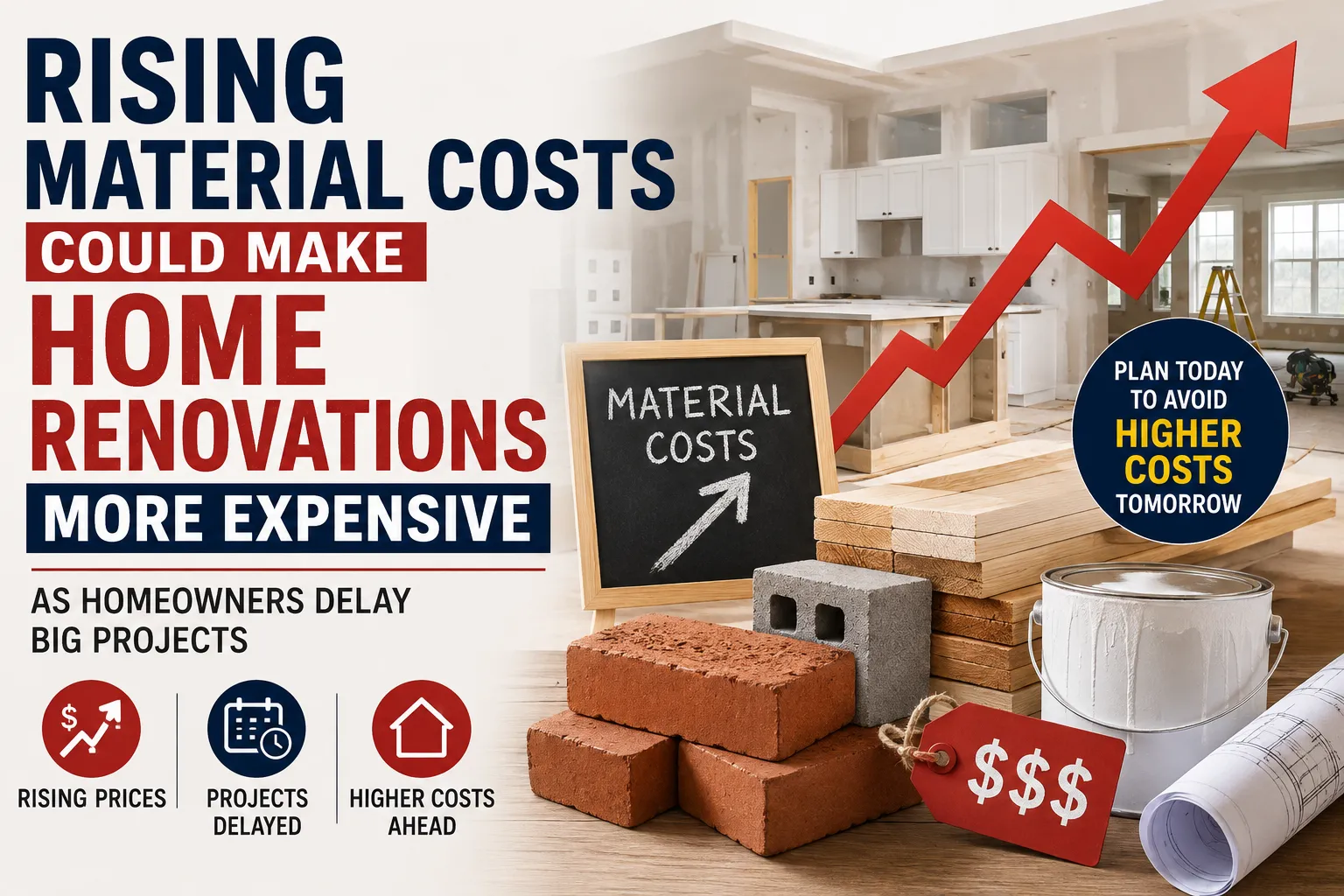
Rising Material Costs Could Make Home Renovations More Expensive as Homeowners Delay Big Projects
Home renovation plans are increasingly being shaped by a difficult combination of higher material costs, expensive financing and cautious household spending.
For homeowners considering a kitchen remodel, bathroom renovation, extension or other major improvement, the challenge is no longer simply deciding what to change. The bigger question is whether the project can still fit comfortably within the household budget.
Recent industry data shows that renovation activity has remained relatively resilient, but larger projects are facing more hesitation as homeowners deal with higher borrowing costs and uncertainty around construction expenses. In the United States, Home Depot recently reported that high interest and mortgage rates were holding back major renovation projects even as demand for smaller repairs remained steady.
That shift could have important consequences for homeowners, contractors and the wider home-improvement market.
Why Renovation Costs Are Under Pressure
The cost of a renovation depends on far more than the price of materials displayed at a hardware store.
A typical project can include:
- Building materials
- Fixtures and fittings
- Contractor labor
- Transportation
- Equipment rental
- Permits
- Design and professional fees
- Waste disposal
- Financing costs
- Unexpected repairs
When several of these expenses rise simultaneously, even a project that appeared affordable at the planning stage can become significantly more expensive by the time construction begins.
Recent industry research has pointed to material prices, labor shortages and economic uncertainty as continuing challenges for remodelers. A second-quarter 2026 remodeling index remained positive, but higher material costs and inflation were contributing to delays in larger projects.
Homeowners Are Becoming More Selective
One of the clearest changes in the renovation market is the difference between small projects and major remodels.
Homeowners may still be willing to spend money on:
- Painting
- Minor repairs
- Landscaping
- Replacing fixtures
- Small bathroom upgrades
- Maintenance
- Energy-efficiency improvements
Large projects are different.
A complete kitchen renovation, home extension or whole-house remodel can require a substantial upfront investment. When borrowing costs are high and household budgets are under pressure, homeowners may decide that postponing the project is safer.
Home Depot recently reported that customers were shifting toward smaller, more manageable projects while delaying larger renovations.
Material Prices Are Only Part of the Problem
It is easy to think of rising renovation costs as simply a materials problem.
In reality, several costs can move together.
Construction Materials
Renovations may require:
- Lumber
- Cement
- Steel
- Tiles
- Drywall
- Paint
- Electrical components
- Plumbing materials
- Flooring
- Roofing products
When these inputs become more expensive, contractors may have to increase project estimates.
Transportation
Heavy materials need to be transported from suppliers to construction sites.
Higher fuel and transportation costs can therefore increase the delivered price of materials even when the underlying product price changes only modestly.
Labor
Skilled workers remain another important component of renovation costs.
Carpenters, electricians, plumbers, painters, masons and other specialists may charge more when demand is strong or skilled labor is difficult to find.
Financing
Homeowners who borrow to fund renovations also face the cost of financing.
Higher interest rates can make a large project considerably more expensive over time.
Kenya’s Construction Costs Offer Another Example
The pressure is not limited to the U.S. market.
In Kenya, recent official data from the Kenya National Bureau of Statistics showed a sharp increase in construction input costs during the second quarter of 2026.
The Construction Input Price Index rose 5.73% between the first and second quarters, with increases in transport, fuel and construction materials contributing to the increase.
Other reporting on the data indicated that cement prices rose by 6.99% during the quarter, while concrete and asphalt increased by 7.25%. Paints, ballast and electrical fittings also recorded increases.
For Kenyan homeowners, this illustrates how fuel and transportation costs can eventually affect renovation budgets even when a homeowner is not directly buying fuel.
Why Homeowners May Delay Major Renovations
Delaying a renovation is often a financial decision rather than a sign that homeowners have abandoned improvement plans altogether.
Someone planning a major project may decide to wait because:
- Material prices are unpredictable
- Contractor quotes have increased
- Mortgage rates remain high
- Household expenses have risen
- Savings need to be preserved
- Financing would be more expensive
- The homeowner expects economic conditions to improve
- The project is desirable but not essential
This creates an important distinction between need-to-do and nice-to-have renovations.
A leaking roof is difficult to postpone indefinitely.
A luxury kitchen upgrade may be much easier to delay.
For homeowners trying to decide which work should come first, a home repairs guide covering common problems and solutions can help put necessary repairs into perspective.
Maintenance Is Winning Over Major Remodeling
The current environment appears to be favoring maintenance and smaller improvements.
Home Depot’s latest results showed that steady demand for repair and maintenance helped offset weaker demand for larger renovation projects.
This makes sense from a household-budget perspective.
A homeowner may not want to spend tens of thousands of dollars on a complete renovation, but spending a smaller amount to repair a leaking faucet, repaint a room or replace a damaged fixture can still make sense.
The result is a market where homeowners remain active but become more selective about what they spend money on.
The broader Home Maintenance Projects framework can also help homeowners think about repairs, improvements and ongoing property care as related but distinct types of spending.
Should Homeowners Wait to Renovate?
There is no universal answer.
Waiting can make sense when a project is primarily cosmetic and the current cost would stretch the household budget.
However, postponing necessary maintenance can sometimes create larger expenses later.
For example, delaying repairs to:
- A leaking roof
- Water damage
- Electrical problems
- Plumbing leaks
- Structural deterioration
- Broken windows
- Poor drainage
can allow a relatively small problem to become significantly more expensive.
The decision should therefore depend on the type of project rather than simply on whether construction prices are rising.
Separate Urgent Repairs From Optional Upgrades
A useful approach is to divide planned improvements into three categories.
Essential
Problems that could cause damage, safety risks or major deterioration if ignored.
Important
Projects that improve efficiency, functionality or property condition but can potentially wait.
Optional
Cosmetic upgrades and improvements that are desirable but not necessary.
When budgets are tight, essential work should generally receive priority.
Get Multiple Renovation Quotes
Homeowners should avoid assuming that the first contractor’s estimate represents the market price.
Getting multiple detailed quotes can reveal significant differences in:
- Labor costs
- Material allowances
- Project timelines
- Contractor margins
- Included services
- Warranty terms
However, the cheapest quote is not automatically the best.
An unusually low estimate may exclude important costs or use lower-quality materials.
A better comparison looks at what each quote actually includes.
Ask How Long the Quote Is Valid
Material prices can change.
A contractor’s estimate from today may not remain accurate several months later.
Before signing a contract, homeowners should understand:
- How long the quote remains valid
- Whether material prices can be adjusted
- What happens if costs increase
- Which materials have fixed prices
- Whether deposits lock in supplier pricing
Clear terms can reduce unpleasant surprises later.
Build a Renovation Contingency Fund
Unexpected costs are common in renovation projects.
Walls may conceal damaged wiring.
Old plumbing may need replacement.
Structural problems may appear after demolition.
Materials may become unavailable.
Permits or design changes may add costs.
For this reason, homeowners should avoid spending their entire renovation budget on the initial estimate.
A contingency reserve provides room for unexpected expenses.
The appropriate amount depends on the project’s complexity and condition of the property, but the general principle is simple:
Do not begin a major renovation with a budget that leaves no room for surprises.
Homeowners can also learn more about how to budget for home maintenance to distinguish ongoing maintenance reserves from money set aside for larger renovation projects.
Consider Renovating in Phases
A large project does not always need to happen at once.
Instead of renovating an entire home simultaneously, homeowners may divide the work into phases.
For example:
Phase 1: Essential repairs
Phase 2: Kitchen improvements
Phase 3: Bathroom renovation
Phase 4: Flooring and painting
Phase 5: Landscaping
Phased renovations can make cash flow easier to manage and allow homeowners to reassess costs before committing to the next stage.
But Phasing Can Also Increase Costs
There is a trade-off.
Completing everything at once may create efficiencies because contractors can work continuously and materials can be purchased in larger quantities.
Phasing can sometimes mean:
- Multiple contractor mobilizations
- Repeated delivery costs
- Repeated demolition or preparation
- Longer disruption
- Higher labor costs
The best strategy depends on the project.
Look for Ways to Reduce Material Costs
Homeowners can sometimes lower costs without sacrificing quality.
Possible approaches include:
- Comparing suppliers
- Buying standard-size materials
- Choosing readily available products
- Avoiding unnecessary custom work
- Comparing equivalent finishes
- Purchasing materials in appropriate quantities
- Reusing existing components where practical
A good contractor or designer can also identify areas where expensive materials provide little additional practical benefit.
Don’t Sacrifice Quality Where It Matters
Cutting costs does not mean choosing the cheapest possible material for every part of a renovation.
Some components are worth paying more for because replacement would be expensive or disruptive.
Examples can include:
- Waterproofing
- Electrical systems
- Plumbing infrastructure
- Structural components
- Roofing
- Quality windows
- Durable flooring in high-traffic areas
Saving money on the wrong component can create larger costs later.
Consider Smaller Improvements With Bigger Impact
When a major renovation is financially difficult, homeowners can look for improvements that deliver noticeable benefits without requiring a complete remodel.
Examples include:
- Repainting walls
- Replacing cabinet hardware
- Updating lighting
- Installing efficient fixtures
- Refinishing existing surfaces
- Improving storage
- Replacing worn flooring in one room
- Improving insulation
- Repairing damaged doors or windows
These projects can refresh a home while keeping spending under greater control.
Energy Efficiency Can Change the Calculation
Some improvements may have financial benefits beyond appearance.
Depending on the property and local energy costs, projects such as:
- Insulation
- Efficient lighting
- Better windows
- Efficient water heating
- Improved ventilation
- Solar equipment
- Efficient appliances
may reduce ongoing operating costs.
The financial case should be evaluated using the project’s upfront cost, expected savings, maintenance requirements and expected lifespan.
Not every energy-efficiency upgrade will pay for itself quickly.
Homeowners should also be aware of common home energy efficiency mistakes that can make an upgrade less effective than expected.
Renovation Decisions Should Consider Financing Costs
A renovation financed through borrowing has two major components:
Project cost + cost of financing
When interest rates are high, even an unchanged construction quote can become more expensive for a homeowner who needs to borrow.
This is one reason higher rates can affect renovation demand even if material prices stabilize.
Homeowners considering financing should compare:
- Interest rate
- Loan term
- Total repayment
- Fees
- Monthly payment
- Early repayment terms
- Variable versus fixed rates
The cheapest-looking monthly payment may not represent the lowest overall cost.
Contractors Are Facing the Same Pressures
Rising costs affect contractors too.
A contractor has to manage:
- Supplier prices
- Fuel
- Labor
- Equipment
- Insurance
- Transportation
- Financing
- Project delays
If costs rise unexpectedly between quoting and purchasing materials, profit margins can shrink.
This can make contractors more cautious about fixed-price contracts and may encourage them to include larger contingencies.
Industry surveys have identified material costs and labor shortages among the major challenges facing construction and remodeling businesses.
Why Delays Can Create a Difficult Cycle
When homeowners delay projects, contractors may see fewer large jobs.
At the same time, contractors still face operating costs.
This can lead businesses to become more selective about which projects they accept.
Homeowners may then experience:
- Longer scheduling times
- Fewer available contractors
- Higher minimum project sizes
- More variable quotes
In some markets, shortages of skilled workers can add another layer of pressure.
Renovation Demand Has Not Disappeared
The current market should not be interpreted as a collapse in home improvement.
Recent data suggests that homeowners are still spending, but their priorities are changing.
The remodeling market can remain active because people still need to maintain aging homes.
Home Depot, for example, reported stronger repair and maintenance demand even as major projects remained under pressure.
This creates an environment where smaller, practical projects can outperform large discretionary renovations.
That shift is consistent with the broader pattern of homeowners prioritizing repairs over major remodels when budgets are under pressure.
What Homeowners Should Watch Next
Several factors could influence renovation affordability over the coming months.
Material Prices
A sustained decline in input costs could make future projects easier to budget.
Interest Rates
Lower borrowing costs could encourage homeowners who have postponed major renovations to restart their plans.
Fuel Prices
Transportation and construction costs can be affected by energy prices.
Labor Availability
A shortage of skilled tradespeople can increase both prices and waiting times.
Household Income
Even stable construction costs may feel expensive if household budgets remain under pressure.
Housing Market Conditions
Homeowners who are reluctant to move may continue investing in their existing properties instead.
A Smarter Way to Plan a Renovation in a High-Cost Environment
Homeowners do not necessarily need to abandon renovation plans when costs rise.
Instead, the planning process becomes more important.
A practical strategy is to:
- Define the problem the renovation needs to solve.
- Separate essential work from cosmetic improvements.
- Establish a realistic maximum budget.
- Get several detailed quotes.
- Check exactly what each quote includes.
- Set aside money for unexpected costs.
- Compare financing options carefully.
- Research material alternatives.
- Consider completing the work in phases.
- Avoid compromising on critical structural or safety components.
This approach can reduce the risk of beginning a project that becomes financially difficult halfway through construction.
The Renovation Market Is Rewarding Careful Planning
Rising material costs do not mean homeowners have to stop improving their properties. They do mean that major renovations require more careful financial planning than they might have a few years ago.
Current industry evidence shows a clear split between essential maintenance and large discretionary projects. Homeowners continue to spend on repairs and smaller upgrades while higher interest rates, inflation and construction costs make major renovations harder to justify.
For homeowners, the smartest response is not necessarily to wait indefinitely for prices to fall. Instead, it is to determine which work genuinely needs to be done, obtain realistic quotes, maintain a contingency fund and consider whether the project can be redesigned or phased to fit the available budget.
The goal is not simply to complete a renovation as cheaply as possible. It is to make improvements that provide lasting value without turning a better home into an unnecessary financial burden.