What Is the Difference Between Cleaning and Disinfecting?
**What Is the Difference Between Cleaning and Disinfecting?
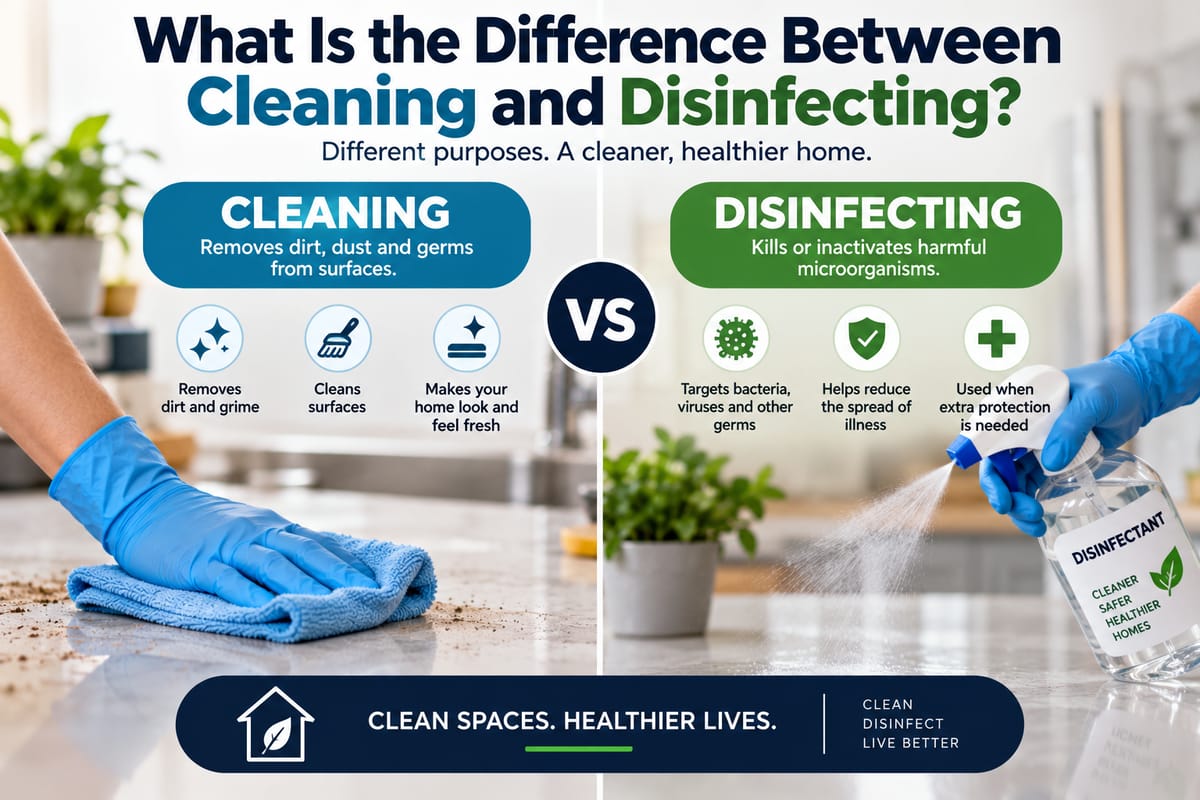
Cleaning and disinfecting are often treated as if they mean the same thing, but they serve different purposes. Cleaning is primarily about removing dirt, dust, food residue, stains, and other unwanted material from a surface. Disinfecting, on the other hand, is designed to reduce or destroy harmful microorganisms that may remain on a surface after cleaning.
Understanding the difference matters because a surface can look spotless without being free of germs. Likewise, disinfecting a visibly dirty surface may not work as effectively as expected because dirt and organic material can interfere with the process.
Knowing when to clean, when to disinfect, and when to do both can make household cleaning more effective without turning every routine chore into a complicated sanitation exercise.
What Does Cleaning Mean?
Cleaning is the physical removal of unwanted material from a surface, object, or area. This can include dust, dirt, grease, food particles, body fluids, stains, and other debris.
Common cleaning methods include:
- Wiping surfaces with a cloth
- Washing with soap and water
- Scrubbing floors and countertops
- Vacuuming carpets and upholstery
- Sweeping and mopping
- Removing food residue from kitchen surfaces
- Washing dishes and household items
Cleaning does not necessarily kill every microorganism. Instead, it removes contaminants and many germs from surfaces, reducing the amount of material that could support their presence.
For routine household maintenance, regular cleaning is often all that is needed.
A broader approach to household cleaning can be found in The Ultimate Guide to Cleaning Your Home, which covers the different areas and surfaces that require regular attention.
What Does Disinfecting Mean?
Disinfecting is a process intended to kill or inactivate harmful microorganisms on surfaces. Disinfectants are formulated specifically for this purpose and may work against bacteria, viruses, fungi, or other microorganisms depending on the product.
Unlike ordinary cleaning, disinfecting is not primarily concerned with removing visible dirt.
A disinfectant may be applied to a previously cleaned surface and left wet for a specified amount of time. This period is sometimes called the contact time. If the product is wiped away too quickly, it may not have enough time to work as intended.
Disinfectants can come in several forms, including:
- Sprays
- Wipes
- Concentrated liquids
- Ready-to-use solutions
- Certain specialized cleaning products
Not every product labeled as a cleaner is a disinfectant, and not every disinfectant is intended for every type of surface.
Cleaning vs. Disinfecting: The Main Difference
The simplest way to understand the distinction is this:
Cleaning removes dirt and contaminants, while disinfecting targets microorganisms.
Imagine a kitchen countertop after preparing a meal. You might see crumbs, grease, and food residue on the surface. Cleaning removes those visible materials.
After someone in the household has been sick, however, there may be a reason to disinfect frequently touched surfaces in addition to cleaning them. Disinfecting addresses microorganisms that may remain after the visible mess has been removed.
The two processes therefore complement each other rather than compete with each other.
Why Cleaning Usually Comes First
Disinfecting a dirty surface is not always the most effective approach.
Organic material such as food residue, grease, and other debris can make it more difficult for a disinfectant to reach microorganisms. A dirty surface can also prevent the disinfectant from making consistent contact with the material underneath.
That is why many cleaning situations call for a two-step approach:
- Clean the surface.
- Disinfect it when disinfection is appropriate.
This sequence removes physical debris first and then allows the disinfectant to work more directly on the remaining microorganisms.
However, some products are specifically designed to clean and disinfect in one step when used according to their instructions. The product label is the best guide for determining how a particular formulation should be used.
When Is Cleaning Enough?
Routine cleaning is appropriate for many everyday household tasks.
For example, you generally do not need to disinfect every surface in your home every time you clean it. Regular cleaning can help keep living spaces comfortable, remove accumulated dirt, and reduce the amount of material where microorganisms may persist.
Cleaning is commonly sufficient for:
- Removing dust from furniture
- Cleaning floors
- Washing ordinary dishes
- Removing crumbs from countertops
- Cleaning mirrors and windows
- Washing laundry
- Removing everyday bathroom grime
- Maintaining generally clean living spaces
The goal is to match the cleaning method to the situation instead of automatically using the strongest available product.
When Should You Consider Disinfecting?
Disinfecting can be particularly useful when there is a greater concern about the spread of infectious microorganisms.
Situations where disinfection may be appropriate include:
- After someone in the household has been sick
- Cleaning surfaces contaminated with certain bodily fluids
- Frequently touched surfaces during periods of illness
- Certain food-preparation situations
- Shared surfaces used by many people
- Areas where contamination is more likely
High-touch surfaces can include door handles, light switches, faucet handles, toilet handles, remote controls, phones, and other objects that multiple people regularly touch.
The need for disinfection depends on the circumstances. Disinfecting every surface constantly is not necessarily better household hygiene.
What Are Cleaning Products Designed to Do?
The words used on product labels can sometimes make cleaning products confusing. A cleaner, sanitizer, disinfectant, detergent, and specialized surface treatment may all have different purposes.
Some products primarily remove dirt. Others are formulated to reduce microorganisms, while some are designed to perform multiple functions.
Understanding these distinctions can make it easier to choose the right product for a particular task. Cleaning Products Explained provides additional information about the different types of products used around the home.
It is also important to follow the manufacturer’s directions. Using more product than recommended does not automatically make a surface cleaner or safer.
What Is Sanitizing?
Sanitizing is another term that is often confused with cleaning and disinfecting.
In general, sanitizing means reducing the number of microorganisms on a surface to a level considered acceptable under the circumstances. It is therefore different from simply removing dirt and different from disinfection.
The distinction can be especially important in food preparation and food-service environments.
For household use, people may encounter products or instructions that refer to cleaning, sanitizing, or disinfecting depending on the surface and situation.
These terms should not be treated as interchangeable because they describe different levels or purposes of microbial control.
Bathroom Cleaning and Disinfecting
Bathrooms contain several surfaces that can benefit from regular cleaning because they accumulate soap residue, mineral deposits, dirt, moisture, and other buildup.
Cleaning a bathroom typically involves removing this visible material from sinks, showers, tubs, floors, mirrors, toilets, and other surfaces.
Disinfection may be appropriate for certain frequently touched or contamination-prone surfaces, particularly when someone in the household is ill.
The process is more effective when surfaces are cleaned properly first. For a practical approach to bathroom maintenance, How to Clean a Bathroom Properly explains how different bathroom areas can be tackled systematically.
It is also important to use products only on surfaces for which they are intended. Some disinfectants can damage particular materials, finishes, fabrics, or sensitive surfaces.
The Kitchen Requires a Different Approach
Kitchens require careful attention because surfaces can come into contact with food, raw ingredients, hands, utensils, and packaging.
Cleaning removes food particles and other residue, while appropriate sanitizing or disinfecting procedures can help manage microorganisms when the situation calls for them.
One of the biggest concerns in a kitchen is not simply whether a countertop looks clean, but whether microorganisms can be transferred from one surface or food to another.
For example, raw meat juices can potentially contaminate cutting boards, utensils, countertops, refrigerator handles, or other areas. Preventing this movement is an important part of kitchen hygiene.
How to Prevent Cross-Contamination in the Kitchen offers a more detailed look at keeping food-preparation areas separated and reducing unnecessary contamination.
Why More Disinfectant Is Not Always Better
It can be tempting to assume that using disinfectants more frequently or in greater quantities will automatically create a cleaner home.
That is not necessarily the case.
Disinfectants are specialized chemical products, and they should be used according to their instructions. Excessive or inappropriate use can create unnecessary exposure to chemicals, damage surfaces, or produce unpleasant fumes.
Some cleaning chemicals can also be dangerous when mixed together. Household products should never be combined unless the manufacturer specifically states that they are compatible.
Good cleaning is not about using the strongest chemical available. It is about using an appropriate method for the problem.
How to Disinfect a Surface Properly
When disinfection is appropriate, several basic steps can help make the process more effective.
1. Remove visible dirt
If the surface is visibly dirty, clean it first unless the product is specifically designed to clean and disinfect simultaneously.
2. Select the appropriate product
Choose a disinfectant intended for the specific surface and purpose.
3. Follow the label
Product instructions can specify how much should be used, whether dilution is necessary, and how long the surface should remain wet.
4. Allow sufficient contact time
A disinfectant generally needs to remain on the surface for the period specified by its manufacturer.
5. Follow any rinsing instructions
Some products may require rinsing after treatment, particularly when used on food-contact surfaces or other specific materials.
6. Store products safely
Keep cleaning and disinfecting products in their original containers and store them where children and pets cannot accidentally access them.
Common Mistakes People Make
Several misconceptions can make household cleaning less effective.
Assuming a clean-looking surface is germ-free
A surface can look spotless while still containing microorganisms. Appearance and microbial cleanliness are not the same thing.
Disinfecting without cleaning
Visible dirt and organic material can interfere with the effectiveness of some disinfectants.
Using the wrong product
A product designed for one surface may be unsuitable for another. Always check the label.
Wiping disinfectant away immediately
Removing a disinfectant before its required contact time can reduce its effectiveness.
Mixing cleaning chemicals
Combining products can create hazardous reactions or irritating fumes. Household cleaners should be used separately unless the manufacturer explicitly permits mixing.
Using excessive amounts
More chemical does not necessarily mean better results. Following the recommended amount is generally the safer and more effective approach.
How Often Should You Clean and Disinfect?
There is no single schedule that works for every home.
Routine cleaning can be performed according to how quickly different areas accumulate dirt and how heavily they are used. Kitchens and bathrooms, for example, often need more frequent attention than relatively low-traffic areas.
Disinfection can be more situation-dependent.
A household may choose to disinfect certain high-touch surfaces more frequently when someone is sick, while routine cleaning may be sufficient under normal circumstances.
Factors that can influence the approach include:
- How many people live in the home
- How frequently surfaces are touched
- Whether someone is ill
- Whether pets are present
- How a room is used
- Whether food is prepared on the surface
- Whether visible contamination has occurred
The most effective routine is one that addresses actual household needs rather than treating every surface as though it requires intensive disinfection.
A Practical Cleaning and Disinfecting Routine
For many households, a straightforward routine can make the distinction easier to apply.
Start with routine cleaning. Remove dust, dirt, food particles, grease, stains, and other debris from commonly used areas.
Pay particular attention to kitchens and bathrooms because these spaces often experience moisture, food contact, frequent handling, and heavier daily use.
When circumstances create a greater concern about harmful microorganisms, identify high-touch or contaminated surfaces and disinfect them using an appropriate product.
This approach prevents unnecessary chemical use while still providing a way to increase hygiene when it matters.
Cleaning and Disinfecting Work Together
Cleaning and disinfecting are not competing approaches. They address different parts of household hygiene.
Cleaning focuses on removing unwanted material. Disinfecting focuses on reducing or destroying microorganisms.
In many ordinary situations, regular cleaning is enough to maintain a comfortable and hygienic home. When there is an increased risk of contamination or infectious disease transmission, disinfection can provide an additional layer of protection.
The key is understanding the purpose of each process and applying it appropriately. A clean home does not need to be saturated with disinfectant, and a disinfected surface is not necessarily clean if dirt and debris remain.
Once that distinction becomes clear, household cleaning becomes much easier to approach: remove the dirt first, use disinfection when it is genuinely needed, and always follow the directions for the products being used.