AI-Powered Home Appliances Move Further Into Everyday Household Life
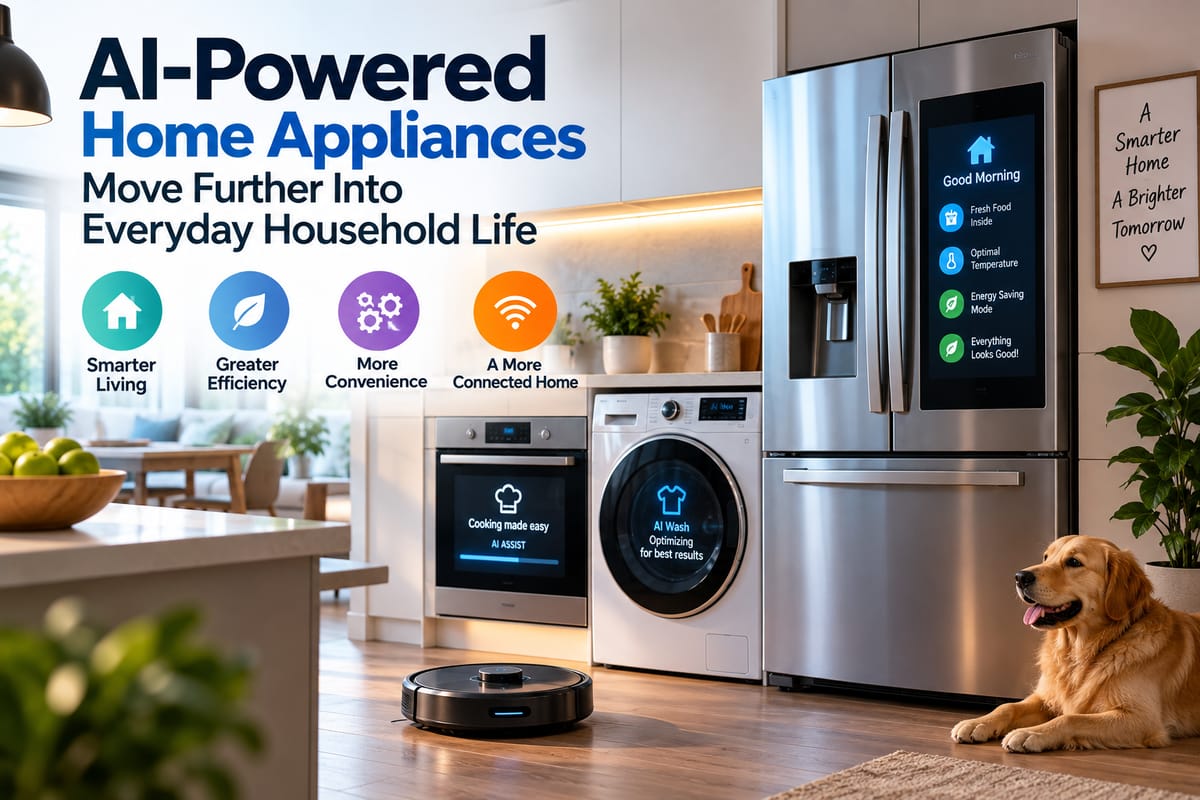
AI-Powered Home Appliances Move Further Into Everyday Household Life
Artificial intelligence is moving beyond smartphones and computers and into one of the most familiar parts of daily life: the home.
Modern appliances are increasingly being designed with sensors, connectivity and AI-powered software that can recognize patterns, adjust settings and respond to changing household conditions. Refrigerators, washing machines, ovens, vacuum cleaners, thermostats and other devices can now do more than perform a single programmed function.
The shift is changing what people expect from household appliances. Instead of simply responding to buttons or manual settings, connected appliances can increasingly anticipate needs, optimize their operation and communicate with other devices.
What Makes an Appliance AI-Powered?
Traditional appliances generally follow predefined instructions. A washing machine, for example, may allow users to select a cycle, temperature and spin speed before starting.
An AI-enabled appliance can use additional information to make decisions about how it should operate.
Depending on the device, that information may come from:
- Temperature sensors
- Motion detectors
- Cameras
- Weight sensors
- Energy monitors
- Humidity sensors
- Usage history
- Connected devices
- Voice commands
- Environmental data
Software can then analyze these inputs and adjust the appliance’s behavior.
This does not mean every smart appliance contains sophisticated artificial intelligence. Some connected products simply allow remote control through an app. Others use machine learning or automated decision-making to adapt to household patterns.
Understanding the wider technology behind these devices is useful when exploring The Complete Guide to Smart Homes.
Appliances Are Becoming More Adaptive
One of the biggest changes is the move from fixed settings toward adaptive operation.
A smart thermostat, for example, can learn when a household typically needs heating or cooling and adjust its schedule accordingly. A robotic vacuum may identify frequently used areas and change its cleaning behavior based on the layout of a home.
Smart washing machines can use information about load size or fabric type to recommend or automatically select appropriate settings.
The objective is not simply to add more technology. It is to reduce the number of decisions people need to make during routine household tasks.
How AI Can Learn Household Patterns
AI-powered appliances can become more useful when they have access to information about how a household operates.
Consider a kitchen appliance that is used at approximately the same time each morning. Over time, software may identify that recurring pattern and make certain controls easier to access or suggest a frequently used setting.
Other devices can respond to changing conditions rather than relying exclusively on schedules.
For example, a smart home system could detect that someone has entered a room, determine the current lighting conditions and activate connected lighting based on predefined preferences.
The underlying concept is explored in How Smart Homes Detect User Activity and Respond Automatically.
The Connected Kitchen
The kitchen is becoming one of the most visible areas for AI-enabled household technology.
Smart refrigerators can monitor temperature conditions and provide alerts. Some models can use internal cameras or other sensors to help households keep track of stored food.
Ovens can offer guided cooking programs, monitor cooking conditions and automatically adjust certain settings.
Coffee makers, dishwashers and other kitchen appliances can also connect to broader smart-home systems.
The long-term direction is toward a kitchen in which individual appliances do not operate entirely independently.
AI-Powered Cleaning
Robotic vacuum cleaners have become an important example of household automation.
Earlier robotic vacuums largely followed simple movement patterns. Newer systems can use cameras, sensors and mapping technologies to understand the environment more effectively.
Some can distinguish rooms, identify obstacles and create cleaning schedules.
AI can also help these devices adapt to changing conditions. A robot may recognize that certain areas require more frequent cleaning or alter its route when furniture changes.
The result is a household appliance that performs a recurring task with less direct involvement from the user.
Smarter Laundry Appliances
Laundry is another area where automation can reduce repetitive decision-making.
AI-enabled washing machines may use sensors to estimate load characteristics and recommend settings. Depending on the model, software may help determine factors such as water level, cycle duration or washing intensity.
Dryers can similarly use sensors to detect moisture levels and adjust operation rather than relying entirely on a fixed timer.
These capabilities can potentially reduce unnecessary cycles and make laundry routines more convenient.
However, automated recommendations still need to be understood as recommendations or programmed decisions rather than guarantees that every load will receive the perfect treatment.
Smart Appliances Need to Work Together
The real potential of an AI-powered home becomes more apparent when individual appliances can communicate with one another.
A smart thermostat, lighting system, security camera and appliance may each provide useful information independently. When compatible systems can share information, they can create more coordinated household routines.
For example, a home could use occupancy information to adjust lighting and temperature when residents arrive. A connected appliance could send a notification to a smartphone when a cycle is complete.
Learning How to Make Different Smart Home Devices Work Together can help explain why communication between devices is such an important part of the smart-home experience.
Compatibility Remains a Major Challenge
Buying several smart appliances does not automatically create a seamless smart home.
Different manufacturers may use different platforms, communication standards and applications. Some devices may work with one ecosystem but have limited functionality with another.
This can create frustration for homeowners who expect every connected product to work together automatically.
Compatibility is therefore becoming an important consideration when purchasing smart appliances. The issue is examined in greater detail in Understanding Smart Home Integration and Compatibility.
Consumers may need to consider not only what an appliance can do today, but also how easily it can communicate with other products they already own.
Voice Control Is Only One Part of AI
Voice assistants helped introduce many consumers to smart-home technology, but AI-powered appliances are no longer dependent on voice commands.
Modern systems can combine several forms of input.
An appliance may respond to:
- A voice instruction
- A smartphone command
- A sensor reading
- A predetermined schedule
- Detected household activity
- Information from another connected device
This allows automation to happen without requiring the user to interact with a screen every time.
Energy Management Is Becoming More Intelligent
Energy efficiency is another area where smart appliances can have an important role.
Connected appliances can monitor their own operation and, in some systems, provide information about energy consumption.
A household may use this information to identify appliances that consume significant amounts of electricity or adjust routines to reduce unnecessary usage.
Smart thermostats can also optimize heating and cooling schedules based on occupancy and environmental conditions.
The technology does not guarantee lower energy bills, since savings depend on appliance efficiency, household behavior, utility rates and how automation is configured. Still, better visibility and automated controls can give households more tools for managing consumption.
Privacy and Data Matter
The convenience of connected appliances comes with another consideration: data.
An appliance that detects occupancy, records usage patterns or connects to an online account may generate information about how a household operates.
Consumers should therefore pay attention to privacy settings, account security, software updates and the information a device collects.
A smart appliance should not be viewed solely as a physical product. It can also be part of a software ecosystem that receives updates and handles household data.
Strong passwords, secure home networks and regularly updated software can help reduce common security risks.
AI Does Not Eliminate Human Control
The increasing automation of household appliances does not mean people have to surrender control of their homes.
Most systems still allow users to change settings, disable certain automated functions or establish schedules and preferences.
That human control remains important because household routines can change. A system that learns from yesterday’s behavior may not automatically understand why today’s routine is different.
A good smart-home system should therefore make automation convenient without making basic control unnecessarily complicated.
What Homeowners Should Consider Before Buying
AI features can make an appliance sound more advanced, but additional technology is not always the most important factor.
Before purchasing a connected appliance, homeowners can consider:
- Actual usefulness: Does the AI feature solve a real household problem?
- Compatibility: Will the appliance work with existing smart-home devices?
- Privacy: What information does it collect and how is that information handled?
- Security: Does the manufacturer provide regular software updates?
- Reliability: Can the appliance still perform essential functions if the internet connection fails?
- Repairability: Are replacement parts and service available?
- Long-term support: How long is the software expected to remain supported?
- Cost: Does the additional technology justify the higher purchase price?
These questions can help distinguish genuinely useful automation from features that simply make an appliance appear more technologically advanced.
The Next Stage of the Smart Home
AI-powered appliances are gradually changing the role of household technology. The appliance of the future is increasingly being designed not simply to execute instructions, but to interpret information and adapt its behavior.
That shift could make routine tasks easier, improve visibility into household energy use and allow different devices to coordinate their operation.
At the same time, successful smart homes will depend on more than increasingly capable AI. Compatibility, privacy, security, reliability and user control will remain just as important as automation.
As these systems become more common, the most meaningful change may be less about individual appliances becoming smarter and more about the entire home becoming capable of responding intelligently to the people who live in it.