How Food Preparation Changes Calories
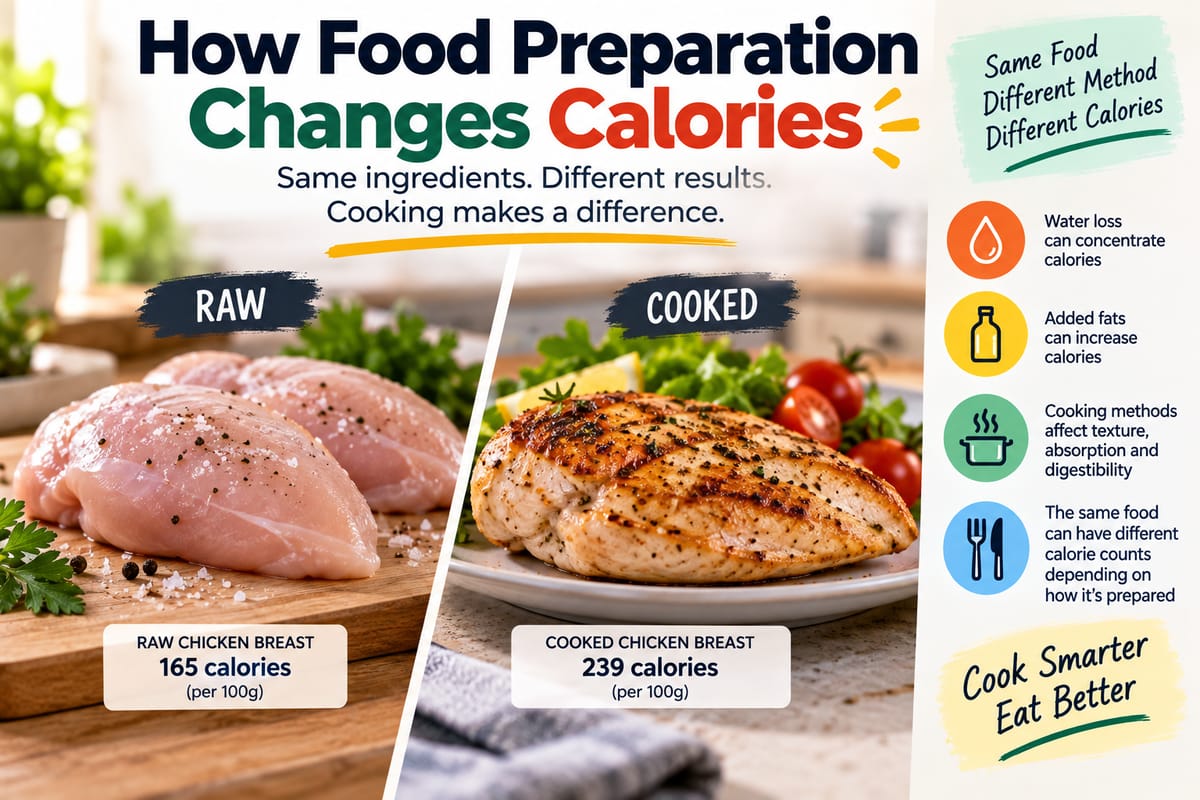
How Food Preparation Changes Calories
When people talk about calories in food, they often focus on the number printed on a nutrition label or listed in a food database. But the way food is prepared can change how many calories a person ultimately consumes from a meal.
Cooking does not simply make food hotter. It can alter moisture content, break down structures within ingredients, change the amount of fat absorbed, and affect how easily the body can digest certain foods. Portion size and added ingredients can also dramatically change the calorie content of a finished dish.
This does not mean that cooking automatically makes food more or less healthy. Instead, food preparation changes the physical and chemical characteristics of ingredients in ways that can influence their energy content, digestibility, and overall nutritional profile.
Understanding these changes can make it easier to plan balanced meals and interpret calorie information more realistically.
What Does It Mean When Food Preparation Changes Calories?
A calorie is a unit used to describe energy. In nutrition, the calories listed for foods generally represent the amount of energy that can be obtained from carbohydrates, proteins, fats, and other energy-producing components.
Food preparation can affect calorie intake in several different ways.
For example, boiling vegetables without adding anything does not suddenly create additional calories. However, frying those same vegetables in oil introduces energy from the cooking fat. Roasting a food can also remove water, making its calories more concentrated by weight.
Preparation can therefore affect calories through:
- Added ingredients
- Water loss or absorption
- Fat absorption
- Changes in food structure
- Changes in digestibility
- Changes in portion size
- Changes in how much food is consumed
The distinction between calories in the food itself and calories in the finished meal is particularly important.
Cooking Does Not Always Add Calories
One common misconception is that cooking itself increases the calorie content of every food.
Heat does not inherently create calories. If a potato is boiled in plain water, for example, the water does not provide meaningful calories, and the potato does not suddenly gain energy simply because it was heated.
What can change is the food’s water content and physical structure.
Boiled foods may absorb water, while roasted foods often lose water. These changes can make the calorie content appear very different when measured by weight even if no calorie-containing ingredient was added.
This is one reason raw and cooked food should not always be compared gram for gram.
Water Loss Can Concentrate Calories
Water contains no calories, but it contributes substantially to the weight of many foods.
When food is cooked and loses water, its weight decreases while much of its energy remains.
Consider a food that begins with a large amount of water. After roasting or baking, some of that water evaporates. The finished food weighs less, but the remaining carbohydrates, proteins, fats, and other components may be concentrated into a smaller amount of food.
As a result, 100 grams of the cooked food can contain more calories than 100 grams of the raw food, even though no calories were created during cooking.
This is particularly relevant when comparing calorie information for:
- Meat
- Fish
- Vegetables
- Potatoes
- Grains
- Legumes
The amount of water lost varies depending on the ingredient and cooking method.
Water Absorption Can Dilute Calories by Weight
The opposite can happen when foods absorb water.
Rice, pasta, beans, and other dry ingredients can absorb substantial amounts of water during cooking.
The cooked food therefore weighs much more than the dry ingredient, but the additional weight comes largely from water rather than additional calories.
For example, a measured amount of dry rice contains a certain amount of energy. After cooking, that same rice may weigh considerably more because it has absorbed water.
This means that the calorie content per 100 grams can be much lower after cooking even though the total calories in the original portion have not disappeared.
For accurate calorie tracking, it is therefore important to know whether a food’s nutritional information refers to its raw or cooked weight.
Frying Can Increase Calories Significantly
Frying is one of the clearest examples of food preparation changing the calorie content of a finished meal.
Cooking oil contains a concentrated amount of energy. When food is fried, some of that oil can remain on the food or be absorbed into it.
The amount absorbed depends on factors such as:
- Type of food
- Surface area
- Cooking temperature
- Cooking time
- Moisture content
- Type of coating
- Amount of oil used
A food that is naturally low in calories can become considerably more energy-dense when prepared with a substantial amount of oil.
This is why the cooking method alone does not tell the whole story. The ingredients used during cooking are equally important.
Baking and Roasting Can Change Energy Density
Baking and roasting often involve less added fat than deep-frying, but they can still alter the calorie density of food.
One major factor is water loss.
As moisture evaporates, foods can become smaller and more concentrated. A roasted vegetable, for example, may occupy less space than the same amount of raw vegetable.
Roasting can also involve oils, sauces, marinades, or other ingredients that add calories to the final dish.
The cooking method is therefore only one part of the calculation.
For practical guidance on making nutritious choices during meal preparation, a Healthy Cooking Guide can help put cooking techniques and ingredient choices into a broader context.
Boiling and Steaming Usually Do Not Require Added Fat
Boiling and steaming are often useful techniques when the goal is to prepare food without adding significant amounts of cooking oil.
Water-based cooking can change the food’s texture, weight, and nutrient composition without necessarily adding calories.
However, what happens after cooking still matters.
A bowl of steamed vegetables may be relatively low in calories, but adding a creamy sauce, butter, cheese, or oil can substantially increase the energy content of the finished meal.
Similarly, boiled potatoes can become a much higher-calorie dish when they are turned into a preparation containing substantial amounts of butter, cream, or other energy-dense ingredients.
Cooking Can Make Some Foods Easier to Digest
Cooking can also change the physical structure of food.
Heat can soften plant cell walls, alter proteins, gelatinize starches, and make some foods easier to chew and digest.
These changes can influence how the body accesses nutrients and energy from food.
This is one reason researchers distinguish between the theoretical energy contained in food and the amount of energy that the body can actually obtain from it.
The effect varies between foods and cooking methods, so it is difficult to assign one universal calorie adjustment to cooking.
The Role of Starch and Carbohydrates
Starchy foods provide a useful example of how preparation can change food structure.
Foods such as potatoes, rice, pasta, and grains contain starch. Heating starch in the presence of water can cause it to swell and change structure, making it easier to digest.
After some cooked starches cool, portions of the starch can reorganize into a form commonly called resistant starch.
Resistant starch is not digested in the small intestine in the same way as readily digestible starch. Some reaches the large intestine, where it can be fermented by gut microorganisms.
This means that the way starchy foods are cooked, cooled, and subsequently prepared can affect how their carbohydrates behave.
However, this should not be interpreted as meaning that simply cooling every starchy food dramatically reduces its calories. The actual effect depends on the food, preparation process, storage conditions, and portion.
Food Texture Can Influence Eating
Food preparation also changes texture, and texture can indirectly affect calorie intake.
Soft, highly processed foods may be easier and faster to eat than foods that require more chewing. Cooking can also change how filling a meal feels and how quickly it can be consumed.
For example, a whole cooked vegetable and a blended vegetable soup may contain similar ingredients but have very different textures and eating experiences.
The broader relationship between cooking and physical characteristics is explored in How Cooking Methods Affect Food Texture and Consistency.
Texture does not determine calorie intake by itself, but it can influence eating behavior and portion size.
Temperature Can Affect Cooking Results
Temperature matters because it determines how quickly food changes during cooking.
Higher temperatures can accelerate browning, moisture loss, fat rendering, and other chemical and physical processes. Lower temperatures can produce different textures and may preserve more moisture.
The relationship between temperature and cooking outcomes is discussed in How Cooking Temperature Affects Food and Cooking Results.
Temperature also interacts with cooking time. Two foods cooked at different temperatures for different lengths of time may lose different amounts of water or absorb different amounts of fat.
Added Ingredients Often Matter More Than the Cooking Method
When people compare cooking methods, it is easy to focus on whether something was baked, boiled, grilled, or fried.
But the ingredients added during preparation can sometimes make a much larger difference.
Consider a basic vegetable:
- Steamed vegetables with no added fat remain relatively low in calories.
- Roasted vegetables with a small amount of oil contain additional calories from that oil.
- Vegetables coated in a rich sauce may contain substantially more calories.
- Deep-fried vegetables can absorb significant amounts of cooking fat.
The same basic ingredient can therefore become several very different meals depending on what is added.
This is why looking at the entire recipe is more useful than judging the cooking method in isolation.
Portion Size Still Matters
Changes in food preparation do not eliminate the importance of portion size.
A calorie-dense ingredient can contribute a relatively small amount of energy when used sparingly, while a nutritious ingredient can contribute substantial calories when consumed in very large quantities.
Cooking can also change the apparent size of a portion.
For example, vegetables may shrink substantially during roasting, while grains and legumes expand as they absorb water.
Using visual comparisons alone can therefore sometimes make it difficult to estimate how much food is actually being consumed.
Raw Versus Cooked Measurements
Anyone tracking calories should pay close attention to whether measurements are based on raw or cooked food.
This is especially important for foods that undergo major changes in water content.
For example:
- Dry rice and cooked rice have very different weights.
- Raw meat and cooked meat have different water contents.
- Dry pasta and cooked pasta differ substantially in weight.
- Raw vegetables may weigh more than the same vegetables after roasting.
If a nutrition database gives calories for a cooked ingredient but a person weighs the ingredient before cooking, the resulting calculation may be inaccurate.
Consistency is often more useful than trying to find a perfect universal conversion.
Different Cooking Methods, Different Calorie Outcomes
Several common cooking methods can affect calorie density in different ways.
Steaming
Steaming generally adds little or no energy to food because it does not require food to be submerged in oil.
Boiling
Boiling can cause foods to absorb water, increasing their weight without adding calories from the water itself.
Grilling
Grilling can cause moisture and some fat to leave food, although marinades, oils, and sauces can add calories.
Baking
Baking can reduce moisture and concentrate calories by weight, while added fats or ingredients can increase total calories.
Roasting
Roasting commonly reduces water content and can increase energy density by weight. Added oil can further increase calories.
Stir-Frying
Stir-frying can be relatively energy-dense when substantial amounts of oil are used, although the total amount depends on the recipe.
Deep-Frying
Deep-frying can substantially increase the energy content of foods because cooking oil can become part of the finished meal.
A broader overview of these techniques can be found in Cooking Methods Explained: The Complete Guide.
Does Cooking Destroy Calories?
Cooking does not simply destroy calories.
Some components of food can be lost during preparation. For example, small amounts of carbohydrates, fats, proteins, or other substances may be lost in cooking water or rendered away from foods.
However, the calorie content of a food does not behave like a fixed quantity that either disappears or remains completely unchanged.
What happens depends on:
- The original ingredient
- Cooking method
- Temperature
- Cooking time
- Water movement
- Fat loss or absorption
- Added ingredients
- Whether cooking liquid is consumed
A soup provides a good illustration. If nutrients and energy-containing compounds move from vegetables or meat into the broth and the broth is consumed, much of that material remains part of the meal. If cooking water is discarded, some components may leave the food system entirely.
Why Calorie Estimates Can Differ
Two calorie estimates for the same food may sometimes differ without either one being intentionally misleading.
Nutrition databases use different assumptions about:
- Raw versus cooked weight
- Moisture content
- Ingredient composition
- Cooking method
- Portion size
- Recipe ingredients
Real-world cooking also varies.
One person may roast potatoes with one tablespoon of oil, while another uses several tablespoons. One person may cook meat until it loses substantial moisture, while another stops cooking earlier.
Consequently, calorie numbers should be treated as useful estimates rather than perfectly precise measurements.
How to Prepare Food With Calories in Mind
People who want to manage calorie intake do not necessarily need to avoid particular cooking methods.
Instead, they can pay attention to the overall preparation process.
Useful habits include:
- Measuring calorie-dense cooking fats when appropriate
- Using vegetables and other nutrient-rich ingredients generously
- Paying attention to portion sizes
- Comparing raw and cooked measurements consistently
- Choosing cooking methods that fit personal nutritional goals
- Being mindful of sauces, dressings, coatings, and toppings
- Avoiding assumptions that a particular cooking method automatically makes food healthy or unhealthy
The goal is not to make every meal as low in calories as possible. A balanced diet also depends on adequate nutrition, satisfaction, variety, and enjoyment.
Cooking Changes More Than Calories
The effects of food preparation extend well beyond energy content.
Cooking can influence:
- Flavor
- Aroma
- Texture
- Digestibility
- Food safety
- Nutrient availability
- Moisture
- Appearance
- Satiety
- Portion size
These factors interact with one another.
A cooking method that produces a more appealing texture may encourage someone to eat more vegetables. A method that removes substantial moisture may concentrate flavor. A sauce can increase calories while also making a meal more enjoyable and helping someone eat a wider variety of nutritious foods.
Healthy cooking is therefore about more than minimizing calories.
Making Sense of Calories in the Kitchen
Food preparation can change the calorie content of a meal in several ways, but the biggest effects often come from changes in water content, added fats, ingredients, portion sizes, and food structure.
Cooking itself does not automatically make food more or less caloric. Instead, different techniques alter the physical characteristics of ingredients and can change how much energy is contained in a given weight or serving.
Understanding these differences makes it easier to interpret nutrition information and make practical choices in the kitchen. Rather than focusing on one cooking method as universally better, it is more useful to consider the ingredients, preparation technique, portion, and overall nutritional balance of the finished meal.