Different Types of Household Stains and How They Form
Different Types of Household Stains and How They Form
Household stains are more than just unpleasant marks on walls, floors, furniture, clothing, and countertops. They are the visible result of substances interacting with a surface, and understanding how that interaction happens can make stain removal much easier.
A coffee spill on a fabric sofa behaves differently from grease on a kitchen backsplash, while hard-water deposits on a faucet require an entirely different approach. The longer a stain remains, the more opportunity it may have to penetrate, chemically react with the surface, dry into a residue, or become difficult to remove.
Knowing what caused a stain and how it formed is therefore one of the most important steps in choosing the right cleaning method.
What Exactly Is a Household Stain?
A stain is a visible discoloration or alteration of a material caused when another substance comes into contact with its surface.
The substance responsible for the stain may remain on the surface, penetrate into the material, chemically react with it, or leave behind particles after a liquid evaporates.
Stains commonly come from:
- Food and beverages
- Oils and grease
- Dirt and soil
- Pet accidents
- Cosmetics
- Ink and dyes
- Rust
- Hard-water minerals
- Mold and mildew
- Soap and detergent residue
- Biological materials
- Smoke and soot
- Certain household chemicals
The nature of the surface matters just as much as the substance causing the stain. Porous materials such as untreated wood, natural stone, grout, and fabric can absorb liquids, while glass, glazed tile, and some sealed surfaces are generally less absorbent.
For broader cleaning strategies, The Ultimate Guide to Cleaning Your Home offers a useful foundation for maintaining different areas and surfaces throughout the house.
Why Some Stains Are Easier to Remove Than Others
Not all stains bond to surfaces in the same way.
A fresh water-based spill may remain mostly on the surface and can sometimes be removed quickly. A greasy substance, however, may spread across a larger area and cling strongly to the material.
Other stains become difficult because they dry out.
As water evaporates, dissolved substances can become more concentrated. Food particles, minerals, dyes, and other materials may remain behind and become increasingly difficult to loosen.
Time is therefore an important factor.
A stain that is relatively easy to treat when fresh may become much more challenging after hours, days, or repeated exposure to heat.
Water-Based Food and Beverage Stains
Coffee, tea, juice, soft drinks, sauces, and many other beverages and foods can produce common household stains.
These substances may contain pigments, sugars, acids, proteins, oils, or combinations of these materials.
When spilled on an absorbent surface, the liquid can spread outward through tiny spaces in the material. As it dries, colored compounds and other residues remain behind.
Coffee and Tea
Coffee and tea contain naturally occurring compounds that can produce brown or yellowish discoloration.
On fabric, upholstery, carpets, and porous surfaces, the liquid can penetrate below the visible surface.
Heat can sometimes make certain stains more difficult to remove by encouraging residues or proteins to bind more strongly to fibers.
Fruit Juice
Fruit juices can contain strong natural pigments as well as sugars and acids.
The pigments can leave visible discoloration, while the sugar component can create a sticky residue that attracts dirt if it is not cleaned thoroughly.
Tomato-Based Foods
Tomato sauces contain pigments that can produce noticeable red or orange stains.
The combination of pigment, moisture, oils, and acidity can make these stains particularly persistent on fabrics and some plastic surfaces.
Grease and Oil Stains
Grease stains are among the most common problems in kitchens and dining areas.
Cooking oils, butter, meat fats, salad dressings, cosmetics, and oily food residues can all leave behind greasy marks.
Unlike water-based spills, oils do not mix readily with water. Instead, they spread across surfaces and can penetrate porous materials.
Grease can also trap dust and other particles, causing an initially small stain to become darker and more noticeable over time.
This is why simply wiping an oily surface with water may leave a slippery film behind.
Degreasing products are designed specifically to help break down or disperse these oily substances.
More information about choosing and understanding household cleaners is available in Cleaning Products Explained.
Protein-Based Stains
Protein-containing substances can produce particularly stubborn stains.
Common examples include:
- Blood
- Milk
- Eggs
- Meat juices
- Some bodily fluids
Proteins can adhere to fibers and surfaces as they dry.
Heat can be especially problematic for some protein-based stains because it may cause proteins to set more firmly into fabric fibers.
For this reason, stain treatment often depends on identifying the substance before applying heat.
Mud and Soil Stains
Mud stains contain a mixture of water, soil particles, minerals, organic matter, and other debris.
When mud is wet, it can spread easily across fabric, carpets, shoes, and floors.
As it dries, the water evaporates and leaves soil particles embedded in or attached to the surface.
Attempting to aggressively rub wet mud can sometimes push particles deeper into fabric fibers or spread the stain.
Allowing appropriate amounts of soil to dry before removing loose particles can make the cleaning process easier in some situations.
Ink and Dye Stains
Ink and dyes are designed to produce strong color, which is precisely why they can be difficult household stains.
Ink may contain pigments, dyes, solvents, oils, or other chemicals depending on the type.
When ink contacts a porous material, the coloring compounds can travel into the material through tiny spaces.
The same basic principle applies to some clothing dyes and colored products that transfer onto other surfaces.
The type of ink or dye matters, so treating every colored stain with the same cleaning product can produce unpredictable results.
Rust Stains
Rust stains usually have a distinctive orange, reddish, or brown appearance.
They are associated with iron compounds formed when iron or steel reacts with oxygen and moisture.
Rust can transfer from metal objects, corroded fixtures, tools, furniture components, and water systems onto nearby surfaces.
Bathrooms are particularly susceptible to rust-colored marks around plumbing fixtures when iron is present in water or metal components begin to corrode.
Rust is chemically different from ordinary dirt, which means conventional all-purpose cleaners may not always remove it effectively.
Hard-Water Mineral Stains
Hard water contains dissolved minerals, commonly including calcium and magnesium.
When water evaporates from faucets, shower doors, sinks, tiles, and other surfaces, these minerals can remain behind.
Repeated evaporation can gradually create a cloudy, white, chalky, or crusty deposit.
These marks are often called:
- Limescale
- Mineral deposits
- Water spots
- Hard-water stains
The longer mineral deposits accumulate, the thicker and more noticeable they can become.
This is why regularly drying wet surfaces can help prevent deposits from building up.
Soap Scum
Soap scum is a residue that commonly forms in bathrooms.
It can develop when soap ingredients interact with minerals in water and combine with body oils, dirt, and moisture.
The resulting film can accumulate on:
- Shower walls
- Bathtubs
- Glass doors
- Faucets
- Tiles
- Shower curtains
Soap scum can create a dull, cloudy appearance and may become increasingly difficult to remove when it is allowed to accumulate.
Regular cleaning helps prevent the residue from developing into a thick layer.
Mold and Mildew Stains
Mold and mildew can produce dark, greenish, gray, brown, or black discoloration depending on the organism and surface.
They thrive particularly well in environments where moisture is persistent.
Common problem areas include:
- Bathrooms
- Damp basements
- Around leaking pipes
- Poorly ventilated rooms
- Window frames
- Damp fabrics
- Areas affected by water damage
Mold-related discoloration is different from an ordinary surface stain because the underlying growth may continue if moisture remains available.
Removing the visible discoloration without addressing the moisture source can allow the problem to return.
Pet Stains
Pet accidents can involve more than visible discoloration.
Urine, for example, contains compounds that can leave behind residues after the liquid evaporates. If the liquid penetrates carpet, upholstery, wood, or padding, the odor and discoloration may persist beneath the surface.
Pet stains can become more difficult when they are not discovered immediately.
The material involved also matters. A stain on a washable textile can be treated differently from one that has penetrated unfinished wood or carpet padding.
Makeup and Cosmetic Stains
Foundation, lipstick, mascara, sunscreen, creams, and other cosmetics can leave marks on clothing, towels, bedding, bathroom surfaces, and upholstery.
Cosmetic products frequently contain a mixture of pigments, oils, waxes, and other ingredients.
This combination means a makeup stain may have both an oily component and a strongly colored component.
Using only water may therefore be insufficient.
Identifying whether the product is primarily oil-based, water-based, waxy, or pigmented can help determine the appropriate cleaning approach.
Sweat and Body-Oil Stains
Clothing, pillowcases, bedding, collars, and upholstery can gradually develop yellowish or darker discoloration from sweat, skin oils, deodorants, and accumulated body products.
Fresh perspiration is not necessarily responsible for all of the visible discoloration.
Over time, oils and residues can interact with detergents, deodorants, minerals, and environmental contaminants, creating marks that become increasingly noticeable.
Regular laundering and proper fabric care can help prevent these residues from accumulating.
Smoke and Soot Stains
Smoke can leave a thin layer of particles and chemical residues on surfaces.
Candles, fireplaces, cooking, tobacco smoke, and fires can all contribute to soot or smoke-related discoloration.
Soot particles are extremely fine and can settle on walls, ceilings, furniture, fabrics, and other surfaces.
Aggressive dry or wet wiping can sometimes spread these particles rather than remove them effectively.
Smoke odors can also penetrate porous materials, making restoration more complicated than simply removing visible discoloration.
Wax Stains
Candles are another common source of household stains.
When melted wax drips onto a surface, it cools and solidifies.
Unlike a liquid stain that soaks into a material, wax may initially form a hardened layer on top of it. However, pigments, fragrances, or oils within the wax can leave additional residues.
The safest removal method depends heavily on the surface because excessive heat or scraping can damage certain finishes.
Why Porous Surfaces Hold Stains Longer
Porosity is one of the biggest factors determining how easily a stain can be removed.
A porous surface contains microscopic spaces that can absorb liquids.
Examples include:
- Untreated wood
- Natural stone
- Grout
- Concrete
- Fabric
- Carpet
- Some types of upholstery
Once a staining substance enters these spaces, surface wiping may no longer be enough.
Nonporous or well-sealed surfaces generally prevent liquids from penetrating as deeply, although they can still develop surface residues and discoloration.
How Heat Can Change a Stain
Heat can affect stains in several ways.
It may accelerate drying, causing dissolved substances to concentrate more quickly. In some cases, heat can also encourage certain substances to bind more firmly to fibers or surfaces.
This is particularly relevant when dealing with protein-based stains on washable fabrics.
As a general principle, it is wise to identify the stain before applying high heat.
Why Stains Become Worse Over Time
A fresh spill is often easier to deal with because the substance has had less time to penetrate or chemically interact with the surface.
As time passes:
- Moisture evaporates.
- Residues become concentrated.
- Particles can penetrate deeper.
- Chemical interactions may occur.
- Dirt can accumulate around the original stain.
- Repeated heat or moisture can change the stain.
This is why quick action can make a significant difference.
However, acting quickly does not mean immediately applying the strongest cleaner available.
Using the wrong chemical can permanently damage a surface or make the stain more difficult to remove.
The Surface Matters as Much as the Stain
A cleaning technique that works on ceramic tile could damage natural stone.
A product that is safe for one type of fabric might discolor another.
Wood finishes, painted surfaces, laminate, stainless steel, glass, marble, and upholstery all have different characteristics.
Before treating a stain, consider:
- What caused it?
- What is the surface made from?
- Is the surface porous?
- Is it sealed or finished?
- How old is the stain?
- Has another cleaning product already been used?
- Could the treatment cause discoloration?
This simple assessment can prevent unnecessary damage.
Stain Removal Is About Chemistry, Not Just Scrubbing
Effective stain removal generally involves breaking the connection between the staining substance and the surface.
Different cleaning methods work in different ways.
A cleaner might:
- Dissolve a residue
- Break down oils
- Loosen particles
- Lift pigments
- Emulsify grease
- Neutralize certain substances
- Physically suspend dirt so it can be rinsed away
This is why aggressive scrubbing is not always the best approach.
If the cleaner is appropriate for the stain, less mechanical force may be necessary.
For practical approaches to different types of marks, the Stain Removal Guide can be used alongside an understanding of the underlying stain type.
Protecting Surfaces Can Prevent Future Stains
Prevention is often easier than restoration.
Sealing porous materials, cleaning spills promptly, using appropriate mats and coasters, maintaining ventilation, and following manufacturer care instructions can all reduce staining.
Surface finishes can also provide an important protective barrier.
For more information, see How to Protect Household Surface Finishes.
Regular maintenance is particularly important for countertops, wood floors, natural stone, bathroom fixtures, and other surfaces where damage can become permanent if stains are left untreated.
A Simple Way to Identify an Unknown Stain
When you encounter an unfamiliar mark, start with observation rather than chemicals.
Ask:
1. What color is it?
White or chalky marks may suggest mineral deposits, while orange-brown marks may indicate rust.
Dark organic-looking marks in damp areas could be associated with mold or mildew.
2. Where is it located?
A stain near a faucet may have a different cause from one on a kitchen countertop or bedroom wall.
Location provides valuable clues.
3. What does it feel like?
Is it:
- Sticky?
- Greasy?
- Powdery?
- Crusty?
- Hard?
- Damp?
- Rough?
Texture can help distinguish between different types of residue.
4. How long has it been there?
Fresh stains and old stains can require very different approaches.
5. What might have caused it?
Think about what normally happens in that area.
A mark beside a cooking surface may be related to grease, while discoloration beneath a leaking pipe may have a completely different cause.
Avoid Mixing Cleaning Chemicals
One of the most important household cleaning safety rules is to avoid mixing cleaning products unless the manufacturer specifically says the combination is safe.
Some combinations can create hazardous gases or dangerous chemical reactions.
Using more than one cleaner does not necessarily produce better results.
Instead, identify the stain, select an appropriate product, follow the label instructions, and ensure adequate ventilation.
The Goal Is to Remove the Stain Without Damaging the Surface
A successful cleaning job does more than make a stain disappear.
The surface itself should remain intact.
Aggressive scraping, excessive heat, abrasive materials, or incompatible chemicals can leave scratches, discoloration, dullness, etching, or other permanent damage.
This is especially important for expensive countertops, finished wood, natural stone, delicate fabrics, and specialty surfaces.
When there is uncertainty, testing a cleaning method on a small, inconspicuous area first can help reveal whether the treatment is compatible with the material.
Understanding the Stain Makes Cleaning Easier
Household stains may look similar from a distance, but their causes can be completely different.
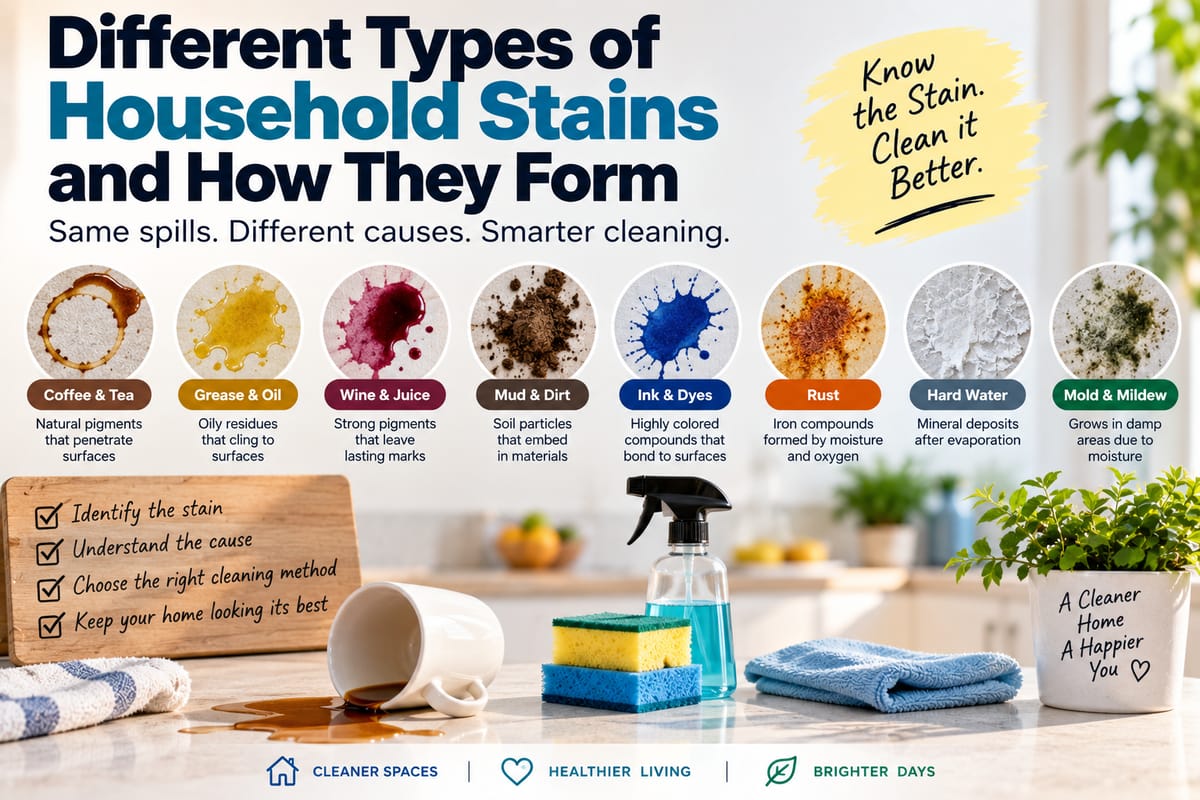
Coffee and tea leave colored residues. Grease adheres because of its oily nature. Hard water creates mineral deposits as moisture evaporates. Rust results from iron-related corrosion, while mold and mildew are associated with persistent moisture and biological growth.
The key lesson is simple: identify the substance and the surface before choosing the cleaning method.
Once you understand how a stain formed, it becomes easier to select an appropriate treatment, avoid unnecessary scrubbing, protect the underlying material, and prevent the same problem from returning. Good household cleaning is not simply about making things look clean—it is about understanding the materials in your home and caring for them in ways that preserve their appearance and function over time.