How Cooking Methods Affect Food Texture and Consistency
How Cooking Methods Affect Food Texture and Consistency
Cooking does far more than make food hot. The method used, the temperature reached, the amount of moisture present, and the length of cooking can fundamentally change how food feels, looks, and behaves.
The same ingredient can become crisp, tender, creamy, chewy, flaky, soft, or even tough depending on how it is prepared. A raw potato can become fluffy when baked, creamy when boiled and mashed, or crisp when fried. A piece of meat can become tender through slow cooking but dry and firm when exposed to excessive heat for too long.
Understanding the relationship between cooking methods and texture can help home cooks make more predictable meals and troubleshoot dishes that do not turn out as expected.
Why Cooking Changes Food Texture
Food texture is determined by the physical structure of ingredients and how that structure responds to heat, water, fat, pressure, and mechanical movement.
Cooking can cause:
- Proteins to change structure
- Starches to absorb water and swell
- Water to evaporate
- Fats to melt
- Sugars to caramelize
- Plant cell walls to soften
- Connective tissues to break down
- Surface moisture to decrease
- Chemical reactions to create crusts and browning
These changes occur differently depending on the cooking technique.
A useful overview of the major techniques can be found in Cooking Methods Explained: The Complete Guide.
Moist-Heat Cooking Usually Produces Softer Textures
Moist-heat methods involve water, steam, broth, or another liquid.
Common examples include:
- Boiling
- Simmering
- Steaming
- Poaching
- Braising
- Stewing
Because water transfers heat efficiently, moist cooking can soften many foods.
Boiling
Boiling exposes food to hot water.
Vegetables, pasta, grains, eggs, and potatoes can all be boiled, but the resulting texture depends heavily on cooking time.
Vegetables cooked briefly may remain firm and crisp, while prolonged boiling can cause them to become soft and potentially mushy.
Potatoes, meanwhile, gradually soften as their starch structures change and water enters the cells.
Simmering
Simmering is gentler than vigorous boiling and is often used when cooks want gradual softening.
It is particularly useful for soups, sauces, beans, grains, and tougher cuts of meat.
The slower process allows connective tissue in meat to break down over time while helping ingredients absorb surrounding flavors.
Steaming
Steaming cooks food using hot vapor rather than immersing it directly in water.
Because the food does not sit in boiling water, steaming can help preserve a firmer texture in many vegetables.
The result is often tender but not waterlogged.
Cooking time still matters. Vegetables that are steamed too long can lose their firmness and become soft.
Dry-Heat Cooking Creates Browning and Crispness
Dry-heat techniques cook food primarily through hot air, heated surfaces, or fat.
Examples include:
- Baking
- Roasting
- Grilling
- Broiling
- Pan-searing
- Frying
These methods are especially important when the goal is to develop a browned or crisp exterior.
As surface moisture decreases and temperatures rise, browning reactions can occur. This can create new flavors, aromas, colors, and textures.
Baking Can Create Crisp Exteriors and Soft Interiors
Baking surrounds food with hot air.
Bread, cakes, pastries, vegetables, casseroles, and many other foods can be baked.
The texture depends on ingredients and formulation as well as the baking conditions.
For example, bread develops a firm crust as its outer surface loses moisture and heats up, while the interior remains comparatively moist and soft.
Cookies can become crisp, chewy, cakey, or somewhere in between depending on ingredients, proportions, temperature, and baking time.
Understanding how temperature changes the outcome is essential, which is why How Cooking Temperature Affects Food and Cooking Results is useful for understanding the relationship between heat and texture.
Roasting Intensifies Surface Texture
Roasting exposes food to dry heat, usually in an oven.
Vegetables can become tender inside while developing browned or crisp edges. Meat can develop a browned exterior while retaining moisture inside when cooked appropriately.
Roasting also removes surface moisture, which contributes to more concentrated flavors and a firmer exterior.
Cut size matters.
Small pieces have more surface area relative to their volume and can brown and crisp more quickly than large pieces.
Grilling Creates Charred and Firm Surfaces
Grilling exposes food to intense heat from below or above.
The direct heat can rapidly brown the surface while the interior cooks more gradually.
This creates a characteristic contrast:
charred or browned outside + tender interior
Grilling vegetables can produce softened centers with lightly charred edges. Meat can develop a browned crust while remaining tender inside if it is cooked appropriately.
The distance from the heat source and cooking time have a major influence on the final texture.
Pan-Searing Builds a Crust
Searing uses a hot pan to rapidly brown the surface of food.
The technique is commonly used for:
- Steaks
- Chicken
- Fish
- Tofu
- Vegetables
- Scallops
A dry surface generally browns more effectively than a very wet one.
When food is placed into a sufficiently hot pan, its surface temperature can rise rapidly once surface moisture has been reduced, allowing browning reactions to produce a flavorful crust.
The goal is often to create contrast between the browned exterior and the softer interior.
Frying Produces Crisp Textures
Frying surrounds food with hot oil or places it in a relatively shallow layer of heated fat.
The high temperature rapidly removes moisture from the surface.
As the exterior dries, it can become crisp while the interior remains softer.
This is why fried foods such as potatoes, chicken, and battered vegetables can have dramatically different textures from their boiled or steamed counterparts.
Batter composition also matters. A coating can create a crisp shell while protecting the interior from excessive moisture loss.
Slow Cooking Can Transform Tough Ingredients
Slow cooking uses relatively gentle heat over an extended period.
It is particularly useful for tougher cuts of meat and ingredients that benefit from gradual softening.
Connective tissue contains collagen, which can gradually break down during prolonged cooking under appropriate conditions.
As this happens, meat can transition from tough and chewy to tender and easy to pull apart.
The key is that tenderness does not simply come from higher temperatures.
Time, moisture, temperature, and the structure of the ingredient all interact.
Braising Combines Moist and Dry Heat
Braising typically begins with browning the food before cooking it slowly with a relatively small amount of liquid.
This combination produces multiple texture changes.
The initial browning develops a flavorful exterior, while the subsequent moist cooking helps soften the interior and connective tissue.
Braising is especially useful for tougher cuts of meat, root vegetables, and other ingredients that benefit from extended cooking.
The finished dish can have a rich sauce, tender main ingredients, and a complex contrast between browned and softened surfaces.
Stewing Produces Tender, Soft Ingredients
Stewing involves cooking relatively small pieces of food in liquid over an extended period.
Because ingredients remain surrounded by moisture, vegetables and meats can gradually soften.
The result is generally much softer than what would be produced by quick grilling or searing.
However, overcooking can cause delicate ingredients to lose their structure completely.
Timing therefore matters even in slow-cooked dishes.
Steaming Preserves Structure in Many Vegetables
Steaming is often associated with vegetables because it can produce a tender texture while retaining some firmness.
Broccoli, carrots, green beans, cauliflower, and other vegetables can be steamed until they reach the desired level of tenderness.
Short steaming times can maintain a crisp-tender texture, while longer cooking produces softer vegetables.
The difference can be surprisingly large even with only a few additional minutes of cooking.
How Cooking Affects Meat Texture
Meat contains muscle fibers, water, proteins, fat, and connective tissue.
Heat changes these components in different ways.
As muscle proteins change structure, meat generally becomes firmer. At the same time, prolonged cooking under appropriate moist conditions can break down connective tissue and make some cuts more tender.
This creates an important distinction between protein firmness and connective-tissue tenderness.
A steak cooked quickly at high heat can become firmer as it cooks, while a tough braising cut may become increasingly tender after a much longer cooking period.
Different cuts therefore require different strategies.
Why Overcooked Meat Becomes Dry and Tough
Cooking can cause meat to lose moisture.
If a relatively tender cut is exposed to excessive heat for too long, muscle proteins can contract and squeeze out more water.
The result can be dry, firm, or tough meat.
This is why cooking time should be considered alongside temperature.
Higher heat is not automatically better, and longer cooking is not automatically better.
The ideal approach depends on the ingredient and the desired result.
Fish Requires a Different Texture Strategy
Fish generally has a more delicate structure than many meats.
Its muscle fibers are shorter and contain less connective tissue, meaning fish can cook relatively quickly.
Excessive heat or prolonged cooking can cause fish to become dry and flaky in an undesirable way.
Gentler techniques such as steaming, poaching, baking, and controlled pan cooking can help maintain moisture.
The desired texture is often moist, tender, and flaky rather than dense or chewy.
How Cooking Changes Vegetables
Vegetables contain water, plant cell walls, starches, sugars, and other structural components.
Heat can weaken plant cell walls, causing vegetables to soften.
Cooking time influences how much structural change occurs.
For example:
- Brief cooking can leave vegetables crisp.
- Moderate cooking can produce a tender texture.
- Prolonged cooking can make them soft or mushy.
Dry-heat methods can create browned edges and concentrated flavors, while moist-heat methods generally produce softer textures.
The best technique depends on whether the goal is crispness, tenderness, caramelization, or a combination.
What Happens to Starch During Cooking?
Starch plays a major role in the texture of potatoes, rice, pasta, bread, and many other foods.
When starch is heated in the presence of water, its structure changes and it can swell.
This process contributes to the softening of foods such as potatoes and grains.
It also explains why uncooked rice is hard while properly cooked rice is soft and separate or sticky depending on the variety and cooking conditions.
Pasta provides another example.
Cooking allows water to penetrate the pasta and soften its structure, but cooking for too long can result in an overly soft texture.
Why Pasta Can Go From Firm to Mushy
Pasta texture depends heavily on cooking time and water absorption.
A shorter cooking period generally produces a firmer bite, while additional cooking progressively softens the pasta.
The amount of water, pasta shape, cooking temperature, and flour composition can all influence the final result.
This is why checking pasta toward the end of its recommended cooking period is often more reliable than simply assuming that every batch requires exactly the same amount of time.
Eggs Demonstrate the Power of Cooking Time
Eggs are a particularly clear example of how cooking changes texture.
Raw egg proteins are fluid. As they are heated, the proteins change structure and form a more solid network.
Different temperatures and cooking times therefore produce different results.
A gently cooked egg can have a soft, flowing center, while prolonged cooking creates a firmer yolk and white.
The same ingredient can move through a wide range of textures simply by changing the cooking conditions.
How Fat Changes Texture
Fat can influence food texture by contributing richness, tenderness, crispness, and mouthfeel.
In baked goods, fat can interfere with gluten development and help create a tender texture.
During frying, hot fat rapidly transfers heat to the surface and helps create a crisp exterior.
In meat, fat can contribute to juiciness and richness, although cooking can also cause fat to melt and drain away.
The type and amount of fat therefore matter when predicting the final texture.
Moisture Is One of the Biggest Texture Controls
One of the simplest ways to think about cooking is to consider what happens to water.
More retained moisture generally means softer or juicier textures.
Less surface moisture often means greater browning and crispness.
This explains why:
- Steaming produces tender vegetables.
- Roasting produces browned edges.
- Frying creates crisp coatings.
- Slow cooking produces tender meats.
- Overcooking can produce dry foods.
Managing moisture is therefore one of the most important skills for controlling texture.
Temperature and Time Work Together
Cooking temperature cannot be separated completely from cooking time.
A food cooked at a moderate temperature for a longer period may develop a very different texture from the same food exposed to intense heat for a short period.
Temperature affects the rate at which chemical and physical changes occur, while time determines how far those changes progress.
Home cooks can learn more about this relationship in The Complete Guide to Cooking for Beginners.
Cutting Food Changes the Cooking Result
The size and shape of an ingredient can dramatically affect its texture.
Smaller pieces generally cook faster because heat has less distance to travel toward the center.
Thin slices can become crisp quickly, while large pieces may remain moist inside even after their surfaces have browned.
Uniform pieces also tend to cook more evenly.
This is why recipes often recommend cutting vegetables into pieces of similar size.
Measurements Can Affect Texture Too
Texture does not depend only on the cooking technique.
Ingredient ratios can be equally important.
Too much liquid can produce soft or loose results, while too little can leave grains, pasta, or baked goods undercooked.
In baking, small changes in flour, fat, sugar, or liquid can significantly alter structure.
Accurate measurements are therefore particularly important when consistency matters. The Cooking Measurements and Ingredient Conversions for Home Cooks guide can help when adjusting quantities or converting between measurements.
Browning Creates Texture and Flavor
Browning is one of the defining characteristics of many dry-heat cooking methods.
When the surface becomes hot and sufficiently dry, complex reactions can produce brown colors and new flavor compounds.
The resulting surface may become crisp or firm while the interior remains relatively moist.
This contrast is central to foods such as roasted potatoes, seared meat, toasted bread, roasted vegetables, and baked pastries.
Why Resting Can Change Texture
Cooking does not always stop affecting texture the moment food leaves the heat.
Resting can allow temperatures and moisture to redistribute.
This is especially relevant for cooked meats. Cutting immediately into a hot piece of meat can release juices that might otherwise redistribute through the interior during resting.
Resting can therefore influence the final eating experience even though no additional heat is being applied.
Choosing a Cooking Method Based on the Desired Texture
Instead of choosing a cooking method solely because a recipe recommends it, consider the texture you want.
| Desired texture | Methods that may help |
|---|---|
| Crisp exterior | Frying, roasting, grilling, searing |
| Tender vegetables | Steaming, roasting, sautéing |
| Soft vegetables | Boiling, braising, stewing |
| Flaky fish | Baking, steaming, poaching |
| Tender tough meat | Braising, stewing, slow cooking |
| Firm pasta | Controlled boiling |
| Fluffy potatoes | Baking, boiling and mashing |
| Browned crust | Searing, roasting, grilling, baking |
| Soft and creamy foods | Simmering, steaming, gentle cooking |
The exact result will still depend on the ingredient, temperature, cooking time, moisture level, and preparation.
Common Texture Problems and What They Can Mean
When food does not have the expected texture, the cooking method can provide clues.
Food Is Too Dry
Possible causes include:
- Excessive cooking time
- Excessive temperature
- Insufficient moisture
- Thin cuts exposed to prolonged heat
Food Is Too Mushy
Possible causes include:
- Excessive cooking time
- Too much liquid
- Very aggressive boiling
- Ingredients cut too small
Food Is Not Browning
Possible causes include:
- Too much surface moisture
- Insufficient heat
- Crowding the pan
- Short cooking time
Meat Is Tough
Possible causes depend on the cut.
A naturally tender cut may have been overcooked, while a tough cut may simply require more time under appropriate cooking conditions to break down connective tissue.
Cooking Is Really the Art of Controlling Change
Every cooking method produces a different balance of heat, moisture, time, and physical change.
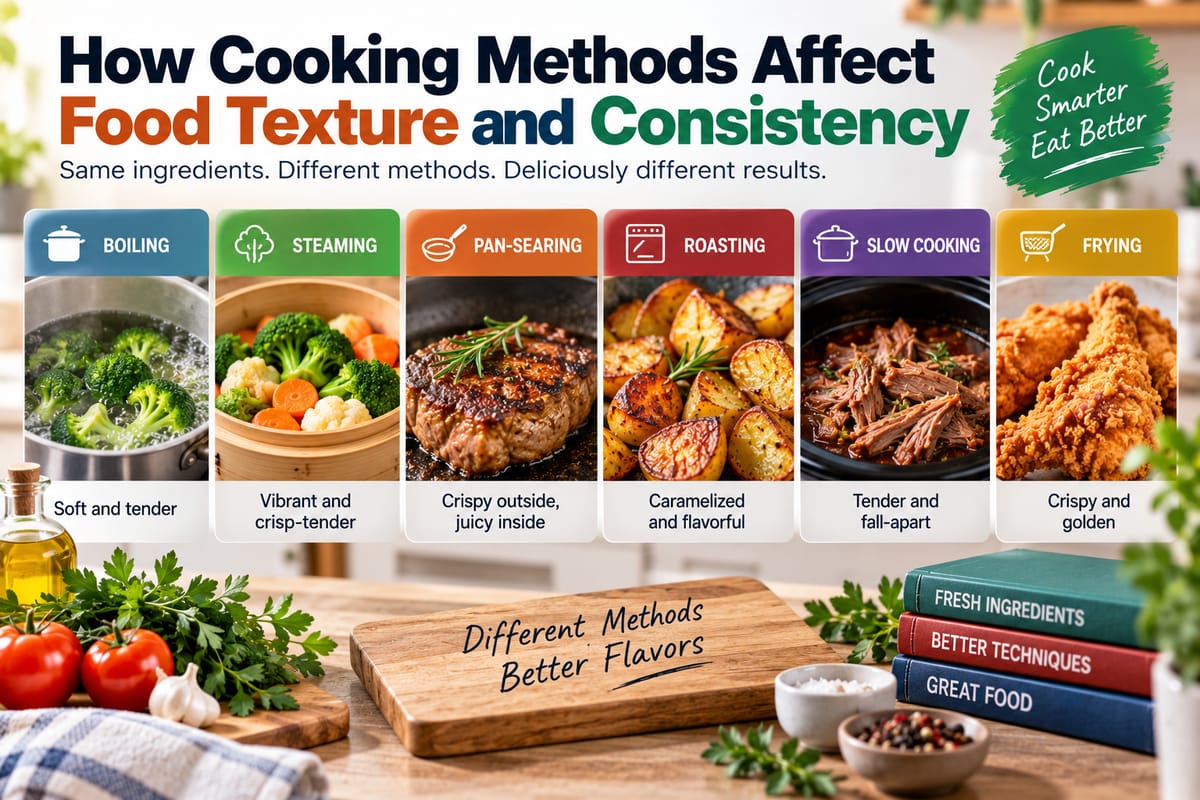
Boiling emphasizes moisture. Roasting encourages surface drying and browning. Steaming gently transfers heat through vapor. Frying creates rapid surface dehydration and crispness. Slow cooking gives connective tissues time to soften.
The best cooks learn to think beyond recipes and recognize these relationships.
Once you understand what heat, moisture, time, fat, and ingredient structure are doing, you can make better decisions when adjusting a recipe, rescuing an overcooked dish, or creating something from scratch.
Ultimately, texture is not an accident of cooking—it is the result of controlled physical and chemical changes. Learning how those changes work gives home cooks greater control over whether dinner turns out crisp or tender, firm or soft, juicy or dry, and exactly the way they intended.