Home Depot Earnings Preview: What the August 18 Results Could Reveal About Home Improvement Spending
Home Depot Earnings Preview: What the August 18 Results Could Reveal About Home Improvement Spending
Home Depot’s second-quarter results arrive as homeowners face a difficult mix of high borrowing costs, housing-market uncertainty and rising renovation expenses. The numbers could offer one of the clearest snapshots yet of whether consumers are postponing major projects—or continuing to spend on the homes they already own.
Publication date: August 14, 2026
The home improvement market is approaching an important test.
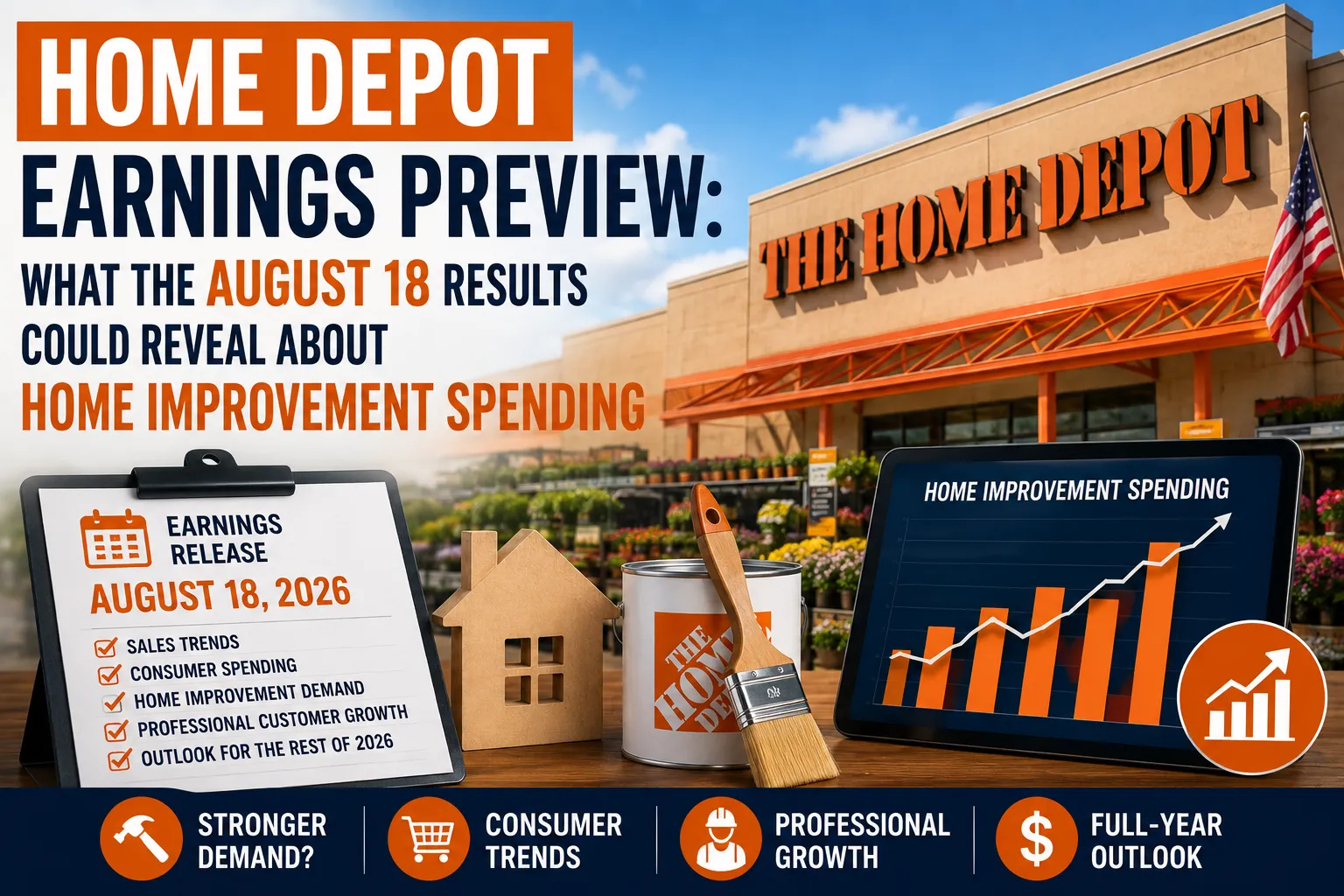
The Home Depot is scheduled to report its fiscal second-quarter 2026 results on Tuesday, August 18, 2026, at 9:00 a.m. ET. The company’s earnings release is arriving at a time when housing affordability remains strained, mortgage rates are elevated and consumers are becoming more selective about large renovation projects.
That makes the report more than another quarterly earnings event. Home Depot’s sales trends could provide investors, contractors and homeowners with a useful indication of how Americans are currently thinking about repairs, remodeling and discretionary home upgrades.
Why Home Depot’s Earnings Matter for Home Improvement Spending
Home Depot is one of the largest retailers serving homeowners and professional contractors, giving its results an unusually broad window into the housing-related economy.
Its performance can reflect several different forces at once:
- Homeowners repairing aging properties
- Consumers delaying major renovations
- Homebuyers purchasing materials after closing
- Contractors working on remodeling projects
- Professional customers undertaking larger construction jobs
- Consumers shifting toward smaller, lower-cost projects
- Demand for maintenance and essential repairs
The distinction between those categories will be particularly important this quarter.
A weak housing market does not necessarily mean Americans stop spending on their homes. Someone who cannot afford to move may instead renovate an existing property, repair a roof, replace an aging appliance or improve a kitchen or bathroom.
For homeowners trying to decide which projects deserve attention first, the broader principles covered in Home Maintenance Projects can provide useful context.
Recent data already points to this complicated picture.
Harvard University’s Joint Center for Housing Studies expects remodeling and repair spending to lose momentum through mid-2027, with year-over-year growth projected to slow to just 0.5% in the second quarter of 2027.
At the same time, remodeling activity has remained more resilient than new-home construction in some areas.
The Home Depot report could help show which side of that divide is becoming more important.
When Is Home Depot Reporting Earnings?
Home Depot has confirmed that its Q2 fiscal 2026 earnings release will be published Tuesday, August 18, at 9:00 a.m. ET.
The company reported its first-quarter results on May 19. Q1 sales reached $41.8 billion, up 4.8% year over year, while comparable sales increased 0.6%. U.S. comparable sales increased 0.4%.
However, earnings per share declined year over year, with adjusted diluted EPS falling from $3.56 to $3.43.
Management also reaffirmed its fiscal 2026 outlook:
- Total sales growth of approximately 2.5% to 4.5%
- Comparable sales growth of approximately flat to 2.0%
- Approximately 15 new stores
- Adjusted operating margin of approximately 12.8% to 13.0%
- Adjusted diluted EPS growth of approximately flat to 4.0%
Those targets give investors an important benchmark for judging Tuesday’s numbers.
What Analysts Are Expecting
Market estimates currently point to roughly $47.3 billion in revenue and about $4.73 in earnings per share for the upcoming quarter, although estimates can change before the release and should not be treated as company guidance.
The bigger question may therefore be whether Home Depot simply meets those expectations—or gives investors a reason to change their outlook for the remainder of 2026.
The CEO Change Adds Another Layer to the Earnings Report
The earnings announcement will come just days after an unexpected leadership development.
Home Depot said on August 12 that CEO Ted Decker would take a temporary medical leave of absence and is expected to return within a few months. CFO Richard McPhail and Senior Executive Vice President Ann-Marie Campbell will jointly handle CEO responsibilities during his absence.
The timing makes the August 18 report especially significant.
Investors will likely pay attention not only to financial results but also to management’s comments about:
- Consumer demand
- Professional customer demand
- Remodeling trends
- Housing-market conditions
- Pricing
- Margins
- Project sizes
- Guidance for the rest of fiscal 2026
- Leadership continuity
The CEO situation is separate from the underlying consumer-spending question, but it could increase attention around the earnings call.
Are Homeowners Still Spending on Renovations?
The evidence is mixed.
Home improvement spending has remained relatively resilient compared with new-home construction, but there are signs that consumers are becoming more cautious.
The Home Improvement Research Institute reported in July that 30% of homeowners planned to spend less on home improvement over the following 12 months, compared with 27% planning to spend more. That represented a reversal from the previous quarter.
Interestingly, average spending among households that did undertake projects nearly doubled during the quarter.
That creates an important possibility for Home Depot: fewer customers may be starting projects while the customers who do spend are committing more money.
If the earnings report shows this pattern, headline sales could remain relatively healthy even while the number of active DIY projects declines.
High Mortgage Rates Could Be Changing Home Improvement Behavior
The housing market remains one of the biggest variables.
U.S. existing-home sales fell 1.7% in July to a seasonally adjusted annual rate of 4.06 million, marking a second consecutive monthly decline. The median existing-home price reached $434,100, while mortgage costs remained a major obstacle for potential buyers.
That matters to Home Depot because housing turnover can create demand for:
- Paint
- Flooring
- Tools
- Appliances
- Hardware
- Plumbing supplies
- Lighting
- Kitchen products
- Landscaping materials
When fewer homes change hands, some of that transaction-driven spending can disappear.
But high mortgage rates can produce the opposite effect for existing homeowners.
People who locked in much lower mortgage rates may be reluctant to sell and take on a new, more expensive mortgage. Instead, they may choose to improve the home they already have.
This creates a potentially important divide:
Lower housing turnover can hurt some home improvement demand while encouraging homeowners to invest in existing properties.
Home Depot’s results could reveal which effect is currently stronger.
Big Renovations vs. Essential Repairs
One of the most important signals to watch will be the composition of spending.
Consumers under financial pressure do not necessarily eliminate home improvement spending altogether. They may prioritize projects based on urgency.
For homeowners trying to distinguish between routine maintenance and problems requiring immediate attention, a Home Repairs Guide: Common Problems and Solutions can help put these decisions into perspective.
Essential projects may remain resilient
Examples include:
- Roof repairs
- Plumbing problems
- Electrical work
- Heating and cooling repairs
- Water damage
- Broken appliances
- Weather-related maintenance
- Basic home security
These expenses can be difficult to postpone.
Discretionary projects may be easier to delay
Examples include:
- Luxury kitchen renovations
- Large bathroom remodels
- High-end outdoor projects
- Decorative upgrades
- Premium appliances
- Major room additions
If Home Depot reports stronger demand for maintenance-oriented products but weaker demand for major discretionary projects, that would reinforce the idea that homeowners are becoming more selective.
Professional Customers Could Be Especially Important
Another major area to watch is Home Depot’s professional customer business.
Contractors and other professional customers can generate significantly larger transactions than individual DIY shoppers. Their activity can also provide an early indication of remodeling and construction demand.
Home Depot has increasingly focused on professional customers, including through its SRS Distribution acquisition strategy.
If professional sales remain strong while DIY spending weakens, the company could still find support from contractors working on renovation, maintenance and construction projects.
That would also suggest that the home improvement economy is not simply moving in one direction.
What Home Depot’s Guidance Could Reveal
For investors, the most important number may not be quarterly revenue.
It could be what management says about the months ahead.
Home Depot previously projected comparable sales growth of approximately 0% to 2% for fiscal 2026.
A change to that outlook could have a much bigger impact on investor sentiment than whether the company beats or misses quarterly expectations by a small amount.
Three scenarios are particularly worth watching.
Scenario 1: Strong results and stronger guidance
This would suggest home improvement demand is holding up better than feared.
Potential implications could include:
- Stronger consumer confidence
- Resilient remodeling demand
- Healthy professional activity
- Greater willingness to undertake larger projects
- Improved outlook for the home improvement sector
Scenario 2: Results meet expectations but guidance stays cautious
This may indicate that consumers are spending, but the company does not expect conditions to improve dramatically.
That could reinforce the idea of a slow, uneven recovery rather than a major rebound.
Scenario 3: Weak results or weaker guidance
This would raise concerns that high housing costs, interest rates and economic uncertainty are finally causing consumers to pull back more substantially.
It could also increase pressure on other home improvement retailers and housing-related companies.
The Remodeling Market Has a Complicated Outlook
The broader data does not point to a simple boom-or-bust environment.
Harvard’s latest remodeling indicator forecasts continued deceleration in renovation and repair spending through mid-2027. The organization expects spending to reach approximately $519 billion through mid-2027, but with annual growth slowing considerably.
Meanwhile, remodeling spending has remained comparatively resilient in parts of the residential construction market.
The more recent data suggests the environment has become less favorable.
U.S. construction spending unexpectedly fell 0.1% in June, while overall construction spending was down 3.2% from a year earlier. Residential construction also weakened.
Taken together, the evidence suggests that remodeling has been relatively defensive, but it is not immune to broader affordability pressures.
Homeowners weighing these conditions should also consider How to Budget for Home Maintenance when deciding how much room their household finances have for repairs and improvements.
What Homeowners Should Watch
Although the earnings report is primarily an investor event, homeowners can learn something from it too.
The most useful signals will be indications of where consumers are continuing to spend.
If Home Depot highlights strong demand for smaller projects, repairs and maintenance, homeowners may be responding to higher costs by prioritizing practical improvements.
If larger projects are recovering, it could indicate that consumers are becoming more comfortable committing to major renovations despite economic uncertainty.
Either way, the report could help identify where the home improvement market is heading.
Home Depot Earnings Could Become a Housing-Market Signal
The August 18 earnings report comes at an unusually informative moment.
Home sales are weak, mortgage rates remain a major affordability barrier, builder confidence has fallen and remodeling forecasts point toward slower growth. Yet homeowners continue to maintain aging properties, and remodeling has demonstrated more resilience than some other parts of residential construction.
That makes Home Depot’s results a useful real-world test of consumer behavior.
The key question is not simply whether Home Depot beats earnings expectations.
It is whether Americans are still willing to spend meaningful amounts of money improving the homes they already own—and, if they are spending, which projects are receiving their money.
Tuesday’s numbers, combined with management’s outlook, should provide a clearer answer.
Key Questions to Watch on August 18
- Did comparable sales accelerate or weaken?
- Are professional customers outperforming DIY shoppers?
- Are large renovation projects being delayed?
- Are essential repair categories remaining resilient?
- What is Home Depot seeing in appliances, kitchens and bathrooms?
- Has housing-market weakness affected demand?
- Are consumers trading down to cheaper products?
- Is the company maintaining its full-year guidance?
- What does management expect for the second half of fiscal 2026?
- How will the temporary CEO absence affect investor confidence?
For anyone trying to understand the health of the U.S. home improvement market, those answers may be more revealing than the headline EPS figure alone.