How Fermentation Preserves Certain Foods
How Fermentation Preserves Certain Foods
Fermentation is one of the oldest ways of preserving food. Long before refrigeration and modern food-processing equipment became commonplace, people used naturally occurring microorganisms to transform milk, vegetables, grains, fruits and other foods into products that could last longer and develop distinctive flavors.
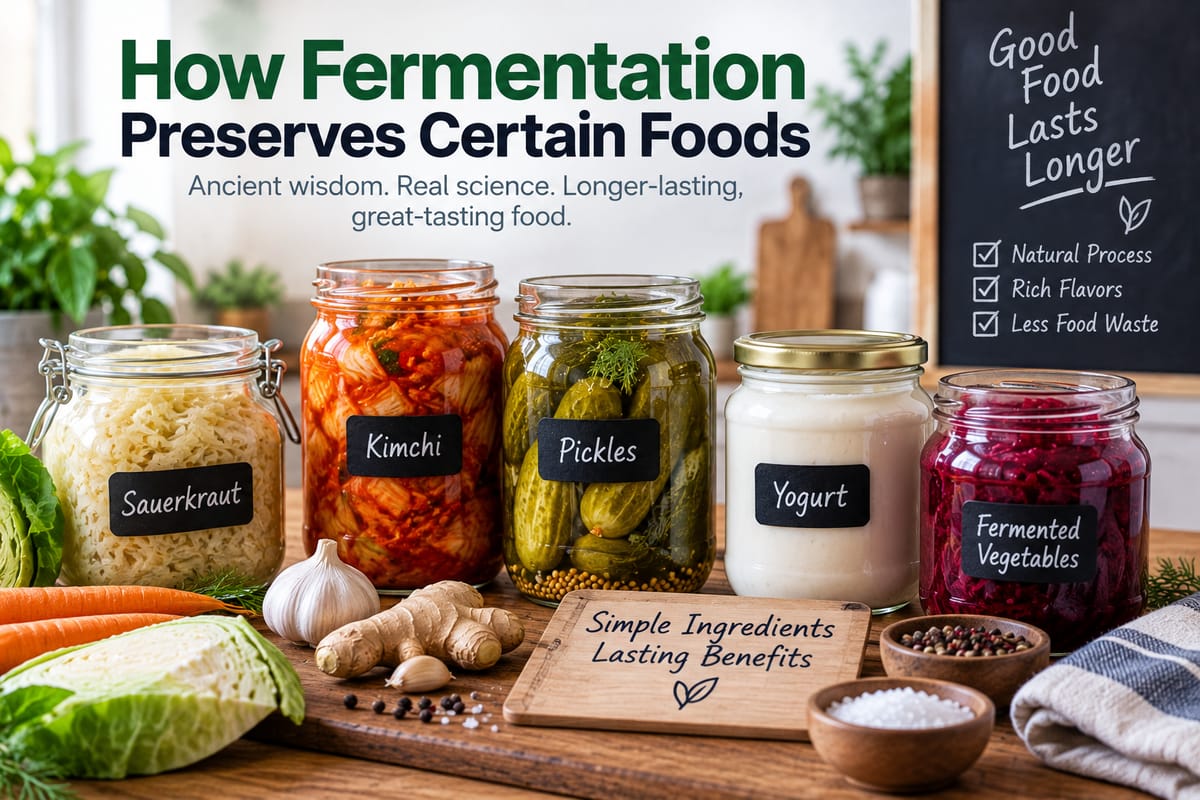
Today, fermentation remains an important part of food culture around the world. Yogurt, sauerkraut, kimchi, kefir, certain cheeses, sourdough bread, pickles and other fermented foods are produced through processes that rely on microorganisms such as bacteria, yeasts and molds.
The preservation effect comes largely from the chemical changes these microorganisms create. Depending on the type of fermentation, they can produce acids, alcohol, gases and other compounds that make conditions less favorable for many spoilage organisms.
Understanding how fermentation works helps explain why some foods can be preserved through this process while others require different methods.
What Is Food Fermentation?
Fermentation is a biological process in which microorganisms transform components of food, particularly carbohydrates, into other substances.
Different microorganisms and fermentation conditions produce different results.
For example:
- Lactic acid bacteria can convert sugars into lactic acid.
- Yeasts can convert sugars into alcohol and carbon dioxide.
- Some microorganisms involved in food fermentation produce other acids or compounds.
The resulting changes can alter the food’s acidity, flavor, texture, aroma and shelf life.
Fermentation is therefore both a preservation technique and a method of transforming food.
How Fermentation Preserves Food
The preservation effect of fermentation comes from creating an environment where many undesirable microorganisms have difficulty growing.
One of the most important mechanisms is acidification.
When certain bacteria consume sugars and produce acids, the pH of the food decreases. A more acidic environment can inhibit the growth of many microorganisms responsible for spoilage and some foodborne illnesses.
Other fermentation processes can preserve food through alcohol production, competition between microorganisms and the production of compounds that discourage unwanted microbial growth.
The precise mechanism depends on the food and fermentation method.
The Role of Microorganisms
Microorganisms are central to fermentation.
Although microorganisms are often associated with food spoilage, some are deliberately used to produce desirable changes in food.
Beneficial or desired microorganisms consume nutrients and produce substances that change the environment around them.
This can give particular microorganisms an advantage over competitors while making conditions less suitable for many unwanted organisms.
Successful fermentation therefore depends on controlling the conditions under which microorganisms grow.
Lactic Acid Fermentation
Lactic acid fermentation is one of the most important preservation processes used for foods.
In this process, lactic acid bacteria consume available carbohydrates and produce lactic acid.
The resulting acidity can help preserve foods while producing the characteristic sour taste associated with many fermented products.
Examples include:
- Yogurt
- Sauerkraut
- Kimchi
- Some fermented pickles
- Certain cultured dairy products
The exact microorganisms involved vary depending on the food, environment and fermentation method.
Fermentation and Acidity
Acidity is particularly important because microorganisms have different tolerances for acidic environments.
As fermentation progresses and acids accumulate, the food can become increasingly inhospitable to many unwanted organisms.
This is one reason fermented vegetables and dairy products can have a noticeably sour flavor.
However, acidity alone should not be treated as a guarantee of food safety. Proper fermentation depends on factors such as ingredients, salt concentration, temperature, time, equipment cleanliness and the microorganisms involved.
Why Salt Is Sometimes Used
Salt plays an important role in several traditional fermentation processes.
In fermented vegetables, salt can draw water from plant tissues and create conditions that favor certain salt-tolerant microorganisms.
At the same time, salt can suppress some microorganisms that are less tolerant of salty conditions.
This selective pressure helps create an environment in which desirable fermentation organisms can become dominant.
Salt levels therefore matter. Reducing salt substantially in a fermentation recipe without understanding the process can alter the microbial environment and affect both quality and safety.
Fermentation of Vegetables
Vegetables are commonly preserved through lactic acid fermentation.
Cabbage, for example, can be transformed into sauerkraut through controlled fermentation. Other vegetables can be fermented using similar principles.
Kimchi is another example, although its preparation can involve a more complex combination of vegetables, seasonings and fermentation conditions.
During fermentation, microorganisms consume available sugars and produce acids and other compounds. These changes contribute to the food’s characteristic flavor and can help extend its storage life.
Yogurt and Fermented Dairy
Yogurt provides a familiar example of fermentation.
Specific bacterial cultures ferment lactose, the naturally occurring sugar in milk, and produce lactic acid.
As acidity increases, milk proteins change structure and the mixture thickens.
This produces yogurt’s characteristic texture and tangy flavor.
The process also illustrates how fermentation can simultaneously transform a food and make it more resistant to some forms of spoilage.
Other cultured dairy products rely on different combinations of microorganisms and production conditions.
Kefir and Cultured Beverages
Kefir is another fermented dairy product, traditionally produced using a community of bacteria and yeasts.
The microorganisms ferment components of the milk and produce acids, gases and small amounts of alcohol.
The resulting beverage has a distinctive tangy flavor and can have a thinner consistency than many types of yogurt.
Other fermented beverages around the world use similar microbial processes, although their ingredients and production methods vary considerably.
Fermented Pickles
Pickling can involve either fermentation or the direct addition of an acid such as vinegar.
These processes should not be confused.
In fermented pickling, microorganisms produce acids that gradually lower the food’s pH.
In vinegar pickling, acetic acid is added directly to create an acidic environment.
Both approaches can produce sour, preserved foods, but they rely on different mechanisms.
Understanding these differences is important when following preservation recipes.
Fermentation and Sourdough
Sourdough bread demonstrates another type of fermentation.
A sourdough starter contains communities of yeasts and lactic acid bacteria. These microorganisms metabolize carbohydrates in flour and produce carbon dioxide and organic acids.
Carbon dioxide helps the dough rise, while the acids contribute to sourdough’s distinctive flavor and can influence the dough’s structure.
Unlike fermented vegetables, however, the final bread is usually baked. The preservation characteristics of the finished product therefore involve both fermentation and the effects of baking, moisture content and storage conditions.
Alcoholic Fermentation
Yeasts can ferment sugars to produce alcohol and carbon dioxide.
This process is used in products such as:
- Wine
- Beer
- Cider
- Some traditional fermented beverages
Alcohol can inhibit the growth of many microorganisms, although its preservation effect depends on concentration and other factors.
Alcoholic fermentation therefore represents another way microorganisms can contribute to food preservation.
Fermentation Can Change Food Chemistry
Fermentation does more than make food sour.
Microorganisms can transform sugars, proteins and other components into new compounds.
These changes can affect:
- Flavor
- Aroma
- Texture
- Acidity
- Digestibility
- Nutrient availability
- Shelf life
The precise changes depend on the microorganisms and the food being fermented.
This is one reason fermented foods can taste substantially different from their original ingredients.
Fermentation and Food Flavor
One of the most noticeable effects of fermentation is the development of complex flavors.
Microorganisms produce various metabolic byproducts during fermentation. These compounds can contribute sour, savory, fruity, earthy or other characteristics.
The flavor of a fermented food can also change over time.
Shorter fermentation may produce a milder result, while longer fermentation can create stronger acidity and more developed flavors.
Temperature and ingredient composition can influence these changes as well.
Fermentation and Texture
Fermentation can also alter the physical structure of food.
In vegetables, acidification and microbial activity can change firmness and texture.
In dairy products, acid production can cause proteins to coagulate and form a thicker structure.
In dough, microbial fermentation produces gases that create pockets within the dough and contribute to its rise.
These examples show how fermentation can transform food physically as well as chemically.
Why Temperature Matters
Temperature influences which microorganisms grow and how quickly fermentation proceeds.
Different fermentation processes have different preferred temperature ranges.
If the temperature is too low, fermentation may proceed slowly. If it is too high, undesirable microorganisms may gain an advantage or the intended fermentation culture may behave differently.
Temperature control is therefore an important part of reliable fermentation.
This is one reason preservation recipes should be followed carefully rather than relying solely on appearance or taste.
Time and Fermentation
Fermentation is also affected by time.
As microorganisms consume available nutrients, the chemical environment changes.
A short fermentation may produce limited acidification, while a longer process can result in greater microbial transformation.
However, longer does not automatically mean better or safer.
Different foods require different fermentation periods, and the desired endpoint depends on the particular recipe and process.
Fermentation Versus Refrigeration
Refrigeration slows microbial growth by lowering temperature.
Fermentation works differently. It deliberately encourages particular microorganisms to grow and transform the food.
The two methods can sometimes work together.
For example, a fermented food may be refrigerated after reaching the desired level of fermentation. Refrigeration slows further microbial activity and helps maintain the product’s characteristics.
This illustrates that preservation methods do not always have to operate independently.
Fermentation Versus Freezing
Freezing preserves food primarily by lowering its temperature and slowing microbial activity and chemical reactions.
Fermentation instead changes the food’s chemical environment.
The two methods also affect food differently.
Freezing can preserve many foods with relatively little flavor transformation, although it can alter texture. Fermentation intentionally changes flavor, aroma and texture as part of the preservation process.
The choice between methods depends on the food and the desired result.
Fermentation as a Cooking and Preparation Technique
Fermentation is often considered alongside other methods of preparing and preserving food.
Cooking uses heat to change ingredients, improve texture and, in many cases, reduce microorganisms. Fermentation uses controlled microbial activity to transform ingredients.
The broader range of techniques available to home cooks is discussed in Cooking Methods Explained: The Complete Guide.
Understanding these differences helps cooks choose a method based on the characteristics they want from the finished food.
The Ingredients Matter
Fermentation depends heavily on the ingredients available to microorganisms.
Sugars and other carbohydrates can provide food for fermenting microorganisms. Salt, water content, acidity and other ingredients influence which microorganisms can thrive.
For example, the sugar content of fruit can support yeast fermentation, while vegetables contain carbohydrates that can support lactic acid bacteria.
The Cooking Ingredients Guide: Types, Uses, Substitutions and Storage provides broader information about how ingredients behave and how they can be handled in the kitchen.
Why Clean Equipment Matters
Fermentation encourages microbial growth, but the objective is to encourage the right microorganisms.
Clean equipment helps reduce the opportunity for unwanted microorganisms to enter the process.
This can include:
- Clean containers
- Clean utensils
- Properly prepared ingredients
- Clean work surfaces
- Appropriate storage containers
Cleanliness does not mean attempting to eliminate every microorganism. Fermentation requires microorganisms. The goal is to create conditions that favor the intended fermentation process.
Food Safety During Fermentation
Fermentation can be a safe preservation method when performed using an appropriate, validated process.
However, improper fermentation can create food-safety risks.
Factors such as acidity, salt concentration, temperature and time can all affect the outcome.
Foods intended for fermentation should therefore be prepared using reliable instructions designed for the specific product.
The Complete Guide to Food Safety provides broader information about safe food handling, preparation and storage.
Signs That Fermentation Is Progressing
Depending on the food, fermentation may produce visible or sensory changes.
These can include:
- Bubbles
- Increased acidity
- Changes in aroma
- Changes in texture
- A sour taste
- Cloudiness in some liquids
These signs can indicate microbial activity, but appearance alone is not a sufficient way to establish safety.
A food that smells unusual, develops unexpected mold or shows other signs of contamination should not simply be assumed to be properly fermented.
The Difference Between Fermentation and Spoilage
Fermentation and spoilage both involve microorganisms, but they are not the same process.
In fermentation, microorganisms are intentionally encouraged under conditions designed to produce desirable changes.
Spoilage occurs when microorganisms or chemical processes produce unwanted changes that make food unacceptable or potentially unsafe.
The distinction depends on the food, microorganisms, conditions and intended process.
This is why controlled fermentation requires an understanding of the environment being created.
Traditional Fermentation Around the World
Fermentation appears in food traditions across many regions.
Examples include:
- Sauerkraut in Central and Eastern European food traditions
- Kimchi in Korean cuisine
- Yogurt and other cultured dairy products across numerous regions
- Sourdough bread traditions in different cultures
- Fermented soy products in East and Southeast Asia
- Various fermented beverages around the world
These traditions demonstrate that fermentation is not a single recipe or technique. It is a broad family of processes adapted to local ingredients, climates and culinary practices.
Fermented Foods and Modern Food Production
Commercial food producers use controlled fermentation systems to produce consistent results.
Industrial fermentation can involve carefully selected microbial cultures, temperature controls, controlled ingredient ratios and specialized equipment.
Manufacturers may monitor acidity, temperature, time and other characteristics to maintain product quality.
Commercial processes can therefore be considerably more controlled than traditional household fermentation, even though they rely on the same fundamental biological principles.
Can Fermentation Improve Food Storage?
Fermentation can extend the period during which certain foods remain suitable for consumption by changing their microbial and chemical environment.
However, the resulting shelf life varies significantly.
A fermented product may still require refrigeration or other storage conditions after fermentation.
The preservation effect should therefore be understood as part of a complete process rather than assuming that every fermented food can be stored indefinitely at room temperature.
Fermentation and Nutrition
Fermentation can alter the nutritional characteristics of food.
Microorganisms may consume some carbohydrates and produce other compounds. They can also change the availability of certain nutrients or reduce some naturally occurring compounds.
However, nutritional effects vary widely among fermented foods.
The fact that a food is fermented does not automatically make it nutritionally superior to its unfermented counterpart.
Its overall nutritional value depends on the original ingredients, fermentation process and final product.
Why Fermentation Remains Useful
Despite the availability of refrigeration, freezing and industrial preservation, fermentation remains valuable because it offers several benefits at once.
It can:
- Extend the storage life of certain foods
- Create distinctive flavors
- Transform texture
- Produce traditional foods
- Support culinary diversity
- Make use of seasonal ingredients
- Create products with characteristics unavailable through simple cooking
For many foods, fermentation is as much about culinary transformation as preservation.
Fermentation for Home Cooks
Home fermentation can be rewarding, but it requires more attention than simply placing food in a container and waiting.
Beginners should understand the specific process they intend to use, including the appropriate ingredients, equipment, temperature, salt or sugar concentration, fermentation time and storage requirements.
Starting with a well-established recipe designed for home use can reduce unnecessary uncertainty.
People who are new to food preparation can also review The Complete Guide to Cooking for Beginners for broader kitchen fundamentals.
Common Fermentation Mistakes
Several mistakes can interfere with successful fermentation.
Using the Wrong Recipe
Different foods require different fermentation conditions. A method suitable for sauerkraut may not be appropriate for dairy or another product.
Changing Salt Concentrations Without Understanding the Process
Salt can influence which microorganisms grow. Arbitrary changes can affect fermentation and safety.
Ignoring Temperature
Temperature can determine which microorganisms become dominant and how quickly fermentation progresses.
Using Contaminated Equipment
Poor sanitation can introduce unwanted microorganisms.
Storing Fermented Food Incorrectly
The appropriate storage conditions depend on the product and process. Fermentation does not eliminate the need for proper storage.
How Fermentation Fits Into Food Preservation
Food preservation involves controlling conditions that would otherwise allow food to deteriorate.
Different methods approach that challenge in different ways.
Refrigeration slows microbial growth.
Freezing slows microbial activity and many chemical reactions.
Drying reduces available water.
Canning uses heat and sealed containers to create controlled storage conditions.
Fermentation changes the food’s microbial and chemical environment.
Some foods may use more than one preservation method, creating multiple barriers against deterioration.
The Science Behind a Very Old Technique
Fermentation preserves certain foods by harnessing microorganisms to create an environment that discourages many unwanted microbes. In lactic acid fermentation, for example, bacteria consume sugars and produce acids, lowering the food’s pH and helping create conditions that favor preservation.
The process also changes flavor, aroma and texture, which is why fermented foods are valued for much more than their longer storage life.
From sauerkraut and kimchi to yogurt, sourdough and fermented beverages, the basic principle has been adapted to countless ingredients and culinary traditions. Modern food production has added precise controls and monitoring, but the underlying process remains a remarkable example of using naturally occurring biological activity to transform and preserve food.