How to Choose Vegetables for Your Garden
How to Choose Vegetables for Your Garden
Choosing vegetables for a garden can be one of the most rewarding parts of growing food at home, but the best choices are not always the vegetables that look most appealing in a seed catalog or garden center.
Every garden has different conditions. Sunlight, soil, available space, temperature, rainfall, water access, and the gardener’s available time can all affect how well a crop performs. Some vegetables grow quickly and can be harvested several times, while others need months of care before producing a crop.
Choosing vegetables that match both the garden and the gardener can make the growing season more productive and easier to manage.
Start With Your Garden Conditions
Before choosing seeds or seedlings, examine the area where you plan to grow vegetables.
Pay attention to:
- Amount of sunlight
- Soil type and drainage
- Available growing space
- Local temperatures
- Seasonal rainfall
- Access to water
- Wind exposure
- Existing plants
- Pests and disease pressures
A vegetable garden does not need to be large to be productive. Even a small space can support crops when vegetables are selected according to their growing requirements.
The Ultimate Guide to Growing Vegetables at Home provides additional information about planning and maintaining a productive home vegetable garden.
Consider How Much Sunlight You Have
Sunlight is one of the most important factors when selecting vegetables.
Many vegetables grow best when they receive several hours of direct sunlight each day. Fruiting crops such as tomatoes, peppers, cucumbers, and squash generally benefit from strong sunlight.
Some leafy vegetables, including lettuce and certain greens, can tolerate less direct sunlight, particularly in warmer conditions.
Observe the garden throughout the day before deciding where different vegetables will go. Buildings, fences, trees, and other structures can create shaded areas that change as the sun moves.
Match Vegetables to Your Climate
Vegetables have different temperature requirements.
Some crops prefer cool conditions, while others perform best during warm weather. Planting a crop outside its preferred temperature range can result in slow growth, poor germination, or reduced yields.
Cool-season vegetables can include crops such as:
- Lettuce
- Peas
- Radishes
- Spinach
- Some varieties of carrots
- Certain members of the cabbage family
Warm-season crops can include:
- Tomatoes
- Peppers
- Cucumbers
- Beans
- Squash
- Melons
The exact planting period depends on the local climate and the particular variety.
Think About Your Growing Season
The length of the growing season can influence which vegetables are practical.
Fast-growing crops may be suitable for shorter growing periods, while vegetables that take many months to mature may require a longer period of favorable conditions.
Seed packets and plant labels often provide an approximate number of days to maturity. This information can help you estimate whether a crop is likely to reach harvest before unfavorable weather arrives.
Some vegetables can also be planted successively, allowing gardeners to harvest multiple crops during the same season.
Choose Vegetables You Actually Eat
One simple way to improve a vegetable garden is to grow food that you regularly enjoy.
It is easy to become interested in an unusual variety only to discover that the harvest rarely gets used.
Before planting, consider which vegetables your household already buys regularly.
Growing frequently consumed crops can make the garden more practical and can also help reduce food waste.
You can then experiment with a few unfamiliar vegetables once you know which crops work well in your space.
Consider How Much Space Each Vegetable Needs
Vegetables vary dramatically in their space requirements.
Some crops can grow successfully in relatively small areas, while others spread across large sections of a garden.
For example, radishes and many leafy greens can be grown relatively close together. Vining crops such as pumpkins and some squash varieties may require considerably more room.
Before planting, check the recommended spacing and consider the plant’s mature size rather than the size of the seedling.
Vertical Growing Can Save Space
Gardeners with limited ground space can consider vegetables that grow vertically.
Crops such as climbing beans, cucumbers, peas, and certain squash varieties can use trellises or other supports.
Vertical growing can:
- Increase usable growing space
- Improve air circulation
- Keep some produce away from the soil
- Make harvesting easier
- Create visual structure in the garden
The support system should be installed securely and sized appropriately for the mature plant.
Consider Containers and Raised Beds
Not every vegetable garden needs to be planted directly in the ground.
Containers, raised beds, and other growing systems can provide alternatives when soil conditions are poor or space is limited.
Compact vegetables and herbs can be particularly suitable for containers, while larger containers can accommodate crops with deeper root systems.
When choosing container-grown vegetables, consider the mature plant size, root depth, drainage, and frequency of watering.
Examine Your Soil
Soil affects root development, nutrient availability, water retention, and drainage.
Different vegetables can tolerate different soil conditions, but most garden crops benefit from soil that provides adequate drainage and a suitable growing environment.
Before choosing vegetables, it can be useful to understand the condition of the planting area.
The Ultimate Guide to Soil Health provides more information about soil structure, fertility, organic matter, and other factors that influence plant growth.
If your soil is unsuitable for a particular vegetable, you may be able to improve the growing environment or choose a crop better adapted to the available conditions.
Think About Water Requirements
Vegetables generally need consistent access to water during active growth, but their requirements vary.
Some crops tolerate short periods of dry conditions better than others. Leafy vegetables may require consistent moisture to maintain quality, while newly planted seedlings can be particularly sensitive to drying out.
Consider how much water your garden can realistically provide before selecting crops.
The Complete Guide to Watering Garden Plants Correctly offers additional guidance on watering practices and plant moisture needs.
Choose Crops Based on Your Available Time
A vegetable garden requires regular attention.
Depending on the crops you grow, maintenance can include:
- Watering
- Weeding
- Mulching
- Feeding
- Pruning
- Trellising
- Pest monitoring
- Harvesting
- Replanting
If you have limited time, start with vegetables that are relatively straightforward to manage.
Growing fewer crops well can be more satisfying than planting a large selection that becomes difficult to maintain.
Consider How Quickly You Want a Harvest
Some gardeners enjoy watching crops develop slowly, while others want vegetables they can harvest relatively soon after planting.
Fast-growing crops can provide an early reward.
Examples may include:
- Radishes
- Some lettuce varieties
- Baby greens
- Certain types of mustard greens
- Some quick-growing herbs
Longer-season crops such as tomatoes, peppers, and many winter vegetables require more patience.
A combination of quick and slow crops can provide harvests at different points throughout the growing season.
Look at the Expected Yield
The amount of food a vegetable produces can also influence your selection.
Some plants produce continuously over an extended period, while others provide a single harvest.
For a small garden, crops that provide repeated harvests may be particularly useful.
Beans, tomatoes, peppers, cucumbers, and leafy greens can produce multiple harvests under suitable conditions, although productivity depends on variety and growing conditions.
Decide Whether to Grow From Seeds or Seedlings
Vegetables can often be started from seeds or purchased as young plants.
Starting from seeds generally provides more variety and can be less expensive, particularly when growing many plants.
Seedlings can be convenient when you want to shorten the time between planting and harvest or when a crop is more difficult to establish from seed under local conditions.
The choice can also depend on the season and the amount of time available for starting plants.
Pay Attention to Vegetable Varieties
Choosing a vegetable is only the first step. The specific variety can also make a significant difference.
Different varieties of the same vegetable may have different:
- Maturity times
- Sizes
- Disease resistance
- Temperature tolerance
- Growth habits
- Flavor profiles
- Space requirements
- Yield characteristics
For example, one tomato variety may be suited to containers while another may develop into a large plant requiring substantial support.
Reading the information provided with seeds or seedlings can help you select a variety that matches your garden.
Consider Disease Resistance
Vegetable diseases can significantly affect garden productivity.
Some varieties are bred or selected for resistance to particular diseases. Where certain diseases are common in a growing area, choosing appropriate varieties can be useful.
Good garden practices also matter.
Adequate spacing, appropriate watering, crop rotation where practical, removing severely affected plant material, and maintaining good garden hygiene can all contribute to healthier crops.
Think About Pest Pressure
Insects and other pests can affect vegetables at different stages of growth.
Before choosing crops, consider which pests are common in your area.
Some vegetables may be more attractive to particular insects or animals than others.
Regularly inspecting plants can help gardeners identify problems early. Physical barriers, appropriate cultural practices, and other pest-management approaches can sometimes reduce damage without relying exclusively on chemical controls.
Plan Around Your Garden Layout
Vegetables should fit into the overall structure of the garden.
A tall crop planted in front of a short crop could block sunlight. A spreading plant placed beside a narrow pathway could eventually interfere with movement.
Planning the arrangement before planting can help make better use of available space.
Understanding Garden Design and Landscape Planning provides broader guidance on organizing plants and other garden features.
Consider Companion Planting Carefully
Gardeners sometimes group certain plants together because they may have compatible growing requirements or make efficient use of available space.
For example, tall plants can sometimes provide partial shade for crops that tolerate lower light, while crops with different root depths can occupy different parts of the soil.
However, companion planting should not be treated as a guaranteed method for preventing pests or dramatically increasing yields.
Basic factors such as sunlight, spacing, soil, water, and plant health generally remain more important.
Think About Crop Rotation
Growing the same type of vegetable in the same location repeatedly can contribute to certain pest and disease problems and can influence nutrient use.
Crop rotation involves changing where particular plant groups are grown over successive seasons.
A rotation plan can be particularly useful in larger vegetable gardens.
Even when space is limited, gardeners can avoid repeatedly planting the same crop in exactly the same location whenever practical.
Grow a Mix of Vegetables
A diverse garden can spread risk.
If one crop performs poorly because of weather, pests, or disease, other crops may still produce a harvest.
A mixed garden could include:
- Leafy greens
- Root vegetables
- Legumes
- Fruiting vegetables
- Brassica crops
- Herbs
This also creates different harvest periods and gives gardeners more opportunities to experiment.
Consider Succession Planting
Succession planting means planting crops at different times rather than putting everything into the garden at once.
For example, a gardener might plant a fast-growing crop, harvest it, and then use the same space for another vegetable.
This approach can make limited space more productive.
It can also help maintain a steady supply of certain vegetables instead of producing a large harvest all at once.
Choose Vegetables for Your Household Size
A small household may not need dozens of plants producing the same vegetable simultaneously.
Before planting large quantities, consider how much your household normally eats.
This is particularly important for crops that produce heavily over a short period.
A smaller number of productive plants may provide enough food while reducing waste.
Consider Preserving the Harvest
If you plan to grow more vegetables than you can eat immediately, consider how you will use the surplus.
Depending on the vegetable, options may include:
- Freezing
- Drying
- Fermenting
- Pickling
- Cooking and freezing
- Sharing with friends or neighbors
Knowing how the harvest will be used can influence which crops and quantities make sense.
Start With a Manageable Selection
New gardeners do not need to grow everything at once.
A practical starting garden might contain several vegetables with different growth habits and harvest periods.
For example, you could combine a leafy green, a root crop, a climbing crop, and a fruiting vegetable.
This provides an opportunity to learn how different plants respond to the conditions in your garden without creating an overwhelming workload.
Keep Notes From Season to Season
A simple garden journal can make future vegetable selection easier.
Record information such as:
- Planting dates
- Varieties used
- Germination results
- Weather conditions
- Pest problems
- Disease problems
- Harvest dates
- Approximate yields
- Which crops performed well
- Which crops struggled
Over time, these observations can become more useful than generic recommendations because they reflect the specific conditions of your garden.
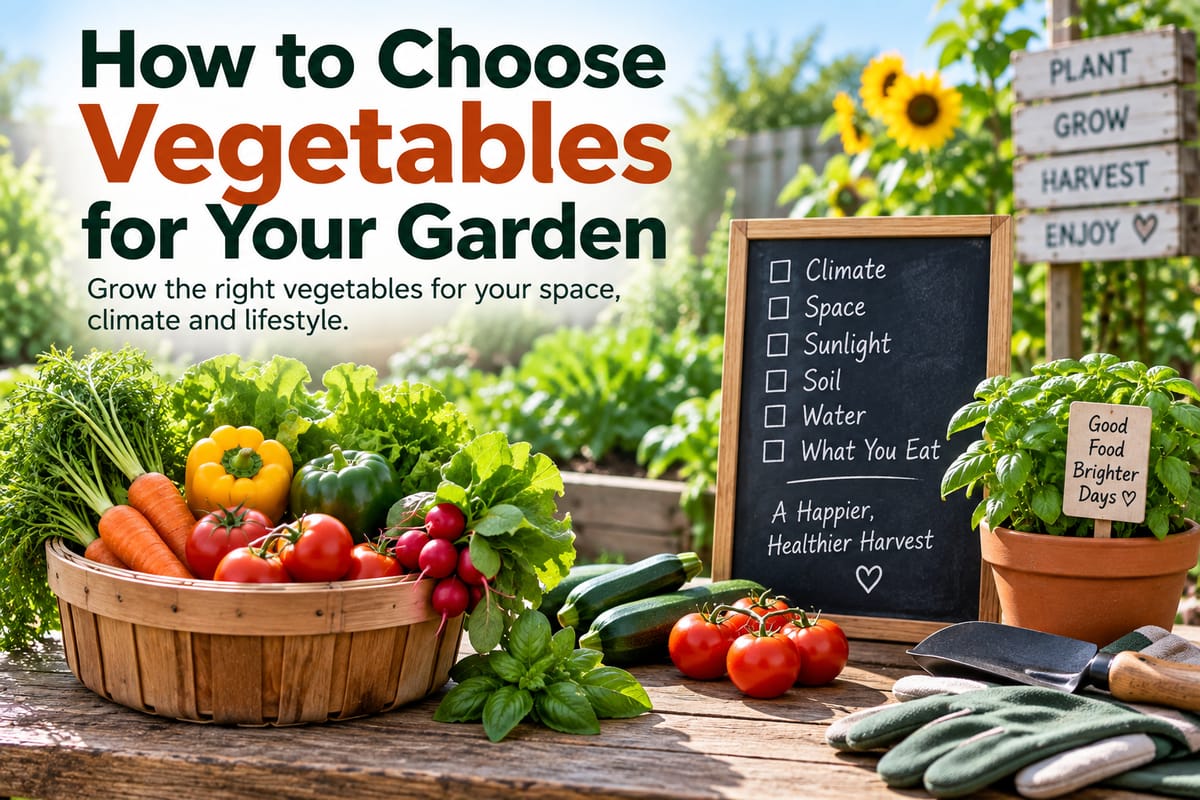
A Simple Vegetable Selection Checklist
Before buying seeds or seedlings, ask:
- Does this vegetable suit my climate?
- Does my garden provide enough sunlight?
- Is the available soil suitable?
- Can I provide enough water?
- How much space will the mature plant require?
- How long will it take to harvest?
- How much maintenance does it need?
- Does the variety suit my growing conditions?
- Will my household actually eat it?
- Do I have a plan for the harvest?
If the answers are favorable, the crop is more likely to be a practical choice for your garden.
Choosing Vegetables With the Whole Garden in Mind
Selecting vegetables is ultimately about matching plants to real conditions.
The most productive garden is not necessarily the one with the largest number of varieties. It is one where the selected crops have enough sunlight, suitable soil, reliable water, sufficient space, and appropriate temperatures to grow successfully.
Starting with vegetables that fit your garden and your lifestyle can make gardening more manageable. Once you understand which crops thrive in your particular space, you can gradually introduce new varieties and experiment with different planting methods.
Building a Garden Around What Works
A successful vegetable garden develops through observation and adjustment.
Pay attention to what grows quickly, what struggles, which varieties produce reliable harvests, and which crops your household actually uses. Combine those observations with the practical realities of your soil, climate, available space, and watering routine.
Over time, choosing vegetables becomes less about guessing which plants might work and more about building a garden around the conditions you already understand.