How Landscape Drainage Systems Work
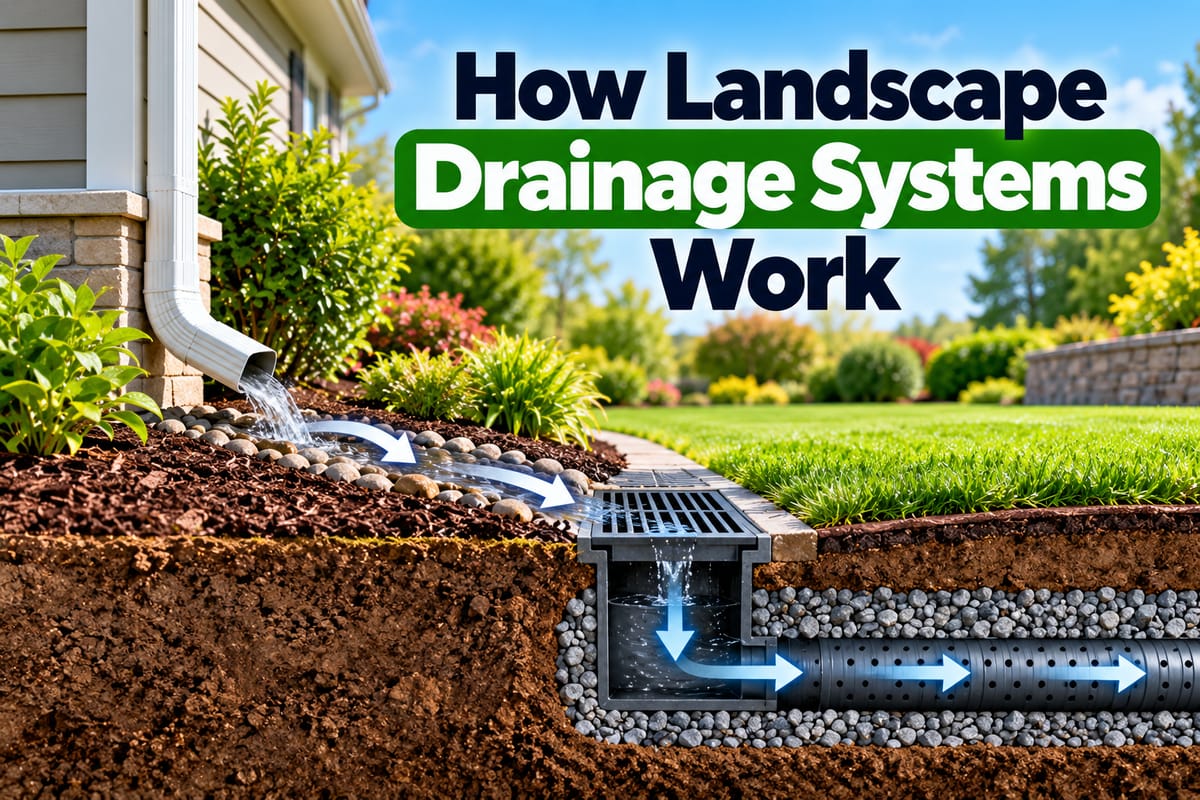
How Landscape Drainage Systems Work
Water is essential for a healthy landscape, but too much water in the wrong place can quickly become a problem. Heavy rainfall, poor grading, compacted soil, low-lying areas, and runoff from roofs or paved surfaces can leave gardens saturated and create standing water around a property.
Landscape drainage systems are designed to manage that water. Rather than allowing rainwater to collect wherever gravity takes it, a well-planned drainage system guides excess water toward appropriate areas where it can be absorbed, stored, or safely discharged.
The system can be as simple as carefully shaped soil that directs runoff away from a building or as sophisticated as a network of surface drains, underground pipes, catch basins, and drainage channels.
Understanding how landscape drainage works can help homeowners identify water problems, protect gardens and structures, and plan outdoor spaces that remain functional during wet weather.
What Is a Landscape Drainage System?
A landscape drainage system is a collection of features designed to control the movement of excess water across or beneath a property’s outdoor areas.
Its primary purpose is not necessarily to remove every drop of water from a landscape. Instead, good drainage manages water so it moves to appropriate locations without causing prolonged saturation, erosion, flooding, or damage.
Depending on the property, a drainage system may include:
- Sloped ground
- Swales
- Drainage channels
- French drains
- Catch basins
- Surface drains
- Perforated drainage pipes
- Dry wells
- Gravel drainage beds
- Rain gardens
- Retention or detention areas
- Downspout extensions
- Permeable surfaces
Different drainage features serve different purposes. A system that works well for a gently sloping garden may not be appropriate for a property with heavy clay soil and significant runoff from paved surfaces.
Why Landscape Drainage Matters
Water problems can affect much more than the appearance of a garden.
Excess water can damage plants, wash away soil, erode pathways, create muddy areas, and contribute to structural problems when it accumulates near a building.
Poor drainage can also make outdoor spaces difficult to use. A lawn may remain saturated for days after rainfall, while paths and patios can develop puddles or become surrounded by eroded soil.
Managing runoff is therefore an important part of maintaining both the landscape and the wider property.
Homeowners looking at drainage as part of their broader property maintenance can also explore How Drainage Systems Protect Homes.
How Water Moves Through a Landscape
Understanding drainage begins with understanding gravity.
Water generally flows from higher elevations toward lower elevations. When rain lands on a property, some of it soaks into the soil, some evaporates, some is taken up by plants, and the remainder flows across the surface or through soil.
The amount of runoff depends on several factors.
Slope
A steep slope can cause water to move rapidly across the landscape. A flatter area may allow water to remain in place for longer.
Soil Type
Different soils absorb water at different rates.
Sandy soils generally allow water to move relatively easily, while dense clay soils can drain more slowly. Compacted soil can also reduce infiltration.
Vegetation
Plants can help intercept rainfall and absorb some water through their roots. Vegetation can also reduce the speed at which water moves across the surface.
Impermeable Surfaces
Roofs, concrete, asphalt, and some paving materials prevent water from soaking directly into the ground.
Instead, rainfall runs across these surfaces and can reach the landscape in concentrated flows.
The Importance of Landscape Grading
Grading is one of the simplest and most important components of landscape drainage.
Landscape grading involves shaping the ground so that water naturally moves in a desired direction.
A properly graded area can direct water away from structures and toward a suitable drainage point.
For example, a lawn near a house may be gently sloped so rainfall moves away from the foundation instead of collecting beside the building.
Grading does not require complicated equipment in every situation, but significant changes to the elevation of a property require careful planning.
Incorrect grading can create the opposite problem by directing water toward a home, retaining wall, patio, or another area where accumulation can cause damage.
How Swales Work
A swale is a shallow, gently sloped channel designed to guide and sometimes slow runoff.
Unlike a conventional deep ditch, a landscape swale can be integrated into the appearance of a garden.
Water enters the swale and follows its gradual slope toward a designated drainage area.
Swales can also help reduce the speed of runoff. Vegetation and soil within the swale can slow the water, allowing some of it to infiltrate into the ground.
A well-designed swale may therefore serve both functional and landscape-design purposes.
How French Drains Work
French drains are underground drainage systems designed to collect and redirect excess water.
A typical French drain contains a perforated pipe surrounded by drainage material such as gravel. Water enters the gravel and reaches the perforated pipe, which carries it toward an appropriate outlet.
The system can be useful when surface drainage alone is not sufficient.
For example, a French drain may be installed in an area where water repeatedly collects beneath the surface or along a property boundary.
The exact design depends on soil conditions, slope, water volume, available space, and the intended discharge location.
How Catch Basins Work
A catch basin is a drainage structure positioned at or near ground level to collect surface water.
Rainwater flows toward the basin through the landscape or along a paved surface. Water enters through a grate and collects inside the basin before moving into a connected drainage pipe.
Catch basins can be particularly useful in areas where water naturally concentrates.
They are often used near:
- Driveways
- Patios
- Walkways
- Low areas
- Sloped lawns
- Parking areas
- Downspout discharge points
The basin provides a defined collection point instead of allowing water to spread unpredictably across the landscape.
How Drainage Pipes Move Water
Underground drainage pipes provide a controlled route for water.
Depending on the system, pipes may be solid or perforated.
Solid Drainage Pipes
Solid pipes are designed to carry collected water from one location to another without allowing water to escape through the pipe walls.
They are often used to transport water toward a discharge point.
Perforated Drainage Pipes
Perforated pipes contain openings along their length.
They are commonly used in systems designed to collect water from surrounding soil. Water enters through the openings and is transported through the pipe.
The choice between solid and perforated piping depends on what the drainage system is intended to accomplish.
How Downspouts Affect Landscape Drainage
Roof runoff can be a major source of concentrated water.
During rainfall, a large roof can collect substantial amounts of water. Gutters direct that water toward downspouts, which then discharge it at ground level.
If the downspout releases water directly beside a building, the surrounding soil can become saturated or eroded.
Downspout extensions can move the discharge farther away from the structure. In some properties, downspouts may also connect to a larger drainage system.
The important consideration is where the water ultimately goes.
Simply moving a downspout outlet a short distance may not solve a drainage problem if the new discharge point is still too close to the structure or sends water toward another problem area.
How Drainage Protects Soil
Uncontrolled runoff can gradually remove soil from a landscape.
Fast-moving water can create channels, expose plant roots, wash away mulch, and carry sediment into other areas.
Drainage systems can help control the speed and direction of water.
Vegetated swales, ground covers, retaining features, and carefully designed slopes can all contribute to erosion management.
The goal is not always to make water move as quickly as possible. In many landscapes, slowing runoff is just as important as directing it.
How Drainage Affects Plants
Plants need water, but their roots also need access to oxygen.
When soil remains saturated for extended periods, air spaces in the soil can become filled with water. This can create difficult conditions for many plants.
Poor drainage may contribute to:
- Weak plant growth
- Root stress
- Yellowing foliage
- Increased susceptibility to certain problems
- Lawn deterioration
- Persistent muddy soil
At the same time, removing water too quickly can create excessively dry conditions.
Good landscape drainage therefore involves finding a balance between retaining enough moisture for plants and preventing prolonged saturation.
How Soil Type Influences Drainage Design
A drainage system should account for the characteristics of the soil.
Sandy Soil
Sandy soils generally have relatively large spaces between particles, allowing water to infiltrate more easily.
A property with sandy soil may have fewer problems with surface saturation, although rapid drainage can create its own challenges.
Clay Soil
Clay particles are small and can create dense soil conditions.
Clay-heavy soil may absorb water slowly, resulting in surface pooling during heavy rainfall.
Improving soil structure through appropriate landscaping practices can sometimes help, although significant drainage problems may require engineered solutions.
Compacted Soil
Heavy foot traffic, construction activity, vehicles, or repeated use can compact soil.
Compaction reduces the spaces through which air and water move.
A landscape that once drained well may therefore develop water problems after years of soil compaction.
How Rain Gardens Manage Runoff
A rain garden is a planted depression designed to temporarily collect and absorb rainwater.
Instead of immediately sending runoff into a conventional drainage system, a rain garden provides an area where water can accumulate for a period and gradually infiltrate the soil.
Plants selected for the environment can tolerate periods of wetter conditions while contributing to the appearance of the landscape.
Rain gardens can be useful for managing runoff from roofs, driveways, patios, and other surfaces when local site conditions are appropriate.
They can also add habitat and visual interest to a garden.
Permeable Surfaces and Landscape Drainage
Traditional hard surfaces can prevent rainfall from entering the soil.
Permeable paving provides an alternative in some applications. These surfaces are designed to allow water to pass through or around the paving material and enter a prepared drainage layer below.
Permeable options may be used for:
- Walkways
- Patios
- Driveways
- Courtyards
- Parking areas
The effectiveness of a permeable surface depends on its design, installation, maintenance, soil conditions, and rainfall characteristics.
How Drainage Systems Protect Buildings
Landscape drainage and building protection are closely connected.
Water that repeatedly accumulates near walls or foundations can create problems beyond the garden itself.
Exterior walls and building envelopes form important barriers against rain, wind, and moisture. Understanding How Home Exterior Walls and Building Envelopes Protect Against Weather helps put landscape drainage into a broader property-protection context.
A drainage system should complement, rather than replace, the building’s own water-management features.
Where Should Landscape Water Go?
One of the most important questions in drainage design is where collected water will ultimately be discharged.
A drainage system should not simply move water from one problem area to another.
Possible destinations can include:
- A suitable landscaped infiltration area
- A rain garden
- A dry well where appropriate
- An approved drainage channel
- A suitable stormwater system
- Another properly designed collection area
The correct option depends on local conditions and applicable requirements.
Discharging water onto a neighboring property, toward a building, or into an unsuitable location can create additional problems.
Common Landscape Drainage Problems
Drainage systems can experience problems of their own.
Blocked Drains
Leaves, soil, mulch, and other debris can obstruct grates, catch basins, or pipes.
Regular inspection helps identify blockages before they become serious.
Sediment Buildup
Fine soil particles can accumulate inside drainage structures and reduce their capacity.
Catch basins and other collection points may need periodic cleaning.
Poorly Positioned Outlets
A drainage pipe may work perfectly while still creating a problem if its outlet is located in the wrong place.
Water should be discharged where it can be safely managed.
Insufficient Capacity
A drainage system designed for light rainfall may struggle during unusually heavy storms.
Drainage planning should consider the volume and speed of runoff the system is expected to handle.
Damaged Pipes
Underground pipes can become damaged by soil movement, tree roots, construction activity, or age.
Persistent wet areas can sometimes indicate an issue beneath the surface.
Maintaining a Landscape Drainage System
Drainage systems require maintenance just like other parts of a property.
Routine maintenance may include:
- Clearing leaves from drain grates
- Removing sediment from catch basins
- Inspecting visible drainage channels
- Checking downspout outlets
- Removing vegetation that blocks drainage structures
- Looking for erosion
- Inspecting areas after heavy rainfall
- Checking for persistent standing water
- Keeping drainage outlets unobstructed
These tasks can be incorporated into a broader property maintenance routine. Homeowners looking to organize seasonal upkeep can also explore Home Maintenance Projects.
Signs That a Property May Have a Drainage Problem
Some drainage issues are easy to recognize.
Potential warning signs include:
- Water pooling repeatedly in the same location
- Muddy areas that remain wet long after rainfall
- Soil erosion
- Exposed plant roots
- Washed-out mulch
- Water flowing toward a building
- Saturated lawn areas
- Cracks or movement around hard landscaping
- Overflowing drainage structures
- Standing water near downspouts
- Strong water flow cutting channels through soil
One isolated puddle after an unusually heavy storm does not necessarily mean a property needs a new drainage system. Persistent or worsening patterns deserve closer investigation.
Why Drainage Problems Should Be Addressed Early
Small drainage problems can become more complicated when they are ignored.
Repeated runoff can gradually erode soil, damage plants, undermine landscaping features, and increase moisture exposure around structures.
Addressing the source of the water is generally more effective than repeatedly repairing the visible damage.
For example, replacing washed-out soil without changing the path of the runoff may only provide a temporary solution.
A more durable approach identifies where the water originates, how it moves, and where it can be safely managed.
Drainage and Climate-Resilient Landscaping
Changing weather patterns can make water management an increasingly important consideration for homeowners.
Properties may experience periods of intense rainfall followed by dry conditions, making flexible water-management strategies valuable.
Landscape features that slow, absorb, redirect, or temporarily store rainfall can help properties respond more effectively to heavy precipitation.
Drainage is one part of a larger approach to resilient property design. Climate-Resilient Home Improvements Are Becoming a Smart Long-Term Investment explores the broader idea of preparing homes and outdoor spaces for changing environmental conditions.
When Professional Drainage Design May Be Necessary
Simple landscape adjustments can address some water problems, but more complicated situations may require professional assessment.
Professional input can be especially useful when:
- Water repeatedly enters a building
- Large volumes of runoff are involved
- A property has significant elevation changes
- Underground drainage is required
- Retaining walls are involved
- Drainage affects neighboring properties
- The problem persists after basic improvements
- Local regulations affect the proposed drainage solution
Professionals can assess grading, soil conditions, water flow, drainage capacity, and potential discharge locations before recommending a system.
Designing Drainage Into the Landscape
The best drainage systems do not necessarily look like drainage systems.
A thoughtfully designed landscape can incorporate water-management features into gardens, pathways, lawns, planting beds, and outdoor living areas.
A shallow swale can become a planted feature. A rain garden can become an attractive focal point. Permeable paving can support a patio while allowing water to infiltrate. Carefully designed grading can direct water without creating an obvious channel.
This approach treats drainage as part of landscape design rather than as an afterthought.
How a Well-Designed Drainage System Works Together
Effective landscape drainage is rarely dependent on one feature.
A property may use several components that work together:
- Grading directs water toward appropriate collection areas.
- Vegetation and soil slow and absorb some runoff.
- Catch basins collect concentrated surface water.
- Drainage pipes transport collected water.
- Swales or rain gardens slow and manage runoff.
- Outlets discharge water at suitable locations.
- Maintenance keeps the system functioning over time.
The precise combination depends on the property.
A small residential garden may need only improved grading and better downspout management, while a larger property with substantial runoff may require an interconnected drainage network.
Making Water Work With the Landscape
Landscape drainage is ultimately about controlling how water interacts with a property.
Rather than allowing rainfall to accumulate wherever the terrain dictates, drainage design gives water a planned path. Good systems slow water where necessary, move it where appropriate, allow it to infiltrate when conditions permit, and keep vulnerable areas protected from excessive moisture.
For homeowners, understanding these principles makes it easier to spot drainage problems and recognize the difference between a temporary puddle and a persistent water-management issue.
When drainage is considered alongside soil health, planting, grading, hardscaping, building protection, and routine maintenance, it becomes an important part of creating an outdoor space that remains healthy, usable, and resilient through changing weather conditions.