How Property Ownership Changes Over Time
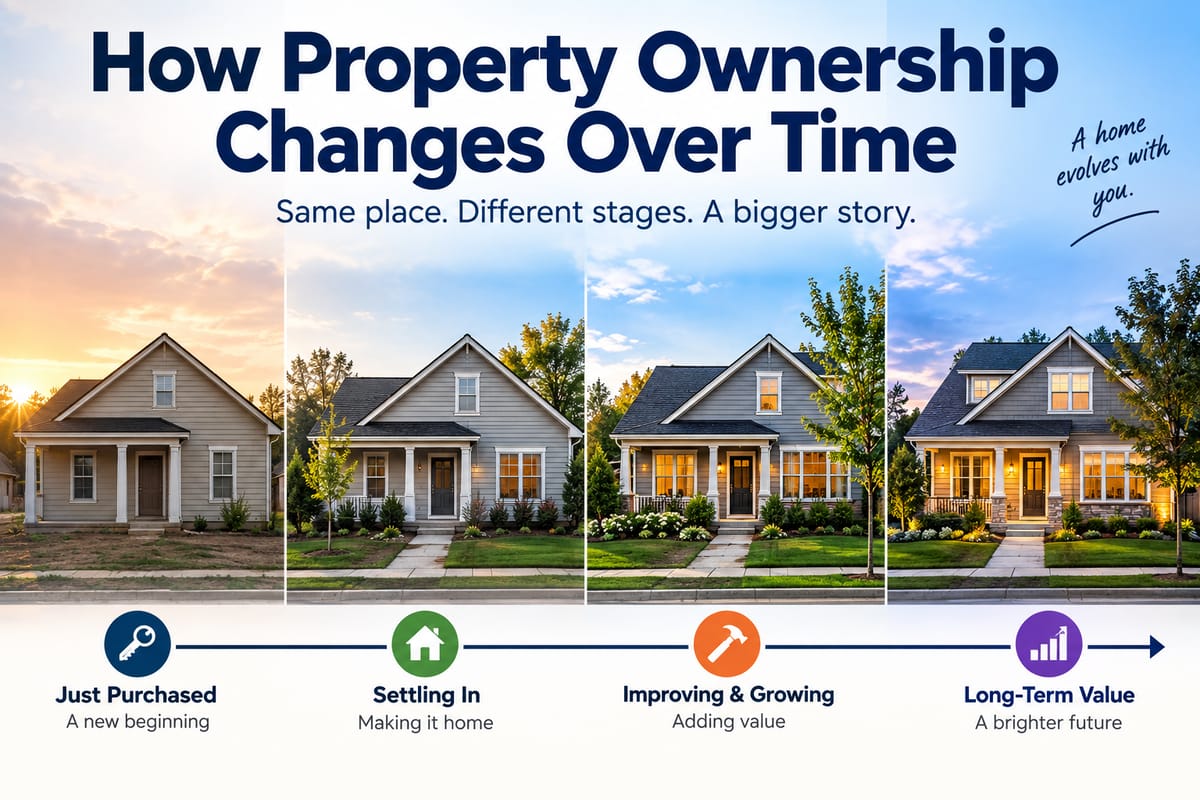
**How Property Ownership Changes Over Time
Buying a property is often viewed as a single milestone: you find a home, complete the purchase, receive the keys, and become the owner. In reality, property ownership is a long-term process that can change significantly over the years.
The condition of the property evolves, its market value can rise or fall, ownership costs change, neighborhoods develop, and the owner’s financial circumstances may shift. A property that begins as a first home can eventually become an investment, a rental, a family asset, or something that is sold to fund another stage of life.
Understanding how property ownership changes over time can help homeowners make better decisions about maintenance, finances, improvements, and eventually selling or transferring the property.
Property Ownership Is More Than Buying a Home
Ownership gives a person or group legal rights over a property, but those rights come with ongoing responsibilities.
A homeowner generally has to think about maintenance, taxes or other applicable charges, insurance, financing costs, utilities, repairs, and changes to the property’s condition. Some of these expenses are predictable, while others arise unexpectedly.
The financial position of the property can also change. A homeowner may build equity as a mortgage is paid down, while the property’s market value may change because of local demand, economic conditions, improvements, or changes in the surrounding area.
This means ownership should be viewed as an ongoing relationship with an asset rather than a one-time transaction.
The Early Years of Ownership
The first few years after purchasing a property are often focused on settling in and understanding the true costs of ownership.
New homeowners may discover maintenance requirements that were not obvious during viewings. Appliances may need replacement, small defects may become more noticeable, and routine maintenance can reveal additional work.
This is why careful inspection before purchasing remains important. A thorough Complete Guide to Property Due Diligence can help buyers understand the importance of investigating a property before committing to the purchase.
During this stage, homeowners may also begin making relatively small changes, such as repainting rooms, improving storage, replacing fixtures, or updating landscaping.
Building Equity Over Time
For homeowners who finance a property with a mortgage, ownership can gradually change their financial position.
As mortgage principal is paid down, the owner’s equity can increase, assuming other factors remain constant. Equity represents the portion of the property’s value that belongs to the owner rather than the lender.
For example, if a property were worth $300,000 and the outstanding mortgage were $220,000, the owner’s gross equity would be approximately $80,000.
However, equity is not necessarily the same as cash available to spend. Selling costs, taxes, outstanding debts, and other financial obligations can affect how much money an owner ultimately receives from a sale.
Property Values Can Change
One of the most significant changes during ownership is the property’s market value.
Property values can increase because of factors such as:
- Strong local demand
- Population growth
- New transportation infrastructure
- Improvements to nearby amenities
- Limited housing supply
- Renovations and improvements
- Economic growth
Values can also decline because of economic downturns, changing buyer preferences, oversupply, deteriorating neighborhoods, or problems affecting the property itself.
A useful Property Value Guide can help homeowners understand the different factors that influence what a property may be worth.
Importantly, the price a homeowner paid for a property does not determine its current market value. The market continues to reassess properties as circumstances change.
Maintenance Becomes an Ongoing Responsibility
Every property ages.
Roofs, plumbing systems, electrical components, heating and cooling equipment, appliances, windows, flooring, exterior finishes, and other components eventually require attention.
Some maintenance tasks are routine, while others involve major repairs or replacement.
Examples include:
- Cleaning gutters
- Servicing heating and cooling systems
- Inspecting roofs
- Maintaining plumbing
- Checking electrical systems
- Repainting exterior surfaces
- Repairing damaged flooring
- Maintaining drainage
- Servicing appliances
Keeping up with Home Maintenance Projects can help homeowners address problems before relatively minor issues become expensive repairs.
Improvements Can Change the Property
Homeowners frequently modify their properties as their needs evolve.
A couple may initially need only a few bedrooms, while a growing family may eventually need additional living space. Someone working from home may convert part of a property into an office. An older homeowner may prioritize accessibility and ease of maintenance.
Common improvements include:
- Kitchen renovations
- Bathroom upgrades
- New flooring
- Energy-efficiency improvements
- Landscaping
- Additional storage
- Exterior improvements
- Room conversions
- Accessibility modifications
Not every improvement produces an equal financial return. Some projects primarily improve comfort and functionality, while others may make the property more attractive to future buyers.
Home Value Depends on More Than Renovations
Renovations can influence value, but homeowners should not assume that every dollar spent on an improvement will increase the property’s value by the same amount.
The quality of the work, local buyer preferences, neighborhood standards, and the property’s overall condition all matter.
For example, addressing a leaking roof or serious structural problem may protect value without dramatically increasing the property’s resale price. Meanwhile, a well-designed kitchen renovation may improve both functionality and buyer appeal.
The objective should therefore be to balance personal enjoyment with long-term practicality.
Homeowners interested in this approach can explore How to Protect and Improve Home Value for strategies that focus on preserving and strengthening a property’s appeal.
Neighborhood Changes Can Affect Ownership
A property does not exist in isolation.
The surrounding neighborhood can change considerably over a decade or more. New schools, businesses, roads, public transportation, parks, and other amenities can influence desirability.
On the other hand, declining infrastructure, reduced employment opportunities, congestion, environmental problems, or changing neighborhood conditions can negatively affect demand.
Homeowners should therefore occasionally consider not only the condition of their own property but also what is happening around it.
Ownership Costs Can Change
The cost of owning a property is rarely fixed.
Insurance premiums may change. Property taxes or local charges may increase. Utility costs can rise. Maintenance expenses tend to become more significant as buildings and systems age.
Mortgage payments may also change in some financing arrangements, particularly when interest rates are variable.
As a result, a property that was affordable when purchased may require a different financial strategy several years later.
Maintaining an emergency fund and budgeting for major repairs can reduce the risk of unexpected expenses becoming financial emergencies.
Life Circumstances Can Change the Meaning of Ownership
A property’s role in someone’s life can change even if the building itself remains largely the same.
A first home may eventually become too small. Children may leave home, creating unused space. A homeowner may relocate for work, retire to another region, or decide to purchase a different property.
Other owners may decide to turn their former residence into a rental rather than sell it.
These decisions can have financial, legal, tax, and practical consequences, so they should be considered carefully rather than based solely on changes in the property’s market value.
Property Ownership Can Become an Investment
Over time, some homeowners begin viewing their property primarily as an asset.
This can happen when the property appreciates substantially, when rental opportunities become attractive, or when the owner acquires additional properties.
However, property ownership as an investment involves more than watching prices rise. Rental properties can involve vacancies, maintenance, insurance, management expenses, taxes, financing costs, and regulatory requirements.
A property’s gross rental income does not necessarily represent its actual investment return.
Ownership Can Be Shared or Transferred
Property ownership does not always remain with one person.
A property may eventually be transferred through a sale, inheritance, gift, divorce settlement, business arrangement, or another legal process.
Joint ownership can also change when one owner sells or transfers their interest.
The precise rules governing these situations vary considerably by jurisdiction and by the legal structure used to hold the property. Anyone considering a transfer should obtain appropriate professional legal and financial advice.
The Property Itself Ages
Buildings have life cycles.
Even a well-maintained home will eventually require major components to be repaired or replaced. A roof may reach the end of its useful life. Plumbing may deteriorate. Windows may become inefficient. Heating and cooling equipment may need replacement.
This does not necessarily mean an older property is a bad investment.
Age can coexist with excellent maintenance and thoughtful upgrades. In fact, a well-maintained older property can sometimes be more appealing than a poorly maintained newer one.
The key is understanding the condition of the major systems and planning for their eventual replacement.
Technology Can Change What Buyers Expect
Technology also changes the meaning of a modern home.
Features such as smart thermostats, security systems, energy monitoring, automated lighting, efficient appliances, and connected home systems can become more common over time.
However, homeowners should distinguish between useful technology and features that may quickly become outdated.
Installing technology solely because it is fashionable may not provide lasting value. Practical improvements that reduce operating costs, improve security, increase convenience, or solve a genuine household problem may have greater long-term usefulness.
Energy Efficiency Can Become More Important
Energy efficiency can influence both household costs and buyer preferences.
Insulation, efficient windows, modern appliances, improved heating and cooling systems, solar technology, and other upgrades can potentially reduce energy consumption.
The value of these improvements depends on the property, local energy prices, climate, available incentives, and buyer expectations.
As energy costs and environmental considerations change, efficient homes may become increasingly attractive to some buyers.
Selling Changes the Ownership Equation
Eventually, many owners decide to sell.
At this point, the property changes from a place to live into an asset being prepared for a transaction.
The homeowner may need to decide which repairs or improvements are worthwhile, establish an asking price, prepare documentation, and account for transaction expenses.
The property’s market value at the time of sale is only one part of the financial calculation. Selling costs, outstanding mortgage balances, taxes where applicable, and other expenses can affect the amount of money the owner ultimately receives.
Long-Term Ownership Requires Planning
The longer someone owns a property, the more useful long-term planning becomes.
Instead of waiting for major problems to appear, homeowners can create schedules for routine inspections and anticipate major expenses.
A long-term ownership plan might include:
- Tracking the property’s condition.
- Maintaining important systems regularly.
- Keeping records of repairs and improvements.
- Building reserves for major replacements.
- Reviewing insurance periodically.
- Monitoring neighborhood and market changes.
- Reassessing whether the property still meets household needs.
- Considering future selling, rental, or transfer options.
This approach can make ownership more predictable and reduce the likelihood of being forced into expensive decisions at inconvenient times.
From First Purchase to Long-Term Asset
Property ownership is a process that evolves alongside the homeowner.
In the beginning, the priority may be simply finding a suitable place to live. Over time, attention shifts toward maintenance, equity, improvements, changing market values, household needs, and long-term financial planning.
Eventually, the owner may decide to sell, rent, transfer, or continue holding the property for another generation.
The most successful long-term approach is not necessarily to maximize the property’s value at every opportunity. Instead, homeowners can focus on maintaining the property properly, making improvements that serve a genuine purpose, understanding changing ownership costs, and periodically reassessing how the property fits into their broader plans.
A home can remain a valuable asset for decades, but preserving that value requires active ownership rather than simply holding the title.