How Rewards Reinforce Repeated Behaviors
How Rewards Reinforce Repeated Behaviors
Why do some habits become automatic while others disappear after a few attempts? One important part of the answer is reinforcement.
When a behavior is followed by a rewarding or satisfying outcome, the experience can make that behavior more likely to happen again. Over time, repeated cycles of behavior and reward can contribute to the formation of habits and routines.
This principle appears throughout everyday life. People may exercise because they enjoy feeling stronger, check their phones because notifications provide immediate stimulation, save money because reaching a financial milestone feels satisfying, or keep a tidy home because an organized space creates a sense of comfort.
Understanding how rewards reinforce repeated behaviors can help explain both helpful and unhelpful routines.
What Is Reinforcement?
Reinforcement is a process through which a consequence increases the likelihood that a behavior will be repeated.
The key idea is simple:
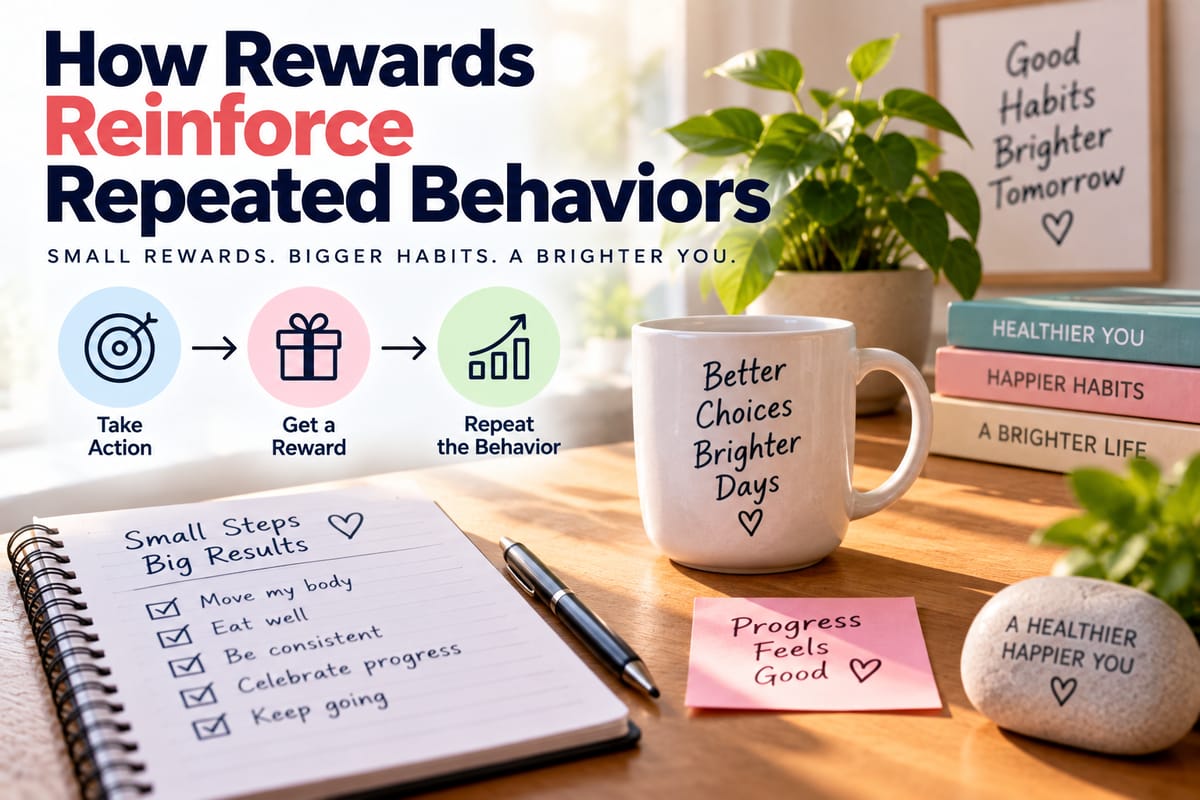
Behavior → Rewarding consequence → Greater likelihood of repeating the behavior
For example, imagine someone starts taking a short walk after work. The walk leaves them feeling relaxed and gives them time away from a busy schedule. Because the experience is enjoyable, they may be more likely to walk again the following day.
The reward does not necessarily have to be something tangible. Feelings such as satisfaction, relief, enjoyment, accomplishment, or social connection can all function as rewarding outcomes.
Why Rewards Influence Behavior
The brain is constantly learning from experiences.
When an action produces an outcome that feels beneficial, the experience can provide information about whether repeating that action may be worthwhile. This learning process helps people adapt to their environments.
Rewards can be particularly influential when they occur soon after a behavior.
For example, completing a task and immediately feeling a sense of accomplishment creates a direct connection between the action and its outcome. By contrast, a reward that occurs months later may be less motivating because the connection is harder to perceive.
This is one reason immediate feedback can be useful when developing new habits.
Positive Reinforcement and Everyday Habits
Positive reinforcement occurs when something desirable follows a behavior and increases the likelihood of that behavior occurring again.
Consider several everyday examples:
- Exercising produces a feeling of accomplishment.
- Completing work early creates more free time.
- Cooking at home produces an enjoyable meal.
- Reading provides entertainment or knowledge.
- Saving money creates progress toward a desired purchase.
- Maintaining a clean workspace makes future tasks easier.
In each case, the outcome can encourage the behavior to continue.
The reward does not have to be deliberately designed. Sometimes ordinary consequences naturally reinforce behaviors.
Rewards Do Not Have to Be Large
A common misconception is that rewards must be significant to influence behavior.
Small rewards can be surprisingly effective when they are meaningful and occur consistently.
A person trying to establish a reading routine might enjoy a cup of tea while reading. Someone building an exercise habit might appreciate listening to favorite music during a workout. A person working toward a savings goal might enjoy seeing their progress increase each week.
These small experiences can make a behavior more satisfying.
Over time, the behavior itself may become rewarding rather than requiring an external incentive.
Immediate Rewards Are Often Powerful
Human behavior is strongly influenced by what happens in the present.
Suppose someone wants to exercise regularly but finds sitting on the couch more immediately enjoyable. The long-term benefits of exercise may be substantial, but they are delayed.
This creates a competition between immediate and delayed rewards.
A useful strategy can be to make the desired behavior more immediately satisfying. For example, someone might choose an enjoyable form of exercise, listen to music while training, or track progress after each session.
The goal is to create a positive experience around the behavior rather than relying exclusively on distant benefits.
Delayed Rewards Can Still Shape Behavior
Not every useful behavior produces an immediate payoff.
Education, saving, skill development, and long-term health habits often involve delayed benefits.
A person may spend months learning a new skill before becoming proficient. Someone saving money may need years before reaching a major financial goal.
In these situations, visible progress can serve as an intermediate reward.
Tracking completed lessons, recording improvements, celebrating milestones, or watching a savings balance grow can make long-term goals feel more rewarding along the way.
The Difference Between Reinforcement and Punishment
Reinforcement and punishment are not simply two different types of rewards.
In behavioral terms, reinforcement increases a behavior, while punishment decreases a behavior.
Positive reinforcement involves adding something desirable after a behavior.
Negative reinforcement involves removing something unpleasant after a behavior.
Punishment, by contrast, is intended to reduce a behavior.
These concepts are sometimes confused because “positive” and “negative” in behavioral science refer to adding or removing something, rather than whether the consequence is good or bad.
Understanding this distinction makes it easier to analyze why particular behaviors continue or disappear.
How Rewards Can Create Habit Loops
Repeated behavior can develop into a habit when a behavior becomes connected with a consistent cue and consequence.
A simplified habit loop can look like this:
Cue → Behavior → Reward
For example:
Feeling tired → Making coffee → Feeling more alert
After enough repetition, the cue can automatically trigger an expectation of the behavior and its associated reward.
This does not mean every habit develops through exactly the same process. Human behavior is influenced by many factors, including environment, motivation, emotions, social circumstances, and individual differences.
Still, the relationship between cues, behaviors, and rewarding consequences provides a useful framework for understanding repeated routines.
Rewards Can Reinforce Unhelpful Behaviors
The same mechanism that supports healthy habits can reinforce behaviors people may later want to change.
Consider a person who feels stressed and immediately checks social media. The activity provides a temporary distraction or stimulation. If that experience reduces the uncomfortable feeling, the person may become more likely to check social media the next time they feel stressed.
Similarly, procrastination can sometimes be reinforced because avoiding a difficult task produces immediate relief.
The behavior may have negative long-term consequences while still providing a short-term reward.
This distinction is important when trying to understand why simply knowing that a behavior is harmful does not always make it easy to stop.
Environment Can Make Rewards More Powerful
The surrounding environment influences which behaviors are convenient and which rewards are readily available.
If healthy food is easy to access, exercising equipment is visible, and a workspace is organized, desired behaviors may require less effort.
On the other hand, if distractions are constantly available, they may become easier to repeat.
Changing the environment can therefore change the reinforcement structure around everyday behaviors.
For example, putting a book beside the bed makes reading easier to start, while keeping a phone outside the bedroom can make late-night scrolling less convenient.
Social Rewards Can Reinforce Behavior
Not all rewards are physical or financial.
Recognition, encouragement, acceptance, attention, and belonging can be powerful social rewards.
A person who receives positive feedback after contributing to a group may be more inclined to participate again. A child praised for completing a responsibility may become more motivated to repeat it.
Social reinforcement can also influence behaviors in workplaces, friendships, families, and communities.
This helps explain why people sometimes continue behaviors even when there is little obvious material benefit.
Rewards and Personal Development
Reinforcement can play a useful role in building skills.
Learning something new often involves periods of difficulty before meaningful results appear. If learners receive feedback and experience small successes along the way, those outcomes can encourage continued effort.
This is especially relevant when developing complex abilities.
The principles discussed in How Personal Development Works and How People Build Meaningful Skills can be connected to this idea because meaningful skill development often depends on repeated practice and visible progress.
Breaking a large skill into smaller achievements can create more frequent opportunities for positive feedback.
Rewards and Personal Goals
Goals can become easier to pursue when progress itself provides some form of satisfaction.
Instead of focusing exclusively on a distant outcome, people can create smaller milestones that make progress visible.
For example, someone aiming to write a book might track chapters completed rather than focusing only on the finished manuscript.
Someone learning a language might celebrate reaching specific vocabulary or conversation milestones.
Someone trying to save money might monitor progress toward smaller financial targets.
This approach connects naturally with How to Set Meaningful Personal Goals, particularly the importance of turning broad ambitions into manageable actions.
Intrinsic and Extrinsic Rewards
Rewards can broadly be divided into intrinsic and extrinsic forms.
Intrinsic rewards come from the activity itself. Enjoyment, curiosity, satisfaction, and a sense of mastery are examples.
Extrinsic rewards come from outside the activity. Money, prizes, recognition, discounts, or other incentives are examples.
Both can influence behavior, but they may operate differently.
A person who exercises because they genuinely enjoy movement may continue exercising even when there is no external reward. Another person might initially exercise because they receive recognition or reach a measurable target.
Over time, an externally motivated behavior can sometimes become internally rewarding as the person begins to enjoy the activity itself.
Why Reward Timing Matters
The timing of a reward can affect how strongly it becomes associated with a behavior.
Immediate consequences are generally easier to connect with the action that produced them.
For example, receiving immediate feedback after completing a task creates a clearer relationship between effort and outcome than receiving feedback several weeks later.
This principle is frequently relevant to education, workplace performance, fitness, personal finance, and habit development.
When rewards are delayed, intermediate milestones can help maintain motivation.
Variable Rewards Can Encourage Repetition
Some behaviors are reinforced by rewards that are unpredictable.
Instead of receiving the same outcome every time, a person may sometimes receive something particularly interesting or satisfying.
Digital platforms frequently use notifications, new content, recommendations, and other unpredictable experiences to encourage repeated engagement.
Variable rewards can be especially compelling because people may continue checking for the possibility of another rewarding outcome.
This is one reason certain digital behaviors can become difficult to regulate.
How Rewards Can Support Better Routines
People can deliberately design routines around rewarding experiences.
For example, someone trying to establish a morning exercise habit could choose an activity they genuinely enjoy rather than treating exercise purely as a chore.
Someone trying to read more could create a comfortable reading environment.
Someone trying to maintain a cleaner home could make the process more enjoyable through music or by breaking cleaning into short sessions.
The underlying principle is to reduce the gap between performing a desired behavior and experiencing something satisfying.
This fits into the broader concept of designing everyday life around deliberate choices, which is explored in the Complete Guide to Lifestyle Design and Personal Living.
Replacing a Behavior Can Be Easier Than Simply Removing It
When an unwanted behavior provides a meaningful reward, eliminating the behavior without addressing that reward can be difficult.
Suppose someone uses their phone whenever they feel bored. Simply deciding to stop using the phone may leave the underlying need for stimulation unresolved.
Replacing the behavior with another activity that provides a similar benefit may be more practical.
Reading, walking, talking with someone, listening to music, or engaging in a hobby could provide alternative forms of stimulation.
The appropriate replacement depends on what reward the original behavior was providing.
Tracking Progress Can Become a Reward
Progress tracking can turn an abstract goal into something visible.
Checklists, calendars, habit trackers, savings charts, workout logs, and project milestones all provide feedback.
Seeing a sequence of completed actions can create a sense of achievement that reinforces continued effort.
However, tracking should remain useful rather than becoming another source of unnecessary pressure. The purpose is to make progress easier to recognize, not to create an obligation to maintain a perfect record.
Rewards Should Support the Bigger Goal
An effective reward should ideally encourage the behavior rather than undermine it.
For example, someone trying to build a regular exercise routine might reward consistency with enjoyable downtime or a new activity-related experience.
Someone trying to improve their finances might celebrate progress without creating a large new expense that undermines the financial objective.
The most useful rewards are often those that make the desired lifestyle more enjoyable and sustainable.
Designing Better Behavioral Patterns
Understanding reinforcement gives people a practical way to examine their routines.
Instead of asking only, “Why do I keep doing this?” it can help to ask:
- What usually happens immediately before the behavior?
- What do I get from doing it?
- Does the behavior provide relief, pleasure, recognition, stimulation, or convenience?
- How quickly does the reward arrive?
- Is there a healthier way to obtain the same benefit?
- Can the desired behavior be made easier or more enjoyable?
- Can progress be made more visible?
These questions can reveal the mechanisms that keep certain behaviors going.
Intentional living involves many of these same ideas because daily choices are shaped by the environments, routines, priorities, and incentives people create around themselves. How Intentional Living Can Improve Everyday Life and Personal Priorities explores this broader relationship between deliberate choices and everyday life.
Small Rewards Can Build Bigger Patterns
Repeated behaviors rarely develop from a single decision. They often emerge from many small interactions between actions and consequences.
A behavior that feels satisfying today is more likely to be repeated tomorrow. Repeated often enough, it can become familiar and eventually feel almost automatic.
That process can work in either direction. It can strengthen routines that support personal goals, or it can reinforce behaviors that provide immediate satisfaction while creating longer-term problems.
Recognizing the role of rewards makes those patterns easier to understand. By paying attention to what reinforces everyday actions and deliberately shaping the environment around them, people can create routines that are more consistent with the lifestyle and priorities they want to build.