How Smart Plugs Measure Energy Use
How Smart Plugs Measure Energy Use
Smart plugs are among the simplest ways to add connected control to ordinary household appliances. Plug one into a wall outlet, connect a device to it, and the appliance can often be controlled through a smartphone app, voice assistant, schedule, or automation.
Many smart plugs offer another useful feature: energy monitoring.
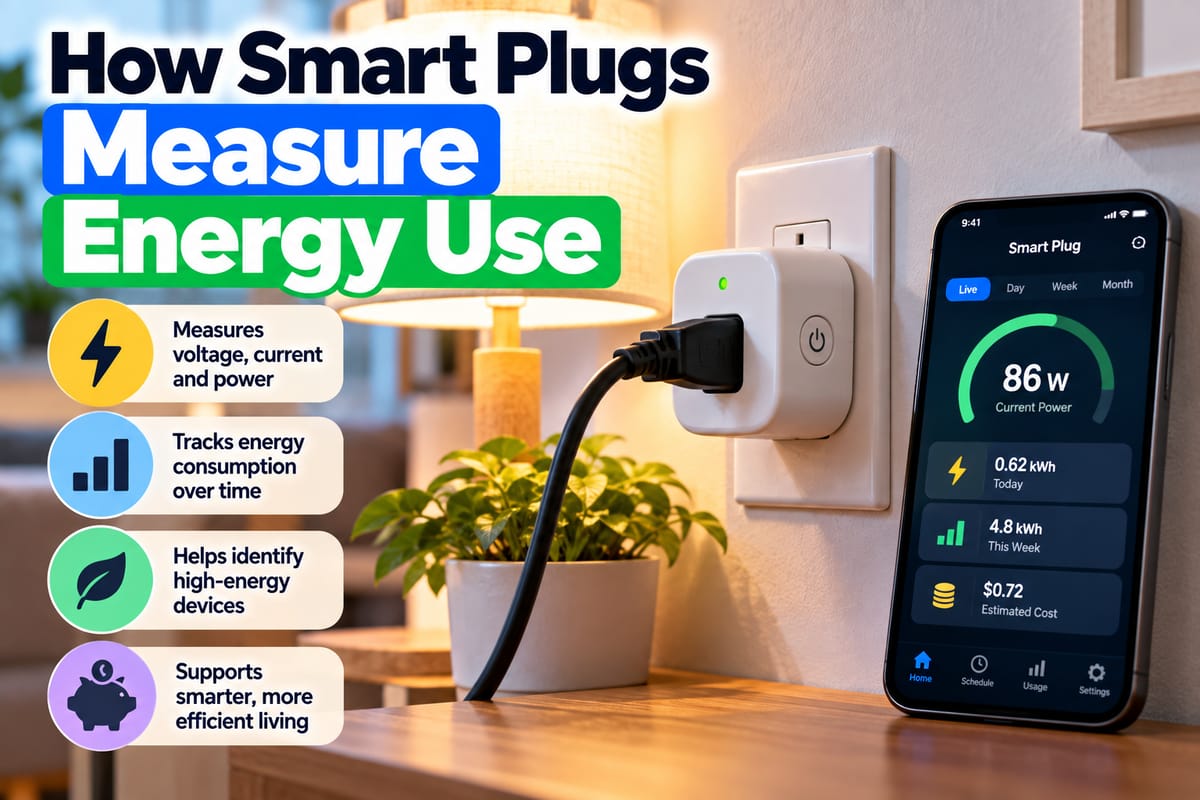
Instead of simply switching electricity on and off, an energy-monitoring smart plug can measure how much electrical power a connected appliance is using. This information can help homeowners understand which devices consume the most electricity, identify unusual usage patterns, and make more informed decisions about household energy consumption.
Understanding how smart plugs measure energy use also explains why their readings are useful but should not always be treated as laboratory-grade measurements.
What Is an Energy-Monitoring Smart Plug?
A smart plug is a connected electrical device that sits between a wall outlet and an appliance.
A basic smart plug typically allows users to:
- Turn an appliance on or off remotely
- Create schedules
- Set automation rules
- Use voice commands
- Monitor whether the outlet is active
An energy-monitoring model adds electrical measurement capabilities.
It can measure characteristics of the electricity flowing through the plug and use those measurements to estimate or calculate power consumption.
Smart plugs are therefore a relatively accessible entry point into the broader connected-home ecosystem described in The Complete Guide to Smart Homes.
What Does a Smart Plug Actually Measure?
Energy-monitoring smart plugs can measure electrical characteristics such as:
- Voltage
- Current
- Power
- Energy consumption
- Sometimes power factor
These measurements are related but not identical.
Voltage
Voltage represents the electrical potential difference supplied to the appliance.
A smart plug can monitor the voltage available at the outlet.
Current
Current represents the flow of electrical charge through the connected circuit.
The plug can measure the current being drawn by the appliance.
Power
Electrical power describes the rate at which electrical energy is being used.
It is commonly expressed in watts.
A simplified relationship is:
Power = Voltage × Current
For some types of loads, however, the relationship can be more complicated because of factors such as alternating current behavior and power factor.
Energy
Energy represents the amount of electricity consumed over time.
It is commonly measured in watt-hours or kilowatt-hours.
For example, an appliance drawing 100 watts continuously for 10 hours would use approximately:
100 W × 10 hours = 1,000 Wh = 1 kWh
This distinction is important because a device can have a high power rating but consume relatively little total energy if it operates only briefly.
How Does a Smart Plug Measure Electricity?
Inside an energy-monitoring smart plug are electrical measurement components.
The exact design varies between manufacturers, but the device typically contains circuitry capable of sensing electrical conditions while also controlling the power supplied to the appliance.
The measurement system can monitor the electrical current passing through the plug and the voltage supplied to the load.
The smart plug’s electronics then process those measurements and calculate values that can be displayed in its companion application.
A simplified process looks like this:
Electrical current flows → Sensors measure electrical characteristics → Electronics process measurements → Software calculates consumption → App displays data
How Smart Plugs Measure Current
Current measurement is one of the most important parts of energy monitoring.
A smart plug needs to determine how much current the connected appliance is drawing.
Depending on the design, measurement circuitry can use different electrical sensing techniques.
The sensor produces information that the plug’s electronics can process without requiring the homeowner to interact with the electrical wiring directly.
The resulting measurements can then be combined with voltage information to estimate the appliance’s power consumption.
How Smart Plugs Calculate Power
For a simple electrical load, power can be approximated by multiplying voltage by current.
For example, if a device operates at approximately 120 volts and draws 2 amps:
120 V × 2 A = 240 W
In a different electrical system, the voltage and current values would be different.
However, real-world alternating-current loads can behave more complexly than this simple calculation suggests.
Why Power Factor Matters
Some appliances do not draw current in a simple, perfectly synchronized way relative to the voltage waveform.
This is particularly relevant for devices containing:
- Motors
- Transformers
- Switching power supplies
- Electronic control systems
Power factor describes the relationship between voltage and current in an AC electrical system.
For certain loads, calculating real power requires considering power factor rather than simply multiplying voltage and current.
Higher-quality energy-monitoring devices may account for these characteristics when estimating actual energy consumption.
From Watts to Kilowatt-Hours
Smart plug apps often display energy consumption in kilowatt-hours because electricity bills commonly use this unit.
One kilowatt-hour equals:
1,000 watts used for one hour
For example:
| Appliance power | Operating time | Approximate energy |
|---|---|---|
| 50 W | 10 hours | 0.5 kWh |
| 100 W | 5 hours | 0.5 kWh |
| 500 W | 2 hours | 1 kWh |
| 1,000 W | 1 hour | 1 kWh |
The examples demonstrate why operating time matters as much as the appliance’s power draw.
A relatively low-power device running continuously can consume substantial energy over a long period.
How Smart Plug Apps Display Energy Data
The smart plug sends measurement information to its software platform.
Depending on the product, the app may display:
- Current power consumption
- Daily energy use
- Weekly consumption
- Monthly consumption
- Historical trends
- Estimated electricity costs
- On/off status
Some systems also allow users to export or analyze historical information.
This turns raw electrical measurements into information that is easier for homeowners to understand.
Real-Time Power vs. Historical Energy
One useful distinction is between real-time power and accumulated energy.
Real-time power answers:
“How much electricity is this appliance using right now?”
Historical energy answers:
“How much electricity has this appliance used over a period of time?”
Both measurements can be useful.
If a refrigerator suddenly appears to draw more power than expected, real-time information may help identify the change.
If you want to understand its contribution to your electricity bill, accumulated energy over days or weeks is more useful.
How Smart Plugs Estimate Electricity Costs
Some smart plug applications allow users to enter an electricity rate.
The software can then estimate the cost associated with measured energy consumption.
A simplified calculation is:
Estimated cost = Energy consumed × Electricity rate
For example, if an appliance uses 10 kWh and electricity costs $0.20 per kWh:
10 kWh × $0.20 = $2.00
Actual electricity bills can be more complicated because rates may vary by location, time of use, taxes, fees, tiers, demand charges, or other billing structures.
A smart plug’s cost estimate should therefore generally be treated as an approximation unless its settings accurately reflect the complete billing structure.
What Can Smart Plugs Reveal About Appliances?
Energy monitoring can reveal patterns that are difficult to notice through normal use.
For example, a homeowner might discover that:
- A desk setup continues consuming electricity overnight.
- A space heater uses substantial power during operation.
- An appliance’s standby consumption is higher than expected.
- A device operates for much longer than assumed.
- A schedule could reduce unnecessary operating time.
This information can help homeowners focus energy-saving efforts where they are most likely to matter.
Standby Power and Smart Plugs
Many electronic devices continue drawing some electricity even when they appear to be switched off.
This is sometimes called standby power or vampire power.
Examples can include:
- Televisions
- Game consoles
- Speakers
- Chargers
- Computers
- Printers
- Streaming devices
The amount of standby consumption varies widely.
An energy-monitoring smart plug can help reveal whether a particular device continues drawing meaningful power while apparently inactive.
However, repeatedly cutting power to some electronics may not be appropriate. Certain devices need continuous power for updates, timers, memory, network connectivity, or other functions.
Smart Plugs Can Support Energy-Saving Strategies
Energy monitoring is most useful when the information leads to better decisions.
A homeowner might use the data to:
- Reduce unnecessary operating time
- Adjust appliance schedules
- Identify high-consumption devices
- Reduce standby consumption where appropriate
- Compare alternative appliances
- Monitor seasonal changes
For a broader approach to reducing household energy consumption, see the Smart Home Energy Saving Guide.
Smart Plugs and Automated Energy Management
Measurement can become more useful when combined with automation.
For example, a smart plug could be scheduled to turn an appliance off at a particular time.
Some smart home systems can also use measured conditions or device states as triggers.
A hypothetical automation might look like:
If appliance power remains below a defined level for a certain period → turn the outlet off
The usefulness of such automation depends on the appliance.
Turning off a lamp after it has been inactive may be harmless. Turning off a device that needs continuous power could cause problems.
Automation should therefore be designed around the behavior of the specific appliance.
How Connectivity Affects Energy Monitoring
Smart plugs generally need some method of communicating measurement information to the user.
Wi-Fi is common, but some smart home systems use other wireless technologies or hubs.
The quality of that connection can affect whether data reaches the app reliably.
The relationship between connectivity and smart home performance is explored in How Wi-Fi Connects Smart Home Devices and Affects Reliability.
A temporary network outage does not necessarily mean the plug has stopped measuring electricity. Depending on its design, the device may continue operating locally and synchronize information later.
Other products may have more limited functionality when disconnected.
Local vs. Cloud Energy Data
Smart plugs can process or store information in different ways.
Some devices may calculate measurements locally before sending data elsewhere. Others may depend more heavily on cloud services.
This can affect:
- How quickly data appears
- What happens during an internet outage
- How much historical information is available
- Remote-access functionality
- Privacy considerations
Understanding where energy data is processed can therefore be useful when evaluating a smart plug.
Can Smart Plugs Measure Every Appliance Accurately?
Smart plugs can provide useful measurements, but they are not necessarily precision laboratory instruments.
Accuracy can vary according to:
- Device quality
- Electrical load
- Measurement technology
- Power factor
- Low-power consumption
- Electrical noise
- Calibration
- Operating conditions
A smart plug may be highly useful for identifying broad consumption patterns while still having some measurement uncertainty.
For everyday energy management, identifying that one appliance uses substantially more electricity than another may be more useful than knowing the exact consumption to several decimal places.
Why Very Low Power Loads Can Be Difficult to Measure
Measurement becomes more challenging when an appliance consumes extremely small amounts of power.
A device drawing only a tiny amount of current may fall near the practical measurement limits of some smart plugs.
The displayed value may fluctuate or remain at zero even though a small amount of electricity is being consumed.
This does not necessarily indicate that the plug is malfunctioning.
What About High-Power Appliances?
Smart plugs have electrical ratings that should never be exceeded.
High-power appliances such as:
- Space heaters
- Air conditioners
- Ovens
- Large power tools
- Water heaters
can draw substantial current.
A smart plug must be specifically rated for the electrical load it is controlling.
Users should always follow the manufacturer’s electrical specifications and safety instructions rather than assuming that every smart plug can safely operate every appliance.
Smart Plugs and Indoor Sensors
Smart plugs measure electricity directly at the outlet, while other smart home devices can monitor environmental conditions.
For example, temperature, humidity, air quality, and motion sensors can provide information about what is happening inside the home.
How Smart Home Sensors Monitor Indoor Conditions explains how these different sensors gather environmental information.
Combining energy measurements with environmental data can provide a broader picture of household activity.
For example, increased heating or cooling energy use may be easier to understand when viewed alongside changes in indoor and outdoor temperature.
Using Multiple Smart Plugs for Energy Monitoring
One smart plug can monitor a single appliance or power strip, depending on its electrical rating and intended use.
Using several energy-monitoring plugs can provide a more detailed picture of household consumption.
For example:
| Smart plug | Connected load | Information gathered |
|---|---|---|
| Plug 1 | Home office equipment | Workday and standby consumption |
| Plug 2 | Entertainment equipment | Evening and standby usage |
| Plug 3 | Kitchen appliance | Cooking-related consumption |
| Plug 4 | Lighting | Scheduled lighting usage |
This can help identify where electricity is being consumed without requiring specialized whole-home monitoring equipment.
Smart Plug Data Can Reveal Patterns Over Time
A single measurement provides limited information.
Historical data is often more useful.
A homeowner might compare:
- Weekday vs. weekend use
- Daytime vs. nighttime consumption
- Summer vs. winter consumption
- Before vs. after an automation change
- Old appliance vs. replacement appliance
These comparisons can help reveal trends that are not obvious from a single reading.
How to Use Smart Plug Data Responsibly
Energy data should be treated as a tool for decision-making rather than a reason to obsess over every watt.
Start by looking for meaningful patterns.
For example:
Which devices consume the most energy?
Then ask:
Can their operating time be reduced without sacrificing an important function?
And finally:
Would a change actually make a meaningful difference to household energy consumption or cost?
This approach keeps energy monitoring practical.
Common Mistakes When Using Energy-Monitoring Smart Plugs
Ignoring the Electrical Rating
Never connect a load that exceeds the smart plug’s specifications.
Treating Estimates as Exact Bills
Cost estimates may not account for every component of an electricity tariff.
Measuring Only for a Few Minutes
Short measurements may not represent typical usage.
Forgetting Standby Behavior
An appliance’s consumption can change significantly between active and idle states.
Automating Without Understanding the Appliance
Turning power off automatically can interfere with devices that need continuous operation.
Assuming Every Reading Is Perfect
Smart plugs provide useful measurements, but their accuracy has limits.
How to Get More Useful Energy Measurements
For meaningful results:
- Measure typical operating periods.
- Record both active and standby consumption.
- Compare similar periods.
- Look at accumulated energy rather than only instantaneous watts.
- Use accurate electricity-rate information when estimating costs.
- Check the plug’s measurement specifications.
- Avoid exceeding its electrical rating.
- Use the data to make practical changes.
Smart Plugs Turn Electricity Into Understandable Data
The main advantage of an energy-monitoring smart plug is not simply that it can display a number in watts or kilowatt-hours. It makes otherwise invisible electricity consumption easier to observe.
By measuring electrical characteristics and translating them into understandable information, a smart plug can show how appliances behave throughout the day and over longer periods.
That information can support practical decisions about scheduling, standby consumption, appliance use, and household energy habits.
Smart plugs are not a replacement for professional electrical measurement equipment, and their readings have limitations. But for everyday home energy awareness, they can provide a useful window into how connected appliances consume electricity.
When combined with smart home automation, reliable connectivity, and other sensors, energy-monitoring plugs can become part of a broader strategy for understanding and managing how a home uses power.