How Smart Thermostats and Connected Climate Control Systems Manage Home Temperatures
How Smart Thermostats and Connected Climate Control Systems Manage Home Temperatures
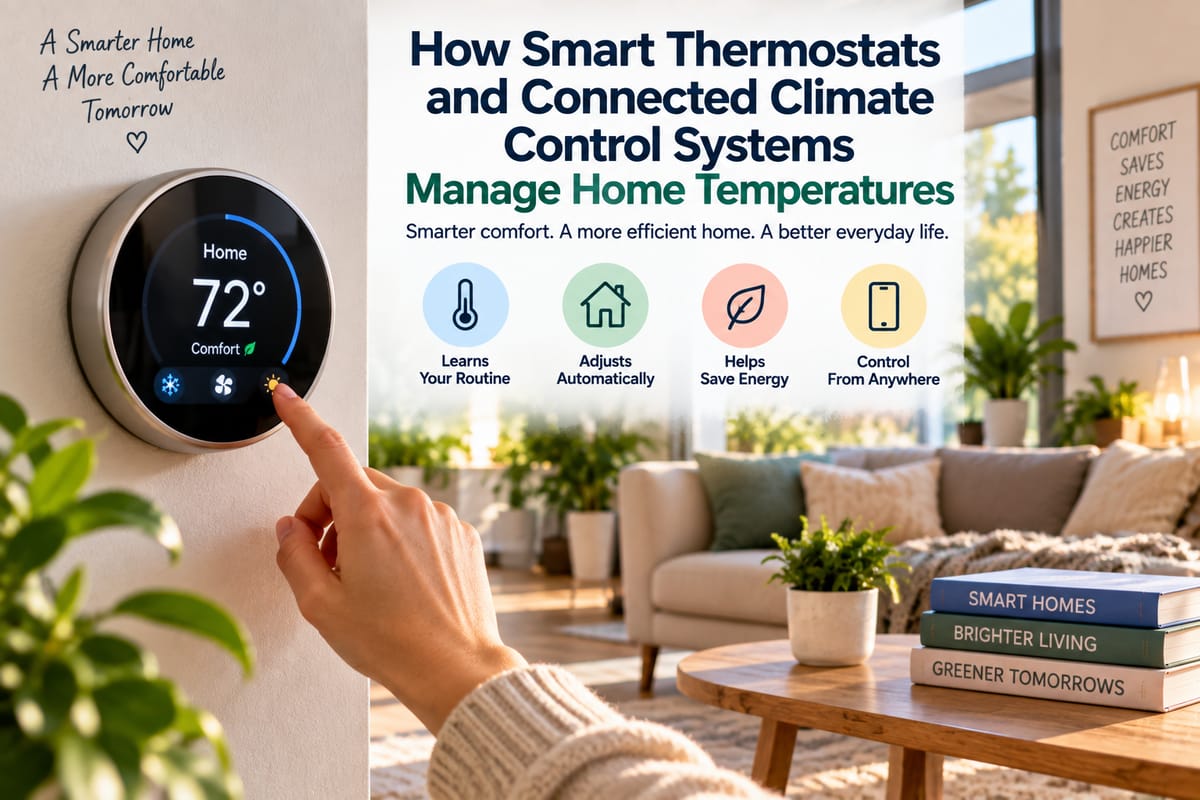
Keeping a home at a comfortable temperature used to require little more than adjusting a thermostat by hand. Today, connected climate control systems can do much more. Smart thermostats can learn household routines, monitor indoor conditions, communicate with heating and cooling equipment, and adjust temperatures automatically.
These systems can also work with sensors, mobile apps, smart home hubs, and other connected devices. Instead of treating the entire house as a single space with one temperature setting, modern systems can respond to different conditions throughout the home.
The result is a more responsive approach to indoor climate control that can balance comfort, convenience, scheduling, and energy use.
What Is a Smart Thermostat?
A smart thermostat is a connected device that controls a home’s heating, cooling, or both while offering features beyond those available on a traditional thermostat.
Depending on the model and HVAC system, a smart thermostat may allow homeowners to:
- Adjust temperatures from a smartphone
- Create heating and cooling schedules
- Monitor indoor temperatures
- Detect when people are home
- Learn household routines
- Receive maintenance alerts
- Integrate with other smart home devices
- Track energy-related information
- Automatically adjust temperature settings
Instead of simply responding to a manual temperature change, a smart thermostat can use information from multiple sources to determine when and how the climate system should operate.
How Smart Thermostats Control Temperature
At its most basic level, a thermostat measures the temperature in its surrounding environment and compares that measurement with the desired temperature.
Suppose a homeowner sets the thermostat to 22°C. If the measured temperature falls below that target and the system is configured for heating, the thermostat can signal the heating equipment to operate.
When the temperature reaches the desired range, the thermostat can signal the equipment to stop or reduce operation.
Smart thermostats build on this basic principle by incorporating additional information.
They may consider:
- Current indoor temperature
- Humidity
- Time of day
- User schedules
- Occupancy information
- Outdoor temperature
- Historical household patterns
- Sensor readings from other rooms
- Equipment operating status
This allows the system to make more context-aware decisions.
Connected Climate Control Goes Beyond the Thermostat
A smart thermostat is often only one part of a larger climate control system.
Connected climate systems can include:
- Smart thermostats
- Room temperature sensors
- Humidity sensors
- Outdoor temperature sensors
- Smart vents
- Connected heat pumps
- Smart air conditioners
- Connected furnaces
- Air-quality sensors
- Smart fans
- Home automation hubs
These components can exchange information to create a more coordinated approach to indoor climate management.
For homeowners who want to understand the broader technology, the Complete Guide to Smart Home Climate Control explores how connected climate systems fit into the wider smart home environment.
Why Room Sensors Matter
A thermostat can only directly measure conditions around the location where it is installed.
That can create a problem in homes where different rooms experience different temperatures.
For example, a thermostat located near a sunny window may detect warmer conditions than a bedroom on the opposite side of the house. Similarly, an upstairs room may become warmer than a downstairs room because of differences in sunlight, insulation, airflow, or building design.
Additional sensors can provide more information.
A smart system might detect:
- Temperature differences between rooms
- Changes in occupancy
- Humidity levels
- Rapid temperature changes
- Areas that consistently become too warm or too cold
The system can then use those measurements when making climate-control decisions, depending on the capabilities of the equipment.
How Smart Home Sensors Monitor Indoor Conditions
Temperature is only one part of indoor comfort.
Smart home sensors can monitor several environmental conditions and provide information that helps connected systems respond appropriately.
How Smart Home Sensors Monitor Indoor Conditions provides a broader look at how sensors can track conditions throughout a connected home.
Depending on the system, sensors may monitor:
- Temperature
- Humidity
- Air quality
- Carbon dioxide levels
- Occupancy
- Motion
- Light levels
- Other environmental measurements
When these sensors are integrated with climate-control equipment, the home can respond to changing conditions instead of relying solely on a fixed schedule.
Smart Scheduling and Daily Routines
One of the most useful features of a smart thermostat is scheduling.
A homeowner might configure different temperature targets for different parts of the day.
For example:
| Time | Example Climate Setting |
|---|---|
| Morning | Comfortable temperature before everyone wakes |
| Daytime | Reduced heating or cooling when the house is mostly empty |
| Evening | Comfortable temperature during household activity |
| Night | Different setting for sleeping |
| Away period | Energy-conscious temperature range |
The exact settings depend on the household, climate, equipment, and personal preferences.
Smart scheduling reduces the need to manually adjust the thermostat throughout the day.
Learning Household Patterns
Some smart thermostats can learn from repeated behavior.
If household members regularly change the temperature at similar times, the system may identify patterns and adjust its recommendations or automated schedule.
For example, if occupants consistently lower the temperature before going to bed, a learning thermostat may eventually recognize that routine.
However, not every smart thermostat uses machine learning in the same way. Some rely primarily on schedules and user-defined settings.
The important distinction is that connected systems can use historical information to make climate management more automated.
Occupancy-Based Temperature Control
Occupancy detection can add another layer of automation.
Sensors or connected devices may provide information about whether people are present in particular areas of the home.
If a house is empty during the day, the system may use a different temperature target than it would when people are home.
Some systems can also prioritize occupied rooms.
For example, if sensors indicate that people are spending most of their time in a particular part of the house, the system may use that information to guide climate-control decisions.
Occupancy detection is not always perfectly accurate, however. A sensor may fail to detect someone who remains still for an extended period, and a smartphone-based system may not know that a guest is present.
How Connected Systems Improve Comfort
Temperature comfort is not simply about reaching one specific number.
People experience comfort differently, and indoor conditions can change throughout a home.
Connected climate-control systems can help address some of these variations by using more information than a traditional thermostat.
How Smart Heating and Cooling Systems Improve Home Comfort explores how connected heating and cooling technologies can contribute to a more responsive indoor environment.
Potential advantages include:
- More consistent temperature management
- Greater control over individual rooms
- Automated scheduling
- Remote temperature adjustments
- Better awareness of indoor conditions
- Faster responses to changing conditions
The actual results depend heavily on the home’s HVAC equipment, insulation, layout, sensors, and system configuration.
Remote Control Through Mobile Apps
Smart thermostats commonly connect to smartphone applications.
This allows homeowners to check or adjust climate settings while away from home.
For example, a person might:
- Change the temperature before returning home
- Check whether the heating or cooling system is operating
- Modify a schedule while traveling
- Receive equipment alerts
- Review energy-related information
Remote access can be particularly useful when plans change unexpectedly.
Instead of leaving the thermostat on a fixed setting all day, users can make adjustments based on their actual schedule.
Smart Thermostats and Weather Information
Some connected systems can incorporate outdoor temperature or weather information.
Outdoor conditions can influence how quickly a home gains or loses heat.
A smart climate-control system may use outdoor information to adjust its operation or help homeowners anticipate changing conditions.
For example, a system might recognize that a significant temperature change is approaching and modify its operation according to its programming.
However, weather integration is not universal, and its capabilities vary between products and HVAC configurations.
Managing Humidity Alongside Temperature
Temperature and humidity can interact to influence how indoor conditions feel.
A room may feel uncomfortable even when the temperature appears reasonable if humidity is unusually high or low.
Some connected climate systems can monitor humidity and coordinate with equipment capable of controlling it.
Depending on the system, this may involve:
- Air conditioning
- Whole-home dehumidification
- Humidification
- Ventilation
- Smart fans
Humidity management can therefore become another component of connected indoor climate control rather than being treated as a completely separate concern.
Smart Climate Control and Energy Use
Energy efficiency is another major reason homeowners consider smart thermostats.
Heating and cooling equipment can account for a substantial portion of household energy consumption, particularly in homes with significant heating or cooling demands.
Smart controls can help reduce unnecessary operation by using schedules, occupancy information, temperature setbacks, and other automation features.
However, installing a smart thermostat does not automatically guarantee lower energy bills.
Results depend on:
- Climate
- Home insulation
- HVAC efficiency
- Household behavior
- Temperature settings
- Equipment condition
- System configuration
- How much the equipment operates
For a broader look at connected technologies that can support more efficient household energy use, the Smart Home Energy-Saving Guide provides additional context.
Understanding Temperature Setbacks
A temperature setback means allowing the indoor temperature to move away from the preferred comfort level during periods when maximum comfort is not required.
For example, a homeowner may use a different setting while everyone is away at work or school.
Smart thermostats make these changes easier because they can automate them according to schedules or occupancy information.
The appropriate setback depends on the climate, building characteristics, HVAC system, and household preferences.
A very aggressive setting may also make it harder or slower to restore the desired temperature later, particularly in homes with certain heating or cooling systems.
Integration With Other Smart Home Devices
Smart thermostats can become more useful when they communicate with other connected devices.
For example, a smart home system may connect climate control with:
- Motion sensors
- Door and window sensors
- Smart speakers
- Home automation hubs
- Smart blinds
- Air-quality monitors
- Energy-monitoring devices
Smart blinds could potentially reduce direct sunlight entering a room, while occupancy sensors could provide information about whether an area is being used.
The thermostat can then become part of a larger automation system rather than functioning independently.
Voice Control and Automation
Many smart thermostats can work with voice assistants and broader home automation platforms.
This can allow residents to make simple requests such as adjusting the temperature without physically walking to the thermostat.
Voice control can also be combined with routines.
For example, a household could create an evening automation that:
- Adjusts the thermostat.
- Changes selected lights.
- Closes connected blinds.
- Activates another preferred home setting.
The exact capabilities depend on compatibility between the thermostat, HVAC equipment, and smart home platform.
What Happens When Internet Connectivity Is Lost?
Smart thermostats can continue to perform some basic functions when the internet connection is unavailable, but capabilities vary significantly by device.
Local temperature control may continue even when cloud-based features are temporarily unavailable.
However, internet-dependent features such as remote smartphone access, cloud analytics, or certain integrations may stop working.
This makes it important to understand which functions operate locally and which depend on an internet connection before choosing a system.
A smart home should ideally remain functional at a basic level even when connectivity is interrupted.
Compatibility Matters Before Installation
Not every smart thermostat works with every heating and cooling system.
Compatibility can depend on factors such as:
- HVAC equipment type
- Wiring
- Power requirements
- Number of heating and cooling stages
- Heat pump configuration
- Auxiliary heating
- Existing control systems
Some installations are relatively straightforward, while others may require professional assessment or additional equipment.
Before purchasing a thermostat, homeowners should verify compatibility rather than assuming that any connected thermostat will work with their existing system.
Privacy and Connected Climate Systems
Smart climate systems can collect information about household behavior.
Depending on the device, data may include:
- Temperature readings
- Occupancy information
- Device activity
- Usage patterns
- Schedule information
- Account information
- Location-related information
This information can be useful for automation, but it also makes privacy and security important considerations.
Homeowners should review available privacy controls, use strong account credentials, enable multifactor authentication when available, keep devices updated, and understand what information the system collects.
Smart Thermostats Are Only One Part of the System
A connected thermostat can provide useful automation, but it cannot compensate for every weakness in a home.
Poor insulation, air leaks, undersized or oversized HVAC equipment, blocked vents, damaged ductwork, and other building problems can still affect comfort and energy use.
This means smart technology works best when combined with sound building maintenance and appropriately designed heating and cooling systems.
Automation can improve how a system operates, but it cannot completely overcome physical limitations within the home.
Making Connected Climate Control Work for the Household
Smart thermostats and connected climate systems are changing temperature management from a simple manual task into a more automated process.
By combining temperature measurements with schedules, occupancy information, sensors, equipment data, and mobile connectivity, these systems can respond to changing conditions throughout the day.
The most useful setup is not necessarily the one with the largest number of features. It is the one that works reliably with the home’s HVAC equipment, fits the household’s routines, provides useful control, and remains understandable when something goes wrong.
As smart home technology continues to develop, climate control is likely to become increasingly integrated with other household systems. For homeowners, the practical goal remains straightforward: create an indoor environment that is comfortable, manageable, and appropriately efficient without making everyday life more complicated.