How to Organize a Kitchen Pantry
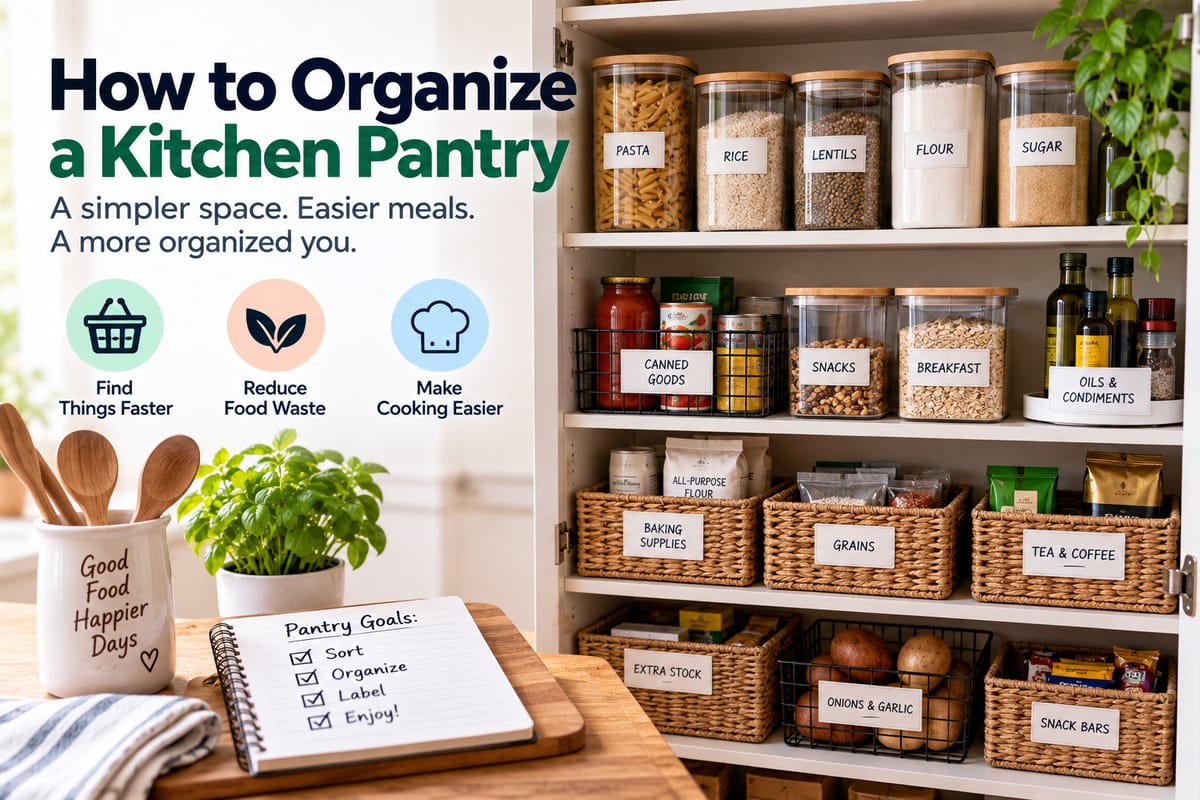
How to Organize a Kitchen Pantry
A well-organized kitchen pantry can make everyday cooking easier, reduce food waste, and make it much simpler to see what is actually available at home. When ingredients are scattered across shelves or hidden behind newer purchases, even a relatively small pantry can quickly become difficult to manage.
Organizing a pantry does not necessarily require expensive containers or a large amount of space. The most effective systems usually begin with simple decisions: grouping similar foods, making frequently used ingredients accessible, labeling items when useful, and creating a routine for checking supplies.
A good pantry should work for the people who use it. It needs to make ingredients easy to find, make older products visible, and provide enough flexibility to accommodate different package sizes and shopping habits.
Why Kitchen Pantry Organization Matters
A pantry is more than a place to store dry food. It is part of the kitchen’s working system.
When ingredients are organized logically, several everyday tasks become easier.
You can:
- Find ingredients faster
- See which foods need to be replaced
- Reduce duplicate purchases
- Use older products before newer ones
- Keep shelves easier to clean
- Plan meals more efficiently
- Make better use of limited storage space
- Reduce the chance of forgotten food expiring
Organization can also make cooking less frustrating. Instead of searching through several shelves for rice, spices, flour, or canned vegetables, you can know approximately where each category belongs.
For broader home organization ideas, the Room-by-Room Home Organization Guide offers a useful framework for creating practical systems throughout the household.
Start by Emptying the Pantry
Before organizing anything, it helps to remove the contents of the pantry.
Place the food on a clean counter, table, or another suitable surface. This gives you an opportunity to see exactly what you have rather than trying to organize around existing clutter.
As you remove items, check:
- Expiration or best-before dates
- Damaged packaging
- Open packages
- Duplicate products
- Ingredients you rarely use
- Items that belong somewhere else
Do not feel pressured to immediately throw away every product that is past a printed date. Different foods have different storage characteristics, and date labels can have different meanings. However, visibly spoiled, damaged, contaminated, or otherwise unsafe food should not be kept.
Emptying the pantry also provides a chance to clean shelves before putting anything back.
Group Similar Foods Together
One of the simplest pantry organization principles is to store similar items together.
Instead of arranging products according to when they were purchased, create categories.
Possible categories include:
- Grains and cereals
- Pasta
- Rice
- Flour and baking ingredients
- Canned vegetables
- Canned beans and legumes
- Sauces and condiments
- Spices and herbs
- Cooking oils
- Snacks
- Breakfast foods
- Tea and coffee
- Dried fruit and nuts
- Packaged meals
The categories do not need to follow a universal system.
If your household uses certain ingredients together, it can make sense to keep them relatively close to one another.
For example, pasta, canned tomatoes, and dried herbs could be positioned near each other if they frequently form part of the same meals.
Choose Categories That Match Your Cooking Habits
A pantry should reflect how the household actually cooks.
A family that frequently bakes may need a dedicated baking section for:
- Flour
- Sugar
- Baking powder
- Baking soda
- Cocoa
- Chocolate
- Decorating ingredients
Someone who cooks many rice-based meals might prefer a larger grains section.
A household that relies heavily on quick meals may prioritize canned foods, pasta, sauces, and other convenient ingredients.
There is no requirement to copy someone else’s pantry layout. The most useful arrangement is the one that makes frequently performed tasks easier.
Keep Frequently Used Foods Within Easy Reach
Items used every day should generally be easier to access than products used only occasionally.
For example, frequently used staples might include:
- Rice
- Pasta
- Cooking oil
- Breakfast cereal
- Tea
- Coffee
- Flour
- Common spices
These can be stored at comfortable eye or hand level when possible.
Less frequently used items can occupy higher or harder-to-reach shelves.
This creates a practical hierarchy:
Frequently used → easiest access
Occasionally used → secondary storage
Rarely used → less accessible storage
The goal is to reduce unnecessary movement and searching.
Use Vertical Space
Many pantry shelves contain unused space above food packages.
Vertical organization can help make better use of that space.
Depending on the pantry design, useful options can include:
- Stackable shelves
- Shelf risers
- Narrow baskets
- Tiered spice organizers
- Adjustable shelving
- Hanging storage where appropriate
The objective is not to fill every available gap.
Overcrowding can make a pantry harder to use. A little empty space can make it easier to see products and remove items without knocking everything over.
Use Bins for Small or Loose Items
Baskets and bins can help contain small packages that otherwise tend to move around.
For example, a bin might hold:
- Snack packets
- Small baking supplies
- Tea bags
- Packets of soup
- Individually packaged foods
Bins are particularly useful when several small items belong to the same category.
However, not every food needs to be transferred into a container. Putting everything into matching containers can create additional work without necessarily improving the pantry.
Use containers where they solve a genuine storage problem.
Decide Which Foods Need Containers
Airtight containers can be useful for certain dry goods, particularly after opening their original packaging.
Depending on the food and storage conditions, containers may help protect products from moisture, pests, and accidental spills.
They can also make some ingredients easier to stack and identify.
Potential candidates include:
- Flour
- Rice
- Pasta
- Cereals
- Sugar
- Dried beans
- Lentils
- Oats
The container should be clean, dry, appropriate for food storage, and properly sealed.
It is also important to transfer food carefully. If a new package is added to an existing container, make sure the container is clean and that older product is not simply buried beneath newer product.
Label Containers When Helpful
Labels can make pantry containers easier to identify, particularly when several ingredients look similar.
A useful label might include:
- Food name
- Variety when relevant
- Date opened when useful
- Other information needed by the household
Labels do not need to be elaborate.
Simple handwritten labels can work just as well as printed ones.
The purpose is to improve clarity rather than create additional work.
Keep Spices Organized
Spices can become one of the most difficult pantry categories to manage because they often come in many small containers.
A practical spice system might involve:
- Grouping spices alphabetically
- Grouping them by cuisine
- Keeping frequently used spices together
- Using a tiered rack
- Storing them in a dedicated drawer
- Keeping spice containers upright and visible
Avoid buying another jar simply because an existing one is hidden behind several others.
A quick inventory of spices before grocery shopping can prevent unnecessary duplicates.
Create a Dedicated Baking Area
If baking ingredients are scattered throughout the pantry, baking can become unnecessarily time-consuming.
A dedicated area can bring together common baking supplies such as:
- Flour
- Sugar
- Baking powder
- Baking soda
- Cocoa
- Vanilla
- Chocolate chips
- Sprinkles
- Nuts
- Parchment or baking-related supplies
The exact contents will depend on how often the household bakes.
Keeping these items together also makes it easier to check whether essential ingredients are running low.
For people developing their overall kitchen abilities, Essential Kitchen Skills Every Beginner Cook Should Learn covers broader skills that can make everyday food preparation easier.
Store Heavy Items Safely
Heavy pantry items should generally be stored where they can be lifted and handled safely.
Large bags of flour, rice, bulk food, and heavy cans can become awkward or dangerous when placed on high shelves.
Consider keeping heavier items on lower shelves where they are easier to retrieve.
At the same time, avoid creating piles so heavy that shelves become overloaded.
Storage systems should always be used according to their weight limits and intended design.
Keep Canned Foods Easy to See
Canned foods can easily become hidden behind one another.
A useful system is to group cans by category and arrange them so that labels remain visible.
Categories might include:
- Vegetables
- Beans
- Fruit
- Soups
- Tomatoes
- Fish or meat products
- Other prepared foods
If multiple cans of the same product are stored together, place newer purchases behind older ones when practical.
This helps encourage rotation.
Practice First In, First Out
A simple pantry habit is to use older products before newer products of the same type.
This principle is sometimes described as first in, first out.
When new groceries arrive, move older products toward the front and place newer items behind them.
For example:
Front of shelf
↓
Older rice
Older pasta
Older canned beans
Newer products
↑
Back of shelf
This makes it more likely that older food will be used before newer purchases.
It is particularly useful when buying several packages of the same product.
Create a Breakfast Zone
If several household members prepare breakfast independently, creating a dedicated breakfast section can make mornings more efficient.
Depending on the household, it might contain:
- Cereal
- Oats
- Tea
- Coffee
- Cocoa
- Spreads
- Pancake ingredients
- Shelf-stable breakfast foods
The idea is to create a small collection of commonly used items rather than requiring people to search the entire pantry each morning.
Create a Snack Zone
Snacks can easily spread across several shelves.
A dedicated snack area helps contain them and makes it easier to monitor how quickly they are being consumed.
For households with children, a clearly defined snack area can also make it easier to establish simple routines around which foods are available for independent access.
The exact arrangement should reflect the household’s needs rather than attempting to make the pantry look like a showroom.
Keep Food Off the Floor
Whenever possible, pantry food should be stored on appropriate shelving rather than directly on the floor.
Keeping products elevated can make cleaning easier and reduce exposure to moisture, dirt, and pests.
It can also make it easier to inspect the area underneath stored items.
If food has to be stored temporarily outside the pantry, use suitable containers and keep it in a clean, dry location.
Consider Food Safety When Organizing
Organization and food safety are closely connected.
A clean, organized pantry makes it easier to identify damaged packaging, spills, pests, and expired or deteriorated products.
Useful habits include:
- Keeping shelves clean and dry
- Cleaning spills promptly
- Checking packages for damage
- Keeping food sealed appropriately
- Avoiding unnecessary overcrowding
- Inspecting for signs of pests
- Storing foods according to their specific requirements
Organization should never come at the expense of proper food storage.
Make the Pantry Easy to Clean
A pantry that is difficult to clean will eventually become difficult to maintain.
Avoid creating unnecessary layers of containers, baskets, and decorative objects that make every shelf difficult to access.
Leave enough room to remove items and wipe surfaces.
If using bins, choose designs that can be removed easily for cleaning.
Simple systems tend to be easier to maintain than complicated arrangements.
Use Clear Containers Strategically
Clear containers can make some ingredients easier to see.
For example, a transparent container holding rice allows you to see approximately how much remains without opening the package.
However, clear storage is not essential.
Opaque containers can work well when properly labeled.
The main priorities are food safety, accessibility, and visibility rather than achieving a particular visual style.
Avoid Buying Organizers Before Measuring
One common organization mistake is purchasing containers before understanding the available space.
A container that looks useful online may be too tall, too wide, or difficult to remove once placed on a pantry shelf.
Before purchasing storage products:
- Measure shelf width.
- Measure shelf depth.
- Measure vertical clearance.
- Consider door movement if applicable.
- Identify awkward corners.
- Estimate how much storage is actually required.
Then choose organizers that fit the space.
This approach can prevent wasted money and unnecessary clutter.
Think of Storage as a System
An effective pantry is not simply a collection of containers.
It is a system that answers several questions:
Where does this item belong?
Can I see it easily?
Can I reach it without moving everything else?
Will I remember that I already have it?
Can I put it away quickly after shopping?
Can I tell when I need more?
If the answer to these questions is generally yes, the pantry is likely organized in a useful way.
The broader principles of household storage are discussed in How Home Storage Systems Organize Household Belongings Efficiently.
Keep a Small Inventory
A pantry inventory does not need to become a complicated spreadsheet.
A simple list can include staple foods that the household regularly needs.
For example:
Rice
Pasta
Flour
Sugar
Cooking oil
Canned tomatoes
Beans
Oats
Tea
Coffee
Common spices
When one of these products is running low, add it to the shopping list.
A digital notes application, paper list, or household shopping app can all work.
The best system is the one that people will actually maintain.
Avoid Overbuying
Bulk purchasing can save money in some circumstances, but only when the household can use the food before it deteriorates and has enough suitable storage space.
Buying large quantities can create problems when:
- Storage space is limited
- The household rarely uses the product
- Packaging is difficult to seal
- Food is vulnerable to moisture
- Multiple similar products are already available
A pantry should support consumption rather than become a warehouse for food that may never be used.
Build a Simple Restocking Routine
An organized pantry becomes much easier to maintain when restocking is part of a regular routine.
After grocery shopping:
- Put older products toward the front.
- Place newer products behind them.
- Group similar items.
- Store opened foods appropriately.
- Break down unnecessary packaging when practical.
- Return items to their designated areas.
This can take only a few minutes when the pantry already has a logical structure.
Review the Pantry Regularly
A full pantry reorganization should not be necessary every week.
A quick review every few weeks can be enough for many households.
Look for:
- Nearly empty containers
- Forgotten products
- Duplicate purchases
- Spills
- Damaged packages
- Products that need to be moved forward
- Categories that have become cluttered
A deeper clean can be performed periodically depending on how heavily the pantry is used.
Improve Organization Skills Beyond the Pantry
Pantry organization is one example of a broader personal organization skill.
The same principles can apply to paperwork, clothing, digital files, household supplies, and other areas.
The How to Improve Personal Organization Skills guide explores ways to create practical systems, establish routines, and reduce everyday disorganization.
The important principle is to create systems that reduce the amount of thinking required to maintain them.
Common Pantry Organization Mistakes
Even a well-intentioned organization project can create new problems.
Overcrowding Every Shelf
Filling every available space makes products difficult to see and retrieve.
Organizing Only by Appearance
A visually attractive pantry may still be inconvenient if frequently used ingredients are difficult to reach.
Using Too Many Containers
Containers should solve storage problems rather than create additional maintenance.
Ignoring Food Rotation
New products can easily hide older ones if everything is simply placed wherever there is room.
Creating Too Many Categories
An overly detailed system can become difficult for everyone else in the household to follow.
Forgetting the Restocking Process
A system that works only on the day it is created will quickly deteriorate without simple maintenance habits.
Make the System Easy for Everyone to Follow
If several people use the kitchen, pantry organization should not depend on one person’s memory.
Categories should be intuitive.
Labels can help when necessary, but the layout itself should communicate where things belong.
For example:
TOP SHELF
Occasionally used items
MIDDLE SHELF
Everyday staples
LOWER SHELF
Heavy foods and bulk items
DESIGNATED BIN
Snacks
DESIGNATED AREA
Baking supplies
The simpler the system, the more likely everyone is to return items to their proper locations.
A Pantry Should Support the Way You Cook
There is no single perfect pantry layout.
A household that cooks from scratch every day may need extensive ingredient storage. Another household may rely on fresh foods and keep only a small selection of dry goods.
The right organization depends on:
- Household size
- Cooking frequency
- Available space
- Shopping habits
- Dietary needs
- Storage requirements
- Budget
- Types of food regularly purchased
The goal is not to create a perfect-looking pantry. It is to make the kitchen easier to use.
Creating a Pantry That Stays Organized
A successful pantry organization system should make everyday tasks simpler rather than adding another chore.
Start by removing unnecessary items, cleaning the shelves, grouping similar foods, and placing frequently used products within easy reach. Then introduce containers, labels, bins, or shelf organizers only where they solve specific problems.
Once the basic structure is established, simple habits such as rotating older products, updating shopping lists, and returning ingredients to their designated places can keep the system working.
A well-organized pantry ultimately does more than make shelves look tidy. It creates a practical connection between food storage, grocery shopping, meal preparation, and everyday kitchen routines. When ingredients are visible, accessible, and logically arranged, cooking becomes easier and the kitchen becomes a more efficient part of daily life.