How to Organize Household Papers and Records
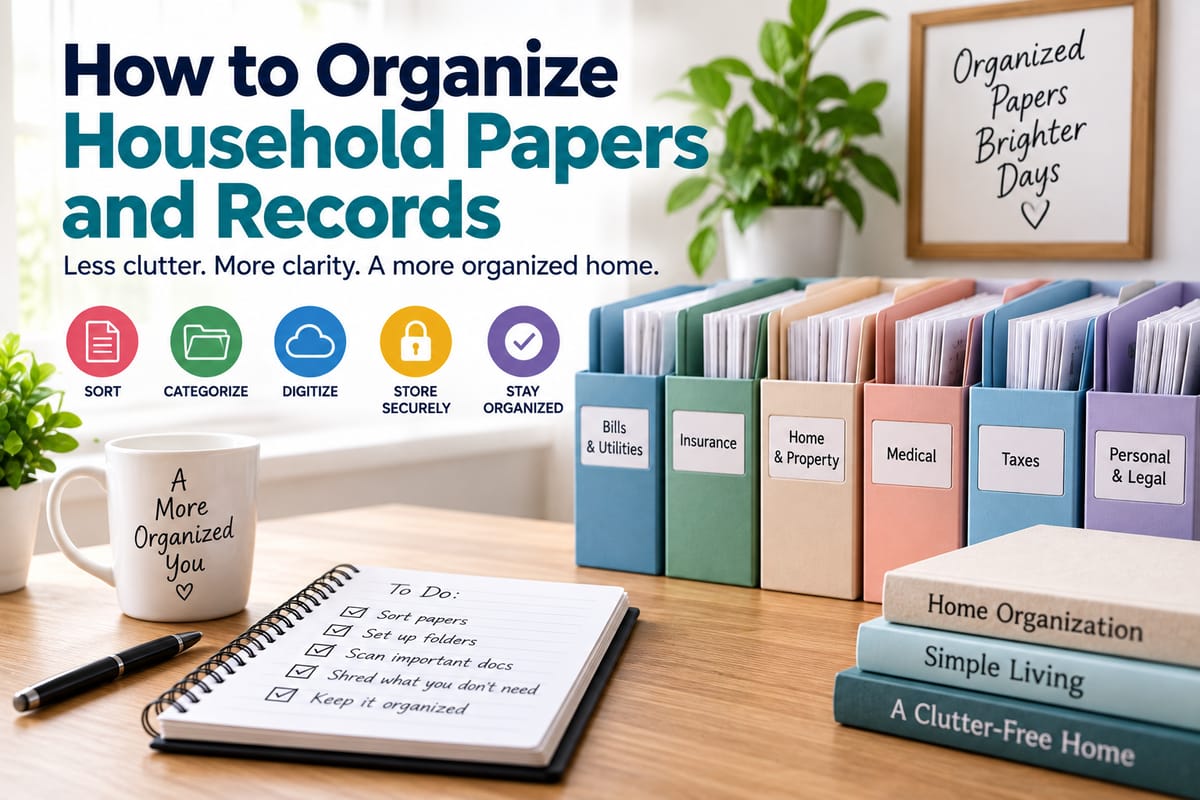
How to Organize Household Papers and Records
Household papers can accumulate quietly. A few bills arrive in the mail, receipts collect in a drawer, medical documents get placed in a folder, and important records are saved “somewhere safe.” Before long, finding one specific document can become surprisingly difficult.
Organizing household papers and records does not require a complicated filing system. The goal is to create a practical system that makes important documents easy to find, protects records that need to be kept, and makes it clear what can eventually be discarded or securely destroyed.
A well-organized paper system can also reduce clutter and make everyday tasks easier, from paying bills and filing taxes to renewing documents and handling household emergencies.
Why Household Paperwork Becomes Difficult to Manage
Paperwork tends to become disorganized for several reasons.
Different documents arrive at different times, have different retention requirements, and serve different purposes. Some papers are needed only temporarily, while others may need to be retained for years.
Common sources of household paperwork include:
- Utility bills
- Bank statements
- Insurance documents
- Tax records
- Receipts
- Warranties
- Property records
- Lease or mortgage documents
- Vehicle records
- Medical paperwork
- School records
- Employment documents
- Identification records
- Contracts
- Home repair documents
- Product manuals
- Personal correspondence
Without a consistent system, these papers can end up spread across desks, drawers, cabinets, bags, and digital devices.
Start by Gathering Everything in One Place
The first step is to stop organizing documents individually as you find them. Instead, collect household papers from around the home.
Check places such as:
- Desk drawers
- Kitchen counters
- Filing cabinets
- Home office shelves
- Junk drawers
- Mail baskets
- Bags and briefcases
- Closets
- Storage boxes
- Folders
- Digital folders and cloud storage
Create a temporary sorting area where everything can be reviewed.
Do not worry about creating perfect categories immediately. The first objective is simply to understand how much paperwork you actually have.
Sort Papers Into Broad Categories
Once the documents have been gathered, divide them into broad groups.
A practical starting system might include:
Financial Records
This category can include:
- Bank statements
- Investment records
- Loan documents
- Credit account information
- Payment records
- Tax-related documents
Home and Property
Include documents such as:
- Mortgage or lease paperwork
- Property purchase documents
- Home improvement records
- Contractor agreements
- Appliance warranties
- Home insurance information
Insurance
Keep relevant:
- Policy documents
- Claims information
- Renewal notices
- Coverage summaries
- Important correspondence
Medical and Health Records
Depending on household needs, this category may contain:
- Medical records
- Prescription information
- Insurance correspondence
- Appointment-related paperwork
- Vaccination records
- Healthcare receipts
Vehicles
Vehicle records can include:
- Registration documents
- Insurance records
- Purchase agreements
- Maintenance records
- Repair invoices
- Warranty information
Personal and Legal Records
This category can include:
- Identification documents
- Birth records
- Marriage or divorce records
- Legal agreements
- Estate planning documents
- Important certificates
Household and Miscellaneous Records
This can serve as a category for useful documents that do not fit elsewhere, including:
- Product warranties
- Manuals
- Service agreements
- Membership records
- Receipts
- School paperwork
The exact categories should reflect the household rather than forcing every home to use the same filing structure.
Separate Important Documents From Everyday Papers
Not every document deserves the same level of storage or protection.
Some records are particularly important and may be difficult or impossible to replace quickly. These should be separated from routine paperwork.
Examples can include:
- Passports and identity documents
- Property records
- Birth certificates
- Legal documents
- Insurance policies
- Important financial records
- Estate documents
- Vehicle ownership records
These documents may require a more secure storage location than ordinary bills or receipts.
Create a Keep, Action, Archive and Discard System
A simple four-category approach can make sorting much easier.
Keep
These are documents that are currently useful or important.
Action
These require something to be done, such as paying a bill, responding to a letter, submitting a form, or renewing a policy.
Archive
These documents are not needed frequently but should be retained for future reference.
Discard
These are papers that no longer serve a useful purpose and can be safely disposed of.
This system prevents paperwork from becoming one enormous pile because every document has a destination.
Create a Dedicated Action Folder
Documents that require attention should not be mixed with permanent records.
Create a clearly labeled Action folder, tray, or digital folder for paperwork that needs a response.
For example, it might contain:
- Bills awaiting payment
- Forms that need completion
- Renewal notices
- Documents requiring signatures
- Receipts that need reimbursement
- Appointment paperwork
Review this location regularly.
An action folder only works if it remains temporary. Once a document has been handled, move it to its appropriate permanent location or dispose of it if it is no longer needed.
Organize Records by Household Function
There are several ways to arrange physical files. Organizing by household function is often easier than filing everything alphabetically.
For example, a filing cabinet might contain:
- Home
- Vehicles
- Insurance
- Banking
- Taxes
- Medical
- Employment
- Education
- Legal
- Warranties
Within each category, documents can be organized by year, household member, account, or specific property.
The best structure is the one that allows someone to locate a document without having to remember complicated rules.
Use Clear Labels
Labels should make sense immediately.
Instead of creating vague folders such as “Important” or “Miscellaneous,” use descriptive names.
For example:
- 2026 Tax Records
- Home Insurance
- Car Maintenance
- Bank Statements
- Appliance Warranties
- Medical Records
- Property Documents
Clear labels reduce the amount of time spent searching later.
Organize Papers by Date When It Helps
Some categories work particularly well when organized chronologically.
Tax documents, financial statements, insurance records, and household maintenance records can often be separated by year.
For example:
Taxes
- 2024
- 2025
- 2026
This approach makes it easier to retrieve older records when they are needed.
However, not every category needs yearly folders. Creating unnecessary subdivisions can make the filing system more complicated than necessary.
Decide What Should Be Digitized
Digital copies can reduce physical clutter and make certain documents easier to access.
Documents that may be suitable for scanning include:
- Receipts
- Invoices
- Warranties
- Bills
- Home maintenance records
- Insurance correspondence
- Manuals
- Certain financial documents
Digital storage should complement rather than automatically replace physical records. Some original documents may be important, legally significant, or difficult to reproduce.
Before discarding an original, make sure a digital copy is actually sufficient for its intended purpose.
Create a Simple Digital Filing System
Digitizing paperwork without organizing the resulting files can simply move the clutter from a cabinet to a computer.
Use a consistent folder structure.
For example:
Household Records
├── Banking
├── Insurance
├── Home
├── Vehicles
├── Taxes
├── Medical
├── Legal
├── Warranties
└── Receipts
Files should also have descriptive names.
Instead of:
document123.pdf
consider:
2026-03-home-insurance-renewal.pdf
A consistent naming system makes digital searches much easier.
Protect Digital Records
Important digital records should be stored securely.
Useful practices can include:
- Using strong passwords
- Enabling multifactor authentication where available
- Keeping important files backed up
- Using reputable storage services
- Protecting devices with security updates
- Maintaining more than one backup for especially important records
The objective is to ensure that an important document does not disappear because of a lost device, damaged computer, or accidental deletion.
Use a Secure Location for Sensitive Records
Some household paperwork contains information that should not be left in an easily accessible location.
Financial documents, identification records, legal paperwork, insurance information, and other sensitive records can contain personal information.
Consider using a secure filing cabinet, lockable storage box, safe, or another appropriate protected location.
The specific security method should reflect the importance and sensitivity of the documents.
Be Careful With Documents You Throw Away
Simply placing sensitive paperwork in a household trash bin can expose personal information.
Before discarding documents containing sensitive information, consider securely destroying them.
A cross-cut shredder can be useful for many household documents. For larger quantities or especially sensitive records, a professional document-destruction service may be appropriate.
Pay particular attention to papers containing information such as:
- Account numbers
- Identification numbers
- Addresses
- Financial information
- Insurance information
- Medical information
- Passwords or security information
Keep Warranties and Receipts Together
Warranties and receipts can become difficult to locate when they are stored separately.
Consider creating a Warranties and Receipts folder for important household purchases.
For major appliances and equipment, record:
- Product name
- Model number
- Serial number
- Purchase date
- Retailer
- Warranty period
- Receipt location
A digital copy of the receipt can also be stored alongside the warranty information when appropriate.
This can make future repairs, replacements, or warranty claims easier to manage.
Create a Home Records Folder
A dedicated home records folder can bring together documents associated with the property.
It might include:
- Mortgage or lease information
- Insurance documents
- Property records
- Major renovation records
- Contractor information
- Appliance warranties
- Home inspection reports
- Maintenance records
For households that have accumulated paperwork across several rooms, creating one central home-records location can make a noticeable difference.
A broader approach to organizing household spaces is covered in the Room-by-Room Home Organization Guide.
Keep an Emergency Documents Folder
Important information should remain accessible during an emergency.
An emergency records folder might contain copies or details relating to:
- Insurance policies
- Emergency contacts
- Identification documents
- Property information
- Vehicle information
- Important account information
- Medical information where appropriate
- Household service contacts
Sensitive information should be stored securely, particularly when the folder contains personal or financial details.
The purpose is to make critical information easier to locate when time is limited.
Avoid Keeping Everything Forever
One of the biggest obstacles to organized paperwork is the belief that every document must be kept indefinitely.
Many routine papers become less useful over time.
Old receipts, expired promotional documents, outdated notices, duplicate records, and obsolete manuals can accumulate unnecessarily.
However, retention requirements vary by document type, jurisdiction, financial situation, and individual circumstances. Before destroying financial, tax, legal, property, medical, or other significant records, determine whether they need to be retained.
When uncertain, it can be appropriate to seek advice from a qualified professional rather than relying on a general household filing rule.
Review Papers Before Filing Them
A filing cabinet should not become a place where paperwork disappears.
Before filing a document, ask:
- Do I need to keep this?
- Does it require action?
- Is there already a copy?
- Does another document replace it?
- Where would I expect to find it later?
- Does it belong in physical or digital storage?
These questions prevent unnecessary papers from entering the permanent filing system.
Make Organization Part of a Routine
Paperwork is easier to manage when it is handled regularly rather than in occasional major cleanups.
A simple routine might involve:
Daily
Open incoming mail and immediately separate actionable documents from items that can be discarded.
Weekly
Process the action folder, file completed documents, and scan appropriate records.
Monthly
Review paperwork that has accumulated and remove unnecessary items.
Annually
Review archived records and determine whether any documents have reached the end of their useful retention period.
Regular maintenance prevents the system from becoming overwhelming.
Improve Personal Organization Habits
A filing system can only work if people use it consistently.
Good organizational habits include:
- Handling documents when they arrive
- Giving every important paper a home
- Returning documents to the correct location
- Avoiding multiple storage locations for the same category
- Scheduling regular paperwork reviews
- Using consistent digital and physical naming systems
For more strategies, How to Improve Personal Organization Skills explores broader habits that can make organization easier to maintain.
Match Storage to the Amount of Paperwork
Not every household needs a large filing cabinet.
Someone with relatively little paperwork might only need:
- A small file box
- A few labeled folders
- An action tray
- A secure location for important documents
- A simple digital filing system
A larger household may benefit from a filing cabinet, archive boxes, or dedicated storage furniture.
Storage should support the organization system rather than becoming another source of clutter.
A broader look at efficient household storage is available in How Home Storage Systems Organize Household Belongings Efficiently.
Reduce Paper Coming Into the Home
Organization becomes easier when less unnecessary paper enters the household.
Where appropriate, consider:
- Switching eligible bills to electronic delivery
- Choosing digital statements
- Cancelling unwanted catalogs
- Unsubscribing from unnecessary mail
- Requesting electronic receipts
- Storing manuals digitally when suitable
Going paperless does not mean eliminating every physical record. It means being more deliberate about which documents need to occupy physical space.
Declutter Paperwork Carefully
Paper clutter is still clutter, even when it is neatly stacked.
A useful decluttering process is to periodically review documents and remove papers that are no longer needed.
Ask:
“If I needed this information later, would I realistically need this particular piece of paper?”
If the answer is no, and there is no legal, financial, practical, or personal reason to retain it, the document may be a candidate for secure disposal.
The broader principles of removing unnecessary possessions are covered in Decluttering Explained: The Complete Guide.
Create a System Everyone Can Understand
A household filing system becomes much more effective when everyone who needs access to it understands how it works.
Avoid systems that depend entirely on one person’s memory.
Use:
- Simple categories
- Clear labels
- Consistent locations
- Straightforward naming conventions
- Easy-to-follow filing rules
If another household member can find a document without asking where it is, the system is doing its job.
A Simple Household Paperwork System
For someone starting from scratch, a straightforward system might look like this:
1. Collect: Gather paperwork from around the home.
2. Sort: Separate documents into broad categories.
3. Remove: Identify unnecessary duplicates and papers that can be securely discarded.
4. Act: Put documents requiring attention in a dedicated action folder.
5. File: Place important current records into clearly labeled folders.
6. Archive: Move older but necessary records into appropriate long-term storage.
7. Digitize: Scan suitable documents and organize them digitally.
8. Secure: Protect sensitive and irreplaceable records.
9. Review: Schedule regular paperwork maintenance.
This approach is simple enough to maintain while still providing structure for a wide range of household records.
Keeping Important Records Under Control
Organizing household papers is less about creating a perfect filing cabinet and more about creating a system that people can actually maintain.
Every important document should have a logical home. Papers requiring action should be separated from records that simply need to be stored. Sensitive documents should receive appropriate protection, while outdated and unnecessary paperwork should be removed responsibly.
Once the initial backlog has been handled, maintaining the system becomes much easier. A few minutes of regular attention can prevent bills, receipts, records, and important documents from once again becoming an unmanageable pile.