How Vacuum Cleaners Work
How Vacuum Cleaners Work
Vacuum cleaners are among the most familiar cleaning appliances in modern homes, yet the basic process happening inside one is surprisingly sophisticated. With the press of a button, a vacuum can pull dust, dirt, hair, crumbs, and other debris from floors, carpets, furniture, and hard-to-reach spaces.
The principle behind a vacuum cleaner is relatively simple: air is moved through the machine to create suction, carrying loose particles into a collection area. A combination of airflow, pressure differences, filters, brushes, motors, and carefully designed pathways allows the appliance to turn that basic principle into an effective cleaning system.
Understanding how vacuum cleaners work can make it easier to choose the right type, use attachments correctly, maintain the machine, and recognize why performance sometimes declines.
What Is a Vacuum Cleaner?
A vacuum cleaner is an electrical or battery-powered appliance designed to remove loose dirt and debris from surfaces.
Most vacuum cleaners contain several essential components:
- A motor
- A fan or impeller
- An air intake
- A dirt collection container or bag
- One or more filters
- A hose, wand, or internal air pathway
- A cleaning head or nozzle
- Brushes or rollers in many models
Although designs vary considerably, these components work together to move air through the machine and separate unwanted material from the airflow.
The result is a controlled stream of air that carries debris away from the surface being cleaned.
How Vacuum Suction Works
The word “suction” can make it sound as though a vacuum cleaner simply pulls objects upward. In reality, the machine creates a pressure difference that causes air to move.
Inside the vacuum, an electric motor spins a fan or impeller. As the fan rotates, it moves air through the machine and toward the exhaust side.
This movement reduces air pressure in part of the system. Because air naturally moves from areas of higher pressure toward areas of lower pressure, surrounding air is drawn into the vacuum through the cleaning nozzle.
That incoming airflow carries dirt and debris with it.
The vacuum therefore does not simply “grab” dirt. It creates an airflow strong enough to transport particles from the surface into the machine.
The Role of the Motor
The motor provides the energy needed to move air.
When a vacuum cleaner is switched on, electrical energy powers the motor, causing its internal components to rotate rapidly. That rotational movement drives the fan or impeller responsible for creating the airflow.
A stronger motor does not automatically mean a vacuum will clean better.
Overall cleaning performance depends on several factors, including:
- Airflow
- Pressure difference
- Nozzle design
- Brush action
- Filtration
- Sealing
- Surface type
- The condition of the filters and collection system
A vacuum with an efficient overall design can perform very well without relying solely on a powerful motor.
What Happens Inside the Cleaning Head?
The cleaning head is where the vacuum interacts directly with the surface.
Different cleaning heads are designed for different materials and types of debris.
A basic floor nozzle may create a relatively narrow opening that concentrates airflow. Carpet heads often include a rotating brush or roller designed to loosen debris embedded between carpet fibers.
The cleaning head may also help control the distance between the surface and the intake opening.
If the nozzle is too far from the surface, airflow may become less concentrated. If it is pressed too tightly against certain surfaces, airflow can also be affected.
This is one reason using the correct attachment can make a noticeable difference.
Why Brush Rollers Matter
Many vacuum cleaners designed for carpets contain rotating brush rollers.
These brushes physically agitate carpet fibers while the vacuum simultaneously pulls air and debris into the machine.
The brush can help loosen:
- Hair
- Dust
- Food particles
- Soil
- Fibers
- Other debris trapped within the carpet
Some brush rollers are motorized, while others are driven by the airflow or movement of the vacuum.
Brush rollers are particularly useful on carpets because not all debris is simply sitting on the surface.
How Dirt Gets Separated From Air
Once air carrying debris enters the vacuum, the machine must separate the particles from the airflow.
The method depends on the vacuum’s design.
Traditional vacuum cleaners often use bags or containers combined with filters. Other models use cyclonic systems that spin incoming air rapidly to help separate larger particles from the air.
The goal is the same: collect debris while allowing cleaned air to continue through the system.
This separation process is essential because sending large amounts of dust directly through the motor and exhaust system could damage components and reduce indoor air quality.
Bagged Vacuum Cleaners
Bagged vacuum cleaners use a disposable or reusable bag to collect dirt.
Air carrying debris enters the bag, while the bag material allows air to pass through. Dirt and particles remain trapped inside.
Bagged designs can offer several practical advantages.
The sealed bag provides a contained place for collected debris, and replacing a full bag can be relatively straightforward. For people who are sensitive to dust, the enclosed collection system may also reduce direct contact with debris during disposal, depending on the design.
However, a bag eventually becomes full and must be replaced.
Bagless Vacuum Cleaners
Bagless vacuum cleaners collect debris in a removable container rather than a disposable bag.
The container can usually be emptied and reused repeatedly.
Many bagless models use cyclonic separation. Incoming air is forced into a circular or spinning pathway, creating centrifugal effects that encourage heavier particles to separate from the moving air.
The collected material then falls into the dirt container.
Bagless systems eliminate the recurring need to purchase replacement bags, but the collection container and filters still require regular cleaning or maintenance.
How Cyclonic Technology Works
Cyclonic vacuum systems use the movement of air to help separate debris.
As air enters a cyclone chamber, it is forced into a rapidly rotating path. Larger and heavier particles tend to move outward under the influence of the rotating airflow and eventually fall into the collection container.
The air then continues through additional stages of filtration.
Cyclonic separation can reduce the amount of large debris reaching the filters, helping maintain airflow as the machine operates.
However, cyclonic technology does not eliminate the need for filters. Fine particles still need to be captured before air leaves the vacuum.
The Importance of Filters
Filters are critical components of modern vacuum cleaners.
Their primary purpose is to capture particles that should not be released back into the surrounding air or allowed to pass through sensitive components.
Depending on the model, a vacuum may contain several filtration stages.
These can include:
- Pre-motor filters
- Fine-particle filters
- Exhaust filters
- Foam filters
- Washable filters
- High-efficiency filters
Some vacuum cleaners use HEPA filtration, which is designed to capture very small airborne particles at high efficiency under specified test conditions.
The effectiveness of a filtration system depends not only on the filter itself but also on the overall design and sealing of the machine.
Why Vacuum Filters Need Maintenance
A dirty filter can restrict airflow.
When air cannot move efficiently through the vacuum, cleaning performance may decline. The motor may also have to work harder to maintain airflow.
Depending on the model, filters may need to be washed, cleaned, shaken out, or replaced.
Manufacturers provide different maintenance instructions, so filters should be handled according to the requirements of the particular vacuum.
Filter maintenance is one of the simplest ways to help preserve a vacuum cleaner’s performance.
Airflow Versus Suction
Airflow and suction are related but not identical.
Suction generally describes the pressure difference that draws air toward the vacuum intake, while airflow describes how much air moves through the system.
Effective cleaning requires both the ability to create an appropriate pressure difference and the ability to move enough air through the cleaning path.
This distinction helps explain why judging a vacuum solely by a motor’s power rating can be misleading.
The entire airflow system matters.
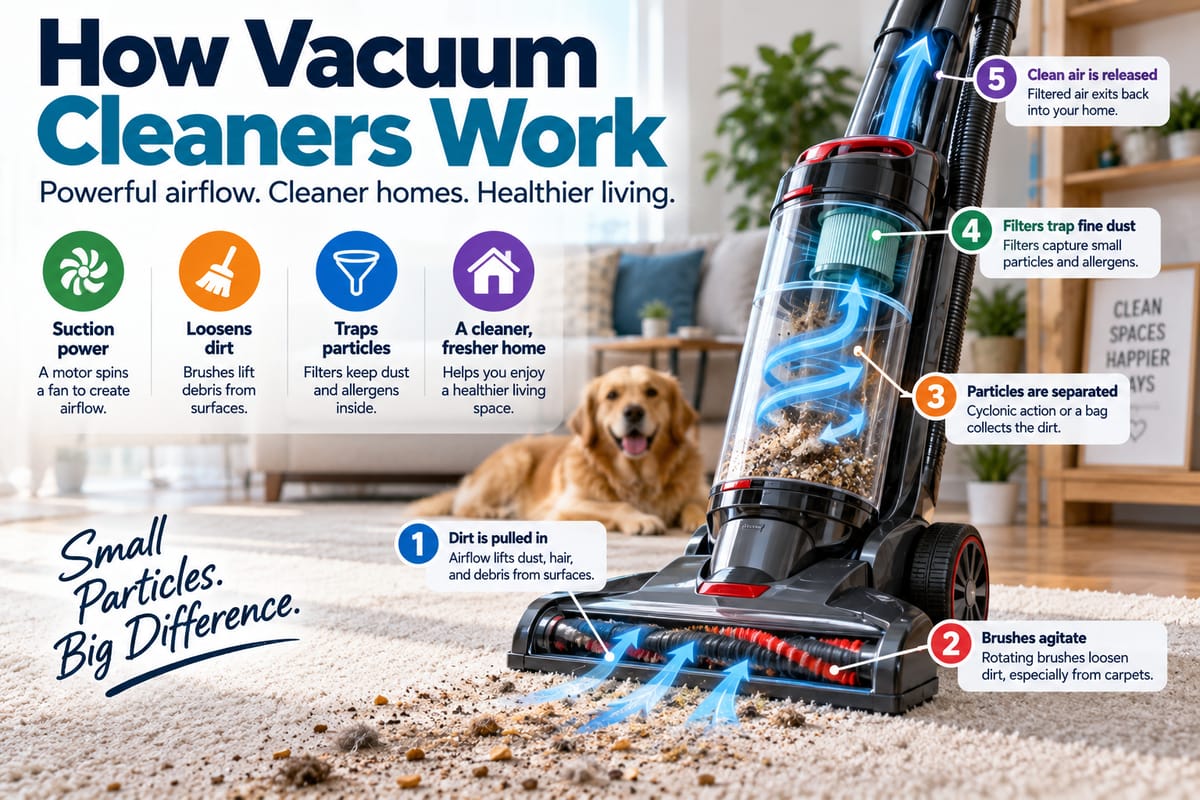
How Vacuum Cleaners Work on Carpets
Carpets present a greater challenge than smooth floors because dirt can become embedded among the fibers.
A carpet vacuum generally combines several actions:
- The cleaning head approaches the carpet surface.
- A brush or roller agitates the fibers.
- The vacuum creates an airflow through the cleaning head.
- Loosened debris is carried into the machine.
- Larger particles are separated into the collection system.
- Fine particles are captured by filters.
- Filtered air exits the machine.
The combination of agitation and airflow makes it possible to remove debris that would be difficult to collect through suction alone.
How Vacuum Cleaners Work on Hard Floors
Hard floors typically require a different approach.
Dust, crumbs, hair, and other particles often remain on the surface rather than becoming deeply embedded.
A hard-floor nozzle may therefore prioritize controlled airflow and gentle contact with the floor.
Some vacuum cleaners have adjustable settings that allow users to raise or disable a rotating brush when cleaning delicate surfaces.
Using an appropriate floor head can help reduce scratching and prevent unnecessary scattering of debris.
Why Vacuum Cleaners Have Different Attachments
Vacuum attachments change the shape, reach, or function of the airflow.
Common attachments include:
Crevice Tool
A narrow crevice tool concentrates airflow into a small opening, making it useful for gaps between furniture, along edges, and around tight spaces.
Upholstery Tool
An upholstery attachment is designed for furniture and other fabric-covered surfaces. It can help collect dust, crumbs, hair, and loose debris without using a large floor head.
Dusting Brush
A soft brush attachment combines gentle brushing with suction. It can be useful for shelves, vents, blinds, and other surfaces where a hard nozzle may be unsuitable.
Extension Wand
An extension wand increases the vacuum’s reach, allowing users to clean ceilings, curtains, high surfaces, and areas behind furniture.
Using the correct attachment is an important part of effective cleaning. A broader overview of household equipment is available in this cleaning tools and their uses guide.
Why Vacuum Cleaners Lose Suction
A vacuum that suddenly seems weaker may not necessarily have a failing motor.
Several common problems can restrict airflow.
A Full Collection Bag or Container
As debris accumulates, airflow can become restricted depending on the vacuum’s design.
Clogged Filters
Dirty filters prevent air from moving efficiently.
Blocked Hoses
Hair, paper, toys, and other objects can become lodged in hoses or internal passages.
Blocked Cleaning Heads
Debris wrapped around a brush roller can interfere with its movement and reduce cleaning effectiveness.
Damaged Seals
Air leaks can reduce the pressure difference and disrupt the intended airflow path.
Regular inspection can identify many of these problems before they significantly affect performance.
Why Hair Is a Challenge for Vacuum Cleaners
Hair can be particularly troublesome because it tends to wrap around rotating brush rollers.
Over time, accumulated hair can restrict brush movement and place additional strain on the mechanism.
Long hair and pet hair may require especially frequent cleaning of the brush roller.
Removing tangled material according to the manufacturer’s instructions can help keep the cleaning head functioning properly.
How Vacuum Cleaners Handle Pet Hair
Pet hair often requires more than simple suction.
Hair can become embedded in carpets, upholstery, rugs, and fabric surfaces. Specialized brush rollers can help loosen these fibers so airflow can carry them into the collection system.
Some vacuum cleaners are specifically designed with pet-hair attachments and brush systems.
The most appropriate design depends on the types of surfaces being cleaned and the amount of hair involved.
Vacuum Cleaners and Cleaning Products Serve Different Purposes
A vacuum cleaner primarily performs mechanical cleaning by removing loose particles.
Cleaning products, by contrast, can help dissolve, loosen, disinfect, or otherwise treat substances that cannot simply be removed through dry suction.
For example, a vacuum can remove loose crumbs from a kitchen floor, but it cannot replace a product designed to remove a sticky residue.
Understanding the difference between physical removal and chemical cleaning is useful when selecting the right approach. The subject is covered in more detail in cleaning products explained.
Vacuuming Is Only One Part of Home Cleaning
Vacuuming can remove a significant amount of loose dirt, but it is only one component of a broader cleaning routine.
Different areas of a home require different approaches.
Dust may need to be wiped from surfaces, bathrooms may require targeted cleaning, kitchens may need degreasing, and floors may sometimes need mopping after vacuuming.
A structured approach can make these tasks easier to manage. The complete guide to cleaning your home provides a broader look at how different cleaning tasks fit together.
How Often Should You Vacuum?
There is no single schedule that works for every household.
The ideal frequency depends on factors such as:
- Number of people living in the home
- Presence of pets
- Amount of foot traffic
- Type of flooring
- Allergies and sensitivities
- Outdoor dirt entering the home
- Whether children regularly play on the floor
High-traffic areas may need frequent vacuuming, while rooms that are rarely used may require less frequent attention.
Vacuuming regularly can prevent dirt from accumulating deeply in carpets and corners, making later cleaning easier.
Vacuuming Versus Deep Cleaning
Routine vacuuming removes loose debris and helps maintain everyday cleanliness.
Deep cleaning involves more extensive work, such as cleaning areas that are not addressed during normal routines.
These tasks can include moving furniture, cleaning neglected corners, washing certain surfaces, and addressing accumulated grime.
The appropriate frequency depends on the home and its occupants. A practical approach to scheduling these tasks can be found in how often you should deep clean.
How to Maintain a Vacuum Cleaner
Regular maintenance can help a vacuum operate efficiently for longer.
Basic maintenance may include:
- Emptying the collection container regularly
- Replacing full bags
- Cleaning or replacing filters
- Removing hair from brush rollers
- Checking hoses for blockages
- Inspecting attachments
- Checking the power cord on corded models
- Keeping air vents clear
- Following the manufacturer’s maintenance schedule
Maintenance requirements differ significantly between models, so the manufacturer’s instructions should take priority.
Choosing the Right Vacuum Cleaner
Different vacuum designs are suited to different cleaning situations.
Upright Vacuums
Upright models are commonly designed for floors and carpets and often combine strong cleaning heads with integrated brush rollers.
Canister Vacuums
Canister models separate the motor and collection system from the cleaning head, connected by a flexible hose. This can make them versatile for stairs, furniture, and different floor types.
Stick Vacuums
Stick vacuums are generally lightweight and convenient for quick cleaning. Many modern versions are cordless and battery-powered.
Handheld Vacuums
Handheld models are useful for small spills, furniture, vehicles, and other localized cleaning tasks.
Robot Vacuums
Robot vacuums use sensors, software, motors, brushes, and suction systems to navigate floors and perform cleaning with limited direct intervention.
Each design involves different compromises involving power, capacity, reach, weight, convenience, battery life, and maintenance.
What Makes a Vacuum Cleaner Effective?
A good vacuum cleaner is not defined by one specification.
Effective cleaning comes from the interaction between several components:
Motor + airflow + cleaning head + brush action + filtration + sealing + appropriate attachment = effective debris removal
The machine must move enough air, maintain an effective pressure difference, capture debris, and prevent unwanted particles from escaping.
Surface design also matters. A vacuum optimized for carpet may not be ideal for delicate hard floors, while a lightweight handheld model may not be suitable for cleaning an entire house.
The Basic Process From Floor to Filtered Air
Although modern vacuum cleaners can be technologically sophisticated, their basic operating sequence can be summarized simply:
1. Motor starts → 2. Fan moves air → 3. Pressure difference develops → 4. Air enters through the cleaning head → 5. Dirt travels with the airflow → 6. Debris is separated and collected → 7. Filters capture fine particles → 8. Filtered air exits
This cycle continues as long as the vacuum is operating.
The effectiveness of the process depends on maintaining an unobstructed and properly sealed airflow path.
Why Understanding Vacuum Technology Matters
Knowing how a vacuum cleaner works can make everyday cleaning more efficient.
It explains why filters need attention, why clogged hoses reduce performance, why brush rollers need cleaning, why different attachments exist, and why the strongest motor is not necessarily the best indicator of cleaning ability.
It also highlights an important principle of household cleaning: the right tool works best when it is matched to the right task.
Vacuum cleaners are designed primarily to remove loose debris through controlled airflow and mechanical agitation. They are powerful tools, but they work as part of a larger cleaning system that includes appropriate tools, products, routines, and maintenance.
When the machine is properly maintained and used with the right attachment for each surface, it can make routine cleaning faster, more consistent, and easier to manage.