Interior Design Summit Puts AI and Digital Design Tools in Spotlight
Interior Design Summit Puts AI and Digital Design Tools in Spotlight
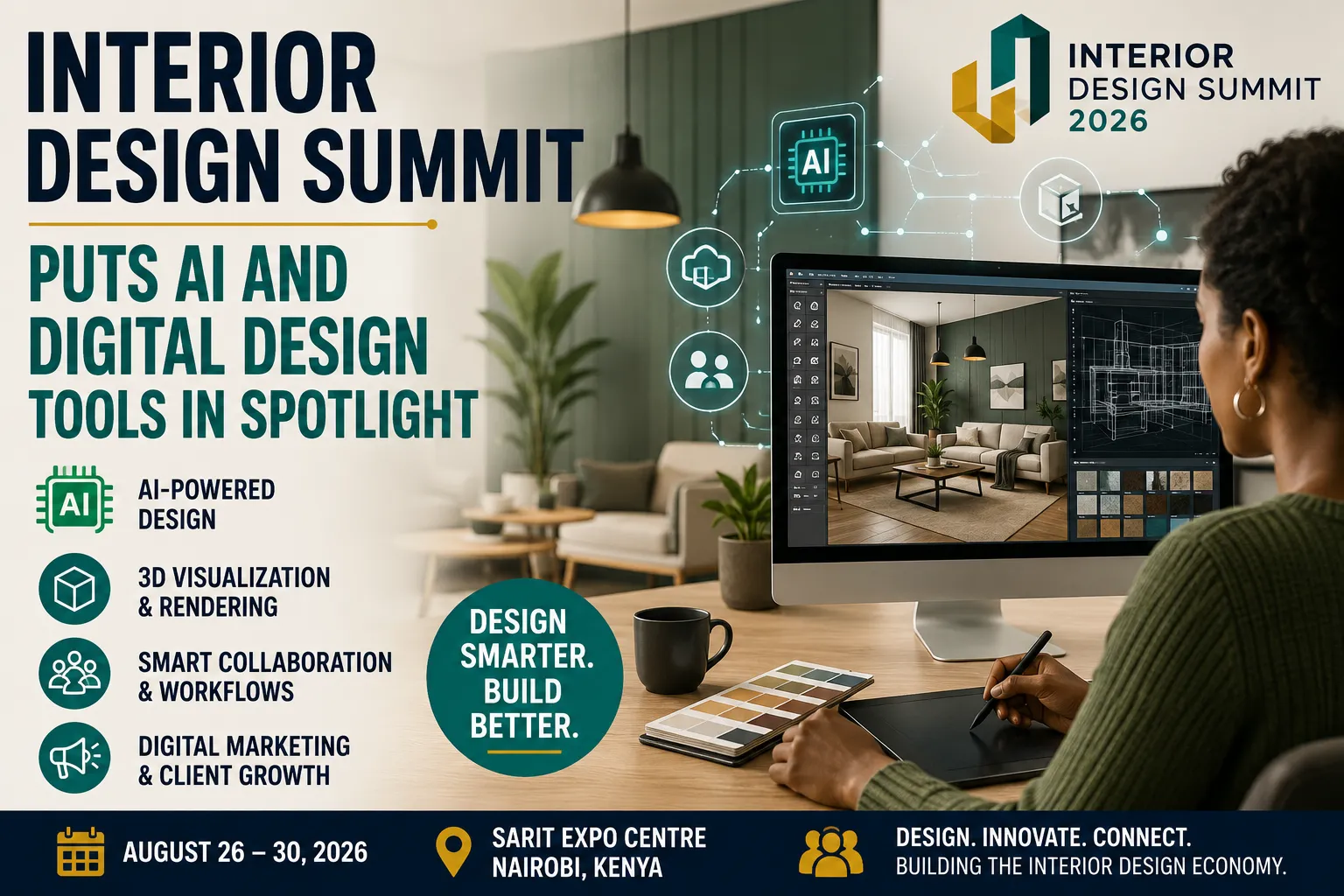
Artificial intelligence and digital design tools are becoming increasingly important to the interior design profession, and Kenya’s Interior Design Summit 2026 is putting that transformation at the center of its programme.
The five-day event, taking place from August 26 to 30 at Sarit Expo Centre in Nairobi, brings together interior designers, manufacturers, suppliers, developers, educators, students, investors and other built-environment professionals under the theme “Building the Interior Design Economy.”
Technology is one of the clearest themes running through the summit, with a dedicated day of workshops focused on AI and professional design workflows, 3D visualisation and collaboration, digital marketing and client acquisition.
The emphasis reflects a broader shift in the industry: interior designers are increasingly expected to combine creative skills with digital fluency, business knowledge and the ability to adapt to rapidly changing technology.
For a broader look at how technology is influencing residential interiors, how AI is changing the way people design their homes explores the growing role of artificial intelligence in the home-design process.
AI Is Moving Into the Interior Design Workflow
Artificial intelligence is beginning to influence several stages of the design process.
Design professionals can use AI-assisted tools to explore concepts, generate visual references, investigate ideas and speed up repetitive tasks. Rather than replacing the designer, these systems can function as additional tools for brainstorming and experimentation.
The Interior Design Summit’s Friday programme specifically includes a workshop on AI and professional design workflows, followed by an emerging designers session featuring a quick AI tools demonstration.
That focus is significant because AI adoption in design is moving beyond simple image generation.
Designers are increasingly considering how AI can fit into established workflows, from the earliest stages of concept development to presentations and client communication.
3D Visualisation Is Changing Client Presentations
Three-dimensional visualisation is another major part of the industry’s digital transformation.
Traditional drawings can communicate dimensions, layouts and technical information, but many clients find it easier to understand a proposal when they can see a realistic representation of the finished space.
3D tools allow designers to demonstrate furniture arrangements, materials, lighting concepts, colours and spatial relationships before construction begins.
The summit’s technology programme includes dedicated sessions on 3D visualisation and collaboration, highlighting the growing importance of these capabilities in professional practice.
For clients, better visualisation can make design decisions easier. For designers, it can create a clearer way to communicate ideas and identify potential problems earlier in a project.
Digital Tools Are Expanding Beyond Design
The technology conversation at the summit is not limited to drawing and visualisation.
The programme also includes digital marketing and client acquisition, showing how technology is affecting the business side of interior design.
A designer’s ability to create an attractive space is only one part of running a successful practice. Professionals also need to attract clients, present their work, communicate effectively, manage projects and build a recognizable reputation.
Digital platforms can help designers showcase portfolios, reach potential clients and maintain relationships with existing customers.
This is particularly relevant for independent designers and smaller studios that may not have large marketing departments.
The Designer Still Provides the Human Judgment
The growing role of AI raises an obvious question: could technology eventually replace parts of the interior designer’s job?
The more immediate reality is more nuanced.
AI can generate concepts and images quickly, but successful interior design requires understanding how people actually use spaces. Designers must consider budgets, construction limitations, materials, safety, accessibility, culture, client preferences and the practical realities of a project.
A generated image can suggest an attractive room. It cannot independently negotiate with a client, inspect a construction site or determine whether a particular design can realistically be built within a project’s budget.
Human judgment therefore remains central.
The most valuable professionals may be those who understand how to combine creative judgment with increasingly capable digital tools.
Technology Could Help Emerging Designers
Digital skills are particularly important for students and people entering the profession.
The summit’s programme includes workshops specifically designed for emerging designers, covering areas such as AI tools, 3D presentations, professional online presence, portfolio development and career development.
This reflects a wider challenge facing design education.
Learning traditional principles such as space planning, materials, lighting, colour and ergonomics remains essential. But graduates also need to understand how modern design practices operate in real projects.
The Interior Design Society of Kenya has highlighted the need for stronger connections between education and professional practice, noting that graduates can have strong creative and digital abilities while lacking sufficient exposure to construction sites, budgets, contracts, procurement and client management.
Technology education therefore works best when it is combined with practical industry experience.
From Classroom Skills to Professional Workflows
The distinction between learning a software tool and understanding how to use it professionally is becoming increasingly important.
A student may know how to create a 3D model, for example, but professional practice requires much more.
The designer needs to know what information the model should communicate, how accurate it needs to be, how it fits into construction documentation and how to present it to a client.
The same principle applies to AI.
Knowing how to generate an image is different from knowing how to use AI responsibly as part of a professional workflow.
Designers need to understand how to evaluate generated results, refine concepts and ensure that technology supports rather than compromises the project’s objectives.
AI Could Speed Up Concept Development
One of the most obvious advantages of AI is speed.
Generating multiple visual directions manually can take considerable time. AI-assisted tools can help designers explore different possibilities rapidly, allowing them to compare styles, layouts, materials and visual moods during early concept development.
That does not mean every generated idea should become a finished design.
Instead, rapid experimentation can give designers more options to evaluate.
The designer’s role shifts toward selecting, refining and translating promising ideas into workable solutions.
For clients, that could eventually mean faster concept development and more opportunities to participate in the creative process.
Digital Collaboration Is Becoming Essential
Interior projects rarely involve only one professional.
Architects, engineers, contractors, suppliers, manufacturers, developers and clients may all need access to project information.
Digital collaboration tools can help teams share drawings, models, specifications, schedules and other project information across different locations.
This can be particularly valuable as design projects become more complex.
Better collaboration can also reduce misunderstandings, provided that teams maintain accurate documentation and clear communication.
The summit’s emphasis on digital collaboration recognizes that modern design technology is not only about creating images. It is also about connecting the people responsible for turning those ideas into physical spaces.
Technology Meets the Business of Design
The Interior Design Summit is deliberately broader than a technology conference.
Its overall goal is to strengthen the economic foundations of Kenya’s interior design sector by connecting designers with manufacturers, suppliers, developers, investors, educators and other industry participants.
That context matters because technology only creates lasting value when it contributes to stronger businesses and better projects.
For a design studio, adopting a new tool should ideally lead to a measurable benefit: faster production, better client communication, more efficient project management, improved marketing or the ability to take on new types of work.
Simply using the latest technology does not guarantee success.
The real question is whether it solves a problem.
Local Manufacturing and Digital Design Could Reinforce Each Other
Another important theme of the summit is manufacturing.
The event includes discussions around manufacturing, designer-manufacturer collaboration, material innovation and responsible sourcing.
Digital design could strengthen these relationships by making it easier for designers to communicate specifications and visualize how locally produced products might fit into a project.
Manufacturers, in turn, can provide designers with detailed product information and technical resources that can be incorporated into digital workflows.
This creates the possibility of a more connected design economy in which designers and manufacturers work together earlier in the project process.
Sustainability Is Also Part of the Digital Conversation
Technology cannot be separated from the industry’s growing focus on sustainability.
The summit includes sessions on material and product innovation, responsible sourcing, reuse, recovery and waste reduction.
Digital tools can potentially help designers compare materials, document specifications and visualize alternatives before products are purchased or installed.
However, technology alone does not make a design sustainable.
The environmental impact of materials, manufacturing, transportation, durability, maintenance and eventual disposal still needs to be considered.
The most effective approach combines digital efficiency with thoughtful material and design decisions.
A New Skill Set Is Emerging
The modern interior designer increasingly needs to operate across several disciplines.
Creative ability remains fundamental, but it now sits alongside:
- AI literacy
- 3D visualization
- Digital collaboration
- Technical documentation
- Digital marketing
- Client communication
- Project management
- Business development
- Material knowledge
- Sustainability awareness
This does not mean every designer needs to become a software engineer.
Instead, professionals need enough digital understanding to select the right tools and integrate them into their work.
The Human Element Remains the Differentiator
As AI becomes more capable, the skills that are difficult to automate may become increasingly valuable.
Understanding a client’s priorities, interpreting cultural context, balancing competing requirements and making responsible design decisions all require judgment.
Interior design is ultimately about people and the spaces they inhabit.
A successful living room, workplace, restaurant, hotel or retail environment must work for its users, not simply look impressive in a digital rendering.
That makes empathy, communication and problem-solving just as important as technical ability.
This human-centered approach also connects with the broader movement toward interiors that feel individual rather than overly manufactured. Interior designers are moving away from perfect showroom-style homes toward more personal spaces, reinforcing the idea that technology should support the people using a space rather than dictate how it should look.
Nairobi Summit Highlights an Industry in Transition
The Interior Design Summit 2026 arrives at a time when Kenya’s design industry is expanding its connections with construction, property development, hospitality, manufacturing and technology.
Its programme reflects that changing environment, combining professional development with technology, business, manufacturing, materials and career development.
The dedicated technology workshops on August 28 provide a particularly clear indication of where the profession is heading.
AI, 3D visualization and digital marketing are no longer simply optional topics for technology enthusiasts. They are becoming part of the broader toolkit available to design professionals.
The challenge for the industry will be ensuring that technology improves the quality and efficiency of design without allowing convenience to replace professional judgment.
The shift toward digital tools is also occurring alongside a desire to create spaces that provide a break from constant connectivity. The rise of the analog room and screen-free interior spaces shows that technological progress in design can exist alongside a renewed appreciation for physical, tactile and human experiences.
The Next Generation of Interior Design
The rise of AI and digital design tools does not necessarily signal the end of traditional interior design. Instead, it may mark the beginning of a more technology-enabled profession.
Designers who combine strong fundamentals with digital skills can potentially develop ideas faster, communicate more clearly and reach clients more effectively.
At the same time, education providers and professional organizations have an important role to play in helping emerging designers understand not only how to use new tools but when and why to use them.
As the Interior Design Summit brings the Kenyan industry together, the conversation is increasingly moving beyond whether technology belongs in interior design.
The more important question is how designers can use it responsibly to create better spaces, stronger businesses and a more connected design economy.