What Is Minimalism and Simpler Living?
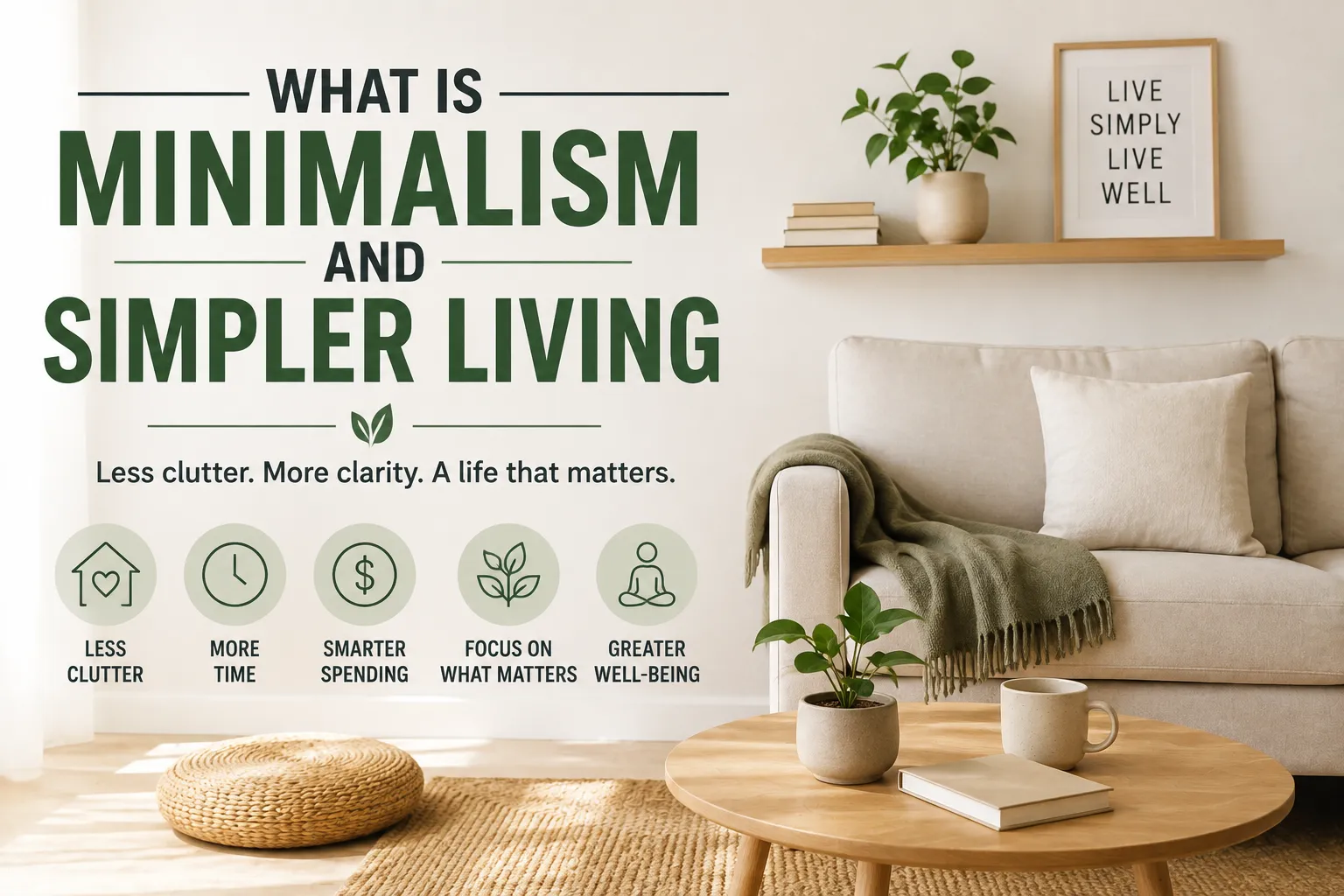
What Is Minimalism and Simpler Living?
Modern life can make it surprisingly difficult to feel that we have enough. Homes fill with possessions, calendars become crowded, notifications compete for attention and everyday decisions seem to multiply.
Minimalism offers a different approach.
At its core, minimalism is about being intentional with what occupies your space, time, attention and resources. It does not necessarily mean owning an almost empty home or giving away everything you own. Instead, it encourages people to distinguish between what genuinely adds value to their lives and what creates unnecessary clutter, expense or distraction.
Simpler living takes a broader view. It can include minimalism, but it also involves reducing unnecessary complexity and creating more room for the things that matter.
For a broader perspective on how different areas of life can work together, see this complete guide to living a balanced lifestyle.
What Is Minimalism?
Minimalism is a lifestyle philosophy centered on intentionality and reducing excess.
The idea can be applied to physical possessions, digital information, finances, schedules, relationships and consumption habits.
A minimalist approach asks questions such as:
- Do I actually use this?
- Does this possession serve a meaningful purpose?
- Am I keeping it because I need it or because I feel obligated to?
- Is this activity worth the time it requires?
- Does buying more improve my life or simply add more responsibility?
- What would happen if I removed this?
The goal is not deprivation.
The goal is to make deliberate choices rather than accumulating things, commitments and distractions automatically.
Minimalism Does Not Mean Owning Nothing
One of the most common misconceptions about minimalism is that it requires owning as few possessions as possible.
There is no universal number of belongings that makes someone a minimalist.
A person may own books, cooking equipment, sporting gear, furniture, technology and clothing while still practicing minimalism.
What matters is the relationship with those possessions.
Someone who owns 50 books that they regularly read may have a more intentional approach to possessions than someone who owns 500 books that remain unopened because they feel compelled to collect them.
Minimalism is therefore less about a specific quantity and more about purposeful ownership.
What Is Simpler Living?
Simpler living extends beyond possessions.
It is an approach to life that seeks to reduce unnecessary complexity.
This could mean:
- Having fewer commitments
- Spending less impulsively
- Simplifying meals
- Reducing digital distractions
- Creating more predictable routines
- Choosing practical possessions
- Spending more time outdoors
- Prioritizing relationships
- Reducing unnecessary work or errands
- Being more intentional about consumption
Simpler living looks different from one person to another because everyone’s responsibilities, resources and priorities are different.
Why People Are Drawn to Minimalism
People pursue minimalism for many reasons.
Some become interested after realizing that clutter makes their homes difficult to manage.
Others want to spend less money.
Some are tired of constantly cleaning, organizing and replacing possessions.
Others want to reduce distractions and create more time for family, hobbies or personal goals.
For some people, minimalism is also a response to consumer culture—the idea that happiness and status can be achieved by continually acquiring more.
The motivation can vary, but the underlying question is often similar:
What can I remove so that the things that matter become easier to see?
Physical Clutter Has a Practical Cost
Possessions require resources.
They have to be purchased, transported, stored, cleaned, maintained and eventually replaced or discarded.
A crowded home can therefore create work beyond the initial purchase.
Every additional item potentially requires:
- Storage space
- Cleaning
- Maintenance
- Organization
- Attention
- Replacement
- Disposal
Reducing unnecessary possessions can lower some of these demands.
That does not mean a minimalist home must be completely empty. It simply means the possessions that remain should justify the space and maintenance they require.
Decluttering Is Often the Starting Point
Many people encounter minimalism through decluttering.
Decluttering involves reviewing possessions and deciding what should remain, be donated, sold, recycled or discarded.
A useful approach is to work in categories rather than attempting to empty an entire house at once.
You might start with:
- Clothing
- Kitchen equipment
- Books
- Paperwork
- Bathroom products
- Decorations
- Electronics
- Storage areas
Starting small can make the process less overwhelming.
For a more practical, step-by-step approach to applying these ideas throughout the home and everyday life, see the Minimalist Living Guide: How to Simplify Your Life.
Keep What Supports Your Life
A useful decluttering question is not simply, “Have I used this recently?”
Some possessions may be used only occasionally but still serve an important purpose.
For example, specialized tools, emergency supplies, formal clothing or seasonal equipment may not be used every week.
Instead, ask whether the item has a reasonable role in your life.
A possession does not have to be used constantly to be valuable.
Sentimental Items Require a Different Approach
Decluttering sentimental belongings can be much harder than sorting ordinary household items.
Photographs, letters, gifts and family possessions may carry emotional significance that has nothing to do with their practical usefulness.
Minimalism does not require eliminating meaningful memories.
Instead, people can consider whether they want to keep every physical object associated with a memory.
Photographs can sometimes be digitized. Several small keepsakes might be combined into one memory box. Important letters can be stored carefully rather than scattered throughout the house.
The goal is to preserve meaning without allowing every sentimental object to become permanent clutter.
Minimalism Can Change Shopping Habits
Decluttering removes possessions that already exist.
Minimalism becomes more powerful when it also changes what enters the home.
Before buying something, consider:
- Do I need it?
- Do I already own something that performs the same function?
- Where will I store it?
- How often will I realistically use it?
- Is it durable?
- Would renting, borrowing or buying secondhand make more sense?
- Am I buying it because I need it or because I am responding to an advertisement or impulse?
These questions create a pause between wanting something and purchasing it.
That pause can prevent many unnecessary purchases.
The Financial Side of Simpler Living
Minimalism can also influence personal finances.
Consuming less can mean spending less, although minimalism itself should not be treated as a guaranteed money-saving strategy.
A person can easily spend large amounts of money purchasing expensive minimalist furniture, clothing or technology.
The financial benefit comes from reducing unnecessary consumption, not from buying products marketed as minimalist.
Simpler living can encourage people to focus spending on priorities such as housing, food, education, savings, experiences or other goals that matter to them.
For a broader look at how intentional financial choices can support a more manageable lifestyle, see this Financial Wellness Guide.
Minimalism and the Cost of Convenience
Modern life offers enormous convenience.
Food delivery, subscription services, online shopping and automated services can save time.
But convenience can also create complexity.
A household might accumulate numerous subscriptions, memberships and recurring purchases that seem inexpensive individually but become significant collectively.
Reviewing recurring expenses is therefore another form of decluttering.
Canceling services that are rarely used can simplify finances and reduce monthly obligations.
Digital Minimalism
Clutter is not limited to physical spaces.
Phones and computers can become crowded with applications, photographs, messages, files, notifications and subscriptions.
Digital minimalism involves being more intentional about technology.
This might include:
- Removing unused apps
- Turning off unnecessary notifications
- Unsubscribing from unwanted emails
- Organizing important files
- Deleting duplicate photos
- Limiting social media use
- Reducing unnecessary screen time
- Keeping only useful digital subscriptions
The objective is not to reject technology.
It is to make technology serve your priorities rather than constantly competing for attention.
A Simpler Schedule Can Be More Valuable Than a Cleaner Home
It is possible to have a tidy home and an exhausting life.
Simpler living therefore involves looking at time as carefully as possessions.
A crowded calendar can create a form of invisible clutter.
Review recurring commitments and ask:
Would I choose this activity again today?
If the answer is consistently no, it may be worth reconsidering whether the commitment still belongs in your life.
Not every obligation can be removed. Work, family responsibilities and essential tasks remain part of life.
But optional commitments can sometimes be reduced.
Protecting Unstructured Time
A completely optimized schedule can become another form of complexity.
Leaving some periods unplanned creates space for rest, spontaneous activities and unexpected needs.
This can be particularly useful for people who feel that every hour of the day is already assigned to something.
Simpler living does not necessarily mean becoming more productive.
Sometimes it means accepting that not every moment needs to produce something.
Minimalism in the Kitchen
The kitchen is a common source of household clutter.
Gadgets, containers, utensils and appliances can accumulate because each item seems useful when purchased.
A simpler kitchen focuses on tools that are versatile and regularly used.
For example, one good chef’s knife can perform many tasks that would otherwise require several specialized gadgets.
The same principle can apply to cookware and storage containers.
The goal is not to have the fewest kitchen tools possible. It is to have the tools that genuinely support the way you cook.
A Simpler Wardrobe
Clothing is another area where minimalism can be practical.
A simpler wardrobe might contain fewer items that are comfortable, versatile and appropriate for everyday life.
This can reduce:
- Decision-making
- Laundry complexity
- Storage requirements
- Unnecessary spending
A minimalist wardrobe does not have to look a particular way.
Someone who loves colorful clothing can still have a minimalist wardrobe if the collection is intentional and manageable.
Minimalism and Sustainability
Reducing unnecessary consumption can also reduce some environmental impacts.
Every product requires resources to manufacture and transport.
Buying fewer unnecessary items can therefore reduce demand for additional production.
However, minimalism should not be treated as automatically sustainable.
Replacing existing possessions simply because they do not fit a minimalist aesthetic can create additional waste.
Using what you already own, repairing products, buying durable items and purchasing secondhand when appropriate can often be more consistent with the underlying principle.
Experiences Versus Possessions
Minimalism often encourages people to think differently about where they derive satisfaction.
Instead of automatically spending money on more possessions, some people choose to invest more in experiences.
That might include:
- Travel
- Time with family
- Outdoor activities
- Learning
- Hobbies
- Community events
- Creative projects
This does not mean possessions are bad or experiences are always better.
The important question is whether spending aligns with personal values.
Minimalism Does Not Require Rejecting Comfort
A common misconception is that simpler living requires sacrificing comfort.
It does not.
A comfortable sofa, a well-equipped kitchen, quality bedding or a reliable computer can all have legitimate value.
The minimalist question is not:
“Can I live without this?”
Almost everyone could live without many things.
A more useful question is:
“Does this meaningfully improve my life enough to justify the money, space and attention it requires?”
The Difference Between Minimalism and Deprivation
Deprivation involves going without something because it is unavailable or because you believe you should not have it.
Minimalism is about choosing intentionally.
That distinction matters.
Someone who loves cooking does not need to give away their cookware to become minimalist.
Someone who enjoys reading does not need to eliminate their book collection.
Someone who enjoys fashion does not need to own only ten pieces of clothing.
Minimalism works best when it supports an individual’s values rather than imposing an arbitrary lifestyle.
How to Start Living More Simply
There is no need to redesign your entire life overnight.
Start with one area.
Choose a drawer, shelf, closet or digital folder.
Remove items that are clearly unnecessary.
Then pause before bringing new things into that space.
Once the process becomes familiar, expand gradually.
The same principle can be applied to time and money.
Review one subscription. Decline one unnecessary commitment. Create one screen-free period. Simplify one recurring task.
Small changes can produce meaningful improvements when they are sustained.
The 30-Day Pause Can Help With Shopping
One practical strategy is to create a waiting period for nonessential purchases.
If you want something that is not urgent, write it down instead of buying it immediately.
After several days or a few weeks, reconsider.
You may discover that the desire has disappeared.
For expensive purchases, an even longer waiting period can help.
This approach separates genuine needs from temporary impulses without requiring you to reject every purchase.
Replace “More” With “Better”
Simpler living does not mean constantly trying to reduce the number of things you own.
It can mean replacing the question “What else do I need?” with “How can I make better use of what I already have?”
Repairing something can be better than replacing it.
Learning to cook a few reliable meals can be simpler than constantly searching for new recipes.
Using one versatile piece of equipment can be easier than managing several specialized alternatives.
The emphasis shifts from acquisition to usefulness.
Minimalism Can Improve Household Maintenance
Fewer possessions can make cleaning and organizing easier.
With less clutter on surfaces, there may be fewer things to move before dusting or cleaning.
With fewer clothes, laundry can become easier to manage.
With fewer kitchen gadgets, cabinets can become easier to organize.
These benefits are practical rather than philosophical.
Reducing the number of objects that require maintenance can create more time for other activities.
Simpler Living Requires Boundaries
Minimalism becomes difficult when other people constantly introduce more consumption into your life.
Family members may have different preferences. Friends may invite you to shop or participate in activities that involve spending.
The solution is not to impose your preferences on everyone else.
Instead, establish boundaries around your own choices.
You can decline purchases, unsubscribe from marketing emails, set spending limits and decide what enters your personal space.
There Is No Perfect Minimalist Lifestyle
Minimalism can become counterproductive if it turns into another source of pressure.
Constantly counting possessions, repeatedly reorganizing your home or feeling guilty about buying something can create more stress rather than less.
The purpose of simpler living is to make life more intentional and manageable.
If a minimalist practice is creating anxiety, obsession or unnecessary inconvenience, it may be worth reconsidering whether it actually serves its intended purpose.
Simplicity Looks Different at Different Stages of Life
A person’s needs change.
A young adult living alone may have very different priorities from a family with children.
Someone working remotely may need equipment that another person does not.
Parents may need toys, school supplies and children’s clothing.
Older adults may prioritize accessibility and convenience.
There is no universal minimalist home or lifestyle.
The right amount of possessions and commitments depends on the life being lived.
Minimalism Can Make Room for What Matters
The most useful way to understand minimalism is not as an aesthetic trend but as a decision-making framework.
It asks people to consider what deserves their money, space, time and attention.
That might lead to a smaller wardrobe, a quieter phone, fewer subscriptions, a less crowded calendar or a home with fewer unnecessary possessions.
But it could also simply mean becoming more conscious about consumption.
Creating a Life With Less Unnecessary Noise
Minimalism and simpler living are ultimately less about subtraction for its own sake and more about making deliberate choices.
The objective is not to own the smallest number of possessions, maintain an empty house or eliminate every convenience.
It is to reduce the things that consume resources without providing enough value in return.
When possessions are chosen intentionally, schedules leave room for important priorities and spending reflects personal values, everyday life can become easier to manage.
Simplicity is not about having less just to have less. It is about creating enough space—physically, financially and mentally—for the parts of life that matter most.