Interior Designers Are Moving Beyond Minimalism as Richer, More Tactile Homes Take Over
Interior Designers Are Moving Beyond Minimalism as Richer, More Tactile Homes Take Over
For years, minimalist interiors dominated design conversations with their clean lines, neutral palettes, uncluttered surfaces and carefully controlled visual simplicity.
But the mood inside many homes is changing.
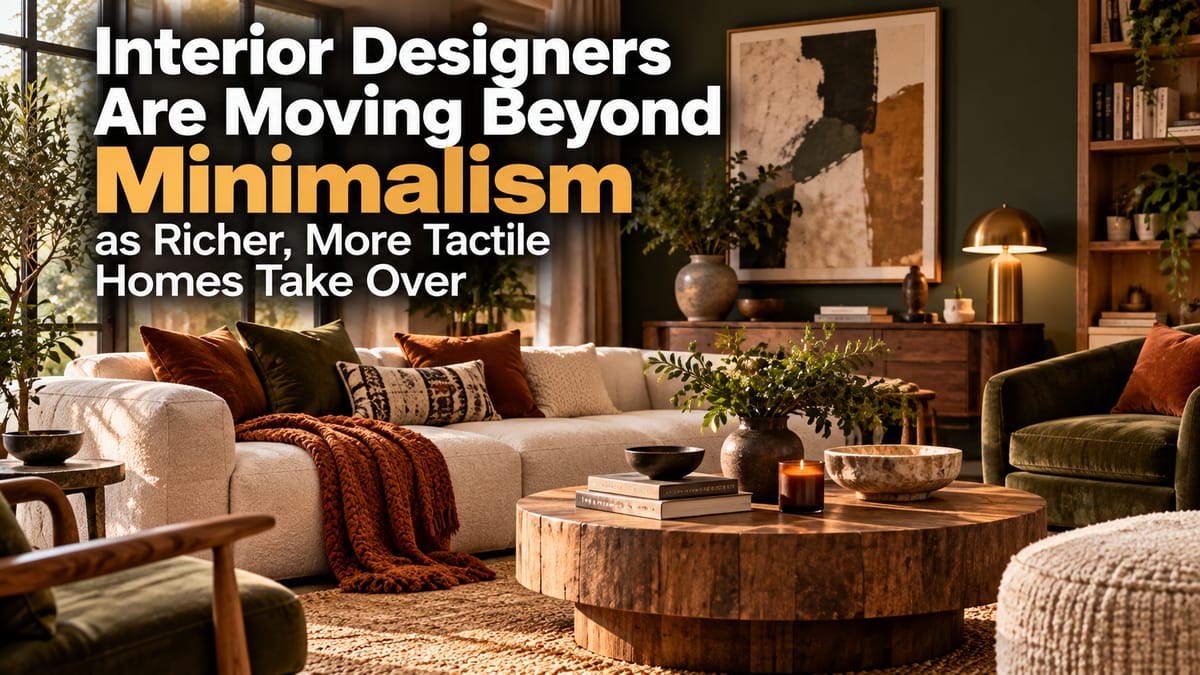
In 2026, interior designers are increasingly embracing rooms that feel warmer, more personal and more layered. Richer colors, tactile fabrics, natural materials, vintage pieces, decorative details and objects with personal meaning are finding their way back into living spaces.
The shift does not mean minimalism has disappeared. Instead, designers are moving toward interiors that balance simplicity with character, creating homes that feel lived in rather than perfectly staged.
Current design forecasts point toward stronger self-expression, saturated colors, artisanal details, layered materials and rooms built around personality rather than rigid aesthetic rules.
The End of the Perfectly Minimal Room?
Minimalism changed residential interiors in significant ways.
The style encouraged homeowners to remove unnecessary objects, prioritize functionality and create calmer spaces. White walls, pale woods, streamlined furniture and limited decoration became common visual signals of modern design.
But an interior can become so carefully controlled that it begins to feel impersonal.
That tension appears to be influencing the current move toward richer spaces. Designers are increasingly interested in homes that reveal something about the people who live in them rather than spaces that could belong to almost anyone.
Recent design coverage has described a growing appetite for color, pattern, texture, craftsmanship and personal collections.
The result is not necessarily clutter.
It is curation with personality.
Texture Is Becoming More Important
One of the clearest changes is the growing importance of tactile materials.
Instead of relying on visual simplicity alone, designers are using surfaces that invite people to touch and experience a room.
Think:
- Bouclé and velvet upholstery
- Handwoven rugs
- Natural wood
- Linen and wool
- Rough stone
- Textured plaster
- Woven baskets
- Handmade ceramics
- Embroidered textiles
- Aged metals
- Carved or sculptural furniture
These materials introduce depth without requiring a room to be filled with decorative objects.
A simple sofa can feel dramatically different when upholstered in a richly textured fabric. A plain wall can become more interesting through limewash, plaster or handcrafted finishes.
Architectural Digest’s 2026 design forecast highlights growing interest in artisanal workmanship, dimensional wall treatments and richly textured materials as designers respond to demand for more expressive interiors.
Warmth Is Replacing Sterility
The move toward richer interiors is also partly a reaction to spaces that can feel overly clinical.
Bright white walls, perfectly coordinated furniture and almost completely empty surfaces can create visual calm, but they can also make a home feel more like a showroom than a personal environment.
Designers are increasingly working with warmer materials and softer visual transitions.
Wood tones, earthy colors, woven fabrics and aged finishes can make rooms feel more comfortable without abandoning contemporary design.
This is one reason the current movement should not simply be described as a return to maximalism.
The emerging aesthetic is often more controlled.
Instead of adding everything at once, designers are layering carefully selected elements to create depth.
Layered Comfort Is Becoming a Design Strategy
Comfort is becoming increasingly important as people expect their homes to perform multiple roles.
A living room may function as a place for entertaining, relaxing, working, reading and spending time with family. Bedrooms increasingly incorporate spaces for reading, exercising or unwinding.
That has changed the way designers think about furniture and materials.
Rather than choosing furniture purely because it looks streamlined, homeowners are paying more attention to how it feels to sit on, touch and use.
This growing interest in physical and visual comfort is reflected in Layered Comfort Is Taking Over, where the emphasis is on combining materials, lighting, furnishings and decorative elements to create spaces with greater warmth and depth.
The goal is not simply to make a room look comfortable.
It is to make the room feel comfortable.
Color Is Coming Back Into the Home
Neutral interiors are not disappearing, but color is becoming much more confident.
Designers are experimenting with deeper greens, burgundy, ochre, tobacco, terracotta, cobalt, chocolate brown and other saturated shades.
The important change is not necessarily that every room is becoming brightly colored.
Instead, color is being used more deliberately.
A deep green library can create an intimate atmosphere. A warm terracotta dining room can make gatherings feel more relaxed. A rich blue bedroom can create a sense of depth.
Color can also be introduced through smaller elements such as curtains, rugs, artwork, lamps and upholstery.
Recent design coverage has identified color as an increasingly important tool for creating individuality, with designers emphasizing intentional combinations rather than simply following a single universal palette.
Saturated Colors Do Not Have to Overwhelm a Room
One reason homeowners sometimes avoid stronger colors is the fear that the result will feel excessive.
The current approach offers another possibility.
A room can use a limited palette while still feeling rich.
For example, different shades of olive can appear across walls, upholstery and accessories. Brown can be combined with cream, rust and dark green. Deep blue can sit alongside natural wood and warm metallic finishes.
The result can be visually expressive without becoming chaotic.
This is where thoughtful layering becomes important.
The strongest rooms often have relationships between their colors rather than dozens of unrelated shades competing for attention.
Natural Materials Are Providing Visual Warmth
Natural materials are also playing a major role in the move toward richer interiors.
Wood, stone, rattan, jute, wool, linen and clay introduce variations that manufactured materials can struggle to reproduce.
Part of their appeal comes from imperfection.
Natural wood contains differences in grain. Stone has variations in color and pattern. Handcrafted ceramics may have subtle irregularities.
Those characteristics can make an interior feel less manufactured.
The 2026 design conversation increasingly emphasizes materials that age well and contribute to a sense of familiarity, tactility and connection with nature.
Vintage Furniture Is Finding a Larger Role
Another way designers are adding personality is through older furniture.
Instead of purchasing every piece from the same contemporary collection, homeowners are mixing new furniture with vintage or antique pieces.
A modern sofa might sit alongside an old wooden cabinet. A contemporary dining table might be paired with vintage chairs. A new bedroom can include an antique mirror or inherited chest.
These combinations prevent a room from feeling overly coordinated.
They also give homeowners opportunities to incorporate pieces with history.
That history can be personal, cultural or simply aesthetic.
Imperfection Can Make a Home Feel More Personal
The growing appreciation for patina and irregularity represents a broader change in how designers think about perfection.
Scratches, worn wood, handmade finishes and slightly mismatched pieces do not necessarily have to be corrected.
Sometimes they contribute to the character of the room.
This is particularly relevant as designers move away from interiors that appear designed primarily for photographs.
A home is used every day.
Furniture gets moved. Cushions become uneven. Books accumulate. Objects are rearranged. Surfaces develop signs of use.
The emerging design philosophy increasingly treats those characteristics as part of a home’s identity rather than problems that must constantly be hidden.
Walls Are Becoming More Expressive
Walls are also receiving more attention.
Instead of treating walls as neutral backgrounds for furniture, designers are using them as major design elements.
Wallpaper, decorative plaster, paneling, murals, textured finishes and hand-painted surfaces can transform a room without requiring dramatic architectural changes.
Architectural Digest’s 2026 forecast specifically points toward more sculptural wall treatments and personalized decorative surfaces.
This approach allows homeowners to introduce personality while keeping furniture relatively simple.
A textured wall behind a neutral sofa, for example, can provide enough visual interest to prevent the room from feeling flat.
Lighting Is Becoming More Sculptural
Lighting is another area where minimalism is giving way to greater expression.
Instead of treating fixtures as purely functional objects, designers are increasingly choosing lamps and pendants that act almost like pieces of sculpture.
Oversized fixtures, organic shapes, woven materials, colored glass and decorative metals can become focal points within a room.
Current 2026 reporting also points to growing interest in natural and plant-based materials in lighting, with designers using fixtures to introduce softness, texture and character.
This is particularly effective because lighting changes both the appearance and atmosphere of a space.
A sculptural lamp can serve as an object during the day and create a completely different mood once illuminated at night.
Homes Are Becoming More Eclectic
The return of richer interiors is also encouraging more eclectic combinations.
Homeowners are no longer necessarily trying to make every item belong to the same design era.
A traditional chair can sit beside a modern coffee table. Contemporary artwork can hang above antique furniture. Handmade objects can share a shelf with mass-produced accessories.
The key is creating relationships between the elements.
Color can connect different pieces. Similar materials can create continuity. Repeated shapes can establish visual rhythm.
This allows rooms to feel collected rather than purchased all at once.
Personal Collections Are Becoming Part of the Design
Books, artwork, photographs, souvenirs, ceramics and inherited objects are increasingly being treated as legitimate parts of interior design.
Instead of hiding personal belongings to maintain a perfectly styled room, homeowners are displaying things that tell stories about their lives.
This is one of the strongest differences between a showroom aesthetic and a lived-in interior.
A showroom demonstrates a design concept.
A home tells a story.
The current design movement increasingly favors the second approach.
Maximalism Does Not Mean Clutter
The word maximalism can sometimes create the impression that more is automatically better.
That is not necessarily what designers mean.
Contemporary maximalist interiors can still be highly organized. The difference is that they use more layers of color, pattern, texture and objects.
Architectural Digest describes the current maximalist movement as an intentional combination of color, pattern, texture, shape and form rather than simply filling a room with possessions.
Good maximalist design still requires editing.
There must be visual relationships between the different elements.
Without that discipline, layering can quickly become clutter.
The New Luxury Is About Craftsmanship
Luxury interiors are also changing.
For years, luxury could be communicated through expensive furniture, large rooms and recognizable designer brands.
Increasingly, craftsmanship itself is becoming a form of luxury.
Handmade tiles, custom upholstery, detailed woodwork, embroidered wall coverings and artisan-produced objects can make a space feel special without relying entirely on obvious status symbols.
Architectural Digest’s 2026 forecast highlights the growing demand for artisan-level workmanship and highly customized decorative details.
That suggests homeowners are increasingly interested in how something was made, not simply how expensive it is.
Comfort and Personality Can Coexist With Simplicity
The shift away from strict minimalism does not mean simple interiors are disappearing.
In fact, some of the most successful spaces may combine the best aspects of both approaches.
A room can have clean architecture and uncluttered circulation while incorporating textured fabrics, warm wood, artwork and personal objects.
Furniture can remain relatively simple while color and material provide richness.
This creates a middle ground between minimalism and maximalism.
The result is a home that feels calm without feeling empty.
Why This Shift Matters
Interior design often reflects changes in how people think about their homes.
When homes are treated primarily as functional spaces, efficiency and simplicity can dominate.
When people increasingly view the home as a retreat, gathering place, creative environment and reflection of personal identity, comfort and expression become more important.
The current design movement appears to reflect that broader shift.
People want spaces that work for everyday life, but they also want those spaces to feel like their own.
That means fewer rooms designed simply to look perfect and more rooms designed to support living.
The Rise of the Lived-In Interior
The strongest direction emerging from current design conversations is not necessarily maximalism itself.
It is personality.
A home can be minimalist, traditional, contemporary, eclectic or highly decorative and still feel current if it reflects the people who live there.
The move toward richer materials, warmer colors, vintage pieces, handcrafted objects and layered furnishings suggests that designers are increasingly interested in interiors with emotional and physical depth.
Minimalism helped establish the value of simplicity, but today’s interiors are showing that simplicity does not have to mean emptiness.
The next generation of homes is likely to be more tactile, more expressive and more personal—spaces that are not simply arranged to be photographed, but designed to be lived in.