Design Week Africa 2026 Showcases New African Interior Design Trends, Materials and Spaces
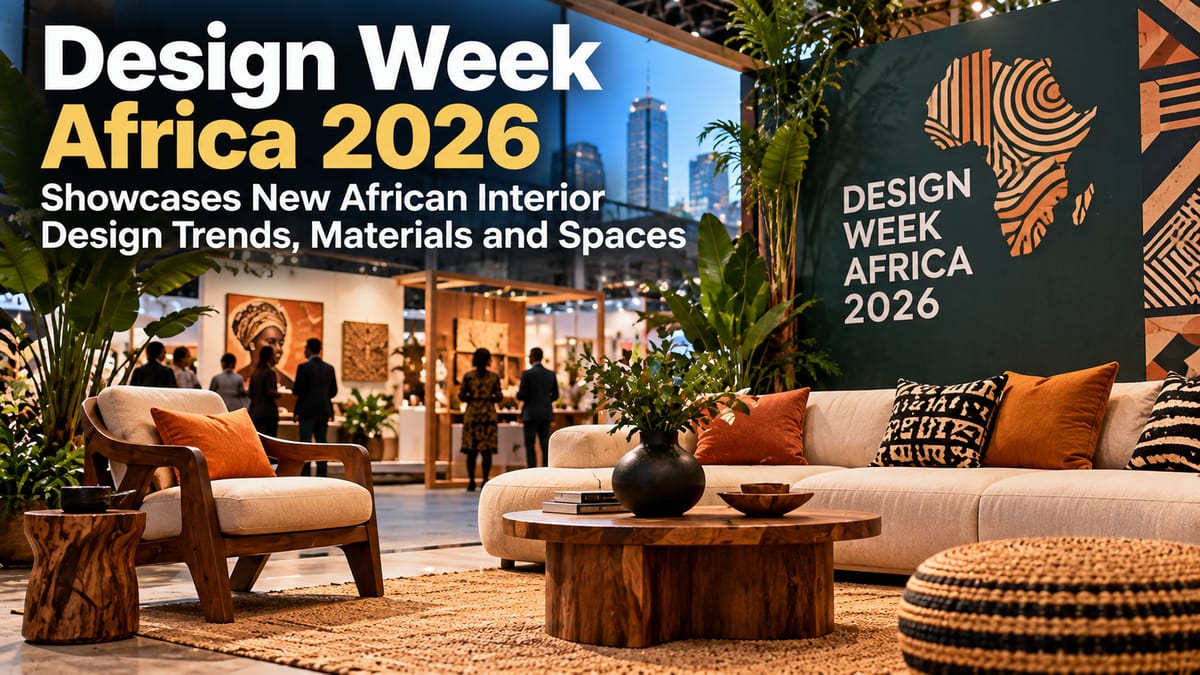
Design Week Africa 2026 Showcases New African Interior Design Trends, Materials and Spaces
Design Week Africa 2026 is bringing designers, architects, manufacturers, researchers and creative professionals together in Nairobi this week as the continent’s interior and built-environment industries turn their attention toward more inclusive, practical and distinctly African spaces.
Taking place from September 23 to 26 at the Kenyatta International Convention Centre (KICC), the event is built around the theme “Leave No One Behind: Innovative Design for Quality Living.” The program combines exhibitions, design research, experiential installations, awards and public programming.
Rather than treating interior design purely as a matter of decoration, this year’s event is placing greater emphasis on how spaces function, who they serve and how design can respond to the realities of African communities.
That shift is helping bring questions of accessibility, sustainability, technology, materials, culture and everyday living into the center of the conversation.
A Different Vision of African Interior Design
African interior design has often been discussed through the lens of aesthetics: color, patterns, materials, craftsmanship and cultural references.
Design Week Africa 2026 is expanding that conversation.
Its organizers describe design as a tool for dignity, accessibility, sustainability, economic empowerment and social transformation. The event’s central theme asks designers to consider how exclusion can be built into everyday environments and how those environments can be redesigned.
That makes the event particularly relevant to interior design because the spaces people interact with every day can influence comfort, mobility, productivity, safety and wellbeing.
Homes, offices, hotels, healthcare facilities, retail environments and public spaces all have different requirements, but they share one fundamental question: How well does the space serve the people using it?
The Experiential Design Centre Puts Spaces to the Test
One of the central components of Design Week Africa 2026 is the Experiential Design Centre, where visitors can interact with design rather than simply view finished objects.
The official program describes the centre as a walk-through environment featuring eight pavilions and 20 categories. It is designed around the idea that people should be able to see, test, interact with and experience design solutions.
That approach changes the role of an exhibition.
Instead of presenting furniture or materials as isolated products, an experiential environment can demonstrate how those products work together inside a larger space.
It also allows designers to consider practical questions such as movement, accessibility, comfort, lighting, technology and functionality.
Homes and Communities Take Center Stage
One of the Experiential Design Centre’s areas focuses on Homes, Communities & Daily Life.
The pavilion includes themes such as smart living and affordable housing, reflecting two issues that are increasingly important as African cities grow and housing needs change.
The emphasis is significant because residential design cannot be separated from affordability and everyday functionality.
A beautiful home still needs to work for the people living in it.
That means considering storage, circulation, ventilation, lighting, adaptability, maintenance and the relationship between private and shared spaces.
It also means recognizing that African households do not all have the same needs.
Interior Design Is Moving Beyond the Perfect Showroom
The broader direction at Design Week Africa also reflects a growing shift in residential interiors toward spaces that feel personal rather than overly staged.
That movement is explored in Interior Designers Move Away From Perfect Showrooms Toward More Personal Homes, which examines the growing interest in interiors that reflect real lifestyles, memories and individual preferences.
For African designers, that idea can take on additional significance.
Homes can become places where cultural identity, family history, local craftsmanship and contemporary lifestyles exist together rather than being separated into traditional and modern categories.
Inclusion Becomes a Design Principle
Accessibility is another major theme running through the 2026 event.
The Inclusion, Humanity & Social Impact pavilion focuses on universal design and assistive design. The official program places these ideas alongside broader questions about how environments can better serve marginalized and underserved groups.
Universal design can influence seemingly ordinary decisions.
Door widths, circulation paths, seating heights, bathroom layouts, lighting levels, signage and transitions between different floor surfaces can all affect whether a space is easy to navigate.
Designing for accessibility from the beginning can also reduce the need for expensive modifications later.
Healthcare Design Gets Greater Attention
Another pavilion focuses on Health, Wellbeing & Care, including healing spaces and inclusive fitness environments.
Healthcare interiors require a particularly careful balance.
They need to support medical functions while also considering the psychological experience of patients, families and healthcare workers.
Lighting, acoustics, wayfinding, privacy, ventilation, material selection and spatial organization can all influence how a healthcare environment feels and functions.
The focus on these spaces suggests that African interior design is increasingly being considered in relation to broader quality-of-life outcomes.
Materials Are Becoming Part of the Design Conversation
Materials sit at the intersection of aesthetics, sustainability, manufacturing and local identity.
Design Week Africa’s 2026 program includes a strong emphasis on material innovation, while its awards recognize Sustainable Materials Excellence alongside product innovation and smart technology.
That reflects a wider shift in interior design.
Materials are no longer evaluated solely on appearance.
Designers increasingly have to consider where materials come from, how they are produced, how long they last, how they are maintained and what happens to them at the end of their useful life.
For African markets, these questions can also involve local availability, transportation costs, manufacturing capacity and the potential for regional production.
Local Craft Can Meet Contemporary Design
African design has an enormous range of craft traditions and material practices.
Woodworking, weaving, ceramics, metalwork, textiles and other forms of making can contribute to contemporary interiors without being reduced to decorative accents.
The challenge is creating spaces where craftsmanship has a meaningful functional role.
A woven textile can provide texture and acoustic benefits. Handcrafted furniture can become a durable centerpiece. Locally produced ceramics can add character to a room while supporting makers and manufacturers.
This approach creates opportunities to connect cultural knowledge with contemporary design requirements.
Sustainable Materials Have a Larger Role
Sustainability is increasingly becoming a practical consideration rather than simply a design slogan.
Designers are looking at materials that can reduce environmental impact, last longer or support more responsible production.
At Design Week Africa, sustainable materials form part of the recognition structure for the Experiential Design Centre, alongside smart technology and hospitality and healthcare design.
That combination is notable.
Sustainability does not have to mean abandoning technology or contemporary aesthetics. Instead, the challenge is to combine environmental responsibility with performance and visual appeal.
Smart Technology Enters African Interiors
Technology is another part of the changing interior landscape.
Smart lighting, connected appliances, automated shading, security systems and energy-management technologies are increasingly becoming part of residential and commercial environments.
Design Week Africa’s program includes smart living and smart technology as part of its broader exploration of future-oriented spaces.
The important question is how technology is incorporated.
A successful smart interior should not feel like a collection of gadgets.
Technology works best when it supports the way people already use a space.
Future Workplaces Need More Flexibility
The Work, Learning & Productivity pavilion focuses on future workplaces, hybrid offices, hospitality, leisure and cultural interiors.
These environments are changing as organizations rethink how people work.
The traditional office model, based around fixed desks and standardized layouts, is being replaced in many settings by spaces designed for different types of activity.
A modern workplace might need quiet areas for concentrated work, collaborative zones for meetings, informal spaces for conversation and flexible areas that can serve several purposes.
This creates new challenges for interior designers.
Furniture, lighting, acoustics and technology all need to work together.
Hospitality Design Is Becoming More Local
Hotels, restaurants and other hospitality environments are also important areas for African interior design.
Travelers increasingly encounter spaces that use local materials, artwork, furniture and cultural references to create a sense of place.
This can make hospitality interiors feel less interchangeable.
A hotel in Nairobi does not need to look identical to a hotel in Paris, Dubai or New York to communicate luxury.
Instead, contemporary hospitality design can draw on local culture while maintaining international standards for comfort, service and functionality.
Cultural Interiors Can Preserve Identity
Cultural spaces present another opportunity.
Museums, galleries, performance venues and community spaces can use interior design to communicate stories and preserve cultural memory.
The challenge is avoiding superficial references.
Meaningful cultural design involves understanding the history and context behind materials, forms, patterns and objects.
When those elements are integrated thoughtfully, an interior can become part of the storytelling rather than simply providing a decorative backdrop.
Affordable Design Does Not Have to Mean Generic Design
The emphasis on quality living also raises questions about affordability.
Good interior design is sometimes associated with expensive furniture, premium finishes and large budgets.
But many of the principles behind effective design are not inherently expensive.
Good spatial planning, appropriate lighting, durable materials, ventilation, natural light and thoughtful storage can improve a space without requiring luxury products.
This is particularly important in rapidly growing cities where designers are being asked to work within different budget levels.
The future of African interiors will likely involve finding ways to deliver quality across a much wider range of households and communities.
Public Spaces Are Part of the Conversation
Design Week Africa is not limiting its vision to private interiors.
Its broader program considers public spaces, cities and the built environment, while the Grand Inclusion March is designed to take the event’s inclusion theme beyond the exhibition venue and into Nairobi’s civic environment.
That connection matters because interior design does not exist in isolation.
People move between homes, workplaces, shops, schools, healthcare facilities, transport hubs and public spaces every day.
The quality of one environment can affect how people experience the next.
Design Research Is Becoming More Important
Another distinctive feature of Design Week Africa 2026 is its Design Research Centre.
The centre is intended to connect design ideas with evidence. According to the event’s organizers, contributors are expected to define an exclusion challenge, present data and methodology, propose an intervention and identify measurable or scalable impact.
This approach pushes design beyond aesthetics.
Instead of asking only whether something looks good, designers can ask whether it solves a problem and whether its impact can be demonstrated.
That kind of research-driven approach could become increasingly valuable as African cities confront complex challenges involving housing, accessibility, climate, mobility and infrastructure.
African Design Is Becoming More Connected
Design Week Africa also illustrates how the continent’s design communities are becoming increasingly interconnected.
Interior designers, architects, manufacturers, suppliers, students, researchers and policymakers can use major events to exchange ideas and develop relationships that continue beyond the exhibition itself.
The official event program describes Design Week Africa as a continental platform rather than simply a conventional trade show.
That broader ambition matters because the future of African design will depend not only on individual designers but also on the ecosystem around them.
Manufacturers need designers.
Designers need skilled craftspeople and reliable suppliers.
Students need mentors.
Consumers need access to qualified professionals.
And cities need design solutions that respond to real conditions.
A More Personal and Practical Future for Interiors
The themes emerging from Design Week Africa 2026 point toward an interior design landscape that is becoming more personal, locally informed and practical.
The emphasis is not simply on creating visually impressive rooms.
It is increasingly about creating spaces that work.
That can mean designing homes around real family routines, workplaces around different working styles, healthcare environments around patient needs and public spaces around accessibility.
It can also mean using materials that connect contemporary interiors to local production and cultural identity.
Nairobi Becomes a Meeting Point for the Industry
With Design Week Africa running through September 26, Nairobi has become a meeting point for conversations about where African design is heading.
The event’s combination of experiential spaces, research, exhibitions, awards and public programming gives designers multiple ways to engage with the industry.
More importantly, the 2026 theme places a clear emphasis on the people who ultimately use the spaces being designed.
That could be one of the most significant directions to emerge from the event: a move toward African interiors that combine visual character with accessibility, sustainability, cultural relevance and everyday usefulness.
As designers, manufacturers and communities continue to develop these ideas, the next chapter of African interior design may be defined less by a single aesthetic and more by how effectively spaces respond to the people who live, work and gather in them.