Kitchen Remodeling in 2026: The Upgrades Homeowners Are Spending On Most
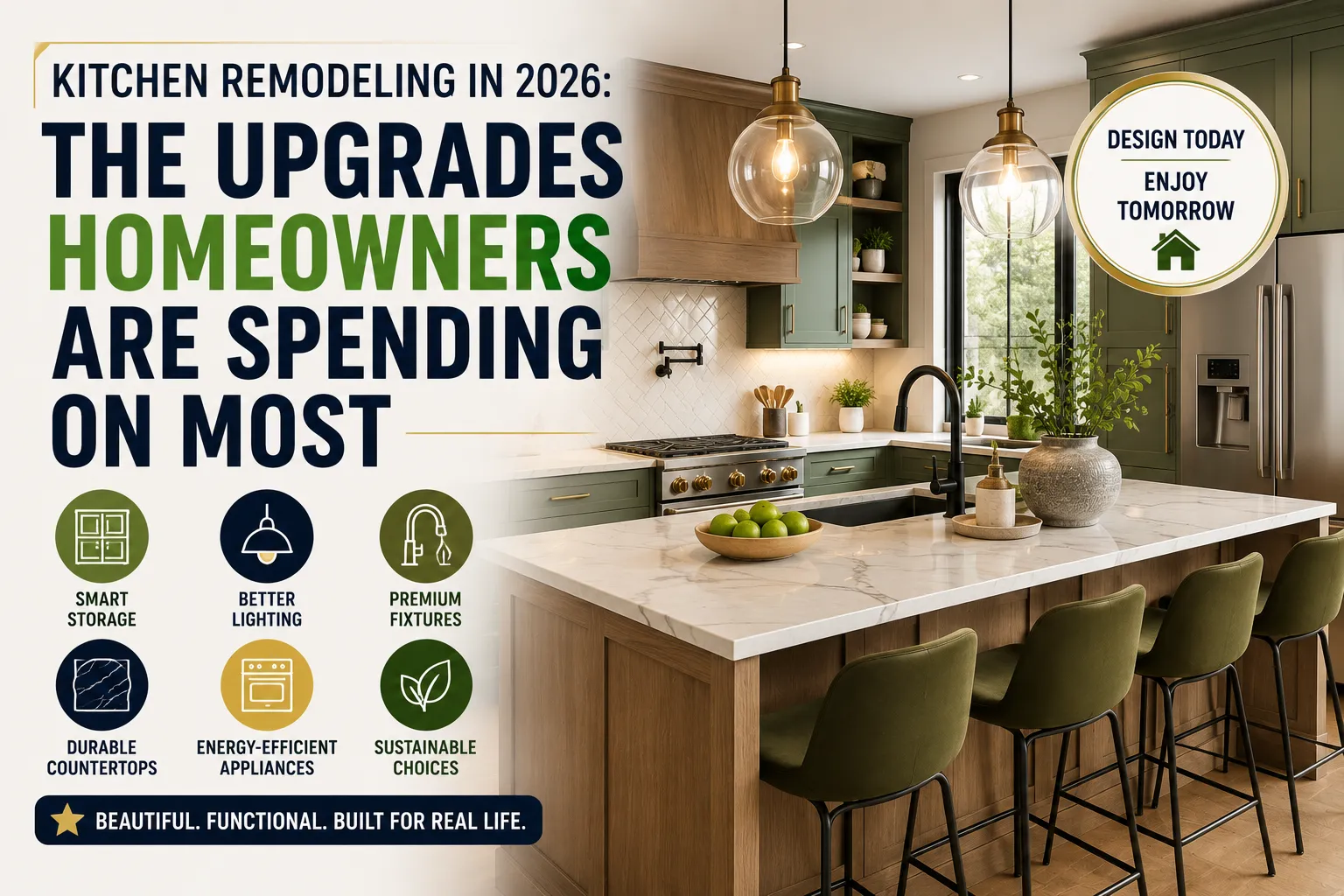
Kitchen Remodeling in 2026: The Upgrades Homeowners Are Spending On Most
Kitchen remodeling is taking a more practical turn in 2026.
Homeowners are still investing in the features that make a kitchen look better, but current remodeling data suggests that function, storage, durability and long-term usability are becoming just as important as appearance. Rather than automatically making kitchens larger, many homeowners are reworking existing layouts and adding features that make everyday cooking and storage easier.
The latest U.S. kitchen-remodeling data from Houzz shows that countertops, backsplashes, sinks, cabinets, faucets and lighting remain among the most frequently upgraded features. At the same time, wood cabinetry, specialized storage, accessibility improvements and smarter layouts are gaining ground.
That shift reflects a broader remodeling environment in which homeowners are choosing to improve the homes they already have rather than automatically moving.
What Is Driving Kitchen Remodeling in 2026?
The kitchen remains one of the most heavily renovated areas of the home, but the reasons for remodeling are changing.
According to the 2026 U.S. Houzz Kitchen Trends Study, 38% of renovating homeowners cite kitchen deterioration or dysfunction as a reason for remodeling, up three percentage points from the previous year. Style dissatisfaction remains slightly higher at 41%. Improving resale value is a motivation for 25% of homeowners.
The broader Houzz & Home study also found that renovation activity remains substantial, with 54% of surveyed U.S. homeowners reporting that they renovated in 2025. The median renovation spend remained $20,000 overall, while spending among the highest-spending 10% reached a median of $150,000.
For kitchens specifically, budgets vary dramatically depending on the scope of the project.
A major kitchen remodel had a median reported spend of $55,000 in the Houzz study. A minor remodel had a median spend of $20,000. Larger major remodels reached a median of $75,000, compared with $46,000 for smaller kitchens.
These figures are U.S. benchmarks, so actual costs can differ substantially by country, city, labor market, materials and project complexity.
1. Countertops Remain a Major Kitchen Investment
Countertops continue to be one of the most important upgrades homeowners make.
The 2026 Houzz Kitchen Trends Study found that 91% of renovating homeowners upgrade their countertops, making them the most commonly upgraded major kitchen feature in the survey.
That makes sense because countertops have to perform several jobs simultaneously.
They need to:
- Withstand daily food preparation
- Resist stains and moisture
- Provide adequate workspace
- Complement cabinetry
- Be relatively easy to maintain
- Hold up to years of everyday use
Homeowners are increasingly looking beyond purely decorative choices and considering how surfaces will perform in real kitchens.
For many remodels, the countertop also becomes one of the strongest visual elements in the room.
What homeowners are looking for
Current design trends point toward materials and finishes that provide warmth, texture and personality rather than making every surface look identical.
Natural-looking stone, warmer tones and contrasting island surfaces can create visual interest without requiring a completely unconventional kitchen.
The key lesson for homeowners is to choose a countertop based on how the kitchen will actually be used, rather than selecting a material solely because it is currently fashionable.
2. Backsplashes Are Getting More Attention
Backsplashes are another major remodeling expense.
According to Houzz, 85% of renovating homeowners upgrade their backsplash.
The backsplash can serve a practical purpose by protecting walls from water, grease and food splashes, but it is also an opportunity to introduce color, texture or pattern.
One notable direction in 2026 is the growing interest in slab backsplashes, which create a continuous visual surface behind countertops.
At the same time, emerging Houzz search data shows growing interest in more distinctive shapes and architectural details. Searches for scalloped tile increased more than threefold, while searches for wave tile rose 38%.
The trend suggests that homeowners are moving beyond the idea that a backsplash has to be a basic rectangular tile in a neutral color.
3. Cabinets Are Getting Warmer and More Natural
Cabinetry is undergoing one of the clearest visual changes in 2026.
Wood cabinets have overtaken white as the most popular cabinet color among renovating homeowners in the Houzz study. Wood was selected by 29% of respondents, compared with 28% for white.
Medium wood tones lead the wood category, followed by light and dark wood.
This represents a noticeable change from the long-running dominance of white kitchens.
The shift toward wood reflects a larger desire for kitchens that feel warmer and more connected to natural materials.
That does not mean white cabinetry has disappeared. Rather, homeowners appear to be adding more alternatives to the traditional all-white kitchen.
4. Complete Cabinet Replacement Remains Common
Cabinet color is changing, but cabinetry itself remains a significant remodeling investment.
Houzz reports that 68% of renovating homeowners replace all their kitchen cabinets, while 27% choose partial cabinet upgrades and only 5% leave their existing cabinets untouched.
Partial renovations can include:
- Refinishing cabinet exteriors
- Adding new cabinets
- Replacing selected cabinets
- Replacing cabinet doors
For homeowners with a limited budget, partial cabinet work can potentially refresh a kitchen without the cost and disruption of replacing every cabinet.
However, the right choice depends on the condition and layout of the existing cabinetry.
If the cabinets are structurally sound but visually dated, refinishing may make sense. If the problem is poor storage, inefficient placement or damaged construction, replacement may provide greater value.
5. Storage Is Becoming a Priority
One of the strongest themes in 2026 kitchen remodeling is the desire to make clutter easier to control.
Houzz found that 76% of renovating homeowners incorporate built-in features into their kitchens.
Pantry cabinets are the most popular built-in feature, appearing in 47% of renovations. Beverage stations follow at 24%, while built-in seating and wine refrigerators each appear in 17%. Walk-in pantries account for 16%.
This reflects a simple reality: homeowners want kitchens that can accommodate modern lifestyles without leaving every appliance, food item and piece of equipment on the countertop.
Storage upgrades gaining attention include:
- Pantry cabinets
- Pullout shelves
- Appliance garages
- Deep drawers
- Dedicated beverage stations
- Walk-in pantries
- Built-in seating
- Specialized food-preparation areas
Storage is particularly valuable because it improves the kitchen without necessarily requiring a larger footprint.
6. Kitchen Layouts Are Being Reworked
One of the most significant investments homeowners are making is not a material at all.
It is the layout.
The Houzz study found that 52% of renovating homeowners modify their kitchen layout, making it the most common major upgrade.
But there is an important twist.
Most homeowners are not dramatically increasing the size of their kitchens.
In fact, 68% of renovated kitchens remain approximately the same size after remodeling. About 26% become somewhat larger and only 6% become significantly larger.
That means homeowners are increasingly asking:
How can I make this kitchen work better without making it bigger?
The answer can involve repositioning appliances, improving work zones, adding storage or changing the relationship between the cooking, preparation and dining areas.
7. Islands Are Becoming More Functional
Kitchen islands continue to play a major role in remodeling, but their purpose is becoming broader.
Instead of functioning solely as a countertop with seating, an island can combine:
- Food preparation
- Storage
- Seating
- Cooking
- Cleanup
- Casual dining
- Socializing
The most useful island is not necessarily the largest one.
An oversized island can interfere with movement if the surrounding space is insufficient. Good kitchen design considers clearance, appliance placement and the way people actually move through the room.
In 2026, the emphasis is increasingly on purposeful kitchen zones rather than simply installing the biggest island possible.
8. Sinks and Faucets Are Getting Upgraded
Two less glamorous features are also receiving substantial attention.
Houzz found that 85% of renovating homeowners upgrade sinks, while 82% upgrade faucets.
These upgrades can have a significant effect on everyday convenience.
A new sink can provide:
- More usable basin space
- Better functionality
- Improved durability
- Easier cleaning
- A different visual style
Meanwhile, faucets increasingly combine design with convenience through features such as pull-down sprays and touch or touchless operation.
Because these are frequently used components, investing in quality can matter more than simply choosing the most visually impressive option.
9. Lighting Is Becoming More Important
Lighting is another area where homeowners are spending more attention.
According to Houzz, 78% of renovating homeowners upgrade kitchen lighting.
Good kitchen lighting typically needs several layers.
Ambient Lighting
Provides general illumination throughout the room.
Task Lighting
Helps illuminate work surfaces such as countertops and cooking areas.
Accent Lighting
Adds visual interest and can highlight architectural features or cabinetry.
Under-cabinet lighting is particularly useful because it can illuminate work surfaces without relying entirely on ceiling fixtures.
The trend toward warmer, more layered lighting also fits with the broader movement away from kitchens that feel cold or overly sterile.
10. Appliances Remain a Major Expense
Appliances are still one of the biggest parts of many kitchen remodels.
The 2026 Houzz data shows that 51% of renovating homeowners replace all their kitchen appliances, while another 33% upgrade selected appliances.
That means appliances are being treated as a core component of remodeling rather than an afterthought.
Popular considerations include:
- Energy efficiency
- Cooking performance
- Refrigerator capacity
- Dishwasher noise
- Induction cooking
- Appliance integration
- Ease of cleaning
- Long-term reliability
Interestingly, dedicated electronics remain relatively uncommon. Only 7% of respondents reported upgrading electronics as part of their kitchen remodel.
This suggests that homeowners are more interested in useful kitchen technology than simply filling the room with gadgets.
11. Hidden Appliances Are Gaining Appeal
A growing design preference is to make appliances less visually dominant.
Integrated refrigerators, appliance garages and concealed countertop appliances can create a cleaner appearance.
This works particularly well in kitchens where homeowners want cabinetry and architectural features to remain the visual focus.
The goal is not necessarily to eliminate technology but to hide the visual clutter created by technology.
That is why appliance garages and built-in storage are becoming increasingly attractive.
12. Aging-in-Place Features Are Moving Into the Kitchen
One of the most significant developments in 2026 is the growing focus on long-term usability.
Houzz reports that 53% of renovating homeowners address current or future special needs as part of their kitchen projects.
Among homeowners planning for aging, 90% incorporate accessibility features.
The most common include:
- Pullout cabinets
- Additional lighting
- Wide drawer pulls
- Rounded countertops
- Nonslip flooring
This trend reflects an important change in remodeling philosophy.
A kitchen is increasingly being designed not just for how a homeowner lives today, but for how the space may need to function years from now.
13. Flooring Is Being Upgraded Too
Kitchen flooring receives less attention than cabinets and countertops, but it remains a substantial remodeling category.
Houzz reports that 65% of renovating homeowners upgrade flooring.
The best kitchen flooring needs to balance:
- Durability
- Water resistance
- Comfort
- Maintenance
- Appearance
- Slip resistance
For households thinking about aging in place, flooring selection becomes even more important.
The objective is not simply to choose the trendiest surface, but one that can withstand years of traffic while remaining practical and safe.
14. Homeowners Are Spending on Function Before Expansion
Perhaps the clearest 2026 remodeling lesson is that bigger does not automatically mean better.
More than half of homeowners are changing their layouts, but more than two-thirds are keeping roughly the same kitchen footprint.
That can make financial sense.
Expanding a kitchen can involve:
- Structural work
- Electrical changes
- Plumbing relocation
- Flooring replacement
- Additional cabinetry
- Permits
- Higher labor costs
A carefully planned redesign within the existing footprint can potentially solve many of the same functional problems without requiring a major addition.
What Are Homeowners Spending the Most on?
It is important to distinguish between the most commonly purchased upgrades and the upgrades that consume the most dollars per project.
The 2026 Houzz Kitchen Trends Study provides strong data on the frequency of upgrades, but it does not publish a simple ranking of total dollars spent on each individual feature.
By frequency, however, the leading upgrades are:
| Kitchen Upgrade | Share of Renovating Homeowners |
|---|---|
| Countertops | 91% |
| Backsplashes | 85% |
| Sinks | 85% |
| Cabinets | 84% |
| Faucets | 82% |
| Lighting | 78% |
| Flooring | 65% |
| All appliances replaced | 51% |
| Wall finishes | 44% |
Cabinetry and appliances can account for substantial portions of a remodeling budget because they involve expensive materials and equipment, but the exact cost breakdown varies significantly from one project to another.
How Much Does a Kitchen Remodel Cost in 2026?
There is no single price for a kitchen remodel.
Project scope, location, kitchen size, labor rates, materials and structural changes can dramatically change the final bill.
The 2026 U.S. Houzz Kitchen Trends Study reports these median figures:
| Project Type | Median Spend |
|---|---|
| Major kitchen remodel | $55,000 |
| Major remodel, 250+ sq. ft. | $75,000 |
| Major remodel, under 250 sq. ft. | $46,000 |
| Minor kitchen remodel | $20,000 |
| Minor remodel, larger kitchen | $25,000 |
| Minor remodel, smaller kitchen | $20,000 |
These figures are based on reported homeowner spending and are not universal price quotes.
At the high end, the top 10% of major-remodel spenders reported median spending of $150,000 for larger kitchens and $120,000 for smaller kitchens.
Why Kitchen Remodeling Costs Can Rise Quickly
The biggest budget increases often occur when homeowners move beyond cosmetic changes.
Replacing cabinet hardware and repainting walls is fundamentally different from:
- Moving plumbing
- Relocating electrical circuits
- Removing walls
- Installing new flooring throughout
- Replacing all cabinetry
- Purchasing premium appliances
- Expanding the kitchen footprint
- Changing windows or doors
Every additional system that moves can introduce more labor, coordination and potential complications.
This is why establishing a scope of work before demolition is so important.
Are Homeowners Still Hiring Professionals?
Yes.
The 2026 Houzz study found that 87% of renovating homeowners hire at least one professional for their kitchen project. General contractors were the most commonly hired professionals at 48%, followed by building specialists such as electricians and plumbers at 42%. Cabinetmakers were hired by 34%.
For projects costing $50,000 or more, professional involvement becomes even more common: 98% of homeowners hire at least one professional.
That is unsurprising when a project involves multiple trades and potentially complex electrical, plumbing and structural work.
What Should Homeowners Prioritize First?
If the budget is limited, the smartest approach is usually to prioritize improvements that solve real problems.
Priority 1: Fix the Layout
A beautiful kitchen with an inefficient workflow can remain frustrating.
Priority 2: Improve Storage
Additional storage can reduce countertop clutter and improve everyday usability.
Priority 3: Upgrade High-Use Surfaces
Countertops, sinks and flooring experience significant daily wear.
Priority 4: Improve Lighting
Good task lighting can make a kitchen more functional without requiring major structural work.
Priority 5: Upgrade Appliances Strategically
Replace appliances that are inefficient, unreliable or poorly suited to the kitchen.
Priority 6: Add Style
Once functionality is addressed, finishes, colors and decorative elements can give the kitchen its personality.
The 2026 Kitchen Is Designed for Real Life
The biggest kitchen remodeling trend of 2026 may not be a particular cabinet color, countertop material or appliance.
It is the growing emphasis on making the kitchen work better.
Homeowners are modifying layouts without necessarily expanding their kitchens, adding storage instead of accepting countertop clutter, choosing warmer materials and incorporating accessibility features for future needs.
That is also why the strongest remodeling projects tend to combine aesthetics with practical improvements.
A kitchen can look beautiful and still be frustrating to use. Conversely, a highly functional kitchen can feel dated if its finishes no longer reflect the homeowner’s taste.
The sweet spot is a space that does both.
The Smartest Kitchen Upgrades for 2026
The remodeling market in 2026 points toward a kitchen that is warmer, more functional, more organized and more adaptable.
Countertops, backsplashes, sinks, cabinets, faucets and lighting remain the most commonly upgraded features, while pantry storage, improved layouts, integrated appliances and aging-in-place features are becoming increasingly important.
The data also suggests that homeowners do not necessarily need to build a bigger kitchen to get a better one. With 68% of renovated kitchens remaining approximately the same size, thoughtful redesign is often taking precedence over simply adding square footage.
For anyone planning a remodel, the best starting point is therefore not “What is trending?” but “What is making this kitchen difficult to live with?”
Solve those problems first. Then choose materials, colors, appliances and decorative details that make the result feel personal.
That approach is more likely to produce a kitchen that looks current in 2026—and still makes sense long after the trends have changed.