Lowe's Drone Delivery Could Change How DIY Homeowners Get Last-Minute Project Supplies
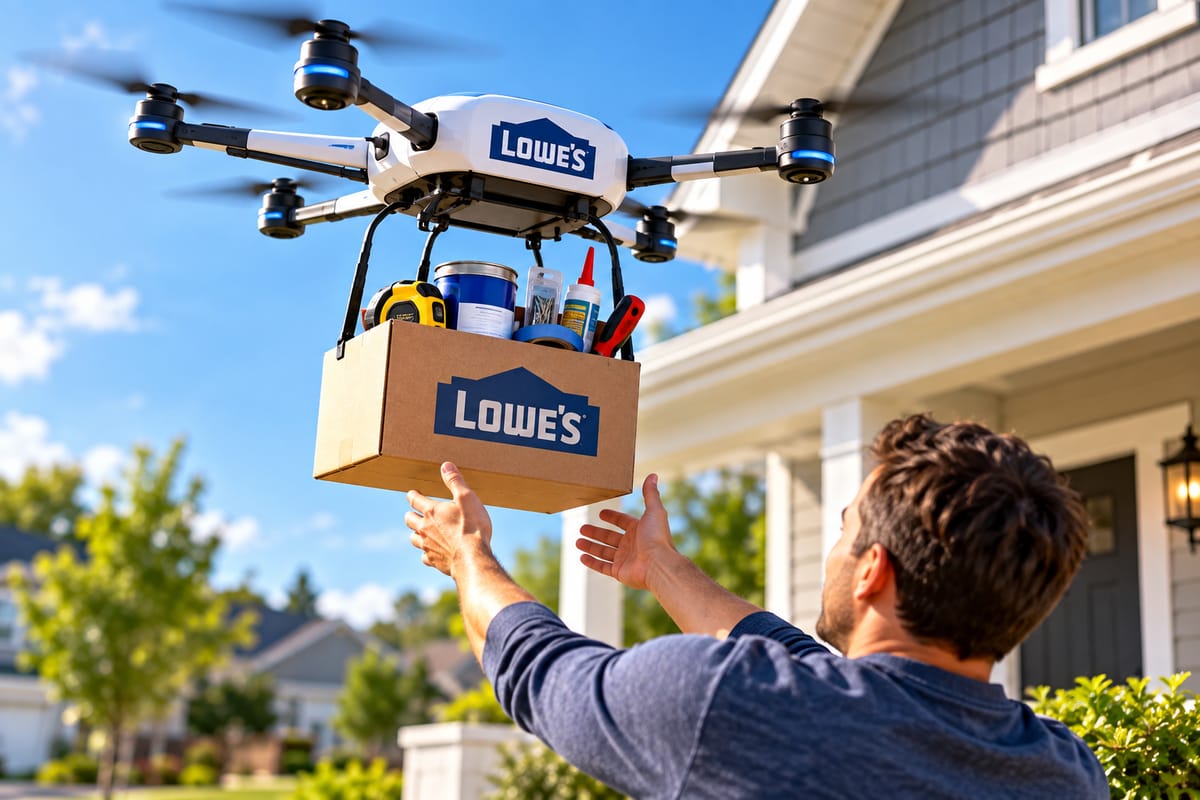
Lowe’s Drone Delivery Could Change How DIY Homeowners Get Last-Minute Project Supplies
A forgotten roll of painter’s tape, a missing screwdriver or an extra tube of caulk can bring a home improvement project to an unexpected stop.
Lowe’s is now testing a new way to solve that problem: drone delivery.
The home improvement retailer launched a drone-delivery pilot on September 24, 2026, at its store in Matthews, North Carolina, partnering with DoorDash and Alphabet’s Wing. The service allows eligible customers to order a curated selection of home improvement and household products through the DoorDash app, with some deliveries arriving in as little as 20 minutes.
For DIY homeowners, the significance goes beyond faster shopping. If the model expands successfully, drone delivery could change the way people handle small, time-sensitive purchases during home repairs and renovation projects.
Lowe’s Is Targeting the Last-Minute Supply Problem
Home improvement projects often depend on having the right materials available at the right moment.
A homeowner may begin painting a room and discover that another roll of painter’s tape is needed. Someone repairing a leaking fixture might realize they need a particular hand tool. A small maintenance job can also reveal a missing battery, cleaning product or other inexpensive item.
Traditionally, the options are straightforward: stop the project and drive to a store, ask someone else to make the trip, place a conventional delivery order or find another way to finish the job with what is already available.
Lowe’s drone pilot is designed around that friction.
The company says its initial drone assortment includes items such as hand tools, paint products, tape, batteries, soap and other household essentials. The products are intentionally relatively small and easy to transport.
That makes the service particularly relevant to the type of purchases that can interrupt a project without necessarily requiring an entire trip to a home improvement store.
How Lowe’s Drone Delivery Works
The current program is limited to eligible customers near the participating Lowe’s store in Matthews, North Carolina.
Customers use the DoorDash app and, when their address qualifies, can access a dedicated Lowe’s drone storefront. They select eligible products, place an order and have the package transported by Wing’s drones.
Wing drones currently transport orders weighing approximately 2.5 pounds per flight, which naturally limits the types of products that can be delivered.
A bag of concrete, a large power tool or a sheet of plywood is not the kind of purchase this system is designed to handle.
Instead, the service is aimed at smaller items that can be delivered quickly.
That distinction is important because drone delivery is not replacing the traditional home improvement store. It is adding another fulfillment option for specific situations.
Why Twenty Minutes Could Matter to DIY Homeowners
Speed has a different value during a home project than it does during an ordinary shopping trip.
If someone is buying household supplies for next week, a delivery arriving tomorrow may be perfectly acceptable.
But if a homeowner has already opened a can of paint, removed a damaged fixture or started repairing part of a house, waiting several hours can be much more inconvenient.
A delivery window of as little as 20 minutes could reduce the amount of downtime associated with small missing supplies.
Lowe’s says the pilot is intended to address precisely this type of problem by making project essentials available when customers need them.
That could be particularly useful during weekend projects, when homeowners may have limited time to complete a repair before returning to work or other responsibilities.
Drone Delivery Fits Into a Larger Home Improvement Workflow
The new service is best understood as one part of a broader home improvement process.
Planning remains important. Materials still need to be selected correctly. Larger items still need to be collected or delivered through conventional methods. And homeowners still have to determine whether a project is appropriate for DIY work or requires professional assistance.
For routine upkeep, Home Maintenance Projects provides a useful framework for understanding the types of tasks homeowners may regularly encounter.
Drone delivery could then become a supplementary tool when a small but necessary item is missing during one of those projects.
Small Supplies Can Cause Disproportionate Delays
One reason the Lowe’s pilot is interesting is that relatively inexpensive items can sometimes cause major delays.
A missing fastener, tool, sealant or piece of protective equipment may cost only a few dollars, yet the entire project can remain unfinished until the item is obtained.
This creates an unusual relationship between the value of the product and the value of fast delivery.
The customer may not be willing to pay a significant premium to have a large shipment delivered immediately, but the convenience of quickly obtaining a small item can be much more meaningful when the alternative is abandoning a project for several hours.
Drone delivery is particularly suited to that situation because small packages can potentially travel directly from a nearby retail location without being affected by road traffic in the same way as a conventional delivery vehicle.
Home Repairs Could Be an Important Use Case
Emergency and semi-urgent repairs could provide another potential application.
Consider a homeowner discovering that a small repair requires a specific tool or supply that is not already in the garage.
The homeowner may not need a large collection of materials. They may simply need one missing item to complete the job.
That is where a rapid delivery system could potentially make the biggest difference.
A broader understanding of common household problems is available in the Home Repairs Guide: Common Problems and Solutions.
The important limitation is that drone delivery cannot solve every repair problem. Large, heavy or hazardous materials will generally require conventional fulfillment methods, and some repairs will require professional expertise rather than another product.
The Service Is Not Yet a Nationwide Option
The biggest limitation of the current program is its geographic scope.
Lowe’s has launched the pilot at its Matthews, North Carolina, store rather than rolling drone delivery out across its entire store network. The company describes it as a pilot and says the program adds to existing fulfillment options such as buy online, pick up in store, curbside pickup and same-day delivery.
That means most Lowe’s customers cannot currently assume that a drone will be available for their next home project.
The Matthews launch is instead an early test of whether drone fulfillment can work effectively within a home improvement retail environment.
Weight Restrictions Will Shape What Can Be Delivered
The approximately 2.5-pound flight limit is another major constraint.
Home improvement products vary enormously in size and weight.
A homeowner might need:
- A screwdriver
- Painter’s tape
- Caulk
- Batteries
- A small hand tool
- Cleaning supplies
- A small paint-related product
Those types of products are more compatible with drone delivery.
But larger items such as lumber, drywall, flooring, roofing materials, appliances and substantial quantities of paint will remain dependent on conventional transportation.
The result is likely to be a hybrid shopping model rather than a complete replacement for traditional delivery.
Drone Delivery Could Change How Projects Are Planned
If rapid delivery becomes widely available, homeowners may eventually approach project planning differently.
Today, many DIYers try to anticipate everything they will need before starting a project. That is partly because an unexpected trip to a store can consume valuable time.
A reliable rapid-delivery option could reduce the consequences of forgetting something.
That does not eliminate the value of planning. It could simply make projects more flexible.
Instead of viewing every missing small item as a potential reason to stop for the day, homeowners might have another way to keep working.
This could be particularly useful for people tackling projects around work schedules, childcare responsibilities or limited weekend availability.
Contractors Could Also Benefit From Faster Small-Item Delivery
Lowe’s is not limiting the pilot’s intended audience to DIY customers.
The company says the drone service is available to both DIY and professional customers within the eligible area.
For contractors, the potential value may be different.
A professional already working at a jobsite may lose productive time if a relatively inexpensive item is missing. Sending someone to a store can take an employee away from the project, while a conventional delivery may not arrive quickly enough.
Small-item drone delivery could potentially reduce that downtime.
The economics will depend on delivery fees, availability, item selection and reliability, but the concept could become another logistical tool for contractors managing active jobsites.
Homeowners deciding when professional assistance is appropriate can also explore How Contractors Fit Into Home Projects.
Faster Delivery Does Not Mean Faster Construction
There is an important distinction between eliminating supply delays and shortening the actual duration of a project.
A homeowner may receive a missing tool within 20 minutes, but the project could still take several hours or days to complete.
Painting requires preparation and drying time. Plumbing repairs may involve inspection and testing. Flooring installation can require careful measurement and acclimation. Larger renovations may involve multiple trades and sequential stages.
Rapid delivery can remove one obstacle without changing the fundamental work involved.
Understanding the expected duration of different types of projects is still important, which is why How Long Home Improvement Projects Take remains relevant to DIY planning.
The Technology Relies on an Existing Drone Network
Lowe’s is not building an entirely new drone-delivery system from scratch for the pilot.
The retailer is working with Wing and DoorDash, which already have drone-delivery operations in the Charlotte area. Lowe’s is effectively adding its retail inventory to an existing last-mile delivery ecosystem.
That approach could make experimentation easier.
Rather than developing every component internally, Lowe’s can test how its products, stores, customers and fulfillment systems interact with drone operations.
The pilot can therefore provide information about demand, product selection, order handling and delivery reliability before a larger rollout is considered.
Lowe’s Is Also Investing in AI and Digital Shopping
The drone initiative is part of a broader technology push at Lowe’s.
The company says its Mylow AI assistant for customers and Mylow Companion for store associates have answered more than 25 million questions since their launch in 2025.
Together, these technologies illustrate a larger change taking place in home improvement retail.
The store is increasingly becoming more than a physical location where customers walk in, select products and take them home.
AI can help customers identify products and answer questions. Digital ordering can make purchasing faster. Curbside pickup can eliminate time spent inside the store. Same-day delivery can bring products to a customer’s home. Drone delivery adds another option for particularly small and urgent orders.
The Store Could Become a Local Fulfillment Hub
The drone model also changes the way a physical retail store can function.
Instead of serving only customers who visit in person, a store can operate as a local fulfillment hub for multiple delivery channels.
Lowe’s already supports buy-online-pickup-in-store and curbside pickup. Drone delivery adds another method for moving inventory from a store to a nearby customer.
This could eventually make the location of stores important for more than traditional foot traffic.
A dense network of stores could potentially provide a distributed system for rapid local fulfillment, although the economics and regulatory requirements would determine where such a model makes sense.
Weather and Safety Will Remain Important
Drone delivery also introduces considerations that do not affect conventional store pickup in the same way.
Weather conditions can influence drone operations. Strong winds, heavy rain and other environmental conditions can affect whether an aerial delivery is practical.
There are also operational considerations involving airspace, delivery locations, package handling and customer safety.
These factors mean that a promise of rapid delivery will necessarily come with eligibility requirements and operational limits.
A drone may be faster than a vehicle under favorable conditions, but the service still depends on a safe and suitable operating environment.
Not Every Home Improvement Purchase Needs to Be Fast
The convenience of rapid delivery should also be viewed in context.
Many home improvement purchases can be planned well in advance.
A homeowner renovating a kitchen, replacing flooring or installing a new deck will typically need materials that are too large or numerous for drone delivery.
For those projects, conventional store pickup, truck delivery or scheduled shipments remain more appropriate.
Drone delivery has a narrower value proposition: small, important items that are needed quickly.
That niche may nevertheless be large enough to make the technology useful.
The Economics Will Determine Whether Drone Delivery Expands
The current pilot demonstrates that the technology can be integrated into a home improvement retail environment, but broader adoption will depend on economics.
Lowe’s and its partners will need to understand how frequently customers use the service, what products they order, how much deliveries cost to operate and whether customers find the service valuable enough to use repeatedly.
Product selection will matter as well.
If the most frequently forgotten items are inexpensive but essential, drone delivery could become particularly useful for those categories.
If demand is too low or operating costs are too high, expansion could be more difficult.
Drone Delivery Could Become Another DIY Tool
For now, Lowe’s drone service is a limited pilot in Matthews, North Carolina.
But the underlying idea addresses a familiar problem for anyone who has tackled a home improvement project: sometimes one small missing item can stop everything.
If drone delivery becomes reliable and economically practical, that problem could become easier to solve.
A homeowner might still plan carefully, visit a store for larger purchases and hire contractors when a project requires professional skills. But for the small forgotten supplies that can interrupt a weekend repair or renovation, rapid aerial delivery could eventually become another tool in the DIY toolkit.
The broader significance of Lowe’s experiment may therefore be less about drones themselves and more about how quickly home improvement retailers can connect inventory, digital ordering and local delivery to keep projects moving.
For homeowners, the ultimate attraction is simple: when a project is already underway, getting the one missing item quickly can sometimes be just as valuable as getting the original shopping trip right.