Paris Design Week 2026 Heads Toward Its Finale With New Furniture, Materials and Decorative Ideas
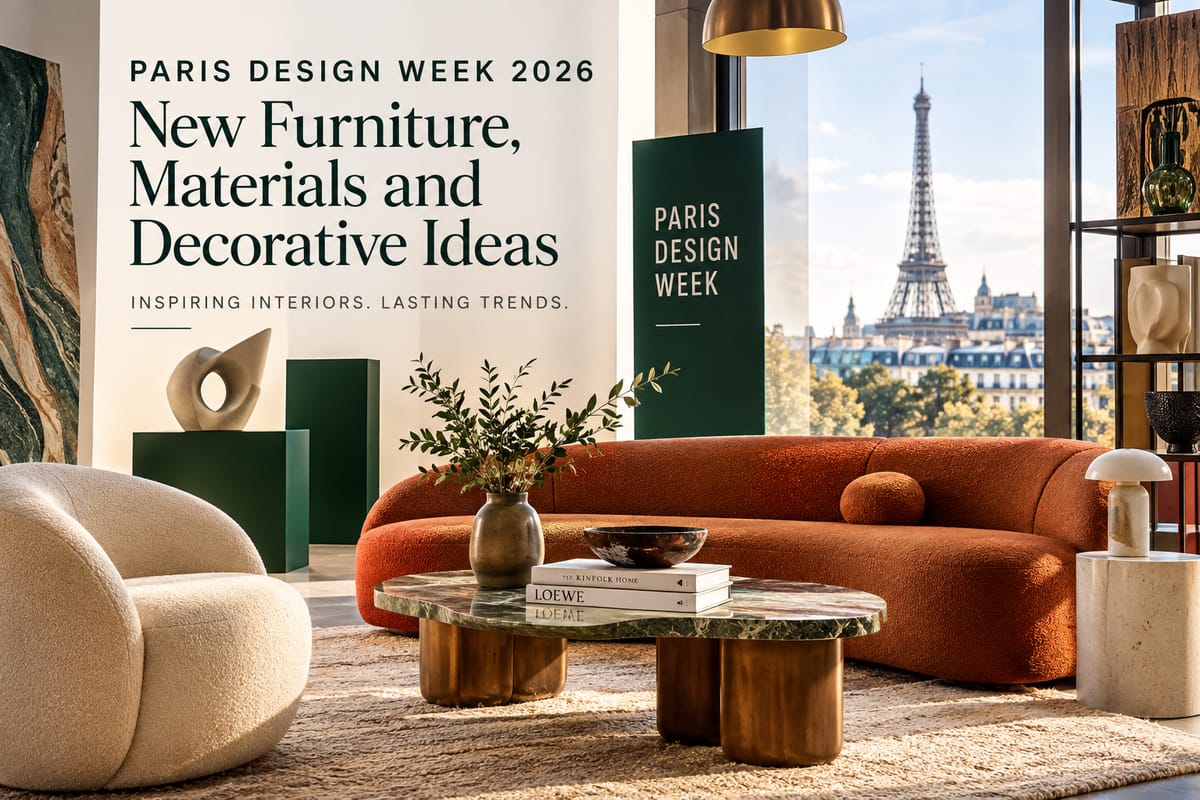
**Paris Design Week 2026 Heads Toward Its Finale With New Furniture, Materials and Decorative Ideas
Paris Design Week 2026 is entering its final days, with designers, galleries, furniture makers and creative studios continuing to showcase new approaches to furniture, materials and decorative interiors across the French capital.
Running from September 10 through September 19, this year’s edition has brought together hundreds of participants across showrooms, galleries, studios, museums and other venues. The program spans four major design districts and includes both established names and emerging designers.
With the event approaching its September 19 finale, several themes have become increasingly visible: tactile materials, sculptural furniture, traditional craftsmanship, experimental production methods and interiors that feel more expressive and personal.
Paris Becomes a Citywide Design Exhibition
Unlike a conventional furniture fair concentrated in one exhibition hall, Paris Design Week spreads its programming throughout the city.
Showrooms, galleries, workshops, museums and cultural institutions participate, creating a network of exhibitions and installations that encourages visitors to move between different parts of Paris.
The 2026 edition includes roughly 500 participants across 320 venues according to the event organizers, while the wider program incorporates exhibitions, product launches, installations and design-focused encounters.
That format gives the event a different character from a traditional trade show. Furniture can be viewed inside historic architecture, contemporary galleries or intimate residential-style settings rather than exclusively against standardized exhibition backdrops.
It also makes the relationship between furniture and its surroundings part of the experience.
Furniture Is Becoming More Sculptural
One of the clearest developments visible during this year’s design events is the continuing overlap between furniture, sculpture and decorative art.
Designers are creating chairs, tables, cabinets and other functional objects with shapes that can command attention almost like artworks.
This approach can be seen in exhibitions such as Matter Before the Name, presented by Galerie Philia and Espace Meyer Zafra, where furniture, sculpture, painting and ceramics are deliberately brought into the same conversation. Some pieces use irregular fiberglass forms, while ceramics explore raw and glazed materials including clay, ash, granite and chalk.
The result is furniture that is not necessarily intended to disappear into a room.
Instead, individual objects can become focal points.
Materials Are Taking Center Stage
Material experimentation has become another important part of the 2026 program.
Designers are exploring not only what an object looks like but also how its surface feels, how it was produced and how different materials interact.
At the Musée Bourdelle, French designer Anthony Guerrée’s Contrepoint installation brings together wood, glass, textiles and mixed clay while responding to the sculptural forms of Antoine Bourdelle. The project also involves stained glass, woodworking, weaving and furniture craftsmanship.
That combination demonstrates how contemporary interiors can use traditional materials without treating them as purely historical.
Wood can become sculptural. Glass can become architectural. Textiles can carry imagery and structure. Clay can connect furniture with the physical qualities of sculpture.
Craftsmanship Is Having a New Moment
Paris Design Week has also placed considerable attention on craftsmanship.
Rather than separating handcrafted work from contemporary design, many projects combine traditional techniques with new forms, applications and production methods.
The Bourdelle installation provides one example, pairing contemporary furniture with specialized woodworking, stained-glass and Jacquard weaving techniques.
Elsewhere, projects connected to the event are exploring upcycling, material reuse and locally rooted production.
One installation involving mobile wardrobes and screens, for example, uses leftover industrial threads and specially developed wool yarn while incorporating traditional braiding techniques.
The emphasis suggests that craftsmanship is not simply being treated as nostalgia. It is increasingly being presented as a way to give objects greater material identity and longevity.
New Materials Meet Traditional Techniques
Another interesting characteristic of this year’s design scene is the coexistence of advanced manufacturing with traditional craft.
Maison&Objet’s September 2026 edition, held alongside Paris Design Week, placed particular emphasis on materials, sustainability, immersive experiences and design in motion. Its programming included experimental materials, biomaterials and 3D printing alongside craft-oriented work.
This combination creates more possibilities for designers.
Digital manufacturing can produce unusual forms and prototypes, while skilled artisans can bring texture, variation and human detail to the finished object.
The distinction between handmade and technologically produced design is therefore becoming less straightforward.
Color and Texture Are Adding Personality
The current design conversation is also moving beyond minimalism based entirely on neutral surfaces.
Designers are using stronger textures, expressive textiles, unusual finishes and carefully selected colors to create interiors with more personality.
Recent reporting from the broader Paris design scene has highlighted expressive textiles, intricate jacquards, embroidery and combinations of stone and metal as important elements in contemporary interiors.
The emphasis is not necessarily on making every room colorful.
Instead, designers are using individual materials and objects to create contrast.
A restrained room can gain character from a sculptural chair, an embroidered textile, a richly textured wall surface or a piece of furniture with an unusual finish.
The Return of the Personal Interior
The growing interest in expressive objects connects with a broader change in residential design.
For years, highly polished interiors could sometimes appear almost indistinguishable from luxury showrooms. More recent approaches place greater value on personality, collected objects, meaningful materials and spaces that reveal something about the people who live in them.
That shift is explored in Interior Designers Move Away From Perfect Showrooms Toward More Personal Homes.
Paris Design Week’s emphasis on collectible pieces, craftsmanship and unusual combinations of materials fits comfortably within that direction.
A home does not necessarily need every object to match. A mixture of contemporary furniture, vintage pieces, art, handmade ceramics and personal possessions can create a more layered environment.
Historic Paris Is Becoming Part of the Design
One of the most distinctive characteristics of Paris Design Week is the way contemporary design interacts with the city’s architectural heritage.
Designers are presenting new furniture and installations inside museums, historic buildings, gardens and other locations with their own visual identities.
At the Musée Bourdelle, Guerrée’s furniture and material experiments are positioned among Bourdelle’s sculptures. At the Hôtel de Sully, cabinetmaker Joseph Walsh is presenting organic ash-wood sculptures within the historic setting. Other installations have appeared at locations including the Grand Palais and the National Archives.
These settings change the way objects are perceived.
A chair placed in a gallery can be evaluated primarily as furniture. The same chair positioned next to sculpture or inside an historic architectural environment can become part of a much broader conversation about art, history and craftsmanship.
Decorative Objects Are Becoming More Meaningful
The growing interest in collectible design is also changing the role of decorative objects.
Rather than treating accessories as finishing touches added after a room has been designed, many contemporary interiors give objects a more prominent role.
A ceramic vessel, lamp, mirror, textile or small sculpture can become an important part of the visual identity of a room.
This approach encourages homeowners to think about objects individually rather than simply buying accessories as part of a matching collection.
The result can be a home that develops gradually instead of appearing completely finished on a single day.
Sustainability Is Moving Into Material Choices
Sustainability continues to influence the design industry, although the conversation is becoming more specific.
Instead of relying only on broad claims about environmentally responsible design, designers are experimenting with reused materials, recycled components, biomaterials, durable construction and production methods intended to reduce waste.
Projects connected to the 2026 Paris design program include material-reuse initiatives involving materials such as reclaimed parquet flooring and tarpaulin.
Maison&Objet’s September edition has likewise emphasized sustainable design alongside creativity and technological experimentation.
This places greater attention on the life of a material before and after it becomes part of a finished product.
The Kitchen and Living Room Are Becoming More Flexible
Another recurring direction across contemporary interiors is the gradual blurring of boundaries between different areas of the home.
Furniture is increasingly expected to perform multiple roles, while materials can connect kitchens, dining areas and living spaces visually.
During Paris Design Week, material-focused presentations have explored coordinated surfaces and finishes that allow different functional areas to feel connected without making them identical.
This approach reflects how modern homes are actually used.
A kitchen can be a workspace, dining area and social space. A living room can accommodate reading, entertainment and work. Furniture therefore needs to be both visually distinctive and adaptable.
Paris Design Week Factory Highlights Emerging Designers
The event’s focus is not limited to established brands.
Paris Design Week Factory, which ran from September 10 to 14, brought together more than 150 emerging designers across four galleries, giving newer creative voices a dedicated platform.
That emerging-design component is important because design trends do not come exclusively from major furniture companies.
Independent designers often experiment with materials, production techniques and unusual forms before those ideas become more widely adopted.
The presence of emerging creators also keeps the event from becoming solely a showcase of established commercial collections.
Why Materials Matter as Much as Form
The growing focus on materials points toward a broader change in how furniture is being evaluated.
A table is no longer just a table. Its material can communicate craftsmanship, sustainability, technological experimentation or cultural heritage.
A piece of furniture made from stone can emphasize weight and permanence. Wood can highlight grain and natural variation. Glass can create transparency and lightness. Textiles can introduce softness and pattern. New composite or recycled materials can communicate experimentation.
The material itself becomes part of the story.
That makes the selection of finishes increasingly important to both designers and homeowners.
The Final Days Could Shape the Lasting Impression
With Paris Design Week scheduled to continue through September 19, the event is entering its final stretch, but many of the ideas presented during the week will continue beyond the closing date.
The official program includes exhibitions and installations that extend beyond the main festival dates, meaning some projects will remain available for visitors after September 19.
That extended life is fitting for a design event increasingly concerned with longevity.
The strongest ideas emerging from Paris this September are not simply about creating objects that look impressive for a season. They point toward interiors that combine craftsmanship, material character, technological experimentation and personal expression.
As the 2026 edition moves toward its finale, Paris is offering a broad picture of where contemporary interiors are heading: away from anonymous perfection and toward rooms where furniture has character, materials have presence and the people living in the space remain at the center of the design.