Portable Lighting Emerges as a Major Interior Design Trend for Flexible Homes
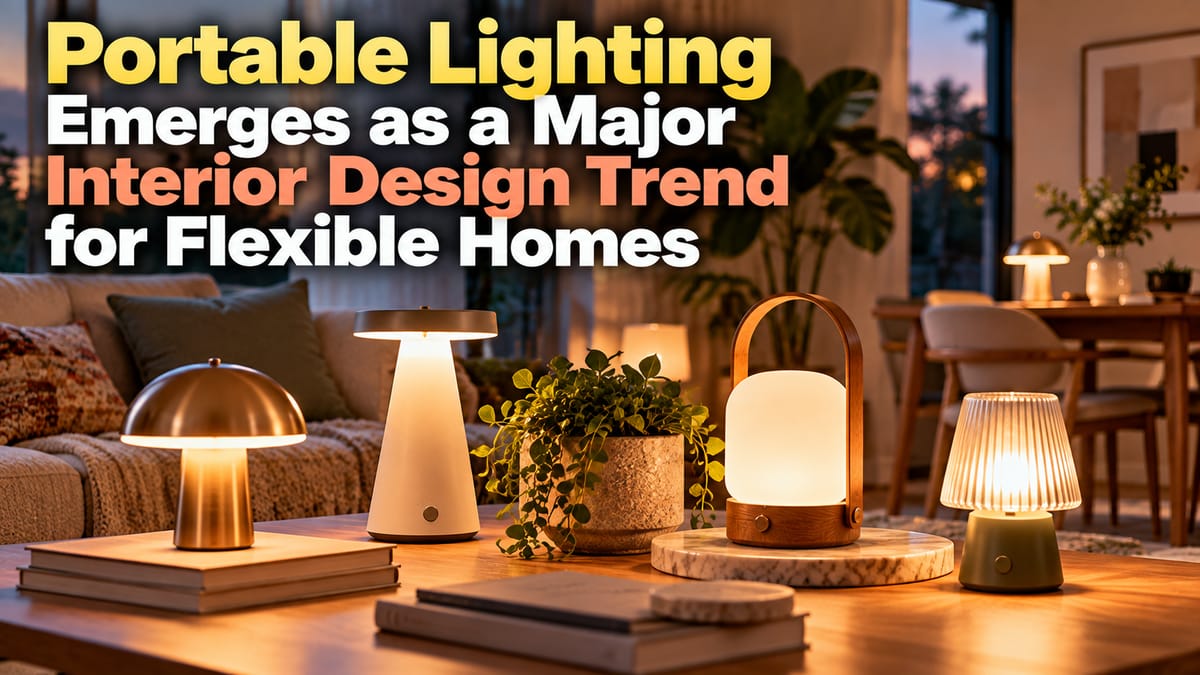
Portable Lighting Emerges as a Major Interior Design Trend for Flexible Homes
One of the biggest lighting trends of 2026 is surprisingly simple: lamps are losing their cords.
Portable rechargeable lighting is moving from a practical accessory to a serious interior design tool, giving homeowners the freedom to place light almost anywhere without worrying about outlets, extension cords or permanent electrical installations.
Designers and lighting retailers are seeing growing interest in cordless lamps as homes become more flexible and interiors move toward warmer, more layered environments. Rather than relying on a single overhead fixture, people are increasingly using several smaller sources of light to create atmosphere throughout a room.
The trend reflects a broader change in how homes are being designed. Furniture is becoming easier to rearrange, rooms are serving multiple purposes and homeowners increasingly want interiors that can adapt throughout the day.
Portable lighting fits naturally into that shift.
Cordless Lamps Are Moving Into the Mainstream
Rechargeable lamps have existed for years, but they were once associated primarily with restaurant tables, patios and outdoor entertaining.
That perception is changing quickly.
Lighting brands are now producing cordless models designed specifically for residential interiors, often combining rechargeable batteries with materials and silhouettes that look much closer to traditional decorative lighting.
Industry reporting in September identified cordless lamps as one of the strongest developments in contemporary lighting, with manufacturers increasingly offering portable versions of both new and established designs.
The result is a category that no longer needs to look purely functional.
Portable lamps can now resemble sculptural objects, vintage table lamps, minimalist fixtures or decorative accent pieces. Some are deliberately understated, while others use colorful finishes, patterned shades and unusual materials to become visual focal points.
That combination of practicality and decoration is helping portable lighting move deeper into mainstream interior design.
Freedom From the Electrical Outlet Changes a Room
One of the biggest advantages of portable lighting is obvious: it can go where conventional lamps cannot.
Traditional table and floor lamps generally need to remain within reasonable reach of an electrical outlet. That can quietly influence furniture placement.
A side table might need to remain against a wall because that is where the socket is located. A reading chair may be positioned near an outlet rather than where it receives the best natural light. Dining tables and kitchen islands can be difficult places for lamps because running electrical cords across open areas is impractical.
Rechargeable lighting removes much of that limitation.
A cordless lamp can sit in the center of a dining table, on a bookshelf, beside a bathtub, on a kitchen counter or in an entryway without requiring permanent wiring.
Designers have described this flexibility as one of the major reasons portable lighting has gained momentum in 2026.
Portable Lighting Fits the Rise of Flexible Homes
Modern homes increasingly need to perform multiple functions.
A dining table might serve as a workspace during the day and an entertaining area at night. A living room may function as a reading space, television room, social area and temporary office.
Lighting needs can change along with those activities.
Portable lamps allow homeowners to move illumination rather than permanently designing the room around fixed fixtures.
A rechargeable lamp might sit beside a laptop during the afternoon before moving to the dining table for dinner. Later, it could provide soft light on a side table while people relax.
That flexibility can be particularly useful in apartments and smaller homes where individual rooms often perform several roles.
Renters may also benefit because portable lighting does not require rewiring walls or installing new fixtures.
Small Lamps Are Appearing in Unexpected Places
Another interior trend is helping portable lighting expand: designers are putting smaller lamps in places where lamps traditionally would not have appeared.
Kitchen counters, bathroom shelves, bookcases, hallways and even laundry spaces are increasingly being treated as opportunities for softer decorative lighting.
Small lamps can create intimate pools of illumination that make these areas feel less utilitarian.
Recent design coverage has highlighted the growing popularity of these “little lamps” in unexpected areas of the home, particularly as designers move away from interiors dominated by uniform overhead lighting.
Cordless designs make this approach significantly easier.
A small lamp can be placed on a kitchen shelf without routing a cable behind appliances. It can sit on a hallway console even when no outlet is nearby. It can illuminate a bookcase without requiring built-in wiring.
These details can make rooms feel more considered without requiring major renovations.
Layered Lighting Is Replacing the Single-Light Approach
Portable lamps also fit naturally into one of the broader lighting trends of 2026: layering.
Rather than expecting one ceiling fixture to illuminate an entire room, designers increasingly combine several types of lighting.
Ambient lighting establishes the overall brightness of a space. Task lighting supports activities such as reading or cooking. Accent lighting draws attention to architectural details, artwork or decorative objects.
Portable lamps can contribute another layer.
Instead of flooding a room with uniform brightness, they create smaller areas of illumination that help establish depth.
Designers discussing 2026 lighting trends have emphasized combinations of pendants, sconces, table lamps and floor lamps rather than relying entirely on recessed or overhead fixtures.
The effect can make a room feel warmer and visually richer.
This philosophy also connects closely with the broader move toward layered comfort in contemporary interiors, where texture, lighting, furniture and personal objects work together rather than following a rigid minimalist formula.
Dining Tables Are Becoming a Natural Home for Portable Lamps
Dining spaces may be one of the strongest applications for cordless lighting.
Traditionally, dining tables have been illuminated from above with pendants or chandeliers. Those fixtures remain important, but small rechargeable lamps provide another option.
Placing one or several portable lamps directly on the table can create pools of warm light similar to candles.
Unlike candles, however, rechargeable lamps can offer adjustable brightness without flames, smoke or melted wax.
This approach has already become familiar in restaurants, where cordless table lamps are widely used to create intimate evening lighting.
Residential interiors are increasingly borrowing the same idea.
Design publications in 2026 have repeatedly highlighted portable lamps as a way to bring a softer, candle-like glow to dining tables and entertaining spaces.
Lighting Is Becoming More Sculptural
Portability is only part of the trend.
The lamps themselves are becoming increasingly decorative.
Designers are treating lighting fixtures almost like furniture, ceramics or artwork. Shapes, materials and proportions matter even when the light is switched off.
This reflects another broader shift in interior design away from purely functional fixtures.
Natural fibers, glass, ceramic, metal and textured materials are appearing across contemporary lighting collections. Retro-inspired silhouettes and warm finishes are also becoming more prominent as interiors move away from the cool gray-and-white palettes that dominated previous years.
A portable lamp can therefore serve two roles.
During the day, it can function as a decorative object.
At night, it becomes a source of atmosphere.
That makes lighting increasingly important to the visual identity of a room rather than something selected only after the furniture and decor are complete.
Rechargeable Technology Makes the Trend Possible
The portable-lighting trend depends heavily on improvements in batteries and efficient LED technology.
LEDs require far less electricity than traditional incandescent bulbs, making battery-powered lamps considerably more practical.
Rechargeable batteries can then store enough energy to operate the light without a permanent electrical connection.
Many contemporary portable lamps recharge through USB connections or charging bases, making the process similar to charging a phone or another personal device.
That familiarity may also help explain why consumers are increasingly comfortable with rechargeable lighting.
Charging another household object no longer feels unusual.
Some models add dimming controls, multiple brightness settings or adjustable color temperatures, while others deliberately keep controls simple.
The technology is becoming part of a broader smart-lighting landscape explored in The Complete Guide to Smart Home Lighting.
Not every portable lamp needs advanced connectivity, however. For many homeowners, the main appeal is precisely the simplicity of picking up a lamp and placing it wherever light is needed.
Portable Lamps Can Move Outdoors Too
The flexibility does not necessarily stop at the back door.
Portable lamps designed for suitable outdoor conditions can move between interior and exterior spaces, giving patios, balconies and garden tables the same layered lighting found indoors.
This can be especially useful for entertaining.
Rather than permanently installing outdoor lighting everywhere guests might gather, homeowners can move rechargeable lamps to dining tables, seating areas or other spaces as needed.
Outdoor-rated models need appropriate materials and weather protection, so not every indoor portable lamp should automatically be used outside.
But the availability of indoor-outdoor designs is helping blur another traditional boundary in residential design.
Indoor furniture styles have already influenced patios and terraces. Portable lighting allows the same thing to happen with illumination.
The Trend Works Particularly Well in Small Spaces
Smaller homes can benefit disproportionately from flexible lighting.
In a large house, each room may have a clearly defined purpose. Smaller apartments often require one space to perform several functions.
A portable lamp allows the lighting arrangement to change without adding more permanent fixtures.
It can also reduce visible cable clutter.
That matters on compact tables, shelves and counters where electrical cords can quickly make a small space feel disorganized.
Because many portable lamps have relatively small footprints, they can also fit into narrow spaces where conventional table lamps would feel oversized.
The combination of compact dimensions and mobility makes them particularly suitable for apartments, bedrooms and multipurpose rooms.
There Are Still Practical Limitations
Portable lighting is flexible, but it is not a complete replacement for wired fixtures.
Battery life remains one of the biggest considerations.
Rechargeable lamps eventually need charging, and operating time varies depending on the battery, brightness level and design.
Brightness can also be limited compared with larger wired lamps.
Interior designers interviewed about 2026 lighting trends have noted that portable lamps work particularly well for atmosphere, but their limited illumination and need for recharging remain disadvantages.
That means a cordless lamp may be excellent for a dining table or reading corner while being insufficient as the only light source in a large room.
The most effective approach is usually to treat portable lighting as one component of a larger lighting plan.
Choosing Portable Lighting for a Home
The right portable lamp depends on how it will be used.
A lamp intended for a dining table should generally be low enough that it does not block conversation across the table.
For reading, brightness and the direction of the light become more important.
A decorative lamp on a bookshelf may prioritize appearance and atmosphere over raw illumination.
Battery life also matters. A lamp used occasionally for dinner may have very different requirements from one used every evening beside a bed.
Dimming can make a portable lamp more versatile because the same fixture can provide stronger task lighting or softer ambient illumination.
For outdoor use, weather resistance becomes another important consideration.
The goal is to choose the lamp according to its role rather than assuming every rechargeable design performs the same function.
Portable Lighting Reflects a Bigger Interior Design Shift
The rise of rechargeable lamps is significant because it represents something larger than a new product category.
Homes are becoming more adaptable.
Furniture is increasingly expected to work in multiple arrangements. Rooms need to accommodate changing routines. Lighting is being layered instead of treated purely as an architectural fixture.
Portable lamps fit neatly into that philosophy because they allow illumination to move with the people using the space.
They also support another important design trend: the return of atmosphere.
After years in which many interiors emphasized clean lines, cool neutrals and highly uniform lighting, warmer and more personal rooms are gaining attention. Smaller pools of light, textured materials and decorative objects help create that feeling.
Lighting That Moves With Everyday Life
Portable lighting may ultimately endure because it solves a practical problem without demanding a major renovation.
A rechargeable lamp can transform an unused corner, soften a dining table, illuminate a shelf or follow homeowners outdoors for an evening gathering. When the room changes, the light can simply move with it.
That flexibility makes portable lamps unusually compatible with contemporary lifestyles.
The strongest interior trends often succeed when aesthetics and practicality reinforce each other. Cordless lighting does exactly that: it can function as a decorative object while giving homeowners greater control over where and how their spaces are illuminated.
As homes become more layered, multifunctional and personal, lighting no longer has to stay exactly where the electrical plan placed it. In 2026, one of the most useful design ideas may simply be giving the light permission to move.