Essential Life Skills Every Adult Should Know
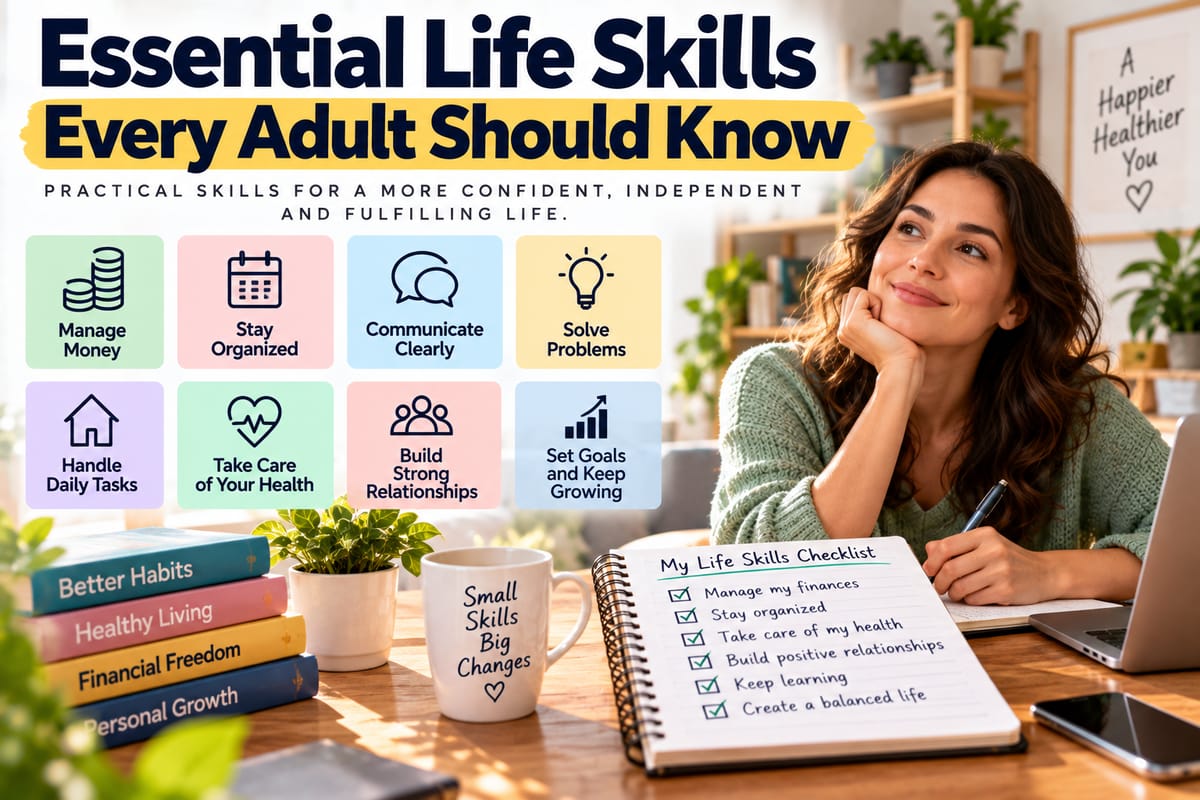
Essential Life Skills Every Adult Should Know
Being an adult involves far more than earning a living or managing a household. Everyday life requires a wide range of practical skills, from handling money and communicating clearly to organizing responsibilities, solving problems, and taking care of personal well-being.
Many of these abilities are learned gradually through experience. Others are rarely taught formally, even though they can make everyday life significantly easier. Developing essential life skills can help adults become more independent, adaptable, and prepared for unexpected situations.
What Are Essential Life Skills?
Essential life skills are practical abilities that help people manage everyday responsibilities, relationships, decisions, and challenges. They can include financial management, communication, organization, basic household skills, emotional awareness, problem-solving, and personal planning.
These skills are not necessarily about becoming an expert. Instead, they provide a foundation for handling ordinary situations with greater confidence.
They also change over time. A person’s priorities and responsibilities may shift as they move through education, employment, relationships, parenthood, homeownership, retirement planning, or other stages of life.
Managing Personal Finances
Knowing how to manage money is one of the most useful adult skills. Income needs to be balanced against regular expenses, savings, debt payments, and unexpected costs.
Adults should understand basic concepts such as:
- Creating and maintaining a household budget
- Tracking regular expenses
- Building an emergency fund
- Understanding interest and borrowing costs
- Paying bills on time
- Comparing prices before making significant purchases
- Setting financial goals
- Reviewing bank and financial statements
Financial management does not require complicated investment strategies. A strong starting point is simply knowing where money comes from, where it goes, and what financial commitments have been made.
Building Personal Organization Skills
Modern life can involve appointments, work deadlines, household responsibilities, bills, social commitments, and personal goals. Without a reliable organizational system, even simple responsibilities can become difficult to manage.
Developing personal organization skills can make it easier to keep track of important information, prioritize tasks, maintain schedules, and reduce unnecessary clutter.
A useful organization system might include:
- A calendar for appointments and deadlines
- A task list for short-term responsibilities
- Organized digital files
- A system for storing important documents
- Regular household routines
- Reminders for recurring bills and maintenance
- A designated place for frequently used items
The best system is usually one that is simple enough to maintain consistently.
Communicating Clearly
Communication affects almost every part of adult life. People communicate with employers, colleagues, family members, friends, service providers, landlords, customers, and professionals.
Clear communication involves more than speaking well. It also requires listening carefully, asking useful questions, explaining expectations, and recognizing when something has been misunderstood.
Written communication is equally important. Adults may need to write professional emails, complete applications, respond to official messages, or communicate about financial and household matters.
Learning to communicate respectfully while being direct can prevent many unnecessary misunderstandings.
Learning How to Solve Problems
Problems are an unavoidable part of everyday life. A household appliance may stop working, an unexpected expense may appear, a work project may go wrong, or a planned schedule may suddenly change.
Problem-solving skills help adults respond systematically rather than simply reacting to frustration.
A basic approach is to:
- Clearly identify the problem.
- Separate facts from assumptions.
- Consider several possible solutions.
- Think about the likely consequences of each option.
- Choose a practical course of action.
- Review the result and adjust if necessary.
This approach can be useful for both small everyday problems and more complicated decisions.
Understanding Basic Household Maintenance
Adults do not need to be professional electricians, plumbers, or builders, but knowing basic household maintenance can be extremely useful.
Simple skills include knowing how to:
- Locate the main water shutoff
- Reset a tripped circuit breaker
- Replace basic household batteries
- Unclog a simple drain safely
- Change common light bulbs
- Check smoke and carbon monoxide alarms
- Identify signs of leaks or moisture problems
- Perform basic cleaning and maintenance
Knowing when not to attempt a repair is just as important. Electrical, structural, gas, and other potentially dangerous problems may require qualified professionals.
Preparing for Emergencies
Unexpected situations can become much easier to manage when basic preparations are already in place.
Every household should consider having access to important documents, emergency contacts, basic first-aid supplies, flashlights, essential medications, and other necessities appropriate to its circumstances.
It is also useful to know basic emergency procedures, including how to contact local emergency services and where important household shutoffs are located.
Preparation does not mean expecting something to go wrong. It means reducing the confusion that can occur when something unexpected happens.
Taking Care of Personal Health
Adults are responsible for many aspects of their own daily well-being. Basic health-related life skills include understanding personal routines, recognizing when something feels unusual, maintaining appropriate hygiene, getting adequate rest, staying physically active, and seeking professional medical advice when necessary.
Health also involves prevention. Regular checkups, appropriate vaccinations, balanced nutrition, physical activity, and healthy sleep habits can all play a role in maintaining overall well-being.
Rather than pursuing perfection, sustainable routines are generally easier to maintain over the long term.
Developing Emotional Awareness
Emotional awareness is another important adult skill. People experience stress, disappointment, frustration, anxiety, excitement, anger, and many other emotions throughout everyday life.
Understanding personal emotional responses can make it easier to pause before reacting. It can also help people recognize when stress is affecting their behavior, relationships, concentration, or decision-making.
Emotional awareness does not mean suppressing difficult feelings. It means recognizing them and finding constructive ways to respond.
Setting Meaningful Goals
Without clear goals, it can be difficult to determine whether everyday activities are moving life in a desired direction.
Goals can relate to education, work, finances, relationships, health, hobbies, or personal growth. They can be short-term or long-term.
Useful goals are generally specific enough to provide direction while remaining flexible enough to adapt when circumstances change.
Personal development can also be viewed as an ongoing process. Learning how personal development works and how people build meaningful skills can help adults think about growth as something that happens gradually through learning, practice, reflection, and experience.
Managing Time and Priorities
Having enough time is not always about having fewer responsibilities. It is also about understanding which responsibilities deserve attention first.
Adults can improve time management by identifying important tasks, estimating how long activities actually take, reducing unnecessary distractions, and creating realistic schedules.
Priorities may change from one period of life to another. Work may take precedence during an important project, while family responsibilities or personal recovery may become more important at other times.
A good schedule should support real life rather than create an impossible list of obligations.
Knowing How to Make Decisions
Decision-making is a skill that improves with practice. Adults regularly make choices about spending, work, relationships, housing, education, travel, and personal commitments.
A useful decision-making process involves identifying the objective, gathering relevant information, considering alternatives, and thinking about potential consequences.
Not every decision requires extensive research. The amount of effort should generally match the importance and potential consequences of the decision.
It is also important to recognize that some decisions can be changed later. Understanding the difference between reversible and difficult-to-reverse choices can reduce unnecessary pressure.
Building Healthy Relationships
Relationships require communication, boundaries, respect, trust, and mutual effort.
Healthy relationship skills include being able to express needs, listen to others, apologize when appropriate, respect personal boundaries, and discuss disagreements without automatically turning them into personal attacks.
Adults should also understand that maintaining healthy relationships does not mean agreeing with everyone. Differences in preferences, opinions, and personalities are normal.
Clear boundaries can help people protect their time, energy, privacy, and personal responsibilities while maintaining respectful relationships.
Learning Basic Digital Skills
Technology is now part of many ordinary adult responsibilities. People may use digital tools for banking, employment, communication, shopping, education, entertainment, and managing personal information.
Basic digital skills include creating strong passwords, recognizing suspicious messages, organizing files, using common productivity software, updating devices, and understanding basic privacy settings.
It is also useful to develop the habit of checking information before trusting or sharing it. Digital literacy is increasingly connected to everyday decision-making.
Cooking and Food Preparation
Knowing how to prepare simple meals can provide greater independence and flexibility.
Adults do not need advanced culinary skills to benefit from cooking. Basic abilities such as safely handling food, following a recipe, preparing several simple meals, storing leftovers correctly, and understanding basic ingredients can make everyday life easier.
Cooking at home can also make it easier to plan meals around personal preferences, budgets, schedules, and nutritional needs.
Understanding Basic Contracts and Documents
Adults encounter many important documents, including employment agreements, rental contracts, insurance policies, loan agreements, service terms, and official forms.
A useful habit is to read important documents carefully rather than accepting terms automatically.
Pay attention to:
- Costs and fees
- Deadlines
- Cancellation terms
- Responsibilities
- Renewal conditions
- Penalties
- Privacy provisions
- Dispute procedures
When a document has significant legal or financial consequences, professional advice may be appropriate.
Learning How to Adapt
Life rarely follows a completely predictable plan. Jobs change, expenses appear, relationships evolve, technology develops, and personal priorities shift.
Adaptability allows adults to respond to change without abandoning their broader goals. This might involve learning a new skill, changing a routine, adjusting a budget, or reconsidering an old assumption.
A flexible approach to life can be supported by continuously learning rather than assuming that existing knowledge will always be sufficient.
Creating a Balanced Lifestyle
Adult responsibilities can easily become overwhelming when work and obligations consume most available time.
A balanced approach involves making room for responsibilities while also protecting time for rest, relationships, recreation, physical activity, learning, and personal interests.
The complete guide to living a balanced lifestyle provides a broader framework for thinking about how different areas of life can fit together rather than treating each responsibility separately.
Balance does not necessarily mean giving every area exactly the same amount of time. Instead, it means recognizing what matters and adjusting priorities as circumstances change.
Designing a Life That Fits Personal Priorities
Life skills become more useful when they support the kind of life a person actually wants to build.
Lifestyle design involves thinking deliberately about routines, priorities, environment, relationships, responsibilities, and personal goals. The Complete Guide to Lifestyle Design and Personal Living explores how these elements can be considered together.
Small changes can sometimes have a meaningful cumulative effect. A better morning routine, a more organized home, a clearer budget, or a consistent learning habit can gradually influence how everyday life feels and functions.
Keep Learning as Life Changes
Essential life skills are not a checklist that adults complete once and never revisit. Circumstances change, and new responsibilities often require new abilities.
Someone starting their first job may need to focus on budgeting and professional communication. Someone managing a household may need stronger organization and maintenance skills. Someone changing careers may need to learn new technologies or develop new professional abilities.
The most valuable long-term skill may therefore be the ability to keep learning. Adults who remain curious and willing to improve can adapt their skills as their lives change.