How Do Carbon Monoxide Detectors Work?
How Do Carbon Monoxide Detectors Work?
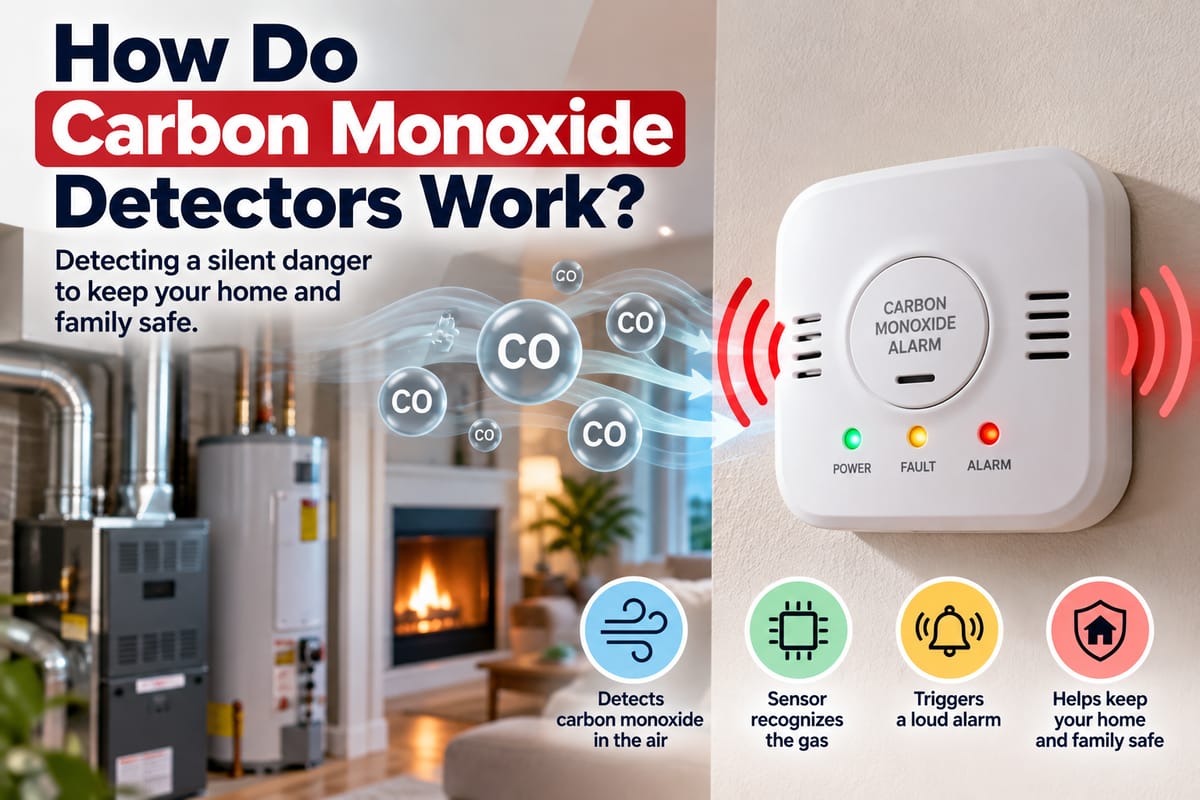
Carbon monoxide detectors are designed to warn people when carbon monoxide, commonly called CO, reaches potentially dangerous levels inside a building. Because carbon monoxide is colorless and odorless, people cannot reliably detect it through their senses. A functioning detector provides an important layer of protection by continuously monitoring the surrounding air and producing an alarm when its programmed detection criteria are met.
Understanding how carbon monoxide detectors work can help homeowners choose appropriate devices, install them correctly, recognize warning signals, and maintain them properly.
What Is Carbon Monoxide?
Carbon monoxide is a poisonous gas produced when carbon-containing fuels do not burn completely.
Common sources can include:
- Gas furnaces
- Boilers
- Gas stoves and ovens
- Fireplaces
- Wood-burning appliances
- Portable generators
- Charcoal-burning equipment
- Fuel-burning water heaters
- Vehicles operating in enclosed or poorly ventilated spaces
Under normal conditions, carbon monoxide cannot be seen or smelled. This makes it particularly difficult to recognize without an appropriate detection device.
A detector provides an electronic method of identifying the gas before people may realize there is a problem.
Why Carbon Monoxide Detectors Are Important
Carbon monoxide can interfere with the body’s ability to transport and use oxygen. Exposure can cause symptoms such as headache, dizziness, weakness, nausea, confusion, and other serious effects depending on the concentration and duration of exposure.
A detector does not remove carbon monoxide from the air. Instead, it provides a warning that can alert occupants to leave the affected area and seek appropriate assistance.
Carbon monoxide detection is therefore part of a broader approach to household safety. The How to Identify and Prevent Common Safety Hazards Inside a Home guide covers other hazards that homeowners should consider when evaluating the safety of their living spaces.
How Carbon Monoxide Detectors Detect the Gas
Most household carbon monoxide detectors use a sensor designed to respond to carbon monoxide in the surrounding air.
The sensor interacts with the gas and produces a measurable change. The detector’s electronic circuitry interprets that change and determines whether the detected concentration and exposure duration meet the conditions required to trigger an alarm.
A typical detector therefore contains several basic components:
- A carbon monoxide sensor
- Electronic processing circuitry
- An alarm or sounder
- A power source
- Status indicators
- Test controls
Some models may also include digital displays, battery backup, wireless connectivity, or additional environmental sensors.
The Three Common Sensor Technologies
Household carbon monoxide detectors can use different types of sensing technology. Three commonly encountered technologies are electrochemical, metal oxide semiconductor, and biomimetic sensors.
Each works differently, but the goal is the same: detect carbon monoxide and provide a warning when exposure reaches the device’s alarm criteria.
Electrochemical Sensors
Electrochemical sensors use a chemical reaction involving carbon monoxide to produce an electrical signal.
When carbon monoxide reaches the sensing element, it participates in an electrochemical reaction. The resulting electrical current can be measured by the detector’s electronics.
The detector uses this information to estimate the concentration of carbon monoxide and determine whether an alarm should be activated.
Electrochemical sensors are widely used in residential carbon monoxide alarms because they can provide accurate measurements while consuming relatively little power.
Metal Oxide Semiconductor Sensors
Metal oxide semiconductor sensors use changes in the electrical properties of a sensing material when exposed to certain gases.
When carbon monoxide interacts with the sensor, its electrical resistance changes. The detector monitors this change and uses programmed electronics to determine whether the gas concentration warrants an alarm.
These sensors require a heating element as part of their operation, which can affect their energy requirements.
Biomimetic Sensors
Biomimetic sensors are designed around materials or chemical processes that mimic aspects of how biological systems respond to carbon monoxide.
Exposure to carbon monoxide can cause a chemical change in the sensing material. The detector monitors that change and uses it to determine whether an alarm condition exists.
Different products use different designs, so the exact operation depends on the manufacturer and model.
Why Detectors Do Not Simply Alarm at Any Trace of Carbon Monoxide
A detector is not normally designed to sound immediately whenever it detects the smallest possible amount of carbon monoxide.
Instead, alarm behavior generally depends on both concentration and exposure time.
This is important because carbon monoxide levels can fluctuate. A detector needs to distinguish between a brief, relatively low-level exposure and a sustained or higher concentration that presents a more significant danger.
The electronics therefore evaluate sensor readings against predetermined alarm criteria.
This means a detector can monitor continuously without producing an alarm every time a tiny amount of carbon monoxide is present.
How the Alarm Works
When the detector determines that the measured carbon monoxide exposure meets its alarm criteria, it activates an audible warning.
Many household devices produce a loud repeating alarm pattern intended to attract attention, even when occupants are sleeping.
Depending on the model, additional warnings may include:
- Flashing indicator lights
- Digital concentration displays
- Voice alerts
- Mobile notifications
- Wireless messages to interconnected alarms
The exact alarm pattern varies between products, so homeowners should understand the signals used by their specific detector.
What the Different Sounds Can Mean
Not every sound from a carbon monoxide detector means the same thing.
A continuous or repeating alarm may indicate that the device has detected a potentially dangerous carbon monoxide condition.
A periodic chirp can instead indicate:
- Low battery
- Sensor malfunction
- End of service life
- Other maintenance conditions
The meaning depends on the specific detector.
Homeowners should read the manufacturer’s instructions rather than assuming that every beep represents the same warning.
Carbon Monoxide Detectors and Smoke Detectors Are Different
Smoke detectors and carbon monoxide detectors protect against different hazards.
A smoke detector is designed to identify smoke or combustion-related particles associated with fires. A carbon monoxide detector is designed to identify carbon monoxide in the air.
Some products combine both functions in a single device, but the underlying detection systems are different.
Having a smoke detector does not necessarily mean that a home has adequate carbon monoxide detection.
Where Carbon Monoxide Detectors Should Be Installed
Placement is an important part of effective carbon monoxide detection.
Detectors are commonly installed near sleeping areas so that an alarm can wake occupants during the night. Depending on the home’s layout and applicable safety requirements, additional detectors may be appropriate near fuel-burning appliances or on different levels of the home.
Important considerations include:
- Sleeping areas
- Each level of a home where required
- Areas near fuel-burning appliances, where appropriate
- Locations specified by local building and safety requirements
- Manufacturer installation instructions
Detectors should not be placed wherever they are likely to be damaged, obstructed, or exposed to conditions outside their intended operating range.
Keep Detectors Away From Potential Interference
Certain environmental conditions can interfere with some detector technologies or cause nuisance alarms.
Depending on the manufacturer’s instructions, detectors may need to be kept away from:
- Excessive humidity
- Steam
- Direct exposure to cooking fumes
- Dust
- Chemical vapors
- Extreme temperatures
- Areas with poor air circulation
Always follow the installation instructions supplied with the specific device.
Carbon Monoxide and Indoor Air Quality
Carbon monoxide is one part of the broader indoor environment.
Indoor air quality can also be influenced by ventilation, humidity, particulate matter, volatile compounds, biological contaminants, and other pollutants.
The How to Improve Indoor Air Quality guide explores practical ways to improve the overall quality of indoor air.
However, improving general ventilation or indoor air quality should not be considered a substitute for carbon monoxide detection where fuel-burning equipment creates a potential CO hazard.
The Connection With Home Heating and Other Major Systems
Carbon monoxide risks can be associated with systems that burn fuel.
Heating equipment, water heaters, fireplaces, cooking appliances, and other systems should be installed, operated, and maintained appropriately.
Understanding how these systems interact with the home can help homeowners recognize why regular maintenance matters. The How Major Home Systems Work and What Homeowners Maintain guide provides a broader overview of major residential systems and the maintenance they require.
A detector is an important warning device, but preventing carbon monoxide buildup also depends on properly installed and maintained fuel-burning equipment.
Why Regular Maintenance Matters
Carbon monoxide detectors are electronic safety devices and require maintenance just like other household equipment.
Maintenance can include:
- Testing the alarm according to the manufacturer’s instructions
- Replacing batteries when required
- Keeping the device clean
- Checking status indicators
- Replacing expired detectors
- Responding to malfunction warnings
- Confirming that the device remains properly installed
Some detectors have replaceable batteries, while others use sealed batteries designed to last for the detector’s rated service life.
The manufacturer’s instructions should always take priority because maintenance requirements vary between models.
Test the Detector Regularly
Most residential carbon monoxide detectors include a test button.
Pressing the test control typically checks whether the alarm circuitry and sounder are functioning. It does not necessarily reproduce a real carbon monoxide exposure or independently verify the sensor’s accuracy.
Regular testing can nevertheless help identify problems such as:
- Dead batteries
- Electrical faults
- Failed alarm components
- Other device malfunctions
Testing should be performed according to the manufacturer’s recommended schedule.
Understand the Detector’s Service Life
Carbon monoxide sensors do not necessarily last indefinitely.
Manufacturers specify a service life for their products, and some detectors provide an end-of-life warning when the sensor needs to be replaced.
A detector that has reached the end of its rated service life should not simply be kept in place because it still appears to turn on.
Replacing the entire device according to the manufacturer’s instructions helps ensure that the home continues to have an operational detection system.
Carbon Monoxide Detectors and Electrical Safety
Some carbon monoxide detectors are battery-powered, while others may connect to household electrical power.
For hardwired devices, correct installation and maintenance of the electrical connection are important.
Homeowners can learn more about the systems that supply electricity throughout a property through How Residential Electrical Systems Work and Stay Safe.
Electrical safety is especially important when installing or replacing hardwired detectors. Work involving household wiring should be handled according to applicable electrical requirements and by a qualified professional when appropriate.
What to Do When a Carbon Monoxide Alarm Sounds
A carbon monoxide alarm should always be taken seriously.
If an alarm sounds, occupants should follow the emergency instructions provided by the detector manufacturer and local emergency authorities. If anyone is experiencing symptoms that could be associated with carbon monoxide exposure, seek emergency medical assistance.
A sensible response generally involves:
- Treating the alarm as a potential carbon monoxide emergency.
- Getting people and pets to fresh air when it is safe to do so.
- Contacting the appropriate emergency service or qualified professional.
- Not returning to the building until it has been determined to be safe.
- Having potential carbon monoxide sources investigated.
The detector should not simply be silenced and ignored without identifying why it activated.
What Not to Do With a Carbon Monoxide Alarm
Homeowners should avoid treating an alarm as a nuisance without investigating the cause.
Do not assume that:
- The detector is malfunctioning simply because the source is not obvious.
- Opening a window automatically makes the situation safe.
- A lack of symptoms means there is no danger.
- Turning off the detector solves the problem.
- A smoke detector can substitute for a carbon monoxide detector.
A properly functioning alarm is designed to draw attention to a potentially dangerous condition.
How Carbon Monoxide Prevention Works
Detection is only one part of reducing carbon monoxide risk.
Prevention can include:
- Maintaining fuel-burning appliances
- Having heating systems inspected when appropriate
- Ensuring proper ventilation
- Using generators only in appropriate outdoor locations
- Never using charcoal-burning equipment indoors
- Keeping vehicle exhaust away from enclosed spaces
- Following appliance installation instructions
- Installing suitable carbon monoxide detectors
The objective is to prevent carbon monoxide from accumulating while also providing an early warning if it does.
A Small Device With an Important Job
Carbon monoxide detectors work by sensing changes associated with carbon monoxide in the surrounding air and using electronic circuitry to determine when exposure conditions meet the device’s alarm criteria. Different technologies can perform this sensing, but all residential detectors are intended to provide an early warning of a potentially dangerous situation.
For homeowners, the most important part is not understanding every detail of the sensor’s chemistry. It is making sure appropriate detectors are installed, tested, maintained, and replaced according to the manufacturer’s instructions.
Combined with proper appliance maintenance, adequate ventilation, electrical safety, and broader household hazard prevention, carbon monoxide detection provides an important layer of protection for the people who live in the home.