How Beneficial Insects Help Control Pests and Support Healthy Gardens
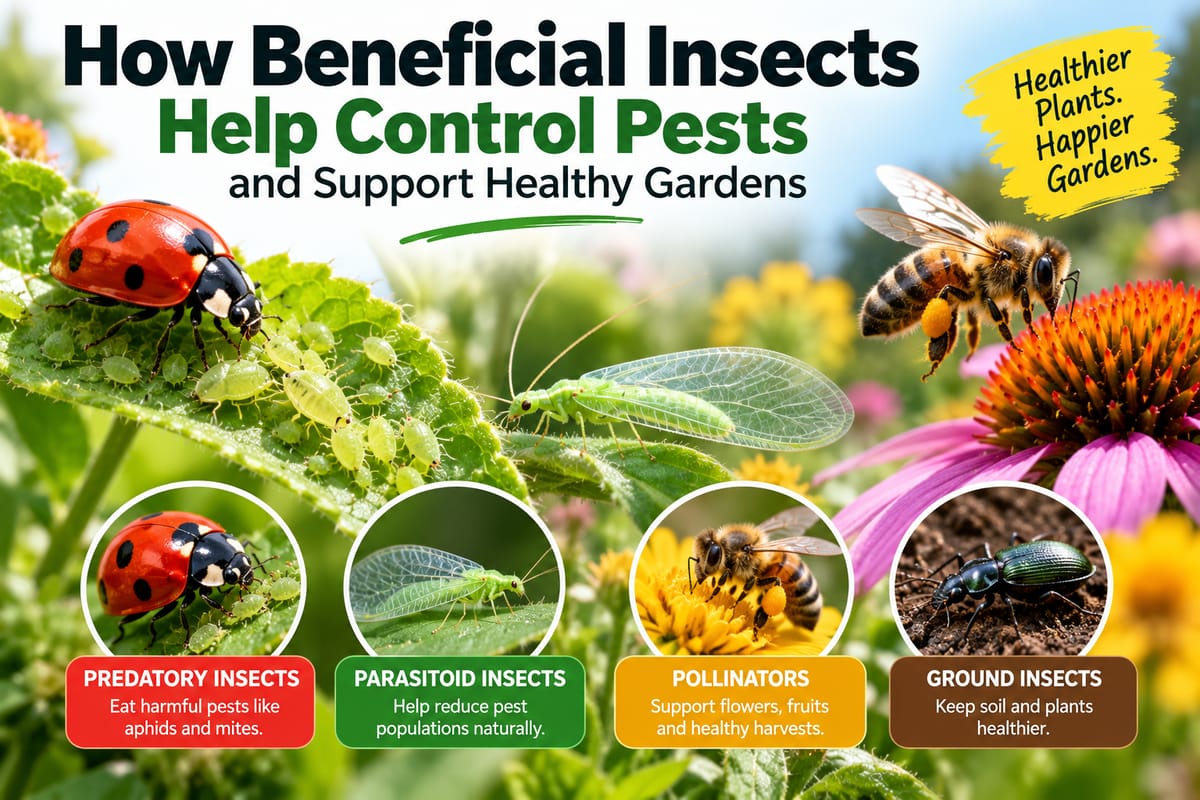
How Beneficial Insects Help Control Pests and Support Healthy Gardens
Not every insect found in a garden is a threat to plants. Some insects are valuable allies that help control pest populations, support pollination, contribute to decomposition, and maintain a healthier garden ecosystem.
Beneficial insects can become an important part of natural pest management. Instead of trying to eliminate every insect, gardeners can learn to identify which species are causing problems and which ones are helping keep those populations under control.
From lady beetles that consume aphids to lacewings that feed on soft-bodied pests, beneficial insects can provide an effective form of biological control while reducing the need for broad-spectrum pest treatments.
Understanding how these insects work is an important part of The Complete Guide to Garden Pest Control, particularly for gardeners interested in maintaining plants without unnecessarily disrupting the wider ecosystem.
What Are Beneficial Insects?
Beneficial insects are species that provide useful functions in a garden.
Some are predators that feed on insects considered pests. Others are parasitoids that develop on or inside specific host insects. Pollinating insects are also beneficial because they help plants reproduce and support fruit and seed production.
Common examples include:
- Lady beetles
- Lacewings
- Hoverflies
- Praying mantises
- Ground beetles
- Assassin bugs
- Parasitic wasps
- Dragonflies
- Bees
- Certain predatory mites
Not every beneficial insect performs the same role. Some primarily control pests, while others contribute to pollination or other ecological processes.
How Predatory Insects Control Pests
Predatory insects actively hunt and consume other organisms.
Lady beetles, for example, are well known for feeding on aphids. Lacewing larvae can also consume aphids and other small, soft-bodied insects.
Ground beetles often hunt insects and other small organisms near the soil surface. Some predatory bugs attack caterpillars, mites, aphids, and other pests.
By consuming pests, these insects can reduce the number of individuals capable of damaging plants.
The effect is not always immediate. Natural pest control depends on the number of predators, the availability of prey, weather conditions, habitat, and the reproduction rate of the pest species.
Lady Beetles and Aphids
Lady beetles are among the best-known beneficial insects in gardens.
Both adult lady beetles and their larvae can feed on aphids, although feeding habits vary among species. Aphids can reproduce rapidly and may gather in large numbers on young shoots, leaves, and flower buds.
A healthy population of predatory insects can help keep aphid numbers from reaching damaging levels.
However, gardeners should learn to recognize lady beetle larvae. Their appearance is very different from that of adult lady beetles, and they are sometimes mistaken for harmful insects.
Protecting larvae as well as adults is important when encouraging natural pest control.
Lacewings Provide Another Layer of Pest Control
Lacewings are delicate-looking insects with transparent wings, but their larvae can be effective predators.
Lacewing larvae are sometimes called aphid lions because they consume aphids and other small insects.
They can be particularly useful in gardens where aphids, mealybugs, whiteflies, and other soft-bodied pests are present.
Adult lacewings may feed on nectar, pollen, or other food sources depending on the species, making flowering plants an important part of creating suitable habitat.
Hoverflies Are More Than Pollinators
Hoverflies are often mistaken for bees or wasps because some species have similar markings.
Adult hoverflies commonly visit flowers and can contribute to pollination. Their larvae, however, can have very different feeding habits.
The larvae of some hoverfly species consume large numbers of aphids.
This makes flowering plants especially valuable because they can provide food for adult hoverflies while helping support the next generation of beneficial larvae.
Parasitic Wasps and Natural Pest Control
Parasitic, or parasitoid, wasps are another important group of beneficial insects.
These tiny wasps use other insects as hosts for developing offspring. Different species specialize in different hosts.
Some attack aphids, while others target caterpillars, whiteflies, scale insects, or other pests.
Although the word “wasp” can make gardeners think of stinging insects, many parasitoid wasps are extremely small and pose little concern to people.
Their importance is primarily ecological because they can help regulate pest populations naturally.
Ground Beetles Work at Soil Level
Ground beetles are often active around the soil surface, particularly at night.
Many species prey on insects, larvae, slugs, snails, and other small organisms. Their presence can therefore provide another layer of pest management below the foliage.
Gardeners can support ground beetles by providing sheltered places where they can hide during the day.
Leaf litter, stones, logs, and other forms of natural ground cover can provide habitat, provided they are managed appropriately for the garden.
Praying Mantises Are Generalist Predators
Praying mantises are recognizable predators that can consume a wide variety of insects.
They may capture caterpillars, grasshoppers, flies, moths, and other insects.
However, mantises are generalist predators rather than specialized pest controllers. They may also eat beneficial insects.
For this reason, their presence should be viewed as one part of a diverse ecosystem rather than as a solution for a particular pest problem.
Dragonflies Help Around Water and Beyond
Dragonflies are most closely associated with water because their young develop in aquatic environments.
Adult dragonflies are skilled aerial predators and can capture flying insects.
They may consume mosquitoes, flies, and other small flying insects.
Gardens near ponds, wetlands, or other suitable water sources may naturally attract dragonflies. Maintaining appropriate habitat can help support these insects as part of the broader local ecosystem.
Bees Support Pollination
Not all beneficial insects control pests.
Bees are among the most important pollinating insects in many gardens. As they move between flowers, they transfer pollen and help plants produce fruits and seeds.
Many crops and ornamental plants benefit from insect pollination.
Providing a variety of flowering plants can help supply nectar and pollen across different seasons, giving pollinators more opportunities to feed.
Beneficial Insects and Garden Diversity
A diverse garden generally provides more opportunities for beneficial insects to find food and shelter.
A landscape consisting of only one plant species may provide fewer resources than a garden containing trees, shrubs, flowers, herbs, ground covers, and other vegetation.
Plant diversity can provide:
- Nectar
- Pollen
- Shelter
- Alternative food sources
- Overwintering locations
- Breeding habitat
- Protection from extreme weather
This does not mean every part of a garden needs to be densely planted. Instead, it means gardeners can think about the garden as an ecosystem rather than simply a collection of individual plants.
Flowering Plants Can Attract Beneficial Insects
Many adult beneficial insects depend on nectar and pollen, even when their larvae or immature stages are predators.
Flowers with accessible nectar can therefore help support insects throughout their life cycles.
Planting different species that flower at different times can extend the availability of food.
Small clusters of flowering plants can be useful, while larger areas of diverse vegetation may provide even more habitat.
Native plants can be particularly valuable where they are well adapted to local conditions and support local insect communities.
Avoiding Unnecessary Broad-Spectrum Pesticides
One of the challenges of encouraging beneficial insects is that some pest-control products can affect both harmful and helpful organisms.
Broad-spectrum insecticides may kill target pests but can also harm predators, pollinators, parasitoids, and other non-target insects.
Repeated disruption can make it harder for natural pest control to establish.
Integrated pest management approaches generally emphasize identifying the pest, monitoring its population, determining whether intervention is necessary, and choosing an appropriate control method.
This can help reduce unnecessary disruption to beneficial organisms.
Not Every Pest Requires Immediate Treatment
Finding a few insects on a plant does not necessarily mean that the plant is in serious danger.
Gardens naturally contain insects, and some minor feeding damage may not have a meaningful effect on plant health.
Monitoring allows gardeners to determine whether a pest population is increasing enough to require action.
This approach also creates an opportunity to see whether predators are already controlling the problem.
For example, a small aphid colony may attract lady beetles, lacewing larvae, or hoverfly larvae. Removing the aphids immediately could also remove an important food source for the predators that would otherwise help control them.
Beneficial Insects and Plant Health
Natural pest control works best when plants are already growing under suitable conditions.
Plants weakened by poor watering, inadequate sunlight, nutrient problems, compacted soil, or other stresses may be more vulnerable to pests.
Healthy growing conditions do not make plants immune to insects, but they can support stronger growth and improve their ability to tolerate some damage.
Soil is particularly important because it influences water availability, nutrient cycling, root development, and the wider biological activity of the garden.
Understanding The Ultimate Guide to Soil Health can help gardeners look beyond visible pests and consider the conditions supporting plant growth.
Beneficial Insects Are Not a Cure for Plant Diseases
Insects and plant diseases are different problems.
Some insects can spread plant pathogens, while others may help reduce pest populations. But introducing or protecting beneficial insects will not automatically resolve fungal, bacterial, viral, or other plant diseases.
Gardeners need to identify the underlying problem before choosing a treatment.
Symptoms such as unusual leaf spots, wilting, discoloration, distorted growth, or dieback can have multiple causes. Poor watering, nutrient deficiencies, environmental stress, insects, and pathogens can sometimes produce similar-looking symptoms.
The Plant Diseases Guide provides additional context for recognizing and understanding common plant health problems.
Organic Gardening and Beneficial Insects
Beneficial insects are closely associated with organic gardening because natural pest management can reduce reliance on synthetic pesticides.
However, organic gardening does not mean that every pest is harmless or that every naturally derived treatment is automatically safe for beneficial insects.
Some organic-approved pest-control products can still affect non-target organisms.
Good garden management therefore involves understanding how a treatment works, identifying the pest correctly, considering timing, and using interventions carefully.
For a broader look at these principles, Organic Gardening Explained explores approaches to growing plants while working with natural processes.
How to Make a Garden More Insect-Friendly
Creating beneficial insect habitat does not necessarily require a large garden.
Even a small outdoor space can provide useful resources.
Gardeners can consider:
- Planting a variety of flowering species
- Allowing some plants to flower rather than removing every bloom
- Including native plants where appropriate
- Providing sheltered areas
- Avoiding unnecessary pesticide applications
- Maintaining different layers of vegetation
- Providing water carefully where appropriate
- Leaving some natural plant material in suitable areas
- Growing plants that flower during different seasons
The goal is to create conditions where beneficial insects can find food and shelter throughout their life cycles.
Why Identification Matters
One of the biggest mistakes gardeners can make is treating every unfamiliar insect as a pest.
Beneficial insects can look very different during different stages of their development. A larva may look nothing like the adult insect it eventually becomes.
Before removing an unfamiliar insect, gardeners can observe what it is doing and identify it if possible.
Does it appear to be feeding on a plant, or is it eating another insect? Is it visiting flowers? Is it living on the soil surface?
These observations can provide useful clues.
Balancing Pest Control With Biodiversity
The goal of natural pest management is not to eliminate every insect.
A healthy garden can contain predators, prey, pollinators, decomposers, herbivores, and microorganisms at the same time.
Some insects will feed on plants, but their populations may remain below levels that cause significant damage because predators and environmental conditions keep them in check.
This balance can change throughout the year. Weather, plant growth, food availability, and seasonal insect cycles all influence garden populations.
When Additional Pest Control Is Necessary
Natural predators cannot always prevent significant pest damage.
A pest may arrive in large numbers, reproduce faster than predators can respond, or attack a particularly vulnerable crop.
In those situations, additional management may be necessary.
The most appropriate approach depends on the pest, plant, severity of damage, and surrounding environment. Targeted methods can sometimes reduce harm to beneficial insects compared with indiscriminate treatments.
Accurate identification should come before treatment whenever possible.
Building a Garden That Works With Nature
Beneficial insects demonstrate that pest management does not always have to mean removing every insect from the garden.
Predators such as lady beetles, lacewings, ground beetles, and parasitoid wasps can help regulate pest populations. Pollinators such as bees and hoverflies can support plant reproduction. Together, these organisms contribute to a more complex and resilient garden ecosystem.
Gardeners can encourage them by providing diverse plants, flowering resources, shelter, and suitable growing conditions while avoiding unnecessary disruption.
The result is not a completely pest-free garden. Instead, it is a garden where natural relationships help keep populations in balance and where plants, insects, soil organisms, and people can coexist more effectively.