How Pickling Uses Acidity and Other Conditions to Preserve Foods
How Pickling Uses Acidity and Other Conditions to Preserve Foods
Pickling is one of the oldest ways to preserve food, but the basic idea behind it is surprisingly straightforward: create conditions that make it difficult for many food-spoilage microorganisms to grow.
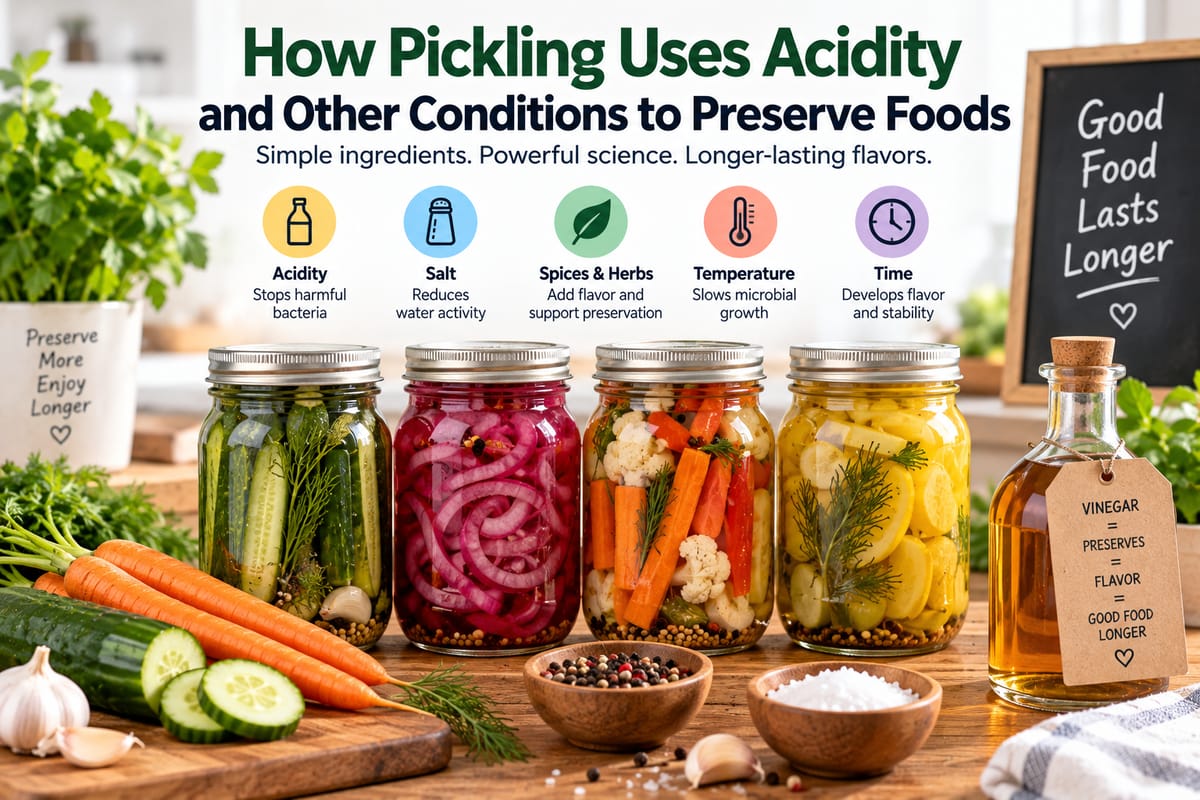
Acidity is one of the most important factors. Depending on the type of pickling, salt, sugar, temperature, moisture, oxygen exposure, and fermentation can also play important roles. Together, these conditions can extend the usable life of vegetables, fruits, eggs, and other foods while creating the distinctive sour, salty, sweet, or spicy flavors associated with pickled foods.
Understanding how pickling works also helps explain why seemingly small details—such as the strength of a brine, the type of vinegar used, or how clean a jar is—can affect both quality and safety.
What Is Pickling?
Pickling is a food-preservation method that uses an acidic environment or controlled fermentation to slow or prevent the growth of microorganisms that can spoil food.
There are two broad approaches:
- Vinegar pickling, which introduces acidity directly through an acidic liquid.
- Fermented pickling, in which beneficial microorganisms produce acids naturally during fermentation.
Some traditional recipes combine several preservation factors, including salt, acidity, refrigeration, and reduced oxygen exposure.
The finished food may be crunchy or soft, mildly tangy or intensely sour, and relatively simple or heavily seasoned. The preservation principle, however, comes down to controlling the environment around the food.
For a broader look at safe handling, storage, and preparation practices, The Complete Guide to Food Safety provides useful context for understanding why preservation methods need to be combined with good kitchen hygiene.
Why Acidity Matters So Much
Acidity is central to many pickling methods because microorganisms generally do not grow equally well across all levels of acidity.
When the environment becomes sufficiently acidic, the growth of many unwanted microorganisms is restricted. This is why vinegar is such a common ingredient in quick-pickling recipes.
Vinegar contains acetic acid, which gives pickled foods their characteristic sharp flavor. When food is surrounded by an acidic liquid, the acidity can gradually move into the food as well.
This process affects more than flavor. It changes the chemical environment in which microorganisms would otherwise multiply.
Understanding pH
Acidity is commonly described using the pH scale. Lower pH values indicate greater acidity, while higher values indicate lower acidity.
The important point for food preservation is that acidity is not simply about whether something tastes sour. A food can taste acidic without having the level of acidity required for a particular preservation method.
That distinction is particularly important when preparing foods intended for longer storage.
Vinegar Pickling and Direct Acidification
In vinegar pickling, acidity is introduced directly rather than waiting for microorganisms to create it.
A typical pickling liquid may contain:
- Vinegar
- Water
- Salt
- Sugar
- Herbs
- Spices
- Garlic or other flavoring ingredients
The vinegar provides the primary acidic component, while the other ingredients influence flavor, texture, and preservation conditions.
Water changes the concentration of the vinegar, which is why the proportions used in a recipe matter. Simply adding a small amount of vinegar to a large quantity of water does not necessarily create the same environment as using a properly formulated pickling liquid.
Why Vinegar Strength Matters
Different vinegars can have different levels of acidity. Their flavor profiles can also vary significantly.
White vinegar tends to provide a sharp, clean acidity, while apple cider vinegar, wine vinegar, and other varieties can contribute different flavors.
For preservation-focused recipes, however, the acidity of the vinegar matters more than its flavor alone.
Changing the proportions of vinegar and water can change the resulting acidity. That is one reason established pickling recipes should not be casually modified when the food is intended for long-term storage.
Fermented Pickles Work Differently
Not every pickle gets its acidity from vinegar.
In fermented pickling, naturally occurring microorganisms use available carbohydrates and produce acids as they grow under controlled conditions. Lactic acid bacteria are particularly important in many traditional vegetable fermentations.
As acids accumulate, the food environment becomes increasingly acidic.
This creates a preservation effect while also producing the characteristic tang associated with fermented foods.
The process is different from simply placing vegetables into vinegar, even though both methods can result in acidic foods.
For a closer look at this process, How Fermentation Preserves Certain Foods explains how beneficial microbial activity can change food and contribute to preservation.
Salt Has More Than One Job
Salt is another important part of many pickling methods.
It can affect preservation by making water less available to microorganisms. Microbial cells require access to water for growth, and high concentrations of dissolved salt can make that environment less favorable.
Salt also affects texture and flavor.
In fermented pickles, salt can help shape the microbial environment by favoring certain microorganisms over others. This contributes to the development of the desired fermentation process.
However, salt is not interchangeable with acidity. A salty food is not automatically safe for every type of storage or preservation situation.
The role of each ingredient depends on the particular preservation method.
How Water Activity Affects Preservation
Food can contain a large amount of water without all of that water being equally available to microorganisms.
This concept is often described as water activity.
Pickling can influence water availability through ingredients such as salt and sugar. These substances interact with water and can make some of it less available for microbial growth.
This is one reason traditional preservation methods often combine multiple barriers rather than relying on one ingredient alone.
For example, a pickled food might have:
- An acidic environment
- Salt
- Reduced available moisture
- Refrigeration
- A sealed container
Each factor can contribute to controlling spoilage.
Sugar Can Play a Role Too
Sugar is especially common in sweet-and-sour pickles, fruit pickles, chutneys, and similar preparations.
At sufficiently high concentrations, sugar can reduce water availability. It also contributes sweetness and balances the sharpness of acids.
In many everyday pickles, however, sugar is primarily a flavor ingredient rather than the main preservation mechanism.
The amount used matters, and its effect depends on the entire formulation.
This is another example of why preservation cannot always be understood by looking at one ingredient in isolation.
Oxygen and the Pickling Environment
Oxygen can influence the microorganisms that are able to grow in food.
Some microorganisms require oxygen, while others can grow with little or no oxygen. As a result, controlling oxygen exposure can be one component of a preservation system.
The importance of oxygen depends on the specific food and pickling method.
In a properly prepared pickling environment, the combination of acidity, salt, temperature, container conditions, and other factors determines which microorganisms can survive and multiply.
This is why sealing a jar does not automatically make its contents safe. A sealed container must still contain food that has been prepared and preserved appropriately.
Temperature Changes the Preservation Process
Temperature has a major influence on microbial growth.
Many microorganisms multiply more quickly at favorable temperatures and more slowly under refrigeration. This is why some pickled foods are stored in the refrigerator even after being placed in an acidic brine.
Refrigeration can therefore act as an additional preservation barrier.
A refrigerated quick pickle and a properly processed shelf-stable pickle are not necessarily the same type of product. Their ingredients, preparation methods, packaging, and storage requirements can differ.
Understanding the difference is important when deciding how long a homemade pickle should be stored.
How Pickling Changes Food Texture
Preservation is not the only thing happening during pickling.
Acid, salt, heat, and time can all change the structure of food.
Vegetables such as cucumbers, carrots, onions, and cabbage may become softer or more tender as they remain in a pickling environment. At the same time, properly prepared pickles can retain considerable crunch.
Texture depends on factors such as:
- The original freshness of the food
- Vegetable variety
- Size and shape of pieces
- Salt concentration
- Acidity
- Temperature
- Processing time
- Storage conditions
Some vegetables naturally withstand pickling better than others.
For more information about selecting and handling ingredients, the Cooking Ingredients Guide: Types, Uses, Substitutions and Storage can help put pickling ingredients into a broader food-preparation context.
Why Pickling Changes Flavor
Pickling creates a distinctive balance between acidity, saltiness, sweetness, and the natural flavor of the food.
Vinegar contributes sharp acidity, while salt can make other flavors more pronounced. Sugar can soften the perception of acidity. Herbs and spices add additional aromatic compounds.
Common pickling ingredients include:
- Dill
- Mustard seeds
- Garlic
- Peppercorns
- Chili peppers
- Bay leaves
- Coriander seeds
- Ginger
- Onions
The final flavor depends on both the ingredients and the time they spend together.
As the pickling liquid penetrates the food, flavors can become more integrated and pronounced.
Why Freshness Matters Before Pickling
Pickling is a preservation method, not a way to reverse spoilage.
Starting with fresh, sound ingredients is important because preservation methods are designed to control specific changes in food. They are not intended to make already spoiled food safe.
Fresh vegetables also tend to produce better texture.
Firm cucumbers, carrots, onions, peppers, and other vegetables generally respond differently to pickling than produce that has already become soft or damaged.
Inspecting ingredients before preparation is therefore an important part of the process.
Clean Equipment Is Part of the Process
The preservation environment begins before the food enters the jar.
Containers, utensils, cutting boards, knives, hands, and preparation surfaces can all come into contact with the food. Unwanted microorganisms introduced during preparation can complicate the preservation process.
Good kitchen hygiene helps reduce this risk.
This is particularly important when preparing foods that will be stored for an extended period.
Practices such as washing produce appropriately, cleaning preparation surfaces, and keeping raw and ready-to-eat foods separated are fundamental. How to Prevent Cross-Contamination in the Kitchen covers these principles in greater detail.
Pickling Does Not Mean Every Microorganism Disappears
It is easy to think of preservation as sterilization, but these concepts are different.
Pickling generally creates conditions that inhibit the growth of many unwanted microorganisms. It does not necessarily mean that every microorganism has been destroyed.
This distinction matters because food safety depends on the entire preservation system.
Factors such as acidity, processing temperature, container condition, storage temperature, ingredient proportions, and handling practices can all influence the outcome.
A properly designed preservation method aims to create conditions where harmful or spoilage organisms cannot grow effectively.
Quick Pickles Versus Long-Term Pickling
The word “pickle” can describe several different preparation methods.
Quick Pickles
Quick pickles are often made by placing vegetables in a vinegar-based liquid and refrigerating them.
They can develop good flavor relatively quickly and are convenient for everyday meals.
Because they are often prepared for refrigerated storage, their handling and storage requirements differ from those of commercially processed shelf-stable products.
Fermented Pickles
Fermented pickles rely on controlled microbial activity to produce acids.
The process can take considerably longer than quick pickling and may produce more complex flavors.
Temperature, salt concentration, time, and cleanliness all matter because the goal is to encourage desirable fermentation while limiting undesirable microbial growth.
Processed Shelf-Stable Pickles
Some pickled foods are prepared using controlled heat processing and packaging methods designed for storage without refrigeration.
These products require carefully established preservation procedures because acidity and heat treatment work together to create the desired level of protection.
Why Pickling Recipes Should Not Be Changed Casually
Cooking recipes are often flexible. Preservation recipes can be less forgiving.
Adding extra herbs or changing the shape of vegetables may have little effect on some preparations, but changing the balance of vinegar, water, salt, or other major ingredients can alter the preservation environment.
For this reason, recipes intended specifically for preservation should be treated differently from recipes designed only for immediate consumption.
The goal is not simply to achieve a particular taste. It is to create a controlled environment with predictable characteristics.
The Role of Time in Pickling
Time allows the components of the pickling process to interact.
Acid can move into food, salt can redistribute, flavors can develop, and—in fermented pickles—microbial activity can produce increasing amounts of organic acids.
The speed of these changes depends on temperature, food size, composition, and the preservation method.
Smaller pieces generally allow the pickling liquid to penetrate more quickly than large pieces.
However, faster flavor penetration does not necessarily mean that a food has undergone every step required for safe long-term preservation.
Common Foods That Can Be Pickled
A wide variety of foods can be preserved through pickling.
Common examples include:
- Cucumbers
- Onions
- Carrots
- Cabbage
- Green beans
- Beets
- Peppers
- Radishes
- Cauliflower
- Garlic
- Eggs
- Certain fruits
The appropriate preservation method depends on the food’s composition and the intended storage conditions.
Vegetables with different moisture levels, densities, and structures can respond very differently to the same pickling liquid.
Pickling and Nutritional Changes
Pickling can change the nutritional characteristics of food without necessarily eliminating its nutritional value.
Some nutrients remain relatively stable, while others can be affected by heat, water, acidity, storage time, or processing.
If vegetables are heated before or during preservation, certain heat-sensitive compounds may decrease. At the same time, pickling can make some foods easier to consume as part of a varied diet because it adds flavor and extends their useful life.
Fermented foods may also contain microorganisms or fermentation products that differ from those found in the original ingredients.
The nutritional outcome therefore depends on the food and the specific preservation method rather than on the word “pickled” alone.
Why Pickling Is an Example of Multiple Preservation Barriers
One of the most useful ways to understand food preservation is to think about multiple barriers.
Instead of relying entirely on one condition, a preservation method may combine several factors:
- Acidity limits the growth of many microorganisms.
- Salt can reduce water availability and influence microbial activity.
- Sugar can affect water availability and flavor.
- Temperature can slow microbial growth.
- Reduced oxygen can affect which organisms can grow.
- Heat processing can reduce microbial populations.
- Clean handling helps prevent unwanted contamination.
- Proper storage maintains the intended preservation conditions.
The effectiveness of the overall system comes from how these factors work together.
Signs That a Pickled Food May Need Attention
Changes in food are not always a reliable way to determine safety, but unusual characteristics should not be ignored.
Depending on the type of pickle, warning signs may include:
- Unexpected mold growth
- Unusual or unpleasant odors
- Unexplained changes in appearance
- Damaged or compromised containers
- Unexpected gas production
- Bulging or leaking sealed containers
- Texture changes that are inconsistent with the recipe
A food that appears or smells abnormal should not simply be tasted to determine whether it is safe.
When in doubt, following established food-safety guidance is preferable to relying on appearance or smell alone.
Making Sense of Pickling at Home
The science behind pickling becomes easier to understand when each component has a clear purpose.
Vinegar can provide acidity. Salt can influence water availability and microbial activity. Sugar can contribute sweetness and alter water availability. Temperature affects microbial growth. Time allows the preservation process and flavor development to progress. Clean preparation reduces the introduction of unwanted microorganisms.
None of these factors should automatically be treated as a substitute for the others.
A recipe designed around vinegar, for example, cannot necessarily be converted into a fermented recipe simply by removing the vinegar. Likewise, refrigeration does not automatically compensate for an incorrectly formulated preservation method.
The safest approach is to understand which preservation method a recipe uses and follow its intended ingredients, proportions, processing steps, and storage instructions.
From Ancient Preservation to Modern Kitchens
Pickling remains popular because it combines practical preservation with distinctive flavor.
Long before modern refrigeration, people developed ways to make food last longer by manipulating acidity, salt, moisture, temperature, and other environmental conditions. Modern food preservation applies the same basic principles with greater understanding of microbiology and controlled processing.
Whether a jar contains crisp cucumber slices, spicy vegetables, fermented cabbage, or sweet-and-sour fruit, the transformation is more than a change in taste. Pickling changes the environment surrounding the food and makes that environment less favorable to many forms of spoilage.
Understanding that relationship between acidity, salt, moisture, temperature, time, and hygiene makes it easier to appreciate both the tradition and the science behind pickled foods.