How Different Cleaning Brushes Work
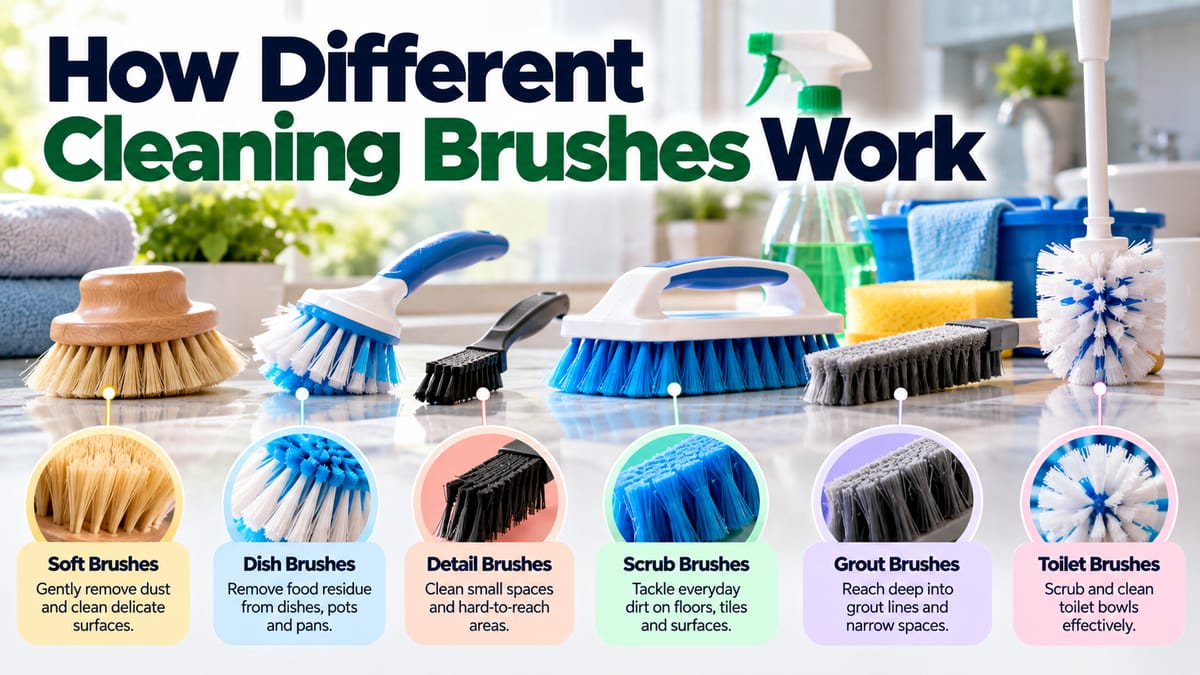
How Different Cleaning Brushes Work
Cleaning brushes may look like simple household tools, but their designs vary considerably depending on the surfaces and types of dirt they are meant to handle. A soft brush can remove dust without damaging a delicate surface, while a stiff-bristled brush can loosen grime from tile, grout, or outdoor materials.
The shape of the brush, the stiffness and material of its bristles, the size of its head, and the way it is used all affect how well it cleans.
Understanding these differences makes it easier to choose the right brush for a particular job and avoid using an unnecessarily aggressive tool on a surface that needs gentler treatment.
Why Cleaning Brushes Work
A cleaning brush works primarily through mechanical action.
When bristles move across a surface, they can loosen dirt, dust, grease, hair, particles, and other debris. Water and cleaning products may help dissolve or soften the material, while the brush provides the physical action needed to separate it from the surface.
The effectiveness of a brush depends on several factors:
- Bristle stiffness
- Bristle material
- Bristle density
- Brush shape
- Head size
- Handle design
- Surface texture
- Type of dirt
- Amount of pressure applied
- Cleaning solution being used
A brush does not necessarily clean better simply because it is harder or stiffer. The right amount of mechanical action depends on the surface being cleaned.
Soft-Bristle Cleaning Brushes
Soft-bristle brushes are designed for surfaces that could be scratched, marked, or damaged by aggressive scrubbing.
They are useful for tasks such as:
- Dusting textured surfaces
- Cleaning delicate materials
- Removing loose debris
- Cleaning some fabrics
- Washing certain dishes
- Cleaning lightly soiled surfaces
Soft bristles can reach small grooves and irregular areas without applying excessive abrasion.
They are particularly useful when the goal is to remove loose dirt rather than hardened buildup.
Medium-Bristle Brushes
Medium-bristle brushes provide a balance between gentleness and scrubbing power.
They can be useful for general household cleaning, including:
- Sinks
- Countertops
- Appliances
- Bathroom surfaces
- Floors
- Household containers
- Moderately dirty surfaces
A medium brush is often a practical general-purpose option because it can handle more than a soft brush while being less aggressive than a heavy-duty scrub brush.
However, the exact suitability still depends on the surface material.
Stiff-Bristle Brushes
Stiff brushes are designed for more demanding cleaning tasks.
Their stronger bristles can help break up material that is firmly attached to a surface.
They are commonly used for:
- Grout
- Outdoor surfaces
- Heavy floor buildup
- Rough concrete
- Garden equipment
- Durable tools
- Stubborn dirt
Because stiff bristles apply more mechanical force, they should be used carefully.
A brush that is appropriate for concrete may be completely unsuitable for polished stone, delicate finishes, or easily scratched materials.
Natural Versus Synthetic Bristles
Brush bristles can be made from natural materials or synthetic fibers.
Natural bristles may come from plant fibers or animal hair, depending on the type of brush. Synthetic bristles are commonly manufactured from materials such as nylon and other polymers.
Each type has different characteristics.
Synthetic bristles can offer consistent stiffness, durability, and resistance to moisture or cleaning chemicals. Natural fibers may have useful properties for particular cleaning applications and traditional household tools.
The best choice depends on the intended task rather than the assumption that one material is always superior.
Nylon Cleaning Brushes
Nylon is widely used in household cleaning brushes because it can provide durable, flexible bristles.
Nylon brushes are available in a wide range of stiffness levels, making them suitable for many different cleaning tasks.
They may be found in:
- Dish brushes
- Bathroom brushes
- Grout brushes
- Scrub brushes
- Bottle brushes
- General-purpose cleaning tools
Their flexibility allows the bristles to bend when they encounter irregular surfaces while still providing enough friction to loosen dirt.
Wire Brushes
Wire brushes are much more aggressive than ordinary household brushes.
They are commonly used for tasks involving durable materials, such as removing rust, corrosion, paint, or hardened material from metal surfaces.
Because wire bristles can scratch or damage surfaces, they should not be treated as general-purpose household cleaning tools.
They can also create small particles during aggressive cleaning, making appropriate protective measures important for certain jobs.
A wire brush should be selected only when the surface and task can tolerate its level of abrasion.
Grout Brushes
Grout brushes typically have narrow heads and relatively stiff bristles.
Their design allows the brush to concentrate mechanical action along narrow grout lines rather than spreading it across a large surface.
This makes them useful for cleaning areas where dirt and residue accumulate in recessed spaces.
A grout brush can be particularly effective when combined with an appropriate cleaning solution and enough time for the solution to loosen buildup.
The narrow design also makes it easier to apply controlled pressure.
Tile and Floor Scrub Brushes
Floor and tile brushes are designed for larger surfaces.
Many have broader heads that allow users to cover more area with each movement. Some include long handles so that floors can be cleaned without repeatedly bending down.
The bristle stiffness varies depending on the intended floor type.
A brush for rough outdoor tile may be considerably stiffer than one designed for a finished indoor floor.
Before using a new floor brush, it is worth checking whether the bristles are appropriate for the flooring material.
Bottle Brushes
Bottle brushes are designed to clean narrow or enclosed spaces that ordinary cloths and flat brushes cannot easily reach.
Their long handles and narrow heads can allow bristles to reach inside:
- Bottles
- Jars
- Vases
- Reusable drink containers
- Narrow kitchen equipment
- Tubes and other hollow objects
Some bottle brushes have flexible heads that adapt to curved interiors.
The effectiveness of a bottle brush depends heavily on whether its shape matches the container being cleaned.
Toothbrush-Style Detail Brushes
Small brushes can be surprisingly useful for detailed cleaning.
Their compact heads make them suitable for narrow areas such as:
- Around taps
- Small appliance seams
- Hardware
- Corners
- Crevices
- Small fixtures
An old toothbrush is sometimes used for household cleaning, although a purpose-designed cleaning brush may be preferable when hygiene or durability matters.
The main advantage of these small brushes is control. They allow users to concentrate cleaning action exactly where it is needed.
Dish Brushes
Dish brushes are designed to remove food residue from cookware, plates, cups, and other kitchen items.
Different models may have soft, medium, or stiff bristles.
Some feature long handles to keep hands away from hot water or dirty surfaces. Others have compact heads for detailed cleaning.
The correct brush depends on the item being washed.
Nonstick cookware, for example, may require a gentler tool than durable cookware with hardened residue.
Toilet Brushes
Toilet brushes are designed specifically for cleaning the interior of toilets.
Their heads typically use relatively stiff bristles that can reach around the bowl’s curved surfaces.
The handle allows users to scrub while maintaining distance from the area being cleaned.
Hygiene is especially important with toilet brushes. They should be rinsed appropriately after use, allowed to dry when possible, and stored in a way that reduces unnecessary contact with other household items.
Dusting Brushes
Dusting brushes generally use softer fibers designed to capture or move loose dust without causing damage.
They can be useful for:
- Furniture
- Decorative objects
- Shelves
- Electronics exteriors
- Blinds
- Hard-to-reach surfaces
Some dusting brushes work by trapping dust in their fibers, while others primarily move dust away from the surface.
For electronics and delicate objects, gentle handling is particularly important.
Scrub Brushes With Long Handles
Long-handled scrub brushes provide additional reach and can reduce the need for bending or kneeling.
They are useful for larger or harder-to-reach areas such as:
- Bathtubs
- Shower floors
- Large floor surfaces
- Outdoor areas
- High or recessed surfaces
Handle length also affects leverage. A longer handle can make it easier to apply pressure from a standing position, although excessive force can still damage certain surfaces.
Specialty Brushes for Hard-to-Reach Areas
Some cleaning brushes are designed around very specific shapes.
Examples include brushes for:
- Window tracks
- Radiator fins
- Bottle interiors
- Keyboard gaps
- Grout lines
- Blinds
- Drain areas
- Small appliance components
These brushes demonstrate an important principle of cleaning tool design: shape matters as much as bristle stiffness.
A perfectly stiff brush may still be ineffective if it cannot reach the area where dirt has accumulated.
How Bristle Shape Affects Cleaning
Bristles do not all have the same shape.
Some are straight, while others may be angled, curved, clustered, or arranged in multiple rows.
Angled bristles can help reach corners and narrow edges. Dense clusters can provide greater contact with a surface. Flexible bristles can conform to irregular shapes.
The arrangement of the bristles determines how the cleaning force is distributed.
This is why two brushes with similar materials can perform very differently.
How Pressure Changes the Cleaning Process
More pressure does not always mean better cleaning.
Applying additional force increases contact between the bristles and the surface, which can help remove stubborn material. However, excessive pressure can also:
- Scratch surfaces
- Damage finishes
- Bend or break bristles
- Spread dirt
- Increase wear on the brush
- Create unnecessary physical effort
A better approach is usually to select a brush that is appropriate for the task and then use controlled pressure.
Let the brush design do much of the work.
Cleaning Solutions and Brushes Work Together
Brushes provide mechanical action, while cleaning products can help loosen, dissolve, disinfect, or otherwise treat certain types of soil.
Understanding cleaning products and how they work can help explain why a particular brush may perform better with one cleaning solution than another.
For example, a cleaning product may soften buildup before the brush removes it.
However, cleaning products should always be used according to their labels and compatibility with the surface.
Using an unnecessarily strong chemical with an aggressive brush can create more risk than benefit.
Match the Brush to the Surface
The most important rule for choosing a cleaning brush is to match its characteristics to the material being cleaned.
Consider surfaces such as:
Glass
Generally requires gentle tools that minimize scratching.
Finished Wood
May need soft brushes and limited moisture.
Ceramic Tile
Can often tolerate more scrubbing, depending on its finish.
Grout
May benefit from narrower, firmer brushes.
Stainless Steel
Requires attention to the direction of the finish and the potential for scratching.
Plastic
Usually tolerates moderate cleaning but can scratch depending on its surface.
Concrete
Can generally tolerate stronger mechanical action than many indoor finished surfaces.
The same brush should not automatically be used everywhere.
Choosing Brushes as Part of a Complete Cleaning System
Cleaning brushes work best when they are considered alongside other household tools.
A cloth may be better for wiping a flat surface. A mop may be more efficient for large floors. A vacuum can remove loose dust before wet cleaning begins.
The complete guide to household cleaning tools and their uses provides a broader way to think about how different tools complement one another.
Choosing the right tool can reduce unnecessary effort and improve the consistency of the cleaning process.
Cleaning Brushes Need Maintenance Too
A dirty cleaning brush can become less effective and may spread residue instead of removing it.
After use, brushes should generally be cleaned according to their intended purpose.
Depending on the type of brush, maintenance may include:
- Rinsing away loose debris
- Removing trapped hair
- Washing accumulated residue
- Allowing the brush to dry
- Inspecting damaged bristles
- Storing it separately from incompatible tools
Moisture is particularly important.
A brush that remains wet and dirty for long periods may develop unpleasant odors or become a less hygienic tool.
When Should a Cleaning Brush Be Replaced?
Cleaning brushes do not necessarily need to be replaced on a fixed schedule.
Instead, inspect their condition.
A brush may need replacement when:
- Bristles become permanently flattened
- Bristles fall out excessively
- The handle becomes damaged
- The brush develops persistent odors
- The head becomes difficult to clean
- The tool no longer performs effectively
A worn brush may require more pressure to accomplish the same job, making cleaning less efficient.
How Different Brushes Fit Into Deep Cleaning
Regular cleaning and deep cleaning often require different levels of attention.
A household may use general-purpose brushes during routine cleaning and reserve specialty or heavier-duty brushes for less frequent tasks.
Understanding how often you should deep clean can help place these tools into a broader household cleaning schedule.
Deep cleaning may involve areas that receive less frequent attention, such as grout lines, behind appliances, detailed fixtures, vents, and other difficult-to-reach spaces.
Common Mistakes When Using Cleaning Brushes
Several mistakes can make brushing less effective or cause unnecessary damage.
Using the Stiffest Brush Available
A stronger brush is not automatically better. It can damage surfaces that require gentle treatment.
Using Excessive Pressure
Letting the bristles work gradually is often safer than forcing them aggressively against the surface.
Using One Brush for Everything
Different surfaces and types of dirt require different tools.
Ignoring the Direction of the Surface Finish
Some materials, particularly finished metals, can show scratches when brushed incorrectly.
Leaving Brushes Wet and Dirty
Poor storage can shorten brush life and create hygiene problems.
Combining Incompatible Cleaning Chemicals
Certain cleaning products should never be mixed. Always follow product instructions.
A Simple Way to Choose the Right Brush
When faced with a cleaning task, consider five questions:
- What surface am I cleaning?
- What type of dirt am I removing?
- How firmly is the dirt attached?
- How much abrasion can the surface tolerate?
- Can the brush reach the entire area effectively?
These questions can quickly narrow down the appropriate brush.
A soft brush may be ideal for delicate dusting. A medium brush may handle ordinary household grime. A stiff brush may be useful for durable surfaces with stubborn buildup. A specialty brush may be necessary when the problem is access rather than scrubbing strength.
Why Brush Design Matters
Cleaning brushes demonstrate how a basic household tool can be engineered for very different purposes.
Bristle stiffness determines how aggressively a brush interacts with a surface. Bristle material affects durability and flexibility. Head shape determines where the brush can reach. Handle design affects control and leverage.
Together, these features determine how effectively the brush can remove a particular type of dirt without unnecessarily damaging the surface.
Choosing the right brush is therefore less about finding the strongest tool and more about finding the tool that matches the job.
When cleaning tools are selected thoughtfully and maintained properly, everyday cleaning can require less effort while producing more consistent results.