How Frying Changes Food Composition, Moisture and Energy Content
How Frying Changes Food Composition, Moisture and Energy Content
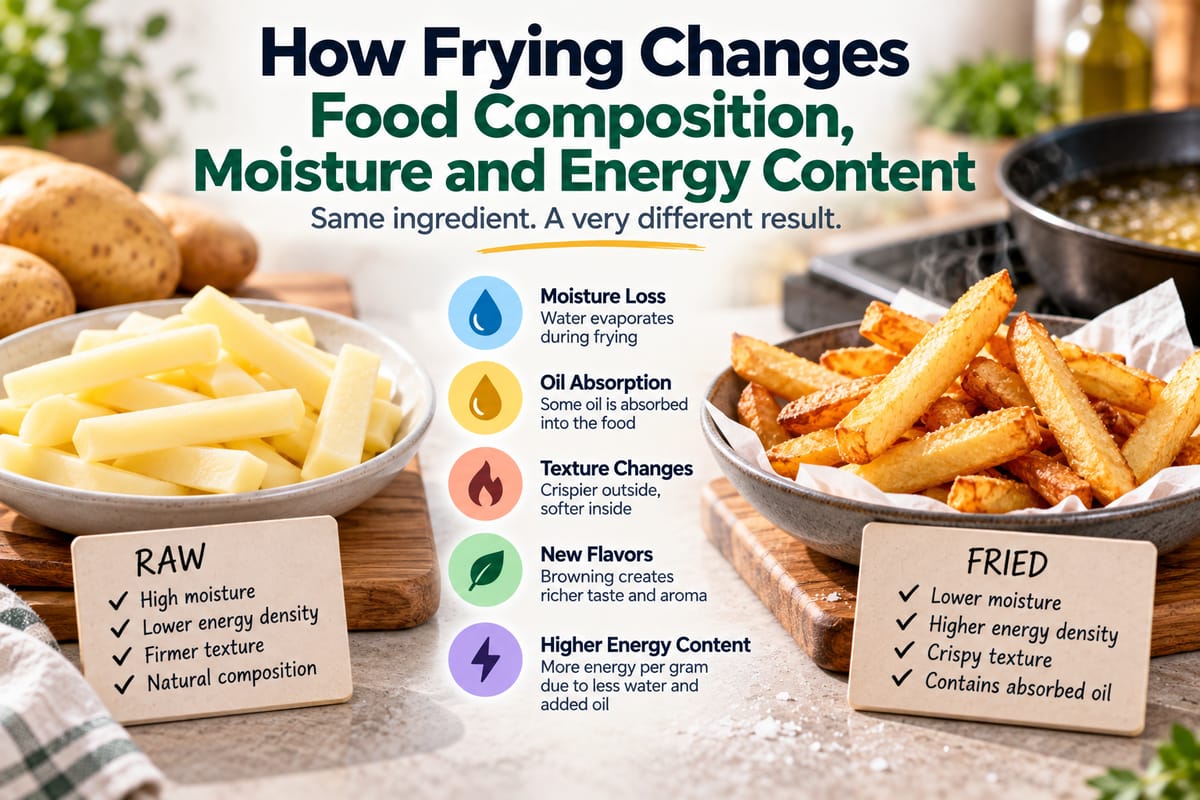
Frying is one of the most widely used cooking methods, and it can dramatically change the characteristics of food. A raw ingredient that enters hot oil may come out with a different texture, moisture level, weight, flavor, and energy density.
These changes happen because frying combines intense heat with oil and relatively rapid moisture loss. Water inside the food turns into steam, while the surface becomes hotter and develops browning and crispness. At the same time, some oil can move into the food, increasing its fat content and changing the amount of energy provided by a given weight of the finished product.
The exact changes depend on the ingredient, frying method, temperature, cooking time, surface area, coating, and amount of oil available.
Understanding these changes helps explain why fried foods can taste and feel so different from the ingredients from which they are made.
What Happens When Food Is Fried?
Frying generally involves exposing food to hot fat or oil.
Depending on the method, the food may be:
- Completely submerged in oil
- Partially submerged
- Cooked in a thin layer of oil
- Stir-fried with a relatively small amount of oil
Despite these differences, several processes commonly occur during frying.
The surface of the food heats rapidly. Water near the surface begins to evaporate, producing steam. As moisture leaves, the outer layer becomes drier and develops a firmer texture.
At the same time, the surface can undergo browning reactions that create new colors, aromas, and flavors.
Oil may also enter parts of the food as moisture is lost.
The result is a food with a composition that can differ substantially from the raw ingredient.
Moisture Loss Is One of the Biggest Changes
Water is a major component of many foods.
When food is exposed to frying temperatures, some of that water is converted into steam and escapes.
For example, a raw vegetable may contain a large amount of water. After frying, the vegetable may weigh considerably less because some of that water has been removed.
This means that the finished food can contain:
- Less water
- More concentrated solids
- A different texture
- A different weight
- A higher energy density per gram in some cases
Moisture loss does not necessarily mean that all of the food’s nutrients disappear. Instead, the proportions of the remaining components can change because water has been removed.
Why Weight Changes During Frying
The weight of fried food can change for two main reasons: water leaves the food and oil may enter it.
These processes occur at different rates and can vary considerably depending on the food.
Imagine a piece of food weighing 100 grams before frying.
During cooking, it might lose 20 grams of water. If it also absorbs 8 grams of oil, the finished food would weigh about 88 grams.
The exact numbers will vary, but the example illustrates an important point:
The weight of cooked food cannot always be compared directly with the weight of raw food.
This is particularly important when estimating energy or nutrient content based on a specific weight.
How Frying Changes Energy Density
Food energy is commonly associated with carbohydrates, proteins, fats, and alcohol.
Fat provides substantially more energy per gram than protein or carbohydrate.
When frying removes water and potentially adds oil, the energy concentration of the food can increase.
For example, imagine that an ingredient starts with a large amount of water and relatively little fat. After frying, some water has evaporated and some oil has been incorporated.
The total food may now contain more energy per 100 grams than the raw ingredient.
This does not necessarily mean that every piece of fried food contains dramatically more total energy than its raw counterpart. The change depends on how much food material was lost, how much oil was absorbed, and how the serving is measured.
Total Energy and Energy Density Are Different
This distinction is important.
Total energy refers to the amount of energy contained in the entire portion.
Energy density refers to how much energy is contained in a particular amount of food, such as per 100 grams.
Frying can reduce the weight of a food through moisture loss while simultaneously increasing its fat content.
As a result, the energy per 100 grams can increase even when the ingredient’s total original food components have not all increased.
For people comparing nutritional information, it is therefore useful to know whether values refer to the raw ingredient, cooked ingredient, drained fried food, or a particular prepared serving.
Oil Absorption During Frying
Oil absorption is one of the defining characteristics of many fried foods.
When food enters hot oil, its surface rapidly heats and water begins to evaporate. As cooking continues, changes in the structure of the food can allow oil to occupy spaces that were previously filled with water or steam.
Oil absorption depends on several factors.
Type of Food
Different ingredients have different structures.
Potatoes, vegetables, meats, doughs, and coated foods do not behave identically when fried.
Surface Area
Small pieces have more surface area relative to their overall mass.
A thin slice can therefore behave differently from a thick piece of the same ingredient.
Frying Time
Longer cooking can provide more opportunity for moisture loss and changes in oil uptake, although the relationship is not simply a matter of “longer always means more oil.”
Temperature
Frying temperature affects the rate of moisture loss, crust formation, and cooking time.
Coating
Batters and breading can change the way oil and moisture move through the food.
These factors interact, which is why two foods cooked in the same oil can end up with very different compositions.
The Role of Frying Temperature
Temperature has a major influence on the physical and chemical changes that occur during frying.
If the oil is sufficiently hot, moisture near the surface can rapidly turn into steam and escape.
This can contribute to the formation of a dry outer layer.
If the temperature is too low, cooking may take longer, potentially allowing different patterns of oil uptake and moisture movement.
If the temperature is excessively high, the exterior may brown or burn before the interior has cooked properly.
The relationship between temperature and cooking results is explored more broadly in how cooking temperature affects food and cooking results.
Frying Creates a Crispy Surface
One of the most noticeable effects of frying is the transformation of the food’s surface.
As moisture leaves the outer layer, the surface becomes progressively drier.
Starches and proteins can undergo changes that contribute to a firm or crispy exterior.
This creates the characteristic contrast often associated with fried foods:
Crispy outside + softer inside
The balance depends on the ingredient and cooking conditions.
A thin potato chip, for example, may lose moisture throughout much of its structure, while a larger fried potato piece can retain considerably more moisture in its center.
How Frying Changes Food Texture
Texture is influenced by moisture, fat, proteins, starches, fibers, and the physical structure of the ingredient.
Frying can produce:
- Crisp surfaces
- Firm coatings
- Tender interiors
- Reduced moisture
- More pronounced browning
- Different levels of chewiness
- Changes in softness
The precise result depends heavily on the original food.
The broader relationship between cooking and texture is explored in how cooking methods affect food texture and consistency.
Frying is therefore not simply a way to heat food. It changes the physical structure of the food as it cooks.
What Happens to Proteins?
Proteins can change structure when exposed to heat.
This process is often described as denaturation.
In foods such as meat, eggs, and some plant-based protein sources, heating causes proteins to unfold and interact differently.
As cooking continues, additional changes can affect firmness and moisture retention.
For meat, for example, frying can produce a browned exterior while heat causes proteins inside the food to change.
The final texture depends on factors such as:
- Cooking temperature
- Cooking time
- Size and thickness
- Fat content
- Initial moisture
- Type of protein
What Happens to Carbohydrates?
Frying can cause several important changes to carbohydrates.
Starches can absorb water and swell during cooking, while high surface temperatures can contribute to browning and crust formation.
In foods such as potatoes, these changes can produce a crisp exterior and softer interior.
The surface can also develop new flavor compounds as sugars and amino compounds participate in browning reactions.
This is one reason fried foods often have a deeper color and more complex flavor than boiled or steamed versions of the same ingredient.
Browning Changes Flavor and Appearance
The attractive golden-brown color associated with many fried foods comes from chemical reactions that occur at the surface.
One important group of reactions is the Maillard reaction, which involves reducing sugars and amino compounds under suitable conditions.
These reactions can create numerous flavor and aroma compounds.
Caramelization can also contribute to browning when sugars are exposed to sufficiently high temperatures.
Together, these processes can produce:
- Golden-brown colors
- Toasted aromas
- Roasted flavors
- Crisp textures
- Greater flavor complexity
The browning process is one reason frying can produce such a distinctive sensory experience.
Does Frying Destroy Nutrients?
Frying can affect nutrients, but the answer depends on the particular nutrient and food.
Heat can reduce the amount of some heat-sensitive compounds, while other nutrients may remain relatively stable.
Water-soluble nutrients can also be affected by cooking conditions, and moisture loss can concentrate nutrients that remain in the food.
The use of oil introduces another variable because fat-soluble compounds may behave differently from water-soluble ones.
Therefore, it is difficult to describe the nutritional effect of frying with one simple rule.
The outcome depends on:
- The original food
- Nutrient type
- Frying temperature
- Cooking duration
- Surface area
- Oil conditions
- Moisture loss
Frying Versus Other Cooking Methods
Frying is only one way to cook food.
Other methods include:
- Boiling
- Steaming
- Baking
- Roasting
- Grilling
- Broiling
- Braising
- Simmering
- Pressure cooking
- Microwaving
Each method transfers heat differently and creates different combinations of moisture loss, fat exposure, texture changes, and browning.
A broader overview can be found in cooking methods explained.
The choice of method can therefore change not only the flavor and texture of food but also its final composition.
Deep-Frying and Pan-Frying Are Different
The word “frying” covers several techniques.
Deep-Frying
Deep-frying involves immersing food in hot oil.
Because the food is surrounded by hot oil, heat can reach much of the exposed surface quickly.
This method is commonly used for foods such as:
- French fries
- Fried chicken
- Doughnuts
- Fritters
- Fried vegetables
Pan-Frying
Pan-frying uses a relatively shallow layer of oil.
The food contacts the pan and oil, and it is often turned during cooking.
This can produce a browned exterior while allowing the cook greater control over the amount of oil used.
Stir-Frying
Stir-frying typically uses a relatively small amount of oil and high heat while ingredients are moved frequently.
The cooking time can be short, helping ingredients retain some of their original texture.
These methods can produce very different outcomes even when applied to similar ingredients.
Why Coatings Change Frying Results
Breading and batter introduce another layer between the food and the cooking oil.
A coating can:
- Increase surface area
- Create a crisp exterior
- Change moisture movement
- Affect oil uptake
- Promote browning
- Alter texture
A breaded piece of food therefore does not behave exactly like the same ingredient fried without a coating.
The coating itself also becomes part of the final food composition.
It can contribute carbohydrates, fat from absorbed oil, and additional energy.
Why Fried Foods Can Become More Energy-Dense
A major reason fried foods can become more energy-dense is the combination of moisture loss and oil absorption.
Consider the basic relationship:
Less water + potential oil absorption = more energy per unit of weight
Water contributes no dietary energy, while oil is energy-dense.
When some water leaves and oil enters, the balance changes.
This helps explain why a raw ingredient and a fried version can have noticeably different energy values when measured per 100 grams.
However, the exact difference cannot be predicted from frying alone.
The Importance of Serving Size
Serving size can make nutritional comparisons confusing.
Suppose someone compares 100 grams of raw potatoes with 100 grams of fried potatoes.
The fried potatoes may have lost substantial water and gained some oil.
Therefore, 100 grams of the fried product may represent considerably more original potato material plus absorbed oil than 100 grams of the raw product.
A comparison based on weight is therefore not necessarily a direct comparison of the same physical amount of the original ingredient.
This is why nutritional data should be interpreted carefully when comparing foods before and after cooking.
How Frying Affects Food Volume
Moisture loss can also change the physical volume of food.
Some foods shrink as water escapes.
Meat, for example, can lose moisture during cooking and become smaller.
Other foods may change structure in different ways.
Coatings can expand, starches can change shape, and ingredients can develop pores or a crisp outer structure.
The relationship between weight and volume can therefore change during frying.
Why Oil Temperature Matters for Oil Uptake
It is tempting to assume that hotter oil always means more oil absorption, but frying is more complicated than that.
Temperature influences how quickly the food surface forms a crust and how quickly moisture escapes.
A sufficiently hot cooking environment can promote rapid surface dehydration and crust formation.
If the oil is too cool, the food may spend longer in the oil while undergoing slower cooking and moisture loss.
However, actual oil uptake depends on the food, coating, surface structure, cooking time, cooling process, and other variables.
Temperature should therefore be considered alongside the rest of the frying conditions.
What Happens After the Food Leaves the Oil?
Cooking does not necessarily stop the moment fried food is removed from the pan or fryer.
The food continues to cool, and steam and moisture can continue moving through its structure.
Oil behavior can also change during cooling.
For this reason, draining and cooling are part of the final cooking process.
The amount of oil remaining on the surface can also depend on how the food is handled after frying.
Draining on a rack, for example, allows excess surface oil to move away more effectively than leaving the food immersed in oil.
Frying and Home Cooking Skills
Understanding what frying does to food can help cooks make better decisions in the kitchen.
Someone learning to cook can benefit from knowing that frying involves more than simply adding oil and applying heat.
The ingredient’s moisture, thickness, coating, oil temperature, cooking time, and desired texture all matter.
For people developing foundational kitchen skills, the complete guide to cooking for beginners offers a broader introduction to cooking principles and techniques.
Practical Ways to Understand Frying Changes
Cooks do not need laboratory equipment to observe many of the changes caused by frying.
Simple comparisons can demonstrate how the process works.
For example, weigh an ingredient before cooking and again after frying.
You may observe:
- Reduced weight
- Lower moisture
- A darker surface
- A crispier texture
- A different aroma
- Increased richness
- Changes in volume
Comparing a raw ingredient, pan-fried version, and baked version can also demonstrate how different cooking methods produce different results.
Frying Changes More Than Flavor
Frying is often associated with flavor because it creates browned, crisp, and aromatic foods.
But the effects extend well beyond taste.
During frying, food can experience:
- Moisture loss
- Oil uptake
- Protein changes
- Starch changes
- Browning
- Texture transformation
- Weight reduction
- Changes in energy density
- Changes in some nutrient levels
These changes occur simultaneously, which is why frying can transform the original ingredient so significantly.
Understanding the Transformation From Raw to Fried
Frying can be understood as a combination of heat transfer, moisture movement, structural change, and oil interaction.
The process often begins with a food containing substantial moisture. As the food enters hot oil, its surface heats rapidly. Water begins escaping as steam, the surface dries, and browning reactions become possible.
As moisture leaves, the structure changes. Depending on the food and cooking conditions, oil may enter parts of the food. The finished product can therefore have a different balance of water, fat, carbohydrates, proteins, and other components.
This explains why fried foods often feel richer, crispier, and more energy-dense than their raw counterparts.
Making Better Comparisons Between Raw and Fried Foods
When comparing a food before and after frying, several questions can make the comparison more meaningful:
- Are both samples being compared by weight or by portion?
- How much moisture was lost?
- How much oil was used?
- How much oil was absorbed?
- Was the food coated?
- What frying temperature was used?
- How long was it cooked?
- Was excess oil drained afterward?
- Did the food shrink substantially?
- Are nutritional values based on raw or cooked weight?
These details can make a major difference.
A label or nutrition database value should therefore be interpreted according to the form of the food it describes.
From Hot Oil to a Different Food
Frying transforms food through several interconnected processes rather than one single chemical change. Moisture escapes, surfaces brown, proteins and starches respond to heat, and oil can become part of the finished product.
The result is often a food with a crisp exterior, reduced water content, a different weight, and potentially greater energy density per gram.
How dramatic these changes are depends on the ingredient and the cooking conditions. Deep-frying, pan-frying, and stir-frying can produce different outcomes, while temperature, cooking time, coating, and oil management all influence the final result.
Understanding these changes gives cooks a clearer picture of what happens between the raw ingredient and the food on the plate—and why cooking method matters just as much as the ingredient itself.