How Voice Control Works for Entertainment
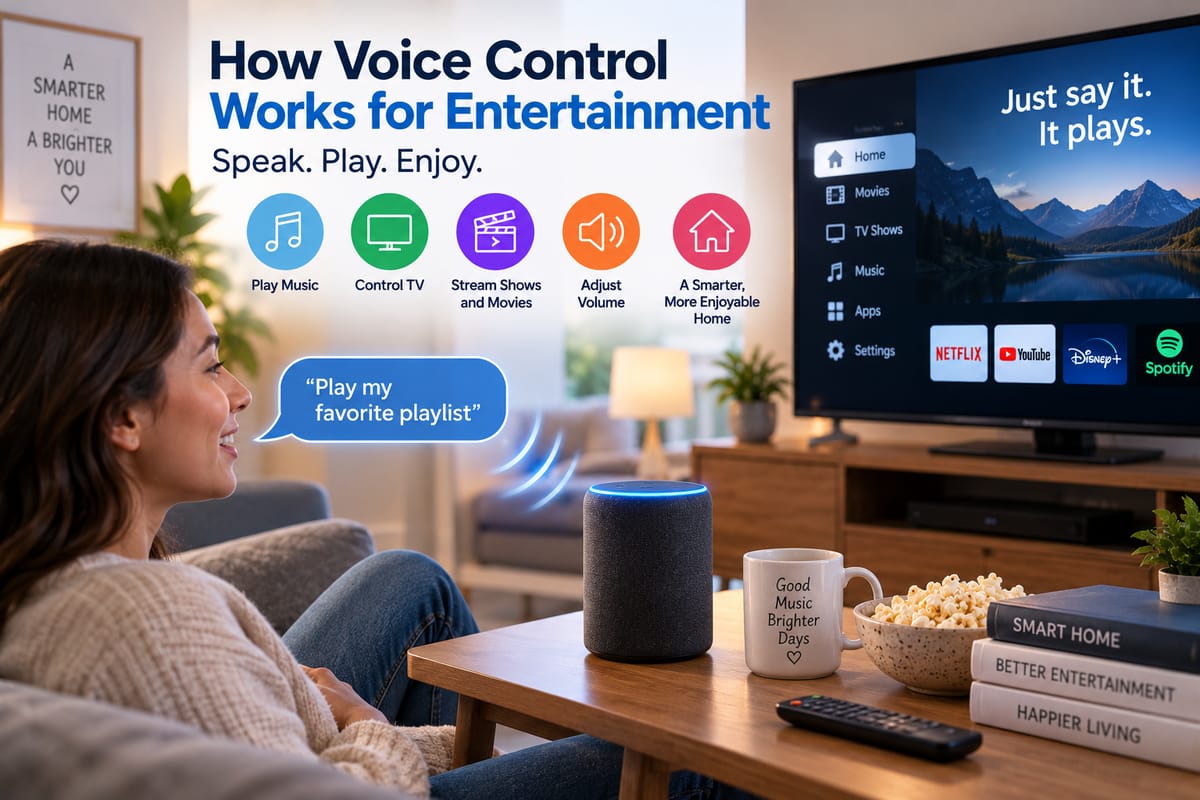
How Voice Control Works for Entertainment
Voice control has changed the way many people interact with entertainment systems at home. Instead of reaching for a remote, opening an app, or searching through menus, users can speak commands to play music, change television content, adjust volume, or control connected entertainment equipment.
The technology behind this convenience combines microphones, speech recognition, artificial intelligence, connected devices, and software platforms. When these components work together, a spoken request can become an action within seconds.
Voice control is increasingly becoming part of the broader connected-home experience, linking entertainment equipment with other smart devices and allowing different systems to work together.
What Is Voice Control?
Voice control allows a device or software system to respond to spoken commands.
A typical voice-controlled entertainment setup may include:
- A smart speaker or voice assistant
- A television or streaming device
- Speakers or a soundbar
- A home Wi-Fi network
- A smartphone or tablet
- Compatible entertainment applications
- A smart home platform or hub
The user speaks a command, the system interprets the request, identifies the intended action, and sends instructions to the appropriate device.
For example, saying “play some music” could cause a connected speaker to begin playback, while “turn up the volume” could send a command to a television or soundbar.
How a Voice Command Becomes an Action
Although the process feels simple to the user, several steps can happen behind the scenes.
First, a microphone detects the user’s speech. The voice assistant then processes the audio to determine what was said.
Speech-recognition technology converts spoken language into information that software can interpret. The system then attempts to determine the user’s intent.
For example:
“Play my favorite playlist.”
The assistant may identify:
- Action: Play
- Content: A playlist
- Destination: A compatible music service or speaker
Once the request has been interpreted, the system sends an appropriate command to the connected entertainment device.
The Role of Smart Speakers
Smart speakers are often the central interface for voice-controlled entertainment.
They typically contain microphones that listen for commands and software capable of recognizing speech and interpreting requests. Some models can also control compatible televisions, streaming devices, lights, and other smart home products.
The speaker does not necessarily perform every task itself. Instead, it can act as a bridge between the user’s spoken request and another service or device.
The broader relationship between voice assistants and connected devices is explained in How Smart Speakers and Voice Assistants Control Connected Home Devices.
Voice Assistants Understand More Than Simple Commands
Early voice-control systems often required highly specific phrases.
Modern assistants are generally designed to handle more natural language. A user may say “put on some relaxing music” rather than specifying an exact command format.
The system attempts to determine the intent behind the sentence rather than simply matching every word to a predefined command.
This makes voice interaction feel more conversational.
However, natural-language processing is not perfect. Accents, background noise, unusual names, multiple people speaking simultaneously, and ambiguous requests can sometimes cause misunderstandings.
Controlling Music With Your Voice
Music playback is one of the most common uses of voice control.
Depending on the connected services and devices, users may be able to:
- Start or stop playback
- Skip tracks
- Replay songs
- Adjust volume
- Request specific artists
- Play albums
- Select playlists
- Choose music by genre
- Ask for recommendations
A command such as “play jazz” may result in a playlist or radio station being selected through a connected music service.
The exact capabilities depend on the voice assistant, music platform, subscription, and connected hardware.
Voice Control for Television
Voice assistants can also interact with televisions and streaming devices.
Compatible systems may allow users to:
- Turn a television on or off
- Change channels
- Adjust volume
- Open applications
- Start specific programs
- Pause or resume playback
- Search for content
- Switch inputs
For example, a user might say, “Open the streaming app,” and the assistant can send the corresponding instruction to the television.
More advanced systems can combine multiple actions. A single request could potentially open an application and begin playing selected content if the relevant devices and services support the required commands.
Voice Search Makes Finding Content Easier
Searching for entertainment can sometimes be frustrating when performed through a remote control.
Typing long titles or navigating an on-screen keyboard takes time. Voice search allows users to describe what they want verbally.
A person could ask for a particular movie, actor, genre, or television program, depending on the capabilities of the platform.
The entertainment system then searches available services and presents matching results.
Voice search can be especially useful when users do not remember the exact spelling of a title.
Voice Control Can Manage Audio Equipment
Entertainment systems often contain several audio components.
A television may connect to a soundbar, wireless speakers, an AV receiver, or a multi-room audio system.
If these products support the same voice-control platform, users may be able to control several aspects of playback using spoken commands.
Commands can include changing volume, selecting a room, starting playback, or moving audio from one compatible speaker to another.
The ability to perform these actions depends heavily on device compatibility.
Compatibility Is Essential
A voice assistant cannot necessarily control every device simply because both devices connect to the internet.
Products need to support compatible communication methods, platforms, applications, or integrations.
Two devices can exist on the same home network while still being unable to communicate with each other.
This is why Understanding Smart Home Integration and Compatibility is an important part of planning a voice-controlled entertainment system.
Before purchasing equipment, users should check whether the television, streaming device, speakers, and voice assistant are designed to work together.
The Role of Smart Home Hubs
Some smart homes use a central hub to coordinate devices and automation.
A hub can provide a common point through which compatible devices communicate and can sometimes connect products that use different communication technologies.
In an entertainment setup, a hub might help coordinate televisions, speakers, lighting, and other equipment.
The exact role varies considerably between systems. Some modern platforms can perform functions that previously required a dedicated hub, while other setups continue to benefit from centralized control.
The Complete Guide to Smart Home Hubs provides more information about how these systems can coordinate connected devices.
Wi-Fi Is Often Part of the Process
Many voice-controlled entertainment devices depend on a home network.
The voice assistant may need internet access to process commands, communicate with cloud services, access streaming platforms, or interact with remote services.
Entertainment devices also frequently depend on Wi-Fi or another network connection to receive commands and stream content.
This means network reliability can affect the experience.
A weak connection may cause delayed responses, buffering, failed commands, or temporarily unavailable devices.
Cloud Services Can Process Voice Requests
Many voice assistants use cloud-based computing to process speech and interpret requests.
In a simplified process, the device captures the spoken command and sends relevant information to a remote service. The service processes the request and determines what action should occur.
The resulting instruction can then be sent back to the device or another connected product.
This approach allows voice assistants to use substantial computing resources without requiring every smart speaker to perform all language-processing tasks locally.
It also means that some voice features may depend on internet connectivity.
Some Functions Can Work Locally
Not every smart-home operation necessarily needs to travel through the cloud.
Certain systems can process some commands locally or communicate directly between compatible devices. Local processing can reduce dependence on an external internet connection and may improve response times for particular functions.
However, local capabilities vary significantly between manufacturers and products.
When evaluating a voice-controlled entertainment system, it is useful to understand which features require an internet connection and which can continue operating locally.
Voice Control Can Combine Multiple Actions
One of the more useful features of connected entertainment systems is the ability to combine several commands into a routine.
For example, a movie-night routine could potentially:
- Turn on the television.
- Select the appropriate input.
- Adjust the lighting.
- Set the audio system to a preferred volume.
- Launch a streaming application.
The user could trigger the routine with a single phrase.
The exact sequence depends on the capabilities of the smart home platform and the devices involved.
Voice Control Can Improve Accessibility
Voice interaction can provide an alternative to physical controls for some users.
People who have difficulty operating small remote controls, navigating complicated menus, or reaching certain devices may find spoken commands easier for particular tasks.
Voice control can also reduce the need to search for remotes or physically interact with multiple devices.
However, it is best considered an additional control method rather than a universal replacement for physical interfaces.
Multiple People Can Use the Same System
A household entertainment system may need to recognize commands from different people.
Some voice platforms support individual profiles or voice recognition features that can associate certain requests with specific users.
This can allow personalized responses or preferences in supported services.
For example, different users may have separate music accounts or content preferences.
The availability and accuracy of these features vary between platforms.
Voice Control Has Privacy Considerations
Because voice assistants rely on microphones, privacy is an important consideration.
Users should understand when devices are listening for wake words, what information may be processed, what settings are available, and how voice recordings or activity data are handled by the relevant service.
Privacy settings can vary between manufacturers and platforms.
It can be useful to review account controls and microphone settings, particularly when a voice assistant is installed in a frequently occupied room.
Background Noise Can Affect Accuracy
Voice recognition works best when spoken commands can be distinguished clearly from surrounding sounds.
Televisions, music, conversations, kitchen appliances, and other sources of noise can interfere with recognition.
Modern devices use microphones and signal-processing techniques to improve speech detection, but errors can still occur.
Placing smart speakers where their microphones are not obstructed and speaking clearly can improve the likelihood of successful recognition.
Voice Control Is Not Always Faster
Voice commands can be extremely convenient, but they are not necessarily the best option for every task.
A remote control may be quicker when someone wants to scroll through many options or make a precise adjustment. Touch controls may also be preferable when visual feedback is important.
Voice control works particularly well for straightforward actions that would otherwise require several button presses.
The best entertainment setup often combines voice commands with traditional controls rather than relying entirely on one method.
Smart Homes Are Expanding Beyond Entertainment
Voice-controlled entertainment is part of a much larger connected-home ecosystem.
The same assistant used to control music or television may also interact with lighting, thermostats, security equipment, appliances, and other devices.
This interconnected approach is a defining feature of modern smart homes. The Complete Guide to Smart Homes provides a broader overview of how connected devices and automation can work together.
As more products adopt common standards and integration platforms, the boundaries between entertainment systems and other household technology can become less distinct.
What Makes Voice-Controlled Entertainment Reliable?
Several factors influence how well a voice-controlled entertainment system performs:
- Reliable network connectivity
- Compatible devices
- Proper account configuration
- Updated software
- Clear microphone placement
- Appropriate privacy settings
- Supported entertainment services
- Properly configured integrations
A system with excellent hardware can still be frustrating if the devices cannot communicate properly.
Likewise, a compatible collection of devices can perform poorly if the wireless network is unreliable.
Setting Up a Voice-Controlled Entertainment System
A practical setup can begin with one voice assistant and a compatible entertainment device.
From there, users can gradually add equipment that works within the same ecosystem.
Before buying additional products, check:
- Which voice platforms they support
- Whether they require a separate hub
- Whether they work with existing devices
- Which features require internet access
- Whether streaming services are supported
- What privacy controls are available
- Whether software updates are provided
Starting small can make it easier to identify compatibility problems before expanding the system.
The Future of Voice-Controlled Entertainment
Voice control is becoming less about issuing isolated commands and more about creating connected experiences.
As speech recognition and smart-home platforms develop, entertainment systems may become increasingly capable of understanding context and coordinating several devices.
A user may not always need to specify every individual action. Instead, the system may be able to interpret a broader request and coordinate compatible devices accordingly.
The technology still has limitations, particularly around privacy, connectivity, compatibility, and accurate interpretation. But the underlying idea remains straightforward: spoken language can serve as a convenient interface for controlling digital entertainment.
For households that already use connected televisions, speakers, streaming devices, and smart-home platforms, voice control can bring these technologies together into a more unified entertainment experience.