How to Organize Shared Family Bathrooms
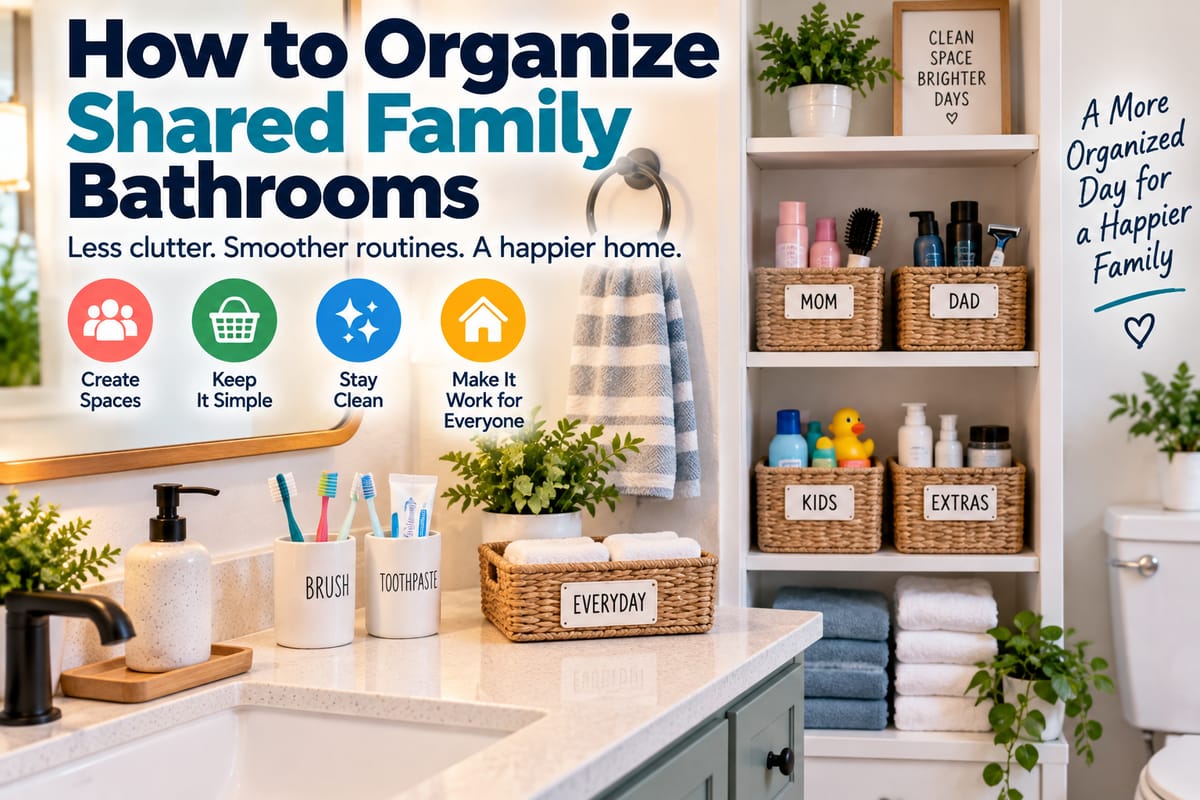
How to Organize Shared Family Bathrooms
A shared family bathroom has to work for several people with different routines, preferences, schedules and storage needs. Without a clear system, even a reasonably sized bathroom can quickly become crowded with toiletries, towels, cleaning products and everyday essentials.
Organizing a shared bathroom is therefore about more than making the room look tidy. The goal is to create a practical system that makes frequently used items easy to find, keeps personal belongings separated when necessary, and makes cleaning and restocking simpler.
With thoughtful storage, clear zones and a few consistent habits, a shared family bathroom can remain functional even when several people use it every day.
Why Shared Bathrooms Become Cluttered
Bathrooms often contain a surprising number of small items.
Toothbrushes, toothpaste, soaps, shampoos, conditioners, razors, cosmetics, hair products, medications, towels and cleaning supplies can all compete for limited space.
Shared bathrooms also have another challenge: different people use the same room in different ways.
One family member may have several hair-care products, while another may only need a toothbrush and soap. Children may need items stored at a lower height, while adults may prefer cabinets or higher shelves.
Without defined places for belongings, the bathroom can gradually become a collection of items left wherever there is available space.
Start by Removing Everything From the Counters
Before organizing storage, clear the main surfaces.
Remove items from:
- Countertops
- Sink areas
- Bathtubs
- Shower ledges
- Open shelves
- Toilet-top storage
- Window ledges
Place everything together so you can see exactly what is being stored.
This makes it easier to identify duplicate products, items that belong elsewhere, expired products and things nobody uses anymore.
It also gives you a chance to clean the surfaces before putting the remaining items back.
Sort Items Into Categories
Once everything is visible, group similar items together.
Useful categories might include:
- Daily toiletries
- Hair-care products
- Skincare
- Dental-care items
- Shaving supplies
- Makeup and cosmetics
- Bath products
- Towels
- Toilet supplies
- First-aid items
- Cleaning supplies
- Extra toiletries
- Children’s bathroom items
The categories do not need to be complicated.
The purpose is simply to make it easier to determine where each group should live.
Create Zones for Different Activities
A shared bathroom becomes easier to manage when storage corresponds to the way the room is used.
For example, create separate zones for:
Sink Zone
Keep everyday dental-care and hand-washing items close to the sink.
Shower Zone
Store frequently used shampoo, conditioner, body wash and other shower products where they can be reached easily.
Bath Zone
If the family uses a bathtub, create a dedicated area for bath-related items.
Towel Zone
Give clean towels a consistent storage location that is easy for everyone to access.
Cleaning Zone
Keep bathroom-cleaning tools and supplies together in a secure location away from everyday toiletries.
Personal Storage Zone
If several people have different personal products, provide separate baskets, drawers or containers where practical.
A broader room-by-room home organization guide can also help when the bathroom is part of a larger household organization project.
Give Each Family Member a Personal Space
One of the simplest ways to reduce bathroom clutter is to give each regular user a defined storage area.
This might be:
- A labeled basket
- A drawer
- A shelf
- A cabinet section
- A toiletry bag
- A small storage bin
Personal storage does not have to be large.
Even a small designated space can prevent individual belongings from spreading across the entire bathroom.
For example, each person could have a small basket containing personal skincare, hair products and other items they use regularly.
Keep Shared Products Separate
Some products are used by everyone, while others belong to individual family members.
Shared items might include:
- Hand soap
- Toilet paper
- Basic body wash
- General-purpose shampoo
- Tissues
- Hand lotion
Personal products might include:
- Cosmetics
- Specialty skincare
- Prescription products
- Personal grooming tools
- Specific hair-care products
Separating these categories reduces confusion and makes it easier to see when shared supplies need replenishing.
Make Everyday Items Easy to Reach
The items used most frequently should generally occupy the easiest-to-access locations.
Daily-use products can be stored in:
- Top drawers
- Front sections of cabinets
- Open shelves
- Shower organizers
- Countertop containers
Less frequently used items can move farther back or higher up.
This creates a simple principle:
Store frequently used items where they require the least effort to retrieve and return.
The system becomes easier to maintain because people are more likely to put things back when the designated location is convenient.
Use Vertical Space
Bathroom floors and countertops can become crowded quickly, so vertical storage can make a major difference.
Depending on the bathroom layout, consider:
- Wall-mounted shelves
- Tall cabinets
- Over-the-door organizers
- Shower caddies
- Hanging baskets
- Towel bars
- Tiered shelving
Vertical storage allows the family to increase capacity without taking additional floor space.
However, avoid filling every available wall with storage. Leaving some open space can make the bathroom feel less crowded and easier to clean.
Organize Bathroom Drawers
Drawers can become messy because small items tend to move around.
Drawer dividers or small containers can separate categories such as:
- Toothbrush accessories
- Floss
- Razors
- Hair accessories
- Cosmetics
- Nail-care tools
- Small grooming items
Avoid creating too many tiny categories.
The goal is to make items easier to find, not to turn the drawer into a complicated filing system.
Organize Cabinets by Frequency of Use
Bathroom cabinets can benefit from a simple hierarchy.
Front: everyday products
Middle: regularly used backup supplies
Back or upper areas: rarely used items
For example, extra soap and unopened toiletries can be stored behind the products currently being used.
This prevents backup supplies from taking over the most convenient storage areas.
Use Baskets to Control Small Items
Baskets can be particularly useful in shared bathrooms because they group multiple related items together.
Possible basket categories include:
- Hair care
- Skincare
- Guest supplies
- Children’s products
- Extra toiletries
- Travel items
- Personal grooming
Labeled baskets are especially useful when several family members share cabinets.
The label does not have to be complicated. Simple descriptions such as “Hair,” “Bath,” “Backups” and “Travel” can be enough.
Store Cleaning Supplies Separately
Bathroom cleaning products should not be mixed with everyday personal-care items.
Keep cleaning supplies together in a designated cabinet or storage area whenever possible.
Items may include:
- Toilet cleaner
- Disinfectant
- Glass cleaner
- Scrub brushes
- Sponges
- Microfiber cloths
- Gloves
- Small cleaning tools
A dedicated system for organizing household cleaning supplies efficiently can make it easier to locate products while also keeping them separate from toiletries.
Cleaning chemicals should be stored according to their labels and kept away from children and products that could be contaminated.
Create a Towel System
Towels can take up considerable space in a shared bathroom.
A practical towel system should answer three questions:
- Where do clean towels go?
- Where does each person place a towel after use?
- Where do used towels go before washing?
Depending on the household, a system might include individual hooks, labeled towel bars or separate sections for clean towels.
Hooks can be particularly useful because they take up little space and make it easier for everyone to return towels to the same location.
Give Children Accessible Storage
If children use the bathroom, storage should take their height and independence into account.
Frequently used items can be placed where children can safely reach them, while potentially hazardous products should remain inaccessible.
A low basket might hold:
- Washcloths
- Children’s toiletries
- Hairbrushes
- Bath toys
- Other appropriate everyday items
Creating an accessible system can also encourage children to participate in keeping the bathroom organized.
Keep Medications in an Appropriate Location
Bathrooms are not automatically the best place to store every medication or health product.
Some medications can be affected by heat or humidity, so storage instructions on the product packaging should be followed.
Where a medication needs to remain in the bathroom, keep it organized and inaccessible to children when necessary.
Avoid mixing medications casually with ordinary toiletries.
A clearly defined storage system reduces the chance of confusion between products.
Manage Duplicate Products
Shared households often accumulate duplicate supplies.
There may be several partly used bottles of shampoo, multiple containers of lotion or several packages of the same product.
Before buying more, check what is already available.
Create a small “use first” area for partially used products when appropriate. This can reduce waste and prevent cabinets from filling with half-empty containers.
Create a Backup Supply Area
Extra supplies should have a dedicated home.
This could include:
- Toilet paper
- Soap
- Toothpaste
- Shampoo
- Conditioner
- Tissues
- Replacement toothbrushes
- Cleaning products
Keeping backup supplies together makes it easier to see what needs replenishing.
It also prevents people from opening another package simply because they cannot find the existing one.
Keep the Countertop Deliberately Limited
Countertops are often the first place where bathroom clutter becomes visible.
Instead of allowing every household member to leave products around the sink, decide what belongs there permanently.
For example, the countertop might contain only:
- Hand soap
- A toothbrush holder
- One small tray
- Another genuinely necessary daily-use item
Everything else can have a designated storage location.
A clear countertop also makes routine cleaning much faster.
Use Trays to Group Items
A small tray can turn several loose products into one organized group.
For example, a tray might hold:
- Hand soap
- Lotion
- A small container
- Another frequently used item
The tray also makes it easier to move several objects at once when cleaning.
This is particularly useful in bathrooms where counter space is limited.
Organize the Shower Carefully
Showers can become cluttered when every family member leaves several bottles on the floor or around the tub.
A shower caddy, corner shelf or wall-mounted organizer can create defined storage.
Group products according to usage rather than simply placing them wherever there is space.
For example:
Everyday: body wash, shampoo and conditioner
Personal: specialty products
Occasional: treatments and less frequently used items
Avoid allowing unused or nearly empty bottles to accumulate.
Check Products Regularly
Bathrooms contain many products with limited useful lifespans or specific storage requirements.
During regular organizing sessions, inspect toiletries and remove items that are:
- Empty
- Expired
- Damaged
- Dried out
- No longer wanted
- Replaced by newer products
Do not automatically keep something just because there is still a small amount left.
If nobody intends to use it, keeping it only creates more clutter.
Establish a Simple Family Reset Routine
Organization works better when the household has a routine for maintaining it.
A short daily reset might involve:
- Returning toiletries to their storage areas
- Hanging towels
- Removing empty containers
- Wiping obvious spills
- Putting personal items back into individual baskets
A weekly reset can involve:
- Checking supplies
- Cleaning shelves
- Wiping drawers
- Washing reusable organizers
- Removing unnecessary products
- Checking the shower area
These routines do not need to take a long time.
The objective is to prevent small amounts of clutter from becoming a major organizing project.
Make Organization Easy for Everyone
A system is more likely to survive when it is simple enough for everyone to follow.
If returning an item requires several steps, people may leave it on the counter instead.
Good organization should make the correct action obvious.
For example:
- Toothbrushes go in one holder.
- Towels go on assigned hooks.
- Personal products go in individual baskets.
- Backup supplies go in one cabinet.
- Cleaning products go in a separate storage area.
Clear rules reduce the amount of decision-making required.
Developing broader personal organization skills can also make it easier for family members to maintain shared spaces consistently.
Avoid Over-Organizing
Organization should solve problems rather than create additional work.
Too many containers, labels and categories can make a bathroom harder to maintain.
If every product requires a specific box and every box requires a specific position, the system may become unnecessarily complicated.
A practical organization system should be:
- Easy to understand
- Easy to access
- Easy to clean
- Easy to maintain
- Flexible when household needs change
Sometimes the simplest storage solution is the most effective one.
Make Cleaning Part of the Organization System
An organized bathroom should also be easy to clean.
Avoid placing unnecessary objects around sinks, toilets and shower areas.
Keep cleaning tools accessible, but separate from toiletries.
Create enough open surface area that wiping and disinfecting can be done without moving dozens of objects first.
For a broader household cleaning routine, The Ultimate Guide to Cleaning Your Home can help put bathroom maintenance into the context of an overall home-cleaning system.
Review the System When Family Needs Change
Bathroom organization should evolve as the household changes.
A system that works for a family with young children may need to change as those children become teenagers. Guests may require additional storage, while older family members may benefit from easier-to-reach essentials.
Review the setup when:
- A new family member joins the household
- Children become more independent
- Storage needs increase
- The bathroom is renovated
- Household routines change
- Products or grooming habits change
The goal is not to create a permanent arrangement. It is to maintain a system that fits the people using the room now.
A Simple Shared Bathroom Organization Checklist
Use this checklist when setting up or resetting a family bathroom:
- Remove unnecessary items
- Group similar products together
- Separate shared and personal items
- Give regular users designated storage
- Keep everyday products easy to reach
- Store backup supplies together
- Organize drawers with simple categories
- Use vertical storage where appropriate
- Create a clear towel system
- Keep cleaning products separate
- Store medications according to their instructions
- Remove empty and unwanted products
- Keep countertops relatively clear
- Make storage accessible to appropriate users
- Establish a quick daily reset
- Schedule regular bathroom organization checks
Building a Bathroom That Stays Organized
The best shared bathroom organization system is not necessarily the one with the most containers or the most elaborate labels. It is the one that matches the household’s routines and makes it easy for everyone to know where things belong.
Start by understanding what the family actually uses, remove unnecessary items, separate personal belongings from shared supplies and give frequently used products convenient storage locations.
Once those foundations are in place, simple habits can keep the room under control.
A well-organized shared bathroom ultimately does more than improve appearance. It reduces daily searching, simplifies cleaning, makes supplies easier to monitor and gives every family member a clearer place for their belongings.