Maison&Objet Paris 2026 Opens With New Interior Design Trends Set to Shape 2027
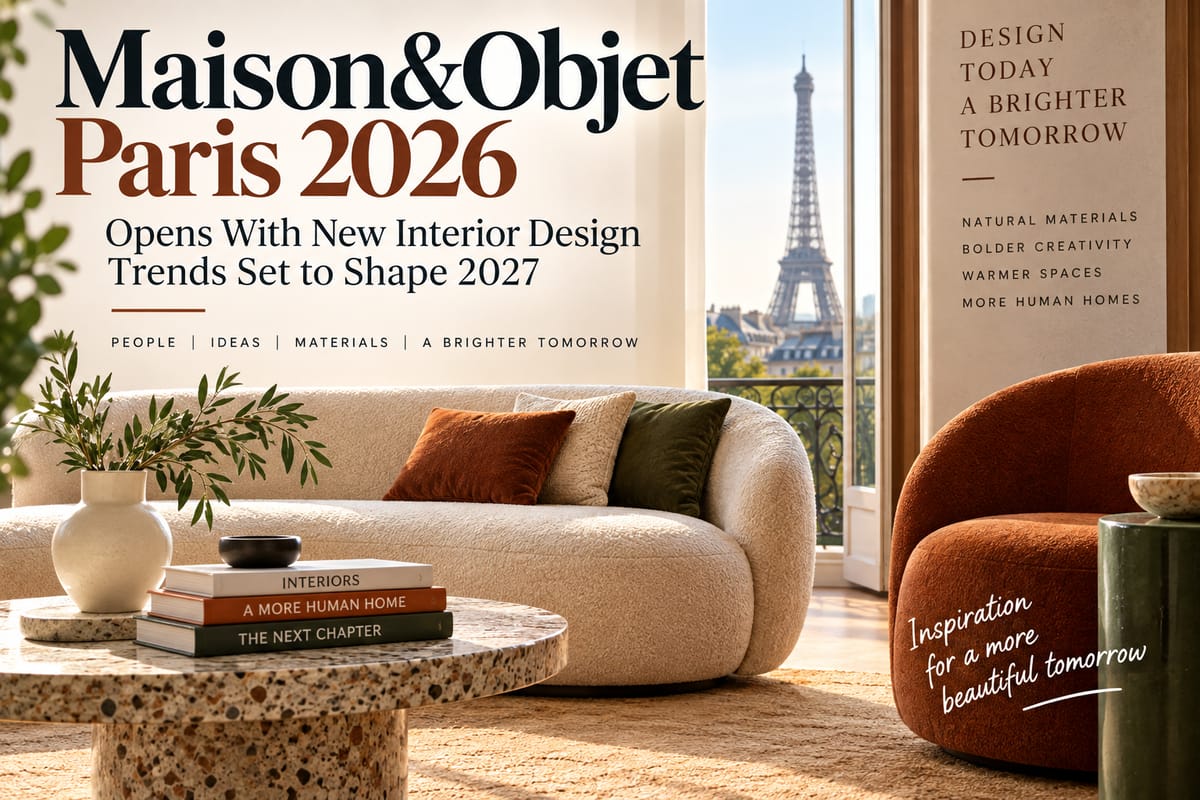
Maison&Objet Paris 2026 Opens With New Interior Design Trends Set to Shape 2027
Maison&Objet Paris has returned for its September 2026 edition, bringing together designers, brands, craftspeople, buyers, and interior professionals to explore the ideas likely to influence the next chapter of home design.
Running from September 10 to 14 at Paris Nord Villepinte, this year’s edition is built around the theme “Pulse in Motion,” a concept centered on movement, creativity, connection, and the changing ways people experience design. The fair brings together 1,700 brands from 49 countries across seven sectors, giving visitors a broad view of where interiors, lifestyle, craftsmanship, technology, and materials are heading.
While Maison&Objet is not simply a prediction machine for the following year, the products, materials, colors, and concepts presented in Paris provide an important snapshot of the direction designers are exploring. And one message is becoming increasingly clear: the future of interiors looks less interested in perfection and more interested in personality, tactility, nature, craftsmanship, and emotional connection.
A New Design Language Built Around Movement
The central idea of Maison&Objet 2026 is “Pulse in Motion,” developed with trend forecasting agency NellyRodi and brought to life by Studio Masquespacio, the edition’s ambassadors.
Rather than treating interior design as a static collection of furniture and decorative objects, the theme emphasizes movement, interaction, creativity, and collective experiences.
That philosophy reflects a broader shift in how homes are being imagined. Rooms are increasingly expected to accommodate multiple activities, while furniture and decorative objects are being chosen for their ability to create atmosphere and support everyday life.
The result is an approach that feels more flexible and experiential than the highly coordinated showroom aesthetic that dominated some earlier design cycles.
For homeowners interested in connecting interiors with broader lifestyle choices, the Complete Guide to Lifestyle Design and Personal Living offers a useful foundation for thinking about how personal habits and living spaces can work together.
Craftsmanship Moves Back to Center Stage
One of the strongest signals emerging from the 2026 edition is renewed attention to craftsmanship.
Maison&Objet’s In Materia installation, curated by Elizabeth Leriche, places living materials and contemporary craftsmanship at the heart of the Fine Craft sector. The presentation highlights unique pieces and limited editions while emphasizing the expressive qualities of materials such as hammered metal, veined wood, and crackled ceramics.
These materials are compelling partly because they do not look perfectly manufactured.
Their irregularities, variations, textures, and signs of transformation give objects a sense of individuality.
That represents an important shift from the idea that luxury must always mean flawless surfaces. Increasingly, luxury can mean knowing how something was made, seeing the hand behind it, and understanding why the material looks the way it does.
Imperfect Materials Bring Personality Into the Home
The renewed interest in craftsmanship is closely connected to another emerging preference: interiors that look lived in.
Natural wood with visible grain, handmade ceramics, textured fabrics, brushed metals, stone surfaces, and objects with slight variations can create a stronger sense of identity than rooms filled entirely with identical mass-produced pieces.
The appeal is not necessarily rustic design. Instead, designers are finding ways to combine traditional craftsmanship with contemporary forms.
A handmade ceramic lamp can sit comfortably beside a streamlined sofa. A rough stone table can work with sophisticated lighting. An irregularly finished cabinet can become the focal point of an otherwise restrained room.
The contrast is what makes the interior interesting.
Nature Continues to Influence Interior Design
Nature remains one of the strongest sources of inspiration in contemporary interiors.
Maison&Objet’s trend programming places significant emphasis on natural materials, organic forms, and environments inspired by landscapes. Its What’s New? In Decor presentation explores desert, ocean, and botanical worlds through colors, textures, and materials.
That approach goes beyond simply putting a few houseplants in a room.
Designers are increasingly translating the characteristics of nature into entire interiors.
Desert-inspired spaces can draw on ochre, clay, sand, brick, and earthy neutrals. Ocean references can appear through fluid shapes, translucent materials, blue-green tones, and reflective surfaces. Botanical influences can introduce deeper greens, organic patterns, natural fibers, and dense layers of texture.
The result is a more immersive interpretation of biophilic design.
Warm Colors Are Becoming More Important
The move toward warmer interiors has been developing for several years, and the direction continues to gain momentum.
Cream, caramel, terracotta, ochre, chocolate, copper, earthy beige, and other warm neutrals can make spaces feel more grounded and comfortable.
This does not mean that cool colors are disappearing completely. Rather, designers are increasingly balancing cooler shades with warmer materials and accents.
That evolution connects naturally with the growing popularity of Warm Earth Tones Continue to Dominate Interior Design, particularly for homeowners looking to create rooms that feel welcoming rather than overly clinical.
Warm palettes also work well with wood, stone, leather, ceramics, woven textiles, and aged metals, making them particularly adaptable to layered interiors.
Texture Is Becoming as Important as Color
One of the most noticeable changes in contemporary interiors is the increasing importance of touch.
Designers are not relying on color alone to create visual interest. They are layering materials with different physical qualities.
A room might combine:
- Rough stone
- Soft upholstery
- Ribbed glass
- Hand-finished ceramics
- Natural wood
- Woven textiles
- Brushed metal
- Textured rugs
- Tactile wall finishes
This creates depth without requiring excessive decoration.
Texture can also make a minimalist room feel warmer. Instead of adding more objects, a designer can introduce visual richness through materials.
That makes tactile design particularly relevant to people who appreciate simplicity but do not want their homes to feel cold or sterile.
Curves and Softer Forms Remain Relevant
The shift away from rigid interiors is also continuing.
Rounded sofas, curved chairs, circular tables, arched details, sculptural lighting, and organically shaped accessories can soften architectural spaces and create a more relaxed atmosphere.
Curves work especially well when combined with natural materials.
A rounded wooden table, for example, can feel both contemporary and organic. A curved sofa upholstered in textured fabric can introduce comfort without making a room appear overly casual.
The broader movement is toward interiors that feel less rigid and more inviting.
The Return of Personal Interiors
Perhaps the most important trend is not a particular color, material, or furniture shape.
It is personalization.
For years, highly styled interiors were often presented as complete visual packages. Every element appeared carefully coordinated, creating photographs that looked polished and aspirational.
But there is growing interest in homes that reveal something about the people who live in them.
Books, inherited furniture, travel finds, artwork, handmade objects, unusual accessories, family photographs, and imperfect pieces can give rooms character.
This is reflected in the continuing movement described in Interior Designers Move Away From Perfect Showrooms Toward More Personal Homes.
The emerging philosophy is simple: a home should look like someone’s life, not like a product catalog.
Vintage Influences Are Being Reinterpreted
Another important development is the continued return of historical design references.
The difference is that designers are rarely reproducing an entire past decade exactly as it appeared originally.
Instead, they are borrowing selected details and combining them with contemporary pieces.
The revival of 1980s design is a good example. Bold shapes, sculptural furniture, playful geometry, richer colors, and expressive decorative elements are returning, but they are being interpreted through a more contemporary lens.
The result is more sophisticated than simply recreating a retro living room.
For a closer look at this development, 1980s Style Is Back—But Designers Are Doing It Differently explores how designers are updating the decade’s distinctive visual language.
Old and New Are Meant to Coexist
The strongest interiors emerging from this design direction are rarely entirely traditional or entirely contemporary.
Instead, they mix different periods and influences.
A modern sectional might sit beside an antique side table. Contemporary lighting might illuminate a traditional painting. A vintage chair could become the unexpected centerpiece of a minimalist room.
This approach gives homeowners more freedom.
Instead of replacing everything whenever design preferences change, people can gradually build interiors by adding pieces that have meaning or genuine visual appeal.
It also makes a home less vulnerable to short-lived trends.
Sustainability Is Becoming More Integrated Into Design
Sustainability is another important part of the industry’s changing conversation.
Rather than treating environmental responsibility as a separate category, designers and manufacturers are increasingly considering materials, longevity, production methods, and sourcing as part of the design process itself.
Maison&Objet’s September program includes an eco-conscious route and dedicated exploration of innovative materials, while its programming emphasizes design that is bold, sensitive, and sustainable.
This matters because sustainable design is increasingly connected with durability.
Buying fewer but better-made objects can reduce waste while also creating more distinctive interiors.
Furniture that can be repaired, refinished, reupholstered, or passed between generations can have value that extends well beyond its initial appearance.
Technology Is Becoming Less Visible
Technology continues to influence interior design, but its role is changing.
Instead of making technology the visual centerpiece, designers are increasingly interested in integrating it discreetly into the environment.
Smart lighting, automated climate control, connected appliances, hidden charging systems, acoustic technology, and other digital features can support everyday life without dominating the room.
This creates an interesting contrast: the technology becomes more sophisticated while its visual presence becomes quieter.
The home of the future may therefore look less like a futuristic showroom and more like a comfortable traditional interior that happens to work intelligently behind the scenes.
Wellness Is Expanding Beyond the Bedroom
Wellness is also becoming an increasingly important part of interior design.
Comfortable lighting, natural materials, acoustics, air quality, greenery, calming colors, ergonomic furniture, and spaces for relaxation can all influence how people experience their homes.
Maison&Objet’s September edition includes Wellness & Beauty alongside traditional interior and decorative sectors, reflecting how the boundaries between home, lifestyle, personal care, and well-being are becoming less rigid.
This could lead to interiors designed not simply to look beautiful but to support better everyday experiences.
A comfortable reading corner, a quiet workspace, a relaxing bathroom, or a dining area designed around social connection can be just as important as the appearance of the room.
The Home Is Becoming More Emotional
Taken together, these trends point toward an interior design philosophy that places emotion alongside aesthetics.
People want rooms that feel comfortable, meaningful, authentic, and connected to their lives.
That could mean a handmade vase rather than a mass-produced decorative object. It could mean a vintage chair inherited from a family member. It could mean warm lighting, textured fabrics, earthy colors, or artwork collected over many years.
The emphasis is moving from “Does this room look perfect?” toward “How does this room make me feel?”
That is a meaningful change.
What These Trends Could Mean for 2027
The most interesting thing about Maison&Objet Paris 2026 is that the emerging trends do not appear to point toward one dominant style.
Instead, several ideas are converging.
Natural materials are becoming more expressive.
Craftsmanship is gaining cultural and aesthetic value.
Warm colors are replacing some of the cooler minimalism of previous years.
Texture is becoming a major design tool.
Vintage influences are being updated rather than copied.
Personal objects are gaining importance.
Technology is becoming more integrated and less visually dominant.
Wellness is influencing how spaces are planned.
Sustainability is increasingly connected to durability and material choices.
If these signals continue into 2027, the most influential interiors may be those that successfully combine several of them without becoming overly thematic.
The winning formula is unlikely to be a room filled with every new trend. Instead, it will be a carefully considered space where contemporary design, craftsmanship, personal history, comfort, and functionality work together.
Designing for a Home That Can Evolve
The broader lesson from Paris may be that homeowners do not need to redesign their entire interiors every time a new trend appears.
A more enduring approach is to establish a strong foundation and introduce change gradually.
Natural materials, comfortable furniture, quality lighting, versatile layouts, and personal objects can provide a foundation that survives changing fashions. Trend-driven elements can then be introduced through smaller pieces such as textiles, artwork, accessories, paint, and lighting.
This makes it possible for a home to evolve without constantly starting over.
And perhaps that is the clearest design direction emerging from Maison&Objet 2026: the future of interiors may belong less to perfect rooms and more to meaningful ones.
As designers look toward 2027, craftsmanship, nature, warmth, texture, technology, sustainability, and individuality are converging into a more human vision of the home—one designed not merely to impress visitors, but to support the people who live there.