Minimalism Gives Way to Craft, Texture and Personality in 2027 Interiors
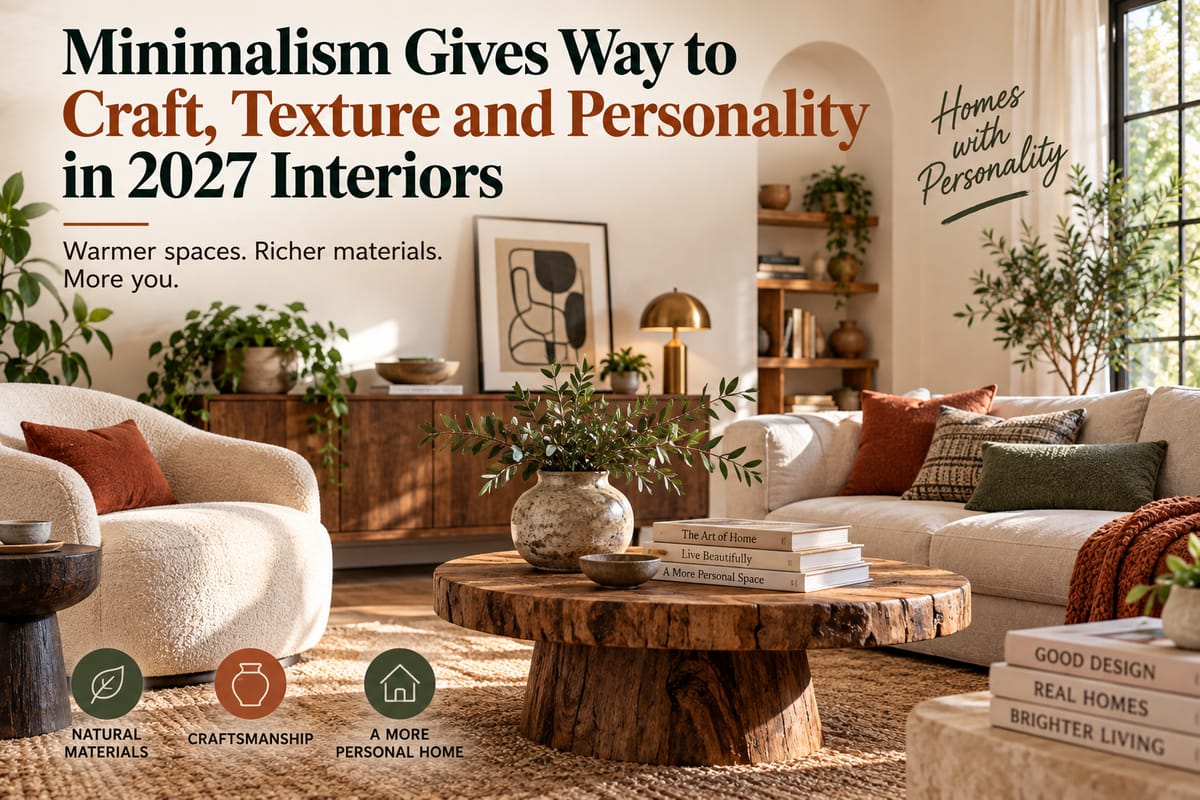
Minimalism Gives Way to Craft, Texture and Personality in 2027 Interiors
For years, minimalist interiors have been defined by clean lines, restrained palettes, uncluttered surfaces and carefully controlled spaces. But as designers look toward 2027, the idea of a perfectly pared-back home is beginning to make room for something warmer and more personal.
Emerging interior design forecasts point toward rooms that place greater emphasis on craftsmanship, texture, natural materials, meaningful objects and individual expression. Instead of asking homeowners to remove everything that makes a room distinctive, the new direction is increasingly about creating spaces that reveal who lives there.
Recent 2027 design forecasts highlight collected interiors, tactile materials, natural variation, warmer colors and handcrafted details as themes gaining momentum.
The shift does not necessarily mean minimalism is disappearing. Rather, its strictest interpretation is being softened.
From Perfectly Minimal to Personally Meaningful
Minimalism has had a major influence on residential design. Its emphasis on simplicity can make rooms feel calm, organized and visually spacious.
The problem comes when simplicity becomes so standardized that different homes begin to look almost interchangeable.
The emerging approach for 2027 is more interested in personality. Designers are increasingly incorporating vintage furniture, inherited objects, artwork, handmade ceramics and pieces connected to personal experiences.
One recent 2027 trend forecast describes the movement toward “personal, collected interiors,” where a home reflects the people who live there rather than reproducing a showroom arrangement.
That does not mean every surface needs decoration. Instead, fewer objects can have greater meaning when they are selected because they contribute something personal to the room.
For homeowners who still appreciate simplicity, What Is Minimalism and Simpler Living? offers useful context on the principles behind minimalist living and why the approach continues to appeal to many people.
Texture Becomes a Design Feature
One of the clearest changes expected in 2027 is the increased importance of texture.
Smooth walls, polished cabinetry and uniform finishes can create a clean appearance, but tactile materials introduce another dimension. Linen, wool, natural wood, stone, handmade tile, plaster and woven materials can make a room feel more layered without necessarily making it look cluttered.
Several recent forecasts identify tactile surfaces as an important direction for 2027 interiors. Designers are paying more attention to how materials feel and how their natural variations contribute to the character of a room.
A room might combine a rough stone table with soft upholstery, visible wood grain with woven textiles, or a textured wall treatment with smoother furniture.
The contrast is what creates depth.
This also represents a subtle change in how interiors are judged. Instead of designing primarily for photographs, homeowners are increasingly interested in how a space feels when they actually live in it.
Craftsmanship Moves Into the Spotlight
Mass-produced furniture and accessories will remain a major part of the home market, but handcrafted details are gaining renewed attention.
Hand-thrown ceramics, artisan textiles, visible joinery, natural stone and individually crafted furniture can give interiors a sense of authenticity that is difficult to reproduce through perfectly uniform manufacturing.
Recent design forecasts have connected this interest in craftsmanship with a broader appreciation for materials that show natural variation and age gracefully.
Small imperfections can become part of the appeal.
A wooden table may have visible grain rather than an entirely uniform finish. A handmade tile installation may contain slight variations between pieces. A brass fixture may develop a patina over time.
Instead of treating those changes as flaws, the emerging design philosophy sees them as evidence that the home is being used and lived in.
Natural Materials Bring Warmth Back
The move away from severe minimalism is also influencing material choices.
Wood, stone, linen, wool, plaster, ceramics and other natural materials are being used to introduce warmth and visual variation. Richer woods, expressive stone and tactile fabrics can soften modern architectural spaces without requiring excessive decoration.
Recent 2027 forecasts specifically highlight natural materials, visible grain, stone variation and textured finishes as important elements of the evolving design landscape.
This can be especially effective in neutral rooms.
A beige or cream palette does not have to look flat when it includes several different textures. A linen sofa, oak table, woven rug, plaster wall and stone accessory can all share a restrained color family while producing considerable visual depth.
The result is calm without being sterile.
Color Is Becoming More Expressive
The return of personality is also changing the role of color.
For much of the minimalist era, white, gray, beige and muted neutrals dominated many contemporary interiors. While those colors are unlikely to disappear, designers are increasingly experimenting with warmer earth tones, deeper shades and more expressive accents.
One 2027 furniture-industry forecast points toward warmer colors, richer materials and more layered combinations, while other recent forecasts have highlighted colors ranging from smoky blues to earthy and jewel-like tones.
The important change is not simply that homes are becoming more colorful.
It is that homeowners appear to have greater freedom to use color according to personal preference rather than following a single dominant palette.
A muted blue wall can coexist with walnut furniture. A warm terracotta accent can sit beside cream upholstery. Deep green can provide contrast against natural stone.
The goal is increasingly character rather than uniformity.
Furniture Becomes Less Matchy-Matchy
The coordinated furniture set has also come under pressure as interiors become more collected.
Instead of purchasing a sofa, chairs, tables and storage pieces from the same collection, homeowners can combine pieces with different shapes, materials and histories.
This approach requires more consideration, but it can produce a room that feels substantially more individual.
Recent 2027 design forecasts specifically point toward fewer matching sets and greater use of different furniture pieces brought together through common elements such as material, scale or color.
Furniture selection therefore becomes less about finding everything that matches and more about finding pieces that work together.
A contemporary sofa might sit alongside a vintage armchair. A sculptural coffee table can provide contrast to a traditional rug. An antique cabinet can become the focal point in an otherwise modern room.
The furniture does not have to come from the same era to create a coherent space.
Vintage Pieces Add Character
The renewed interest in vintage and antique furniture fits naturally into this broader movement.
Older pieces can introduce shapes, materials and details that are difficult to replicate in contemporary mass-market furniture. They can also give a room a sense of history.
Recent forecasts for 2027 have identified vintage references, inherited objects and pieces with visible signs of age as important ingredients in more personalized interiors.
A vintage side table does not require an entire room to become traditional. One carefully chosen piece can provide contrast against modern furniture.
This is one reason the emerging aesthetic feels less like a rejection of modern design and more like an expansion of it.
Personality Does Not Mean Clutter
One potential misunderstanding of the post-minimalist direction is that adding personality requires filling every available surface.
It does not.
A personalized interior can still be highly organized and visually restrained. The difference is that the objects that remain have more purpose.
A framed family photograph, handmade bowl, favorite chair or travel souvenir can carry more visual and emotional weight than a collection of generic decorative objects.
The strongest rooms often create hierarchy. A few meaningful pieces receive attention while less important items remain in the background.
This allows personality and simplicity to coexist.
Lighting Becomes More Sculptural
Lighting is another area where interiors are becoming more expressive.
Rather than relying entirely on recessed ceiling lights, designers are increasingly using table lamps, wall lights, pendant fixtures and sculptural lighting as both functional elements and decorative objects.
The approach supports the broader move toward layered interiors. Different light sources can create distinct moods throughout the day while highlighting materials, artwork and architectural features.
Warm lighting can also enhance tactile surfaces, making wood grain, textured walls and woven fabrics more visually noticeable after dark.
The Home Becomes Less Like a Showroom
Perhaps the biggest change heading into 2027 is philosophical.
The home is increasingly being treated as a place to live rather than a finished product that must look perfect.
Recent forecasts describe a move away from rooms designed to appear complete all at once and toward interiors that can evolve alongside their occupants.
That means a home can contain a mixture of old and new furniture, practical objects, sentimental possessions and unfinished ideas.
A room does not necessarily need to look as though every piece was selected during one shopping trip.
In fact, some of the most interesting spaces may be those that reveal a gradual process of collecting, adapting and changing.
A More Flexible Version of Minimalism
The rise of craft, texture and personality does not mean homeowners need to abandon everything they like about minimalism.
Clean architecture can still provide the foundation. Neutral walls can still create calm. Open spaces can still feel spacious. The difference is that these elements no longer have to exist without warmth or individuality.
A simple room can become more inviting through a textured rug, a handcrafted lamp, a vintage chair or a piece of meaningful artwork.
That makes the emerging 2027 aesthetic less about choosing between minimalism and maximalism and more about finding a personal balance between the two.
For anyone planning a redesign, a useful starting point is to consider not only how the room looks, but also what materials feel good, which objects have meaning and which pieces are likely to remain useful for years.
The furniture itself is part of that equation, making thoughtful furniture selection an important foundation for creating a space that feels both functional and personal.
Why Personality May Define the Next Chapter of Home Design
The movement toward craft, texture and personality reflects a broader desire for homes that feel authentic rather than interchangeable.
Minimalism offered a valuable response to visual overload, but the next stage of interior design appears to be exploring how simplicity can coexist with history, craftsmanship, comfort and individuality.
For 2027, that could mean fewer perfectly matched rooms and more interiors built gradually around the people who live in them.
Natural materials can bring warmth. Handmade objects can add character. Vintage furniture can provide history. Texture can create depth. And personal belongings can turn a beautifully designed room into something that actually feels like home.
The result is not necessarily a return to clutter or excess. It is a more flexible idea of simplicity—one in which a home can be calm without being empty, refined without being impersonal, and modern without losing the marks of human craftsmanship.